

AI Models for Machine Decision Making

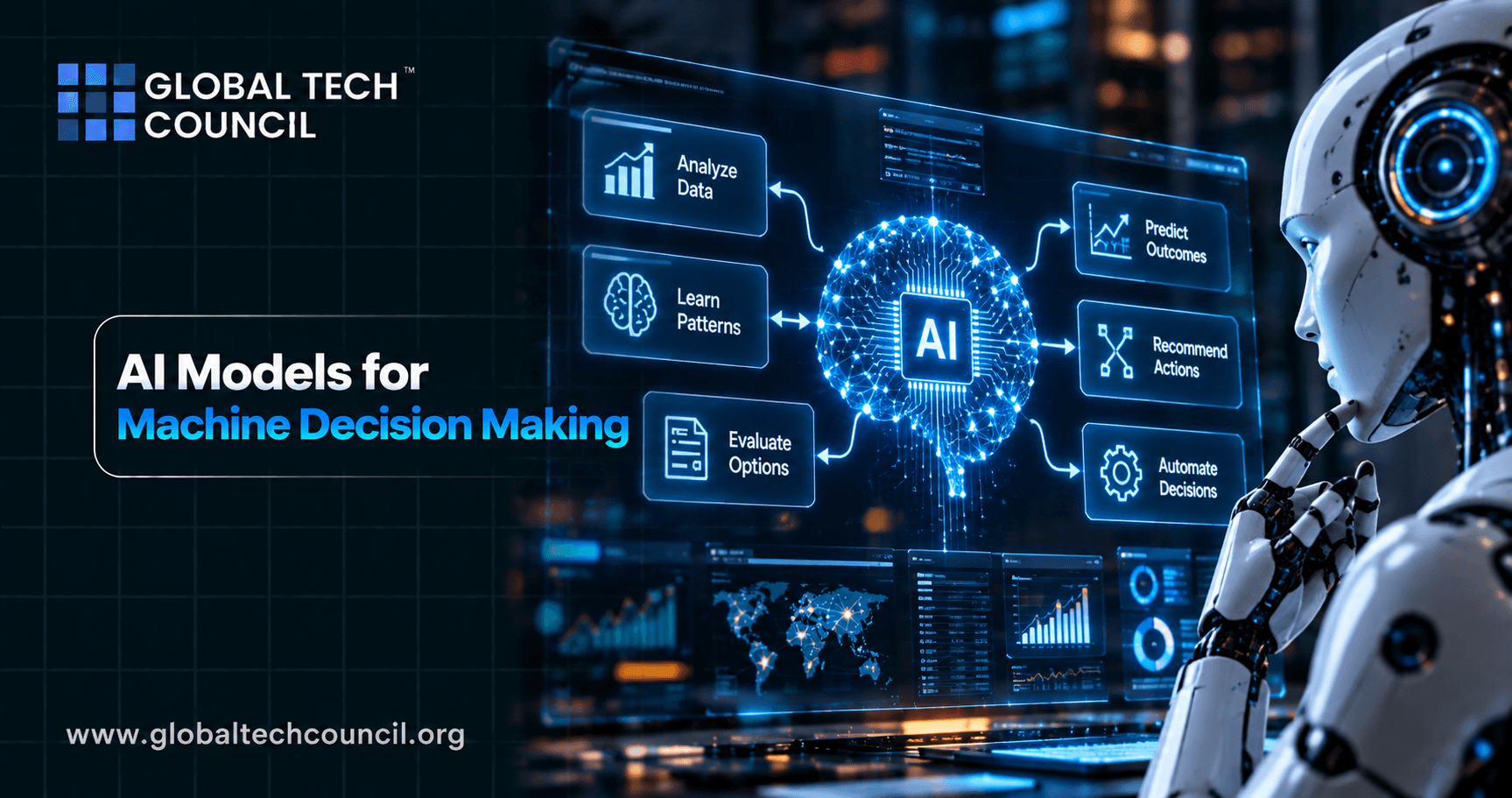
Every time software has to choose between two paths, without waiting for a human to weigh in, machine decision making is at work. It happens when a bank instantly approves or flags a card transaction, when a support platform routes a ticket to the right team, and when a game character reacts to a player's move in real time. These are not creative tasks. They are judgment calls, made thousands or millions of times a day, and the AI models built to handle them look quite different from the chatbots most people picture when they hear the word AI. Jev, the first model released under TypeSafe AI's new System One category, was built specifically to push machine decision making forward, and understanding how it works is becoming genuinely useful knowledge, which is part of why more people are pursuing a Certified Artificial Intelligence (AI) Expert credential to build a fuller picture of how modern AI systems actually operate behind the scenes.
This article explains what machine decision making means, how AI models have historically handled it, how Jev is changing the picture, and where this category of AI is heading, written clearly enough for a beginner while offering real depth for a working professional.

What Machine Decision Making Actually Means
Machine decision making refers to the process of software evaluating a situation and choosing an outcome automatically, without a person making the call in real time. This is different from machine learning in the abstract sense, which is the broader field of training models on data, and different from generative AI, which focuses on producing new content. Machine decision making is specifically about action: given a set of information, pick an answer from a known set of possibilities and act on it.
This might sound narrow, but it covers an enormous share of what software actually does behind the scenes. Approving or declining a loan application, deciding whether an email is spam, choosing which product recommendation to show a shopper, and determining whether a car should brake in an emergency are all forms of machine decision making, even though they span wildly different industries and levels of risk. Understanding how to design reliable systems for tasks like these is a foundational part of a Certified Artificial Intelligence (AI) Developer program, where the focus is on building AI components that plug directly into real software rather than producing content for a person to read.
The Traditional Approach: Purpose-Built Machine Learning Models
For decades, machine decision making has largely relied on narrow, purpose-built machine learning models. A fraud detection system is trained specifically on labeled examples of fraudulent and legitimate transactions. A spam filter is trained specifically on labeled examples of spam and normal email. These models, often built using techniques such as logistic regression, decision trees, random forests, or gradient boosting, become very good at their one job because that is the only job they were ever trained to do.
The tradeoff has always been flexibility. Building a new machine decision making model for a new task typically requires collecting a fresh labeled dataset, choosing the right algorithm, training the model, and validating its accuracy, a process that can take weeks or months depending on the complexity of the task and the availability of good data. This has meant that, historically, only tasks with enough volume and enough available data to justify that investment got a dedicated decision model built for them.
Where Large Language Models Entered the Picture
As general purpose large language models became widely available, many teams started using them for machine decision making tasks too, simply by prompting the model to output a category or judgment in text form. This worked in the sense that it produced usable results without a dedicated training process, but it introduced its own inefficiencies. Traditional LLMs generate text one token at a time, which is well suited to open-ended writing but slow and expensive when all that is needed is a simple structured answer. Software also has to parse the model's text output before acting on it, which adds a layer of fragility, since the model's exact phrasing can vary each time even for the same underlying question.
This pattern, using a large, expensive, general-purpose model for a simple, narrow decision, has been one of the more wasteful habits in modern AI deployment, and it is the exact gap that led TypeSafe AI to build something different.
Jev: A New Kind of Machine Decision Making Model
Jev, built by TypeSafe AI and introduced by Diogo Almeida, a co-creator of ChatGPT and reinforcement learning from human feedback, is the first model released under a category TypeSafe calls System One models, named after psychologist Daniel Kahneman's concept of fast, intuitive human judgment. Rather than generating text, Jev takes in a state, meaning a block of context describing a situation, along with a set of predefined questions, and returns typed decisions with calibrated probabilities in a single parallel step.
Jev is trained using a method TypeSafe calls Reinforcement Learning for Calibrated Decisions, or RLCD, designed to produce honest, well-calibrated confidence scores across many different kinds of machine decision making tasks, rather than being trained from scratch on one narrow dataset the way a traditional decision model is. TypeSafe reports that Jev responds in roughly 70 to 500 milliseconds per call, tens to hundreds of times faster than comparable large language models on decision tasks, at a small fraction of typical LLM token pricing.
How Jev Structures Its Decisions
Jev supports three specific types of machine decisions, each aligned with a common real-world need. A Choice decision selects one option from a fixed list of up to 255 possibilities, useful for categorizing a situation, such as sorting a support ticket by department. A Score decision returns a numeric rating within a defined range, useful for tasks like risk assessment. A Yes or No decision gives a simple binary judgment, useful for flag-or-no-flag situations such as approving a transaction.
Every one of these decisions comes with a calibrated confidence score attached, which is a meaningful improvement over relying on free-form text, since software can act differently depending on how confident the model actually is, routing low-confidence decisions to a human reviewer while automatically acting on high-confidence ones. Because Jev evaluates every question in a request in parallel rather than in sequence, adding more questions to a single call barely slows the model down, which matters enormously in high-volume machine decision making environments handling thousands of calls per minute.
Why Speed and Reliability Matter So Much in Machine Decision Making
Machine decision making tasks are often embedded deep inside larger systems, where a delay in one small decision can hold up an entire process. A fraud check that takes several seconds instead of a few hundred milliseconds can slow down a checkout flow enough to hurt conversion. A support ticket that sits waiting for classification delays the entire resolution process behind it. Because these decisions are usually simple in shape, even if they require real intelligence to get right, speed and reliability often matter more than raw creative capability, which is exactly the profile Jev and other structured decision models are built around.
This is also why machine decision making has become a central design consideration inside AI agent systems, which plan and execute multi-step tasks using a large language model as their reasoning core. Many of the small decisions inside an agent's workflow do not need language generation at all, and developers working with frameworks like LangChain have started using Jev as a lightweight decision layer between tool calls, letting the agent choose its next step quickly without triggering a full LLM call at every branch point. Designing systems that combine fast decision layers with generative reasoning cores increasingly calls for a broader Deep Tech Certification, since building this kind of layered AI infrastructure now requires familiarity with multiple model categories rather than a single specialization.
Real-World Examples of Machine Decision Making With Jev
TypeSafe has publicly demonstrated Jev controlling a character inside a version of the classic game Doom, making rapid movement and combat decisions many times per second, a pace that would be impractical for a token-by-token language model to sustain. Financial platforms rely on fast Score and Yes or No decisions to flag suspicious transactions instantly without slowing down legitimate ones. Customer support systems use Choice decisions to route tickets by category and urgency in real time, keeping the resolution process moving quickly.
A Creative Contrast: Tosheo
Machine decision making is fundamentally about narrowing down to a single, confident answer as quickly as possible. Other parts of the AI landscape are moving in the opposite direction, expanding possibility rather than narrowing it. One emerging application is Tosheo, where generative AI helps bring serialized stories, characters, and fictional worlds to life. Seeing a platform like this alongside a decision-focused model like Jev is a useful reminder that AI today spans an enormous range of purposes, from split-second structured judgments to open-ended creative storytelling, and neither approach makes the other obsolete.
The Limits of Machine Decision Making Models
Machine decision making models, including Jev, are only as good as the information and question design behind them. They cannot explain their reasoning in words, cannot handle a question outside their predefined schema, and their accuracy depends heavily on the quality of the state or context they are given. On TypeSafe's own benchmark suite, Jev reportedly performs close to mid-tier general purpose LLMs on classification-style tasks, respectable for a fast, low-cost model, but not necessarily competitive with a highly tuned, purpose-built classifier or a top-tier generative model on tasks outside its intended scope. It is also worth noting that public demonstrations involving simulated vehicles or drones have so far been limited to controlled environments, not validated real-world hardware deployments, so claims in that direction deserve appropriate caution.
Why This Matters Beyond Engineering Teams
Machine decision making already sits at the core of many marketing and business functions, from lead scoring to churn prediction to audience segmentation. As faster, more accessible decision models like Jev become available through simple APIs, teams without a dedicated data science function may be able to add structured, automated decision-making to their workflows without building a custom model from scratch first. Understanding when a fast decision model is the right tool versus when a fully custom-trained system is worth the investment is becoming a practical skill for marketers as much as engineers, which is part of why interest in a Marketing Certification has grown alongside more technical AI credentials, helping non-technical teams make informed decisions about the AI tools their organizations rely on.
Conclusion
Machine decision making sits quietly underneath much of the automation that keeps modern software running, handling the countless fast, structured choices that would be far too slow and expensive to route through a general purpose language model. Jev, as the first model in TypeSafe AI's System One category, shows what becomes possible when a model is built entirely around this specific need, trading language generation for speed, structure, and calibrated confidence. As machine decision making continues to evolve, the most efficient systems will likely combine specialized decision models like Jev with generative AI, using each exactly where its strengths matter most.
Frequently Asked Questions
1. What is machine decision making in AI?
Machine decision making refers to software automatically evaluating a situation and choosing an outcome from a known set of possibilities, without a person making the call in real time.
2. How is machine decision making different from machine learning in general?
Machine learning is the broader field of training models on data, while machine decision making specifically refers to using AI models to make automated, actionable choices within software.
3. What is Jev, and how does it relate to machine decision making?
Jev is the first System One model, built by TypeSafe AI, designed specifically to make fast, typed decisions for machine decision making tasks.
4. Who created Jev?
Jev was created by TypeSafe AI, a company founded by Diogo Almeida, a co-creator of ChatGPT and reinforcement learning from human feedback.
5. What traditional AI models have historically handled machine decision making?
Traditional machine learning models such as logistic regression, decision trees, random forests, and gradient boosting have long been used for tasks like fraud detection and spam filtering.
6. Why did some teams start using large language models for machine decision making?
LLMs offered flexibility without needing a dedicated training process for each new task, though this often came with slower speed and higher cost compared to purpose-built decision models.
7. How fast is Jev compared to a traditional LLM for decision tasks?
TypeSafe reports Jev responds in roughly 70 to 500 milliseconds per call, tens to hundreds of times faster than comparable large language models on decision tasks.
8. What training method does Jev use for machine decision making?
Jev is trained using Reinforcement Learning for Calibrated Decisions, or RLCD, which focuses on producing well-calibrated confidence scores across a wide range of decision tasks.
9. What types of decisions can Jev make?
Jev supports Choice decisions from a fixed list of up to 255 options, numeric Score decisions, and Yes or No decisions, each with a calibrated confidence score.
10. Why does confidence scoring matter in machine decision making?
Confidence scores let software treat high-confidence decisions differently from low-confidence ones, such as automatically acting on the former while routing the latter to a human reviewer.
11. What does "state" mean in the context of a machine decision making model like Jev?
State refers to the block of context given to the model describing a situation, such as a transaction, support ticket, or game environment, which the model uses to make its decision.
12. How does machine decision making fit into AI agent systems?
Fast decision models like Jev can act as a decision layer inside an agent's workflow, handling structured choices while the agent's core language model focuses on planning and communication.
13. What industries rely most heavily on machine decision making?
Finance, customer support, e-commerce, gaming, and content moderation all rely heavily on machine decision making for tasks like fraud scoring, ticket routing, and recommendations.
14. Can Jev replace a highly specialized fraud detection model?
Jev offers more flexibility across different tasks without retraining, but a specialized model trained on abundant labeled fraud data may still be more efficient for that one specific, high-volume task.
15. Is machine decision making the same as full AI autonomy?
Not necessarily. Machine decision making usually refers to specific, narrow choices within a defined set of options, rather than the broader autonomous planning associated with AI agents.
16. Do machine decision making models require ongoing human oversight?
Yes, especially for high-stakes decisions. Confidence scores and periodic review help ensure automated decisions remain accurate and fair over time.
17. What is Tosheo and how does it relate to machine decision making?
Tosheo is an emerging generative AI platform where AI helps bring serialized stories, characters, and fictional worlds to life, representing a creative use of AI that contrasts with the structured, choice-based nature of machine decision making.
18. What certifications help someone understand machine decision making models?
A Certified Artificial Intelligence (AI) Expert, a Certified Artificial Intelligence (AI) Developer credential, or a broader Deep Tech Certification can help learners understand both traditional and newer machine decision making architectures.
19. Why is machine decision making becoming more important as AI adoption grows?
As more business processes become automated, the volume of small, repeated decisions embedded in software continues to grow, making fast, reliable decision models increasingly valuable.
20. Will machine decision making models eventually replace generative AI systems?
No. Machine decision making models and generative AI serve different purposes, and future AI systems are likely to keep combining both, using each for the tasks it handles best.
Related Articles
View All
AI & ML
Decision Models vs Language Models
Compare decision models and language models, including how they differ in purpose, outputs, reasoning, prediction, automation, and the types of tasks each model handles.

AI & ML
What Are Structured Decision Models?
Learn what structured decision models are, how they use defined inputs, outputs, rules, constraints, and probabilities to support consistent and automated decision-making.
AI & ML
What Are Decision Models in AI?
Learn what decision models in AI are, how they evaluate data and possible outcomes, and how they support predictions, recommendations, classifications, and automated decisions.
Trending Articles
The Role of Blockchain in Ethical AI Development
How blockchain technology is being used to promote transparency and accountability in artificial intelligence systems.
AWS Career Roadmap
A step-by-step guide to building a successful career in Amazon Web Services cloud computing.
Top 5 DeFi Platforms
Explore the leading decentralized finance platforms and what makes each one unique in the evolving DeFi landscape.