

How to Build an End-to-End AI Project: From Data Collection to Deployment and Monitoring
 Suyash Raizada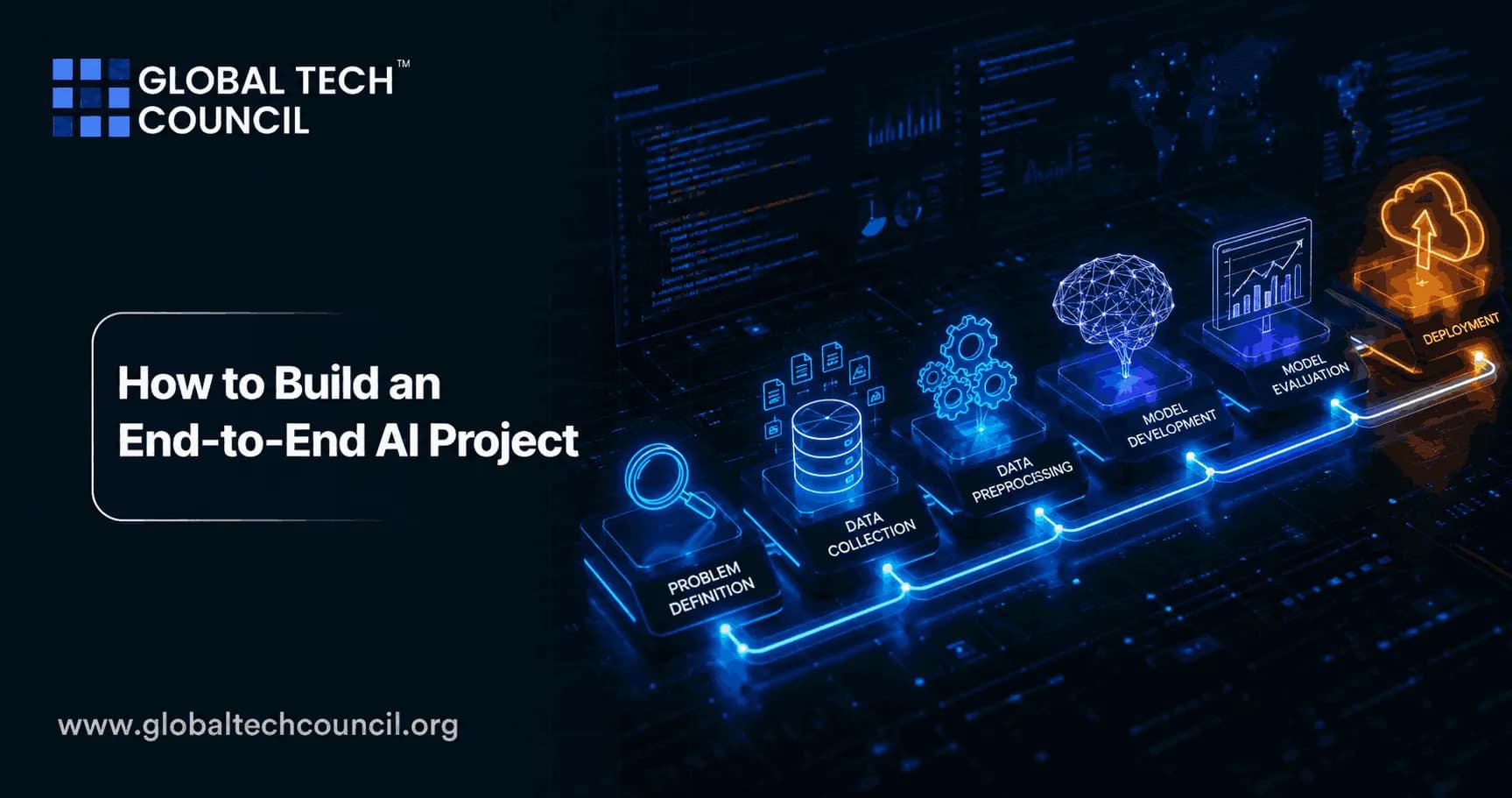
Building an end-to-end AI project requires more than training a model. Modern organizations follow a repeatable, iterative lifecycle that starts with problem definition and ends with deployment, monitoring, and continuous improvement. Enterprise and public-sector frameworks consistently point to two realities: data work is often the most time-consuming phase, and production AI requires ongoing monitoring because real-world data and behavior change over time.
This guide walks through a practical, MLOps-aligned approach to delivering an end-to-end AI project - from data collection to model deployment and monitoring - with checkpoints you can apply in enterprise settings.

1) The end-to-end AI project lifecycle
Most production-grade AI initiatives follow a structured lifecycle:
Problem definition and planning
Data collection and governance
Data preparation and feature engineering
Model development and training
Evaluation and validation
Deployment to production
Monitoring, maintenance, and governance
Treat this as a loop, not a straight line. When evaluation exposes gaps, teams often return to earlier steps - improving labels, revisiting features, or tightening the problem scope. Transform your AI ideas into production-ready solutions by developing advanced implementation skills through an AI Powered Coding Expert Course. Complement your technical knowledge with a globally recognized Tech Certification and discover how emerging technologies can drive business success with a Marketing Certification.
2) Step 1: Problem definition and scoping
Many AI failures originate here. Before collecting data or selecting algorithms, define what success looks like and where the model will fit into real workflows.
Key outputs to document
Business objective: the decision or process the AI system improves
AI task definition: classification, forecasting, ranking, anomaly detection, retrieval, or generation
Scope boundaries: what is automated vs what remains manual or rule-based
Success metrics: technical metrics (F1, ROC-AUC, MAE) plus business KPIs (conversion, cost reduction, SLA impact)
Non-functional requirements: latency, throughput, interpretability, robustness, fairness, and security
Risk assessment: ethical, reputational, operational, and compliance risks, especially those tied to data handling and automation
Practical tip: Involve domain experts and product owners early. A technically strong model that optimizes the wrong metric can still result in a failed end-to-end AI project.
3) Step 2: Data collection and governance
After scoping, establish a data strategy: what you need, where it lives, and how you can use it responsibly. Poor data management increases ethical and regulatory risk and makes reproducibility difficult.
Data collection checklist
Inventory sources: internal databases, application logs, CRM/ERP systems, sensors and IoT feeds, third-party datasets, public data, and APIs
Assess quality and relevance: completeness, timeliness, noise, bias, and label reliability
Identify gaps: missing fields, insufficient history, weak labels, and unrepresentative samples
Plan labeling: human annotation workflow, QA sampling, inter-annotator agreement, and clear guidelines
Data governance essentials
Lineage and documentation: where data came from and how it was transformed
Privacy controls: consent, anonymization, or pseudonymization where required
Access control and audit logs: who accessed what data and when
Retention and deletion policies: aligned with regulatory and organizational requirements
Data preparation and wrangling is consistently the most time-consuming phase of an AI project. Plan for it, staff for it, and treat it as core engineering work.
4) Step 3: Data preparation and feature engineering
This phase turns raw inputs into a model-ready dataset. Subtle inconsistencies handled poorly here can derail an end-to-end AI project at later stages.
Common preparation tasks
Handle missing values, outliers, and inconsistent entries
Normalize and standardize numeric features
Encode categorical variables
Deduplicate records and resolve entity identities
Join datasets and align keys and timestamps
Ensure consistent units and formats (for example, standardize temperature units before training)
Feature engineering and dataset construction
Domain features: aggregates, ratios, time-window features, and seasonality flags
Representation learning: embeddings for text, images, or high-cardinality categories when appropriate
Leakage prevention: ensure features do not accidentally include future information
Correct splits: training, validation, and test sets using time-aware or group-aware splitting when needed
A data-centric mindset pays off here. Improving labels, coverage, and consistency can outperform extensive model tuning, particularly when production data differs from lab conditions.
5) Step 4: Model development and training
With a reliable dataset, you can iterate on modeling. A disciplined approach uses baselines, structured experiments, and careful tracking so results are reproducible and comparable.
Model selection guidance
Start with baselines: logistic regression or gradient boosting for tabular problems
Increase complexity only when justified: deep learning, transformers, or ensembles when the data type and scale warrant it
Consider constraints: compute budget, latency targets, and maintainability
Training best practices
Use regularization, early stopping, and robust validation to reduce overfitting
Track experiments: code version, dataset version, hyperparameters, and metrics
Document assumptions: target definition, label sources, and known limitations
6) Step 5: Model evaluation and validation
Evaluation confirms that the model generalizes to unseen data and meets the business objective defined in step 1. Most lifecycle frameworks emphasize an iterative train-evaluate loop, returning to data or features if results fall short.
What to include in an evaluation pipeline
Hold-out testing: a test set untouched during training and model selection
Task-appropriate metrics: F1 for imbalanced classification, MAE or RMSE for regression, ranking metrics for recommenders
Cohort analysis: performance across segments to detect bias or brittleness
Stress tests: edge cases, noisy inputs, missing fields, and unusual seasonal patterns
Baseline comparison: compare against simple heuristics or non-ML solutions to verify net value
Evaluation should also cover operational acceptance criteria - latency, throughput, and failure behavior when upstream systems degrade.
7) Step 6: Deployment (productionizing the model)
Deployment turns a trained model into a reliable system component. This step requires software engineering practices plus ML-specific safeguards to keep training and serving consistent.
Common deployment patterns
Online inference: low-latency API for real-time decisions
Batch inference: scheduled scoring jobs writing predictions to a database or warehouse
Streaming inference: event-driven scoring via message queues for near-real-time pipelines
Production engineering considerations
Packaging: containerize the model service for consistent environments
Orchestration: scale and manage deployments with standard infrastructure tooling
Feature consistency: use a feature store or shared transformations to prevent training-serving skew
ML-aware CI/CD: automate tests, model registry steps, and safe rollouts
8) Step 7: Monitoring, maintenance, and continuous improvement
Deployment is not the finish line. Production AI systems require ongoing attention because user behavior, data pipelines, and real-world conditions change. Drift monitoring and continuous maintenance are essential components of any mature AI operation.
What to monitor in production
Model performance: accuracy proxies, error rates, calibration, and business KPIs
Data drift: shifts in input distributions compared to training data
Concept drift: changes in the relationship between inputs and outcomes
Operational health: latency, throughput, resource usage, error rates, and timeouts
Fairness indicators: cohort monitoring where decisions impact people
Security signals: anomalies that could indicate adversarial behavior or data poisoning attempts
Retraining and lifecycle management
Trigger-based retraining: drift alerts or KPI drops initiate retraining
Scheduled retraining: periodic refresh using recent data where the domain shifts predictably
Versioning: track model, code, and dataset versions for rollback and audits
Reproducibility: archive training data and metadata needed to recreate results
In regulated environments, monitoring and governance are inseparable. Auditability, documentation, and controlled access to data and models reduce both compliance and operational risk.
9) Real-world examples of end-to-end AI projects
Recommendation systems (e-commerce pattern)
A recommendation engine illustrates the full lifecycle: define the goal (improve relevance and engagement), collect behavioral data (clicks, purchases, ratings), prepare features, train collaborative filtering or ranking models, evaluate against observed behavior, deploy in real time, and continuously retrain as user preferences evolve.
Regulated and public-sector AI workflows
Government and regulated-industry lifecycles place particular emphasis on clear mission outcomes, careful data handling, rigorous evaluation, and post-deployment drift monitoring. This discipline is increasingly relevant to any enterprise facing strict governance or compliance requirements.
10) Practical checklist for an end-to-end AI project
Define the problem: objective, scope, success metrics, and risks.
Collect data responsibly: inventory sources, assess quality, and implement governance.
Prepare data: clean, normalize, prevent leakage, and build correct splits.
Train models: start with baselines, track experiments, and optimize within constraints.
Evaluate: test on unseen data, run cohort checks, and compare to baselines.
Deploy: choose a serving pattern, ensure feature consistency, and automate CI/CD.
Monitor and improve: track drift and KPIs, retrain with version control and audit trails.
Conclusion
An end-to-end AI project succeeds when it is treated as an iterative lifecycle that blends data engineering, modeling, software delivery, and continuous monitoring. The most consistent lessons from enterprise and public-sector practice are straightforward: invest seriously in data quality and governance, validate models in ways that reflect real use, and plan for drift and maintenance from day one. Building these steps into a repeatable MLOps workflow gives AI systems a much stronger foundation for remaining accurate, reliable, and accountable after they reach production. Take your AI journey beyond theory by learning how to design, build, deploy, and manage intelligent systems with an AI Expert Certification. Strengthen your expertise in cutting-edge generative technologies through a Generative AI Expert Course and gain valuable insights into future-focused innovations with a Deeptech Certification.
FAQs
1. What is an end-to-end AI project?
An end-to-end AI project covers the complete lifecycle of an AI solution, from data collection and preparation to model development, deployment, and ongoing monitoring. It ensures that AI systems deliver measurable business value in real-world environments.
2. Why is a structured AI project workflow important?
A structured workflow helps teams manage complexity, improve collaboration, and reduce development risks. It also ensures that every stage of the project contributes to building a reliable and scalable AI solution.
3. What is the first step in building an AI project?
The first step is defining the business problem and project objectives. Clear goals help determine the type of data required, the appropriate AI techniques, and the success metrics for the project.
4. Why is data collection critical in AI development?
Data serves as the foundation of every AI model, influencing its accuracy and effectiveness. High-quality, relevant, and diverse data enables models to learn patterns and make reliable predictions.
5. What are common sources of AI training data?
AI training data can come from databases, sensors, websites, APIs, customer interactions, enterprise systems, and publicly available datasets. The source depends on the project's objectives and industry requirements.
6. What is data preprocessing in AI projects?
Data preprocessing involves cleaning, transforming, and organizing raw data before model training. This process helps eliminate errors, handle missing values, and improve the quality of the dataset.
7. What is feature engineering?
Feature engineering is the process of selecting, creating, and transforming variables that help machine learning models learn more effectively. Well-designed features often lead to better model performance.
8. How do teams choose the right AI model?
Model selection depends on factors such as data type, project goals, computational resources, and desired outcomes. Teams often test multiple algorithms to identify the best-performing solution.
9. What is model training?
Model training is the process of teaching an AI system to recognize patterns using historical data. During training, the model adjusts its parameters to improve prediction accuracy.
10. Why is model evaluation important?
Model evaluation helps determine how well a trained model performs on unseen data. Metrics such as accuracy, precision, recall, and RMSE are commonly used to assess effectiveness.
11. What is hyperparameter tuning?
Hyperparameter tuning involves adjusting model settings to optimize performance. This process can significantly improve accuracy, efficiency, and overall model reliability.
12. What is AI model deployment?
Model deployment is the process of making a trained AI model available for real-world use. It often involves integrating the model into applications, websites, APIs, or enterprise systems.
13. What are APIs in AI deployment?
APIs allow applications and services to interact with deployed AI models. They provide a scalable and flexible way to deliver AI-powered predictions and automation capabilities.
14. Why is monitoring necessary after deployment?
Monitoring helps organizations track model performance, detect issues, and ensure that predictions remain accurate over time. Without monitoring, model quality can decline without notice.
15. What is model drift?
Model drift occurs when changes in real-world data reduce a model's effectiveness. As data patterns evolve, organizations may need to retrain models to maintain performance.
16. What role does MLOps play in AI projects?
MLOps provides tools and processes for managing the deployment, monitoring, and maintenance of machine learning models. It helps automate workflows and improve operational efficiency.
17. How can organizations ensure AI project scalability?
Scalability can be achieved through cloud infrastructure, automation, efficient data pipelines, and modular system design. These practices allow AI solutions to handle increasing workloads effectively.
18. What are common challenges in end-to-end AI projects?
Challenges include poor data quality, unclear objectives, integration difficulties, model bias, deployment issues, and ongoing maintenance requirements. Proper planning helps mitigate these risks.
19. How does security impact AI project development?
Security is essential for protecting data, models, and deployment environments from unauthorized access and cyber threats. Strong security practices help ensure trust and compliance.
20. What skills are needed to build an end-to-end AI project?
Successful AI projects require expertise in data science, machine learning, programming, data engineering, cloud computing, and model deployment. Cross-functional collaboration is often key to project success.
Related Articles
View All
AI & ML
Can AI Build a Better Version of Itself?
Explore whether AI can build a better version of itself, how self-improving systems might work, and the technical, safety, and practical limits of AI-driven development.

AI & ML
Meet Google Playground: Create Games With AI
Meet Google Playground, Google's new experimental platform that lets you create, play, and share custom games with text prompts. Learn how it works, basic game design tips, a sample session, safety and sharing features, Unity Spark plans, and limits.

AI & ML
OpenAI Dots vs Grok Bot vs Muse
Compare OpenAI Dots, Grok Bot, and Meta Muse to understand how these persistent AI agents differ in cloud computer use, connected apps, automation, memory, and long-running workflows.
Trending Articles
The Role of Blockchain in Ethical AI Development
How blockchain technology is being used to promote transparency and accountability in artificial intelligence systems.
AWS Career Roadmap
A step-by-step guide to building a successful career in Amazon Web Services cloud computing.
Top 5 DeFi Platforms
Explore the leading decentralized finance platforms and what makes each one unique in the evolving DeFi landscape.