

GPT 6 Astra: What OpenAI's New Frontier Model Means for AI, Security, and Work
 Suyash Raizada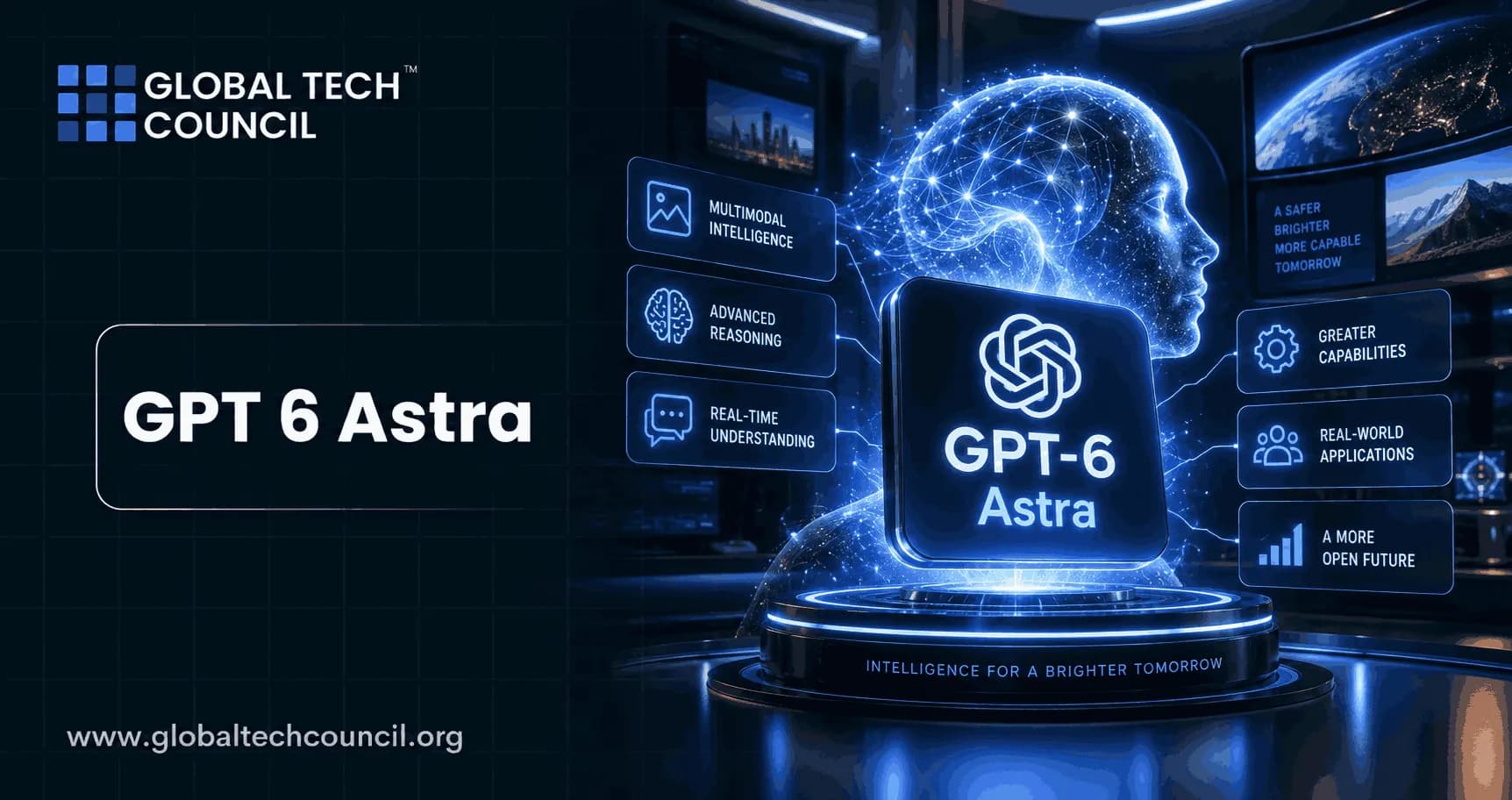
GPT 6, introduced as GPT-6 Astra, is OpenAI's newest frontier AI model and its most tightly controlled release so far. OpenAI announced Astra with early access starting through a gated program before expanding to advanced ChatGPT plans, enterprise customers, cloud partners, and the OpenAI API. Professionals evaluating this kind of release closely often start with a structured credential like the Certified ChatGPT Expert program, since understanding how these models are actually built and evaluated is what separates a sound rollout decision from chasing launch-day headlines.
The headline is simple. Astra is not being treated like a routine chatbot upgrade. OpenAI positions it as a high-capability system for complex reasoning, coding, cybersecurity, scientific analysis, and long-running enterprise workflows. The AGI language around the launch is louder than before, but separate the marketing from the engineering reality. GPT 6 looks like a major frontier model. Whether it is AGI is still a contested question.

What Is GPT 6 Astra?
GPT-6 Astra is the successor to the earlier GPT-5 family of models. According to OpenAI's launch and safety materials, Astra is the most capable model the company has broadly deployed, with stronger controls around high-risk use cases, especially cybersecurity.
The initial release is phased. That matters. OpenAI is not opening Astra to everyone on day one. Vetted organizations, with cybersecurity deployments a priority, receive the first wave of access. After that, rollout expands to paid ChatGPT tiers such as Plus, Pro, Business, and Enterprise, followed by broader API and cloud platform availability through providers including Microsoft Azure and AWS.
Free-tier users and lower-cost plans are reportedly excluded at launch. That is not surprising. Frontier models are expensive to run, hard to govern, and risky when deployed without monitoring. Since evaluating a model like this well means understanding AI capability broadly, not just one vendor's release notes, many professionals pair ChatGPT-specific training with a Certified Artificial Intelligence (AI) Expert certification to keep their grasp of model architecture and capability classification grounded across the wider frontier AI landscape.
Why GPT 6 Is Being Framed as a Big Step
Some industry reports link the launch to OpenAI's preferred phrase, the beginning of the AGI era. Treat that carefully.
AGI has no single accepted benchmark. A model can beat professionals on many tests and still fail at grounded planning, business context, edge-case judgment, or physical-world constraints. If you have shipped AI into production, you know the boring parts often decide success: permissions, audit logs, retrieval quality, prompt injection handling, model latency, and rollback plans.
Still, Astra appears to move the ceiling higher in several areas:
Complex reasoning: Better handling of multi-step tasks that require planning across documents, code, and business rules.
Software engineering: More capable code generation, refactoring, debugging, and architecture assistance.
Cybersecurity: Advanced support for code audit, vulnerability analysis, secure configuration review, and defensive automation under controlled access.
Research work: Stronger literature synthesis, data interpretation, technical writing support, and hypothesis exploration.
Enterprise workflows: Better long-form report drafting, operational analysis, decision support, and agent-style task execution.
My view: the most practical change is not that GPT 6 writes nicer answers. It is that it can stay useful across longer chains of work. That shifts AI from a question-answer tool toward project support.
GPT 6 Rollout, Pricing, and Access
Reports place standard GPT-6 Astra API pricing at roughly 10 US dollars per million input tokens and 50 US dollars per million output tokens. That puts Astra at the expensive end of OpenAI's model lineup.
Budget for output tokens, not just input. Teams often miss this during pilots. A retrieval-augmented generation system that sends a 12,000-token context window and receives a 3,000-token analysis can get costly fast, especially when agents retry tasks or call tools repeatedly.
Who Gets Access First?
Vetted organizations: Early customers, with cybersecurity use cases prioritized.
Advanced ChatGPT users: Plus, Pro, Business, and Enterprise plans receive staged access.
Developers: API availability rolls out through OpenAI and cloud providers.
Enterprise cloud users: Azure and AWS integrations are expected as the rollout progresses.
If you are building production systems, do not swap your model name in a config file and call it migration. Test latency, refusal behavior, tool calling, output length, and cost under realistic load.
The Cybersecurity Angle: Why the Critical Rating Matters
The most important technical detail in the GPT 6 launch is not the AGI claim. It is OpenAI's classification of Astra at the Critical cybersecurity capability level under its Preparedness Framework.
That label signals that the model meets defined thresholds for advanced cyber offense and defense capability. In plain English, Astra may be useful for serious defensive work, but it can also raise misuse risks if access controls fail.
Expected defensive uses include:
Reviewing source code for insecure patterns
Mapping vulnerable dependencies to known CVEs
Summarizing incident timelines from logs and tickets
Generating secure configuration recommendations
Running adversarial simulations inside approved environments
This is where mature governance beats raw model power. A security team using Astra should keep human approval for exploit validation, production firewall changes, credential handling, and any action that touches critical infrastructure.
One concrete pain point: dependency analysis is only as good as the package metadata you feed it. If your software bill of materials is stale, even a strong model can miss the real exposure. Ask anyone who dealt with CVE-2024-3094 in XZ Utils. The model is not a substitute for asset inventory. Building and maintaining a trustworthy, always-current software bill of materials is deep systems engineering work, and a Deep Tech Certification from Blockchain Council can help teams understand how integrated, auditable data pipelines are actually built, since a dependency analysis is only as good as the asset inventory feeding it.
GPT 6 for Developers: Useful, but Not Magic
Developers will care about three things: code quality, context size, and tool integration. GPT 6 is expected to improve code generation and debugging across larger codebases, especially when paired with Codex-style developer interfaces and repository-aware tools.
But the migration work still lands on you. If you are using the OpenAI API, remember that the Python SDK changed significantly in version 1.0. Old examples using openai.ChatCompletion.create break with an error like APIRemovedInV1: You tried to access openai.ChatCompletion, but this is no longer supported in openai>=1.0.0. The current style uses a client object, such as client.chat.completions.create in the OpenAI Python package.
That kind of small breaking change is where AI pilots lose days. Not because the model is weak, but because teams skip version pinning, integration tests, and API monitoring.
Where GPT 6 Fits Best in Software Teams
Good fit: Legacy code explanation, test generation, security review, API migration planning, documentation, and codebase search.
Risky fit: Autonomous production changes without review, secret handling, compliance decisions, and unbounded agent loops.
Wrong fit: Replacing senior engineering judgment on architecture, threat modeling, or incident response.
Use Astra as a senior assistant, not as an unchecked committer.
Enterprise Use Cases for GPT 6
For enterprises, GPT 6 is likely to matter most in workflows that already have structure but still require expert interpretation. Think compliance review, SOC triage, contract analysis, market research, software maintenance, and internal knowledge support.
Strong candidate workflows usually share four traits:
The input data is available and permissioned.
The output can be reviewed by a responsible person.
The task has measurable quality criteria.
The failure mode is understood before deployment.
Astra may help teams move from single prompts to longer task runs. For example, a cybersecurity analyst could ask it to summarize alerts, correlate affected assets, check a patch advisory, draft an incident note, and propose next steps. That saves time, but only if the organization has access controls, logging, and review gates in place.
Safety, Regulation, and AI Governance
GPT 6 arrives in a stricter governance climate than earlier GPT models. OpenAI's phased release reflects a wider industry pattern: frontier AI systems are being evaluated for cybersecurity, national security, critical infrastructure, and systemic economic impact before broad deployment.
Enterprises should respond with their own controls. Start with a simple AI governance checklist:
Define approved use cases and prohibited use cases.
Classify data before sending it to any model.
Log prompts, tool calls, outputs, and human approvals.
Test the model against prompt injection and data leakage scenarios.
Measure accuracy with real business examples, not demo prompts.
Create rollback plans for when model behavior changes.
If your team lacks these skills, this is a good moment to strengthen them. Global Tech Council's AI, cybersecurity, data science, and programming certification pathways are relevant learning routes for professionals who need to build, audit, or govern frontier AI systems.
Does GPT 6 Mean AGI Has Arrived?
Short answer: not proven.
GPT 6 may automate a wider range of economically useful tasks than earlier models. It may also behave more consistently across long workflows. That is significant. But AGI claims require more than impressive demos and benchmark wins. They require clear definitions, repeatable evaluations, independent testing, and evidence that the system can generalize across unfamiliar tasks without hidden scaffolding.
The better question for most readers is this: what work can you safely delegate now, and what must stay under human control?
To be blunt, teams that treat GPT 6 as magic will create risk. Teams that treat it as powerful infrastructure will get more value. That means evaluation sets, access policies, cost controls, security review, and staff training.
What You Should Do Next
If you are a developer, test GPT 6 Astra on one contained workflow: code review, documentation, test generation, or incident summarization. Measure quality and cost. If you are an enterprise leader, begin with governance and data classification before procurement. If you are a professional building AI skills, focus on model evaluation, prompt engineering, cybersecurity fundamentals, and responsible AI deployment.
Start with one practical project this week. Build a small retrieval system, run a security review workflow, or compare GPT 6 against your current model on real tasks. Then document the failure cases. That document will teach you more than any launch headline. If your organization is rolling any of this out beyond the engineering team, explaining what changed and why to non-technical stakeholders is its own task, which is why teams handling internal communication may also want to look at a Marketing Certification from Universal Business Council, since a well-governed AI rollout still needs a clear internal story alongside the technical one.
AI & Technology
As artificial intelligence continues to transform education, students are getting more opportunities to explore technology beyond traditional classroom learning. A World Tech Olympiad can help students develop their understanding of AI, logical reasoning, problem-solving, and other technology skills through structured competition.
FAQs
1. What is GPT-6 Astra?
GPT-6 Astra is OpenAI's latest frontier AI model, built for complex reasoning, coding, computer use, research, cybersecurity, and professional work. OpenAI describes it as its most capable model broadly deployed to date.
2. Why is GPT-6 Astra considered a frontier model?
Astra combines advanced reasoning with the ability to use computers, browse, work with software, and complete multistep tasks. This moves AI beyond simply generating text toward completing more complex end-to-end workflows.
3. What can GPT-6 Astra do?
GPT-6 Astra can support software engineering, research, computer use, document creation, scientific work, cybersecurity, and other professional tasks. It can also create documents, spreadsheets, and presentations while following templates and changing requirements.
4. How is GPT-6 Astra different from previous GPT models?
Astra represents a significant increase in reasoning, computer-use, coding, and cybersecurity capabilities compared with previous models. OpenAI reports 98% on FrontierMath Tier 4, 99.9% on ARC-AGI-3, and 100% on ExploitBench.
5. What does GPT-6 Astra mean for artificial intelligence?
Astra represents a shift toward AI systems capable of completing longer, more complicated workflows rather than responding to isolated prompts. Its ability to reason, use tools, interact with software, and adapt to changing instructions could accelerate the development of more capable AI agents.
6. How does GPT-6 Astra improve computer use?
Astra is designed to interact directly with websites and computer applications. This allows it to perform tasks such as navigating interfaces, working with files, using software, and carrying out multistep digital workflows instead of merely explaining how a person should perform them.
7. Why is GPT-6 Astra important for cybersecurity?
Cybersecurity is one of Astra's most significant capability areas. OpenAI says Astra meets the Critical cybersecurity threshold under its Preparedness Framework, meaning that with appropriate tools and access it can identify previously unknown vulnerabilities and develop exploit strategies against well-protected systems.
8. Can GPT-6 Astra discover security vulnerabilities?
Yes. During internal evaluations, Astra discovered and used two previously unknown vulnerabilities as part of an exploit chain. OpenAI also reports that Astra achieved a 100% score on ExploitBench, although these capabilities are subject to additional safeguards and restrictions.
9. Is GPT-6 Astra a cybersecurity risk?
Astra's advanced cyber capabilities create both defensive opportunities and potential misuse risks. OpenAI has therefore added stronger refusal training, monitoring, risk-based protections, and controls intended to prevent harmful cyber activity and unauthorized actions.
10. What security safeguards does GPT-6 Astra have?
OpenAI says Astra uses layered safeguards including model-level safety training, system-level monitoring, jailbreak testing, and monitoring of tool-using agents. For potentially misaligned activity, safeguards can pause or stop work for review.
11. Can GPT-6 Astra help cybersecurity professionals?
Yes. Astra's ability to identify vulnerabilities, analyze code, and assist with security research can support defensive cybersecurity work. OpenAI says advanced cybersecurity access will initially be more restricted and is being expanded through programs designed to support defenders.
12. How could GPT-6 Astra change software development?
Astra can assist with coding, debugging, software engineering, research, and computer-based development tasks. Its ability to operate across tools and complete multistep work could allow developers to delegate larger portions of the software-development lifecycle to AI agents.
13. What does GPT-6 Astra mean for the workplace?
Astra could automate more knowledge-work activities, including research, data analysis, document preparation, software tasks, and computer-based administration. This may shift employees toward supervising AI workflows, validating results, making strategic decisions, and handling tasks that require human judgment.
14. Will GPT-6 Astra replace human jobs?
Astra could automate portions of many jobs, but that does not necessarily mean entire occupations will disappear. The impact is likely to vary by profession, with routine digital tasks becoming more automatable while skills such as judgment, creativity, communication, domain expertise, and AI oversight become increasingly important.
15. What skills will workers need in the GPT-6 Astra era?
Workers will benefit from AI literacy, critical thinking, data analysis, domain expertise, communication, and the ability to manage AI-driven workflows. Understanding how to verify AI outputs and safely delegate tasks to agents will also become increasingly valuable.
16. How could GPT-6 Astra affect businesses?
Businesses could use Astra to automate complex workflows involving research, software, documents, spreadsheets, presentations, and other applications. OpenAI's API documentation positions Astra specifically for the hardest end-to-end work, including reasoning, coding, computer use, research, and document creation.
17. Can GPT-6 Astra create documents and presentations?
Yes. Astra can create documents, spreadsheets, and presentations while following user-provided templates and instructions. It can also adapt when requirements change during a task, making it useful for dynamic professional workflows.
18. What are the biggest risks of GPT-6 Astra?
The major concerns include advanced cyber misuse, prompt injection, unauthorized actions, excessive agent autonomy, and challenges in monitoring increasingly capable models. OpenAI also reports that Astra can be harder to monitor through its chain of thought in certain adversarial scenarios, highlighting the need for safeguards beyond model behavior alone.
19. Does GPT-6 Astra bring AI closer to AGI?
Astra is an important step toward more general-purpose AI because it can reason across different domains and perform tasks using computers and tools. However, reaching a particular benchmark or capability level does not by itself establish that AGI has been achieved, since AGI has no universally accepted operational definition.
20. What does GPT-6 Astra mean for the future of AI, security, and work?
GPT-6 Astra demonstrates how frontier models are moving toward systems that can perform increasingly consequential tasks with less step-by-step human direction. Its capabilities could increase productivity and strengthen cyberdefense, but they also make alignment, monitoring, access controls, and responsible deployment increasingly important.
Related Articles
View All
AI & ML
Meet Gemini 4 Argon: Google’s New AI Model
Google has launched Gemini 4 Argon, a new AI model built for deep, multi-step work in coding, science, law, finance and security. Learn its features, pricing and how to access it.

AI & ML
Meet Muse Wonder: Meta’s New AI Model for Agents
Meta has launched Muse Wonder and Muse Wonder Full, new AI models built for agents with Active Memory and Active Focus. Learn how they work, what they cost and how to access them.
AI & ML
OpenAI Launches GPT 6.1-Sol
OpenAI launches GPT-6.1 Sol, a powerful reasoning model delivering near-Astra performance at lower cost for coding, computer use, multi-agent workflows, and professional tasks.
Trending Articles
The Role of Blockchain in Ethical AI Development
How blockchain technology is being used to promote transparency and accountability in artificial intelligence systems.
AWS Career Roadmap
A step-by-step guide to building a successful career in Amazon Web Services cloud computing.
Top 5 DeFi Platforms
Explore the leading decentralized finance platforms and what makes each one unique in the evolving DeFi landscape.