

Meet Gemini 4 Argon: Google’s New AI Model

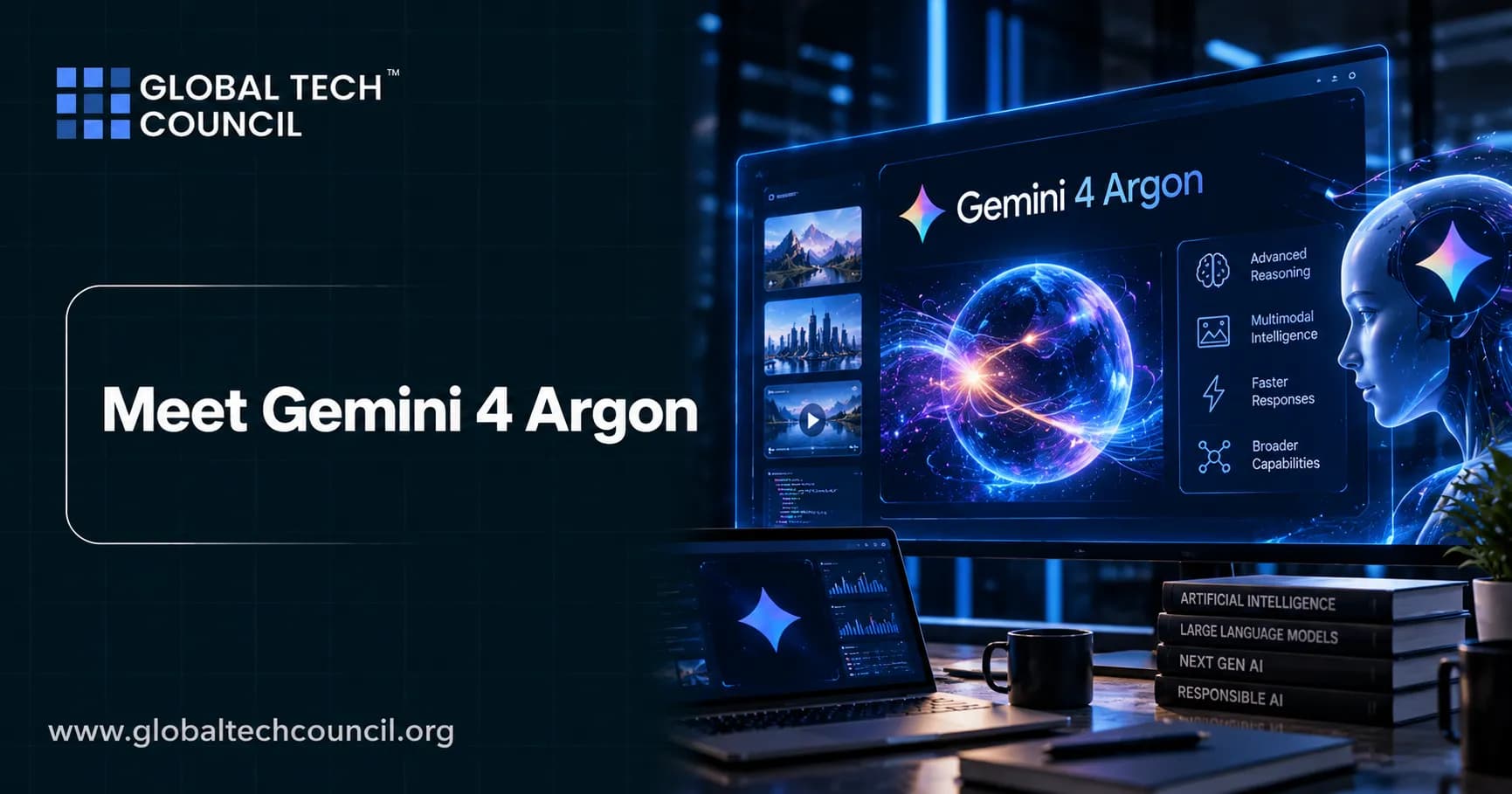
Google has introduced Gemini 4 Argon, the first model in its new Gemini 4 family and the company’s most powerful AI so far. It first appeared on September 30, 2026, in the hands of a small group of security partners, then opened to developers, businesses and paying Gemini users worldwide on October 13. Google describes it as a model for deep work, meaning long and difficult tasks that need many steps, careful reasoning and steady follow-through. This guide explains what Gemini 4 Argon is, what it can do, how much it costs and what to keep in mind before you rely on it. If you want a structured way to learn Google’s AI tools, the Certified Google Gemini Professional program is a useful starting point.
What Is Gemini 4 Argon in Simple Terms?
Gemini 4 Argon is a large AI model built by Google DeepMind. Think of it as the engine behind a smarter assistant. You type or upload something, and the model reads it, thinks through the problem and produces an answer, a plan, a piece of code or a finished document.

What sets it apart, according to Google, is stamina. Many AI tools handle short questions well but lose track on long projects. Argon is designed to stay on course across complex workflows in coding, finance, law, cybersecurity and science.
Key facts at a glance:
Maker: Google DeepMind
First shown: September 30, 2026
Broad release: October 13, 2026
Strong areas: coding, professional research, science and defensive security
Limit: 1 million tokens combined for input and output through the Gemini API
Launch API price: $2 per million input tokens and $10 per million output tokens
How Gemini 4 Argon Works for Everyday Tasks
You do not need to be a programmer to benefit. Android Authority points out that the model is also aimed at regular users, with better reasoning, stronger writing and more direct answers. In the Gemini app, Google shows the model turning a folder of messy project notes into a client proposal deck, sending it by email and creating a scheduled workflow for similar requests later.
A simple way to picture how an agent-style model operates:
You give it a goal in plain language.
It breaks the goal into smaller steps.
It uses tools or apps to carry out those steps.
It checks its own results and fixes problems.
It reports back and pauses for approval before risky actions.
Understanding these steps helps you write better instructions and spot errors faster. Learners who want a solid grounding in how models are built and tested can explore the Certified Artificial Intelligence (AI) Expert certification, which covers concepts that apply to tools like Argon.
Gemini 4 Argon Release Timeline
The launch happened in clear stages:
Date | Milestone |
|---|---|
July 21, 2026 | Google confirmed Gemini 4 had finished pre-training |
Late September 2026 | Model moved into post-training |
September 30, 2026 | Argon announced for vetted Fairwind security partners |
October 13, 2026 | Wider global release to developers, enterprises and subscribers |
Reuters notes the release followed months of delays and a leadership shakeup at DeepMind, as Google worked to catch up with rivals. Google also says more models in the Gemini 4 family are coming.
Standout Capabilities of Gemini 4 Argon
Long, Multi-Step Work
Argon is built to sustain reasoning over long projects. The 1 million token limit, paired with a new continuation protocol for long outputs, gives it room to read large files and produce big results in one session.
Cleaner, More Direct Writing
Google says Argon answers more directly, hedges less, repeats itself less and avoids common AI clichés. It also follows style instructions better than earlier Gemini models. For anyone who writes reports, emails or summaries, that is a practical upgrade.
Visual and Spatial Understanding
The model is described as strong at understanding images, charts, long videos and 3D spaces. Google reports an 87% score on ERQA, a benchmark about physical and spatial problem solving, and says that is the top result among frontier models. Demos include building a playable racing game from photos of a desk and assembling detailed 3D scenes.
Coding in Antigravity
Antigravity is Google’s coding environment, and it is limited to Google AI Ultra subscribers. Google reports that teams using Argon there raised agentic code submissions by more than 35% and cut code rollbacks by nearly one third.
Apps and Task Management
Android Authority reports new task management features and links to more than 40 apps in the Gemini app, which helps the model move from advice to action.
Real Projects Where Argon Has Been Used
Google highlighted several practical cases:
Chrome: The team untangled a roughly 6 million line legacy folder inside Chromium’s 40 million line codebase, finishing months of planned work in weeks.
Python agent framework: Working overnight, the model improved a production codebase, cutting session preparation time by 40% in long sessions.
Open models: Argon helped speed up Google’s Gemma models by 2.85 times with no drop in quality.
Document-heavy research: Isomorphic Labs uses it to pull key details from patents and papers, shortening weeks of reading to hours.
These are results reported by Google and its partners, so independent confirmation will add confidence over time.
Science and Research Results
Some of the most striking claims involve science. Google says Argon helped researchers speed up the xTB quantum chemistry package by up to 2.3 times, design new enzymes that were confirmed in lab tests, and discover new counterexamples to a decades-old fusion physics conjecture known as Grad’s conjecture. It also helped translate a quantum error correction decoder into an optimized hardware kernel that nearly doubled its speed. In rare disease work, Gamow Labs reported that Argon spotted a chromosomal rearrangement that routine software had missed.
To support more research, Google is offering 10,000 scientists free access to the highest Antigravity usage tier for six months, subject to eligibility and selection.
Fields such as quantum computing, fusion energy and advanced computing sit at the edge of modern technology. If you want to understand how these frontier areas connect with AI, security and distributed systems, a Deep Tech Certification can broaden your view of how emerging technologies fit together.
Gemini 4 Argon and Cybersecurity
Cyber defense was the first use Google emphasized. TechCrunch reports that the model was trained for defensive work and can find, validate and patch serious software vulnerabilities. Security firm Wiz used early access to help fix a gap that risked exposing sensitive government data and a flaw that exposed an administrator key at a healthcare provider.
The Fairwind Program gives vetted defenders a version of Argon without its normal cyber guardrails, and Google is now expanding that program to hundreds of additional partners. Everyone else uses the standard version with safeguards in place.
Safety Measures Google Describes
Google calls this its most comprehensive safety and security stack so far. According to its launch post:
External biology red teams could unlock under 1% of the tested sub-tasks.
Violations on a stress test of dangerous requests dropped nearly two-fold compared with older models.
Shortcut attempts on coding tests fell to 2%, and the model is trained to pause for confirmation before irreversible steps.
An automated monitor reads the agent’s actions and reasoning to catch unintended workarounds.
On a prompt injection benchmark, attack success across 15 adaptive attempts was 0.7%.
Prompt injection means hidden instructions placed in a web page or email that try to hijack an AI agent. These numbers come from Google’s testing, so treat them as a promising start.
Pricing and Access
At launch, the API costs $2 per million input tokens and $10 per million output tokens, and cached input tokens are 95% cheaper. After November 30, 2026, Google says the price rises to $4 and $20. Access works like this:
Developers and businesses: Gemini API in AI Studio and the Gemini platform
Google AI Ultra subscribers: Antigravity, plus the Gemini app and AI Mode in Search
Google AI Pro subscribers: Gemini app and AI Mode in Search
Security defenders: Fairwind Program applications
How Do the Benchmarks Compare?
Google says Argon ranks first on the Vals Index, which measures performance on professional work such as finance, coding, legal and tax tasks. TechCrunch adds that Google claims higher scores than OpenAI’s GPT-6 Astra and Anthropic’s Fable and Opus models across many tests.
Benchmark claims are useful, but they are not the full story. Vendors choose which charts to show, and your own tasks may behave differently. A fair test is simple. Pick three or four jobs you do regularly, run the same prompts in each tool and compare accuracy, clarity and time saved.
What It Means for Careers and Hiring
Agentic AI systems can plan tasks, use tools, and execute multi-step workflows with varying degrees of autonomy. As organisations explore these capabilities, they also need professionals who can design, monitor, and evaluate such systems. HireValid can be explored by employers looking for structured ways to assess candidates for emerging technology roles.
For job seekers, the message is encouraging. Tools change quickly, but skills in problem solving, data thinking and responsible AI use stay valuable. Build small projects, document your results and practice reviewing AI output critically.
Limitations and Smart Habits
Verify important answers. Even strong models can be wrong.
Protect private data. Share only what a task needs.
Watch the pricing change. Costs rise after November 30.
Keep humans in charge. Approve payments, messages and irreversible actions yourself.
Wait for outside reviews. Most performance data is still company reported.
How Marketers Can Use Gemini 4 Argon
Marketing teams can use Argon to summarize market research, outline campaigns, draft copy in a defined style, organize performance reports and automate repeat tasks. Its focus on direct, cliché-free writing may help produce cleaner first drafts, but a human should always review facts, tone and compliance. To combine creative strategy with AI-supported workflows, a Marketing Certification can help you build practical, career-ready skills.
Final Thoughts
Gemini 4 Argon marks a clear step toward AI that can carry out long, complex work rather than only answer quick questions. Google backs it with strong early results in coding, science and security, plus a large safety push, though most numbers still need independent confirmation. If you are curious, start small, test it on real tasks you understand, compare it with other tools and keep a careful eye on privacy and cost. The people who benefit most from models like this will be those who learn how they work and use them with good judgment.
FAQs
1. What Is Google Gemini 4 Argon?
Gemini 4 Argon is Google's advanced AI model launched on October 13, 2026. It is designed for complex reasoning, software engineering, scientific problem-solving, and professional knowledge work. The model also supports agentic workflows that involve planning, tool use, and multiple execution steps.
2. Why Did Google Launch Gemini 4 Argon?
Google introduced Gemini 4 Argon to help users and organizations tackle demanding tasks that require deeper analysis and extended execution. Its capabilities target areas such as coding, finance, legal research, cybersecurity, and scientific discovery. The launch reflects Google's focus on AI systems that can contribute to complex workflows rather than simply generate conversational answers.
3. What Are the Main Features of Gemini 4 Argon?
Gemini 4 Argon offers advanced reasoning, coding assistance, multimodal understanding, function calling, and support for autonomous multi-step tasks. It also provides a large context window and configurable thinking levels. These capabilities help developers build applications that can process substantial information and work through complex problems.
4. How Does Gemini 4 Argon Work?
Gemini 4 Argon processes instructions and supplied context to generate responses or determine appropriate next steps. When connected to tools, it can retrieve information, execute code, and evaluate intermediate results. An application or agent framework manages tool execution, permissions, and stopping conditions.
5. What Is the Context Window of Gemini 4 Argon?
Gemini 4 Argon supports a unified input-and-output context limit of up to 1,048,576 tokens, or approximately one million tokens. This allows it to handle substantial documents, large codebases, and extended task histories. Its standard synchronous output limit is 65,536 tokens, while supported long-decode configurations can extend output to one million tokens.
6. How Much Does Gemini 4 Argon Cost?
Google announced introductory API pricing of $2 per million input tokens and $10 per million output tokens through November 30, 2026. After the introductory period, the announced rates are $4 per million input tokens and $20 per million output tokens. Cached input receives a 95% discount under the announced pricing, subject to Google's applicable terms.
7. What Makes Gemini 4 Argon Different From Earlier Gemini Models?
Gemini 4 Argon emphasizes extended reasoning and performance on complex, multi-step tasks. Google highlights improvements in software engineering, professional knowledge work, scientific analysis, and agentic workflows. Its expanded output capacity also supports tasks that may require longer execution trajectories than conventional conversational interactions.
8. Can Gemini 4 Argon Write and Debug Code?
Yes. Gemini 4 Argon is designed for code generation, debugging, refactoring, and complex software engineering. When connected to development tools, it can inspect code, suggest changes, run tests, and use the results to refine its work. Developers should still review generated code and verify its security, correctness, and performance.
9. Can Gemini 4 Argon Build Apps and Games?
Gemini 4 Argon can assist with application development, interactive browser experiences, game prototypes, and complex visualizations. It can generate code and work through implementation steps with suitable development tools. The final result depends on the quality of the requirements, available tools, testing, and additional development work.
10. How Does Gemini 4 Argon Support AI Agents?
Gemini 4 Argon supports agentic workflows through reasoning, function calling, code execution, and computer-use capabilities. An appropriately configured agent can break a goal into steps, interact with tools, inspect results, and adjust its approach. Reliable execution still requires an effective harness, suitable permissions, and clear stopping conditions.
11. Does Gemini 4 Argon Support Multimodal Inputs?
Yes. Gemini 4 Argon accepts text, images, video, audio, and PDF documents as inputs and produces text outputs. This allows applications to analyze different types of information within a single workflow. Accuracy varies by task, so important interpretations should be checked against reliable sources.
12. Can Gemini 4 Argon Help With Scientific Research?
Gemini 4 Argon is designed to support mathematical reasoning, scientific analysis, and complex technical problem-solving. Researchers can use it to explore hypotheses, analyze experimental information, and assist with scientific coding. Its outputs should be independently validated before being used to support research conclusions.
13. How Can Businesses Use Gemini 4 Argon?
Businesses can use Gemini 4 Argon for document analysis, financial research, legal workflows, software development, and enterprise knowledge work. With appropriate integrations, it can process information, prepare structured outputs, and support multi-step operations. Organizations should evaluate privacy, compliance, reliability, and cost before deploying it in critical workflows.
14. How Does Gemini 4 Argon Support Cybersecurity?
Gemini 4 Argon is designed to assist defensive cybersecurity work, including identifying potential software vulnerabilities and helping develop fixes. Security teams can use it to analyze code, investigate weaknesses, and review remediation options. All findings and proposed fixes should be validated through controlled testing and established security processes.
15. Can Gemini 4 Argon Process Large Documents and Codebases?
Yes. Its large context window is intended to support substantial documents, technical reports, and extensive coding projects. This can help the model connect information across multiple sections or files. However, a large context window does not guarantee perfect recall or accurate interpretation of every detail.
16. Where Can Users Access Gemini 4 Argon?
Developers and enterprises can access Gemini 4 Argon through the Gemini API and Google AI Studio. Google AI Pro and Ultra subscribers can also access it through eligible experiences in the Gemini app and AI Mode in Search, while Ultra subscribers have access through Google Antigravity. Availability and usage limits vary by product and subscription.
17. How Does Gemini 4 Argon Compare With Other AI Models?
Gemini 4 Argon competes in areas such as coding, reasoning, long-context processing, scientific problem-solving, and agentic execution. Google has reported strong results on selected benchmarks, but performance depends on the evaluation method and configuration. Users should compare accuracy, speed, cost, reliability, and practical performance on representative tasks.
18. What Are the Limitations of Gemini 4 Argon?
Gemini 4 Argon can still generate inaccurate information, misunderstand instructions, or make mistakes during complex tasks. Tool failures and extended workflows can introduce additional challenges. Independent testing, human review, appropriate permissions, and execution limits remain important, especially in legal, financial, scientific, and cybersecurity applications.
19. Is Gemini 4 Argon Suitable for Everyday Users?
Gemini 4 Argon can help with research, writing, coding, document analysis, and complex planning tasks. Its availability through selected Google products gives eligible users ways to explore these capabilities without building a custom application. Access requirements and feature availability depend on the product and subscription plan.
20. What Does Gemini 4 Argon Mean for the Future of AI?
Gemini 4 Argon reflects the growing focus on AI systems that can reason through complex tasks, use tools, and sustain longer workflows. These capabilities may make AI more useful in software engineering, research, and professional services. Broader adoption will depend on accuracy, security, cost, and effective human oversight.
Related Articles
View All
AI & ML
Meet Muse Wonder: Meta’s New AI Model for Agents
Meta has launched Muse Wonder and Muse Wonder Full, new AI models built for agents with Active Memory and Active Focus. Learn how they work, what they cost and how to access them.

AI & ML
Can Gemini Improve Itself? Google’s AI and Recursive Self-Improvement
Explore whether Google Gemini can improve itself, how DeepMind is developing self-improving AI systems, and what separates current capabilities from true recursive self-improvement.

AI & ML
Meet Google Playground: Create Games With AI
Meet Google Playground, Google's new experimental platform that lets you create, play, and share custom games with text prompts. Learn how it works, basic game design tips, a sample session, safety and sharing features, Unity Spark plans, and limits.
Trending Articles
The Role of Blockchain in Ethical AI Development
How blockchain technology is being used to promote transparency and accountability in artificial intelligence systems.
AWS Career Roadmap
A step-by-step guide to building a successful career in Amazon Web Services cloud computing.
Top 5 DeFi Platforms
Explore the leading decentralized finance platforms and what makes each one unique in the evolving DeFi landscape.