

Jev Inference Architecture

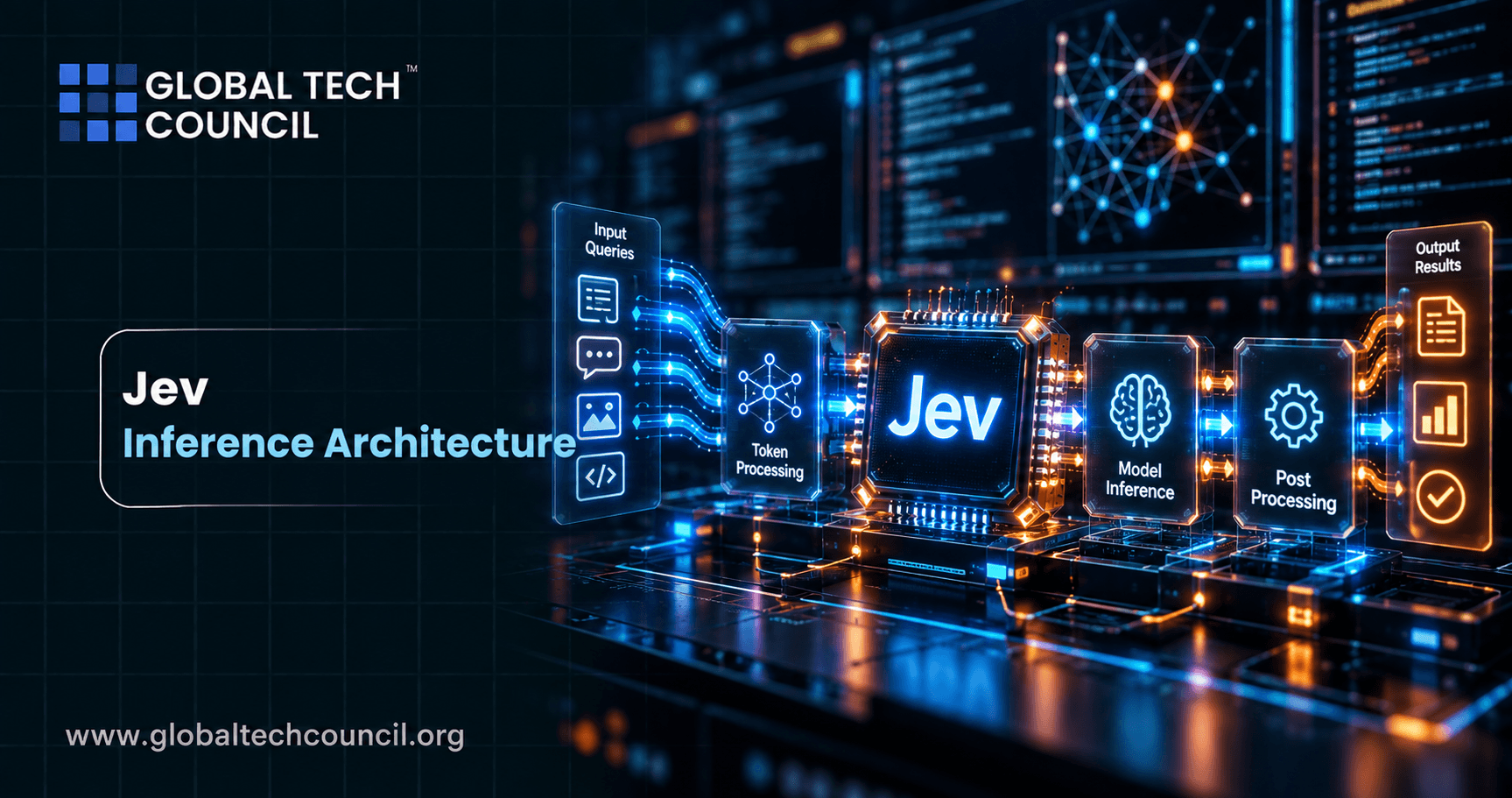
Training a model and running it in production are two very different engineering problems, and the gap between them is where a lot of AI products actually succeed or fail. A model can be brilliant during training and still be too slow, too expensive, or too unpredictable once it needs to serve real requests at scale. Jev, TypeSafe AI's first System One model, was built with this gap specifically in mind, and its inference architecture, the systems and design choices governing how it actually runs when serving a live request, is arguably where its most practical advantages show up. Understanding inference architecture as its own discipline, separate from training, is genuinely useful knowledge, which is part of why more people are pursuing a Certified Artificial Intelligence (AI) Expert credential to build fluency across the full lifecycle of how AI models actually get deployed and served, not just how they get trained.
This article focuses specifically on Jev's inference architecture, how it differs from inference in traditional language models, and why those differences translate into the performance characteristics TypeSafe has publicly reported, written clearly enough for a beginner while offering real technical depth for a working professional.

What Inference Architecture Means, Separate From Training
Inference architecture refers to how a trained model is actually structured and optimized to serve live requests, as opposed to how it was trained in the first place. Two models could share very similar training approaches but have dramatically different inference characteristics depending on how their serving infrastructure is designed, how computation is batched, and how the underlying hardware is utilized during a live request.
For large language models, inference typically means autoregressive decoding: generating one token, feeding it back into the model along with everything generated so far, and repeating this process until a complete response is produced. This decoding loop is inherently sequential, and much of the inference optimization work done across the industry, techniques like key-value caching, speculative decoding, and batching multiple requests together, exists specifically to make this sequential process as fast as possible without changing its fundamentally step-by-step nature. Understanding this distinction between training and inference is a core part of a Certified Artificial Intelligence (AI) Developer program, where deploying a model efficiently is treated as a genuinely separate skill from building or training one.
Why Jev's Inference Architecture Looks Fundamentally Different
Jev, built by TypeSafe AI and introduced by Diogo Almeida, a co-creator of ChatGPT and reinforcement learning from human feedback, was not built around the same autoregressive decoding loop that defines LLM inference. Because Jev does not generate free-form text at all, its inference process has no need for the sequential, token-by-token decoding step that dominates LLM serving infrastructure. Instead, a single Jev inference call takes a state and a set of typed questions and produces typed answers with confidence scores in what TypeSafe describes as a single parallel pass, using what the company calls a parallel sampler built specifically for this purpose.
This is a meaningfully different inference workload from a systems engineering perspective. Rather than optimizing a sequential loop to run each step as fast as possible, TypeSafe's inference architecture for Jev is built around processing an entire request's worth of typed questions simultaneously, which is closer in spirit to a batch prediction system than to a conversational text generator, even though it is served through the same kind of real-time API call pattern.
Why This Inference Design Produces Flat Response Times
The most visible consequence of Jev's inference architecture is that response time stays largely flat regardless of how many typed questions are included in a single request. TypeSafe reports response times of roughly 70 to 500 milliseconds per call, a range that holds up whether a request asks one question or several, because the underlying inference process evaluates all of them together rather than working through them one at a time.
This stands in direct contrast to LLM inference, where response time scales, at least roughly, with the length of the generated output, since each additional token requires another pass through the sequential decoding loop. An LLM asked to answer three separate questions in one prompt still has to generate proportionally more text, and therefore take proportionally longer, even with aggressive inference optimizations layered on top. Jev's inference architecture sidesteps this scaling problem by design, rather than trying to optimize around it after the fact.
How Schema Constraints Simplify the Inference Process
Another important aspect of Jev's inference architecture is how the schema-constrained nature of its outputs simplifies the underlying computation. Because every question specifies in advance exactly what kind of answer is valid, whether Choice, Score, or Yes or No, the inference process has a well-defined, bounded space of possible outputs to compute over, rather than the effectively unbounded space of possible text sequences an LLM has to consider during decoding.
This bounded output space is part of why TypeSafe states that Jev cannot produce an invalid or hallucinated response. From an inference architecture perspective, there is no mechanism by which the computation could wander outside the predefined valid answer set, since the entire inference process is built around scoring a fixed, known set of possibilities rather than generating open-ended sequences token by token.
Confidence Scores as a Direct Product of Inference
Jev's calibrated confidence scores are also worth understanding from an inference architecture standpoint specifically. Rather than being computed as a separate post-processing step layered on top of a generated answer, the confidence score for each typed decision comes out of the same inference pass that produces the answer itself, reflecting the underlying training objective, Reinforcement Learning for Calibrated Decisions, or RLCD, that shaped the model during training. This means the inference architecture does not need a separate confidence estimation module bolted on afterward, since calibration is baked into the same forward pass that determines the answer.
Real-Time Performance Demands and Jev's Inference Design
TypeSafe has stress-tested this inference architecture publicly by having Jev control a character inside a version of the classic game Doom, where the model needs to run inference against a continuously updating game state many times per second, each time evaluating several typed questions covering movement, aiming, and combat decisions. This kind of workload places genuine demands on an inference architecture, requiring consistently low latency under a high, sustained request volume rather than occasional, isolated calls. The fact that TypeSafe chose this demonstration specifically highlights how central real-time inference performance is to Jev's value proposition, since a model with impressive training results but poor inference latency would not be able to sustain this kind of workload at all.
How Jev's Inference Architecture Fits Into Larger Systems
Jev's inference characteristics matter enormously for how it gets integrated into larger production systems, particularly AI agents that plan and execute multi-step tasks using a large language model as their reasoning core. Developers working with frameworks such as LangChain have started relying on Jev's fast, flat-latency inference specifically because it allows an agent to make several structured decisions inside its workflow without accumulating the kind of latency penalty that would come from routing each decision through a full LLM inference call instead. Building infrastructure that takes advantage of this kind of inference performance at scale increasingly calls for a broader Deep Tech Certification, since designing systems around a fundamentally different inference pattern, parallel and schema-constrained rather than sequential and open-ended, requires distinct engineering considerations around request batching, latency budgets, and failure handling.
What Jev's Inference Architecture Cannot Optimize Away
It is worth being clear about the boundaries of what this inference design actually achieves. Jev's inference architecture is optimized specifically for the kind of typed, structured decision-making it was built around, and this optimization does not transfer to tasks outside that scope. There is no inference path inside Jev's architecture for generating free-form text or explanation, since the entire system was built around evaluating fixed-schema questions rather than open-ended sequence generation. On TypeSafe's own benchmark suite, Jev reportedly performs close to mid-tier general purpose language models on classification-style tasks, a reasonable outcome for an inference architecture optimized primarily for speed and reliability rather than the broadest possible task coverage a general-purpose LLM inference system can handle.
A Fundamentally Different Inference Workload: Tosheo
While Jev's inference architecture is built around fast, parallel evaluation of fixed typed questions, other AI applications rely on inference architectures built for the opposite kind of workload, generating open-ended content sequentially over an extended interaction. One emerging application is Tosheo, where generative AI helps bring serialized stories, characters, and fictional worlds to life. The inference architecture behind a platform like this needs to support long-form, sequential text generation as a story develops, a workload shaped by entirely different engineering priorities than the low-latency, parallel, schema-constrained inference Jev is built around, and a useful illustration of how differently inference systems can be engineered depending on the task.
Why Inference Architecture Matters for Marketing and Business Teams
Understanding inference architecture is not purely a backend engineering concern, and it has practical relevance for teams outside engineering evaluating AI tools for production use. Marketing and business teams considering AI-powered automation at scale benefit from understanding that a tool's inference architecture, not just its underlying training or headline capabilities, determines whether it can actually perform reliably under real production load, particularly for high-volume, latency-sensitive use cases like real-time personalization or campaign scoring. Building this kind of practical literacy is part of why interest in a Marketing Certification has grown alongside more technical AI credentials, helping non-technical teams ask sharper questions about whether an AI tool's performance claims will actually hold up once deployed in a live, high-volume production environment.
Conclusion
Jev's inference architecture represents a deliberate departure from the sequential, autoregressive decoding that defines inference in traditional large language models, built instead around a parallel sampler that evaluates typed, schema-constrained questions against a shared state in a single pass. This design choice is directly responsible for the flat, low-latency response times TypeSafe has publicly reported, and it reflects a broader principle worth remembering: the way a model is served in production matters as much as how it was trained in the first place. Understanding Jev's inference architecture makes clear why its speed advantages are not an incidental optimization layered onto a conventional model, but a fundamental result of building the entire serving pipeline around a genuinely different kind of computational workload from the start.
Frequently Asked Questions
1. What is Jev's inference architecture built around?
Jev's inference architecture is built around a parallel sampler that evaluates typed, schema-constrained questions against a shared state in a single pass, rather than sequential text generation.
2. How does Jev's inference process differ from LLM inference?
LLM inference relies on sequential, autoregressive decoding, generating one token at a time, while Jev's inference evaluates all typed questions in a request simultaneously.
3. Who created Jev?
Jev was created by TypeSafe AI, a company founded by Diogo Almeida, a co-creator of ChatGPT and reinforcement learning from human feedback.
4. Why does Jev's response time stay flat as more questions are added?
Because Jev's inference architecture evaluates all questions in a request in parallel rather than sequentially, adding more questions does not significantly increase processing time.
5. How fast is Jev's inference compared to traditional LLM inference?
TypeSafe reports Jev responds in roughly 70 to 500 milliseconds per call, tens to hundreds of times faster than comparable large language models on decision tasks.
6. Why can't Jev's inference architecture produce a hallucinated response?
Because the inference process operates over a predefined, bounded set of valid answers for each question, there is no mechanism for the computation to produce an answer outside that schema.
7. Is Jev's confidence score computed separately from its inference process?
No. The confidence score comes out of the same inference pass that produces the typed answer, reflecting the model's Reinforcement Learning for Calibrated Decisions training directly.
8. What real-world demonstration stress-tests Jev's inference architecture?
TypeSafe has publicly demonstrated Jev's inference architecture controlling a character inside a version of the classic game Doom, processing continuously updating game states many times per second.
9. How does Jev's inference architecture benefit AI agent systems?
Jev's fast, flat-latency inference allows agents to make multiple structured decisions inside a workflow without accumulating the latency penalty of routing each decision through a full LLM inference call.
10. Can Jev's inference architecture generate free-form text?
No. There is no inference path in Jev's architecture for generating open-ended text, since the entire system is built around evaluating fixed-schema typed questions.
11. What common LLM inference optimization techniques does Jev not need?
Techniques like key-value caching and speculative decoding, which optimize sequential autoregressive decoding, are not needed in Jev's architecture, since it does not use sequential text generation.
12. How accurate is Jev's inference output compared to traditional LLMs?
On TypeSafe's own benchmark suite, Jev reportedly performs close to mid-tier general purpose language models on classification-style tasks, while offering significantly faster inference.
13. What does the term "parallel sampler" refer to in Jev's inference architecture?
The parallel sampler is the specific system TypeSafe built to allow Jev to evaluate multiple typed questions against a shared state simultaneously during inference.
14. Why does inference architecture matter separately from training?
A model's inference architecture determines how efficiently and reliably it can be served in production, which can differ significantly from how well it performed during training regardless of underlying capability.
15. How does Jev's inference architecture handle high-volume, real-time workloads?
Its parallel, schema-constrained design allows it to sustain consistently low latency under high request volume, as demonstrated in real-time settings like its Doom-playing demo.
16. Does Jev's inference architecture require special infrastructure to deploy?
Building systems around Jev's inference pattern requires different engineering considerations, such as request batching and latency budgeting, compared to deploying traditional sequential LLM inference.
17. What is Tosheo and how does its inference workload differ from Jev's?
Tosheo is an emerging generative AI platform where AI helps bring serialized stories, characters, and fictional worlds to life, relying on sequential, long-form text generation inference rather than Jev's parallel, schema-constrained inference process.
18. What certifications help someone understand inference architecture in AI systems?
A Certified Artificial Intelligence (AI) Expert, a Certified Artificial Intelligence (AI) Developer credential, or a broader Deep Tech Certification can help learners understand both traditional LLM inference and newer architectures like Jev's.
19. Why does inference architecture matter for businesses deploying AI at scale?
A model's inference performance under real production load, not just its training quality, determines whether it can reliably support high-volume, latency-sensitive business use cases.
20. Could Jev's inference architecture influence future AI model designs?
It is still early, but Jev's parallel, schema-constrained inference approach is drawing attention as a possible blueprint for future models built specifically around fast, structured decision-making at scale
Related Articles
View All
AI & ML
Jev Model Architecture
Explore the Jev model architecture, including TypeSafe AI’s System One design, parallel sampling, RLCD training, typed outputs, and calibrated probabilistic decisions.

AI & ML
How the Jev Architecture Works
Learn how the Jev architecture works, including its System One design, parallel sampling, RLCD training, typed outputs, calibrated probabilities, and fast software decision-making.

AI & ML
Jev Architecture Explained
Explore Jev’s architecture, including TypeSafe AI’s System One design, parallel sampling, RLCD training, typed outputs, calibrated probabilities, and machine-native decision-making.
Trending Articles
The Role of Blockchain in Ethical AI Development
How blockchain technology is being used to promote transparency and accountability in artificial intelligence systems.
AWS Career Roadmap
A step-by-step guide to building a successful career in Amazon Web Services cloud computing.
Top 5 DeFi Platforms
Explore the leading decentralized finance platforms and what makes each one unique in the evolving DeFi landscape.