

Introducing Majorana 2
 Suyash Raizada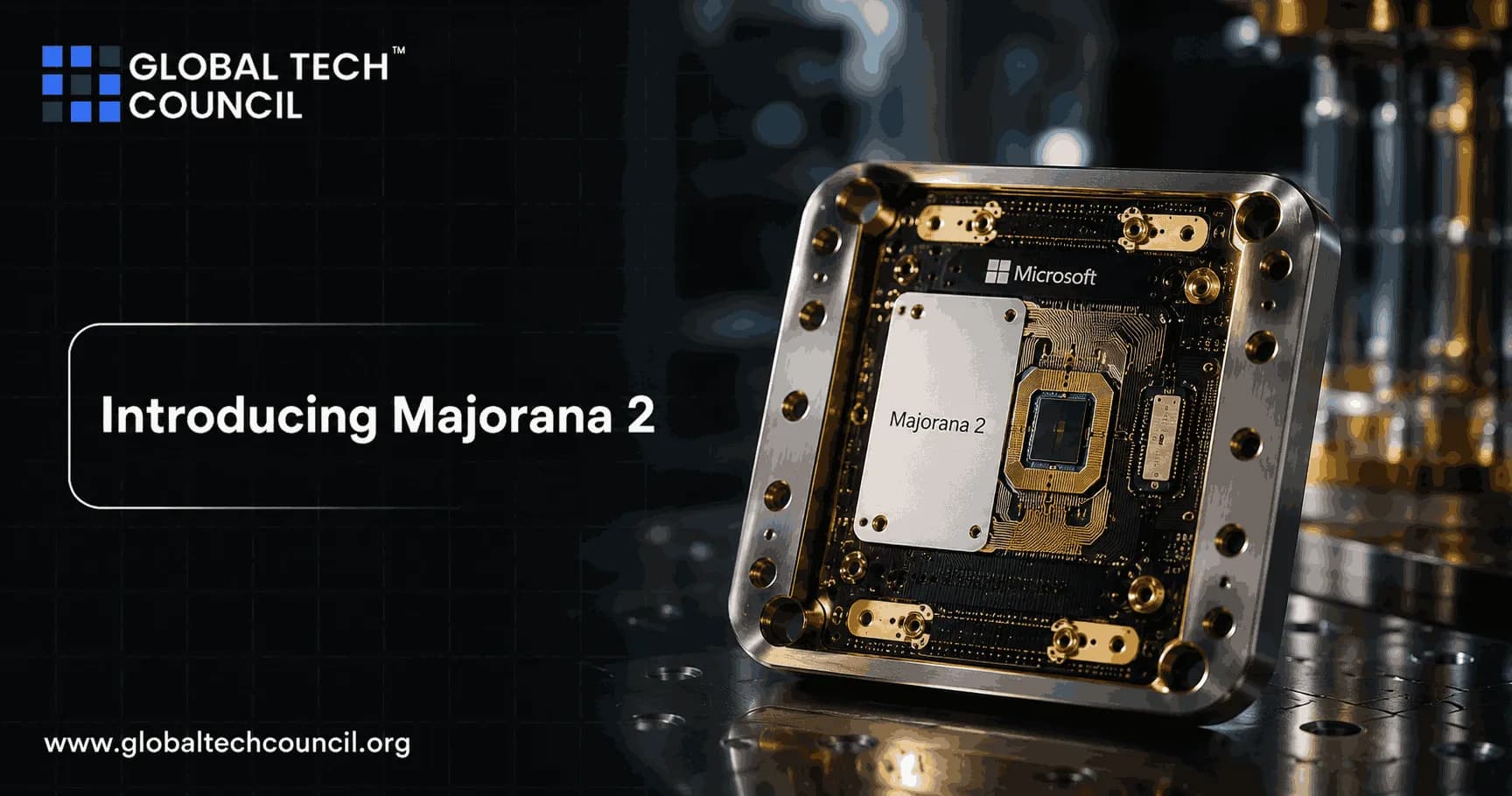
Introduction: The Quantum Chip Built With AI to Break a Decades-Long Barrier
On June 2, 2026, at Microsoft Build 2026 in San Francisco, Microsoft unveiled Majorana 2 a next-generation topological quantum processor that the company says represents a 1,000-fold improvement in qubit reliability over its predecessor. More than any specification, however, what defined this announcement was the story of how the chip was built. For the first time, an agentic AI platform Microsoft Discovery played a direct, documented role in solving the core materials challenge that made the chip possible.
Majorana 2 is not a finished commercial product. It is a milestone one that Microsoft believes is the critical step that justifies naming a specific year for a scalable, commercially viable quantum computer. That year is 2029, cutting the company's previous estimated timeline in half.

Moreover, the announcement arrived at a moment of intensifying global competition in quantum computing. IBM committed ten billion dollars to the field in the same period. Google, Amazon, and several well-funded teams in China are pursuing their own quantum roadmaps. Microsoft's choice to name 2029 publicly, for the first time ever, signals genuine confidence in the trajectory that Majorana 2 represents.
This article explains what Majorana 2 is, how it works, the remarkable materials engineering behind it, the role agentic AI played in its creation, the scientific debate it has sparked, and why it matters for the future of technology.
What Is Majorana 2?
Majorana 2 is Microsoft's second-generation topological quantum chip, announced at Microsoft Build 2026 and designed to advance the company's long-running effort to build a quantum computer capable of solving real-world problems. It follows Majorana 1, which was introduced in February 2025 as the first chip to demonstrate a topological superconductor in a quantum computing device.
Where Majorana 1 served as a proof of concept establishing that topological qubits could be manufactured and measured Majorana 2 is designed to prove that they can be made dramatically more reliable. The qubit lifetimes in Majorana 2 exceed 20 seconds on average, with some devices recording lifetimes of up to one minute. This compares to lifetimes of between one and twelve milliseconds in Majorana 1.
Furthermore, Majorana 2 qubits operate at a speed of one microsecond per operation. Individual qubits measure just one-hundredth of a millimetre in size, a physical compactness that is critical for the eventual scaling of topological quantum systems toward the one-million-qubit architectures that Microsoft considers necessary for utility-scale quantum computation.
The Core Approach: Why Microsoft Chose Topological Qubits
Microsoft's approach to quantum computing differs fundamentally from the superconducting transmon qubit approach favoured by most competitors. The topological approach encodes quantum information across spatially separated quasiparticles called Majorana Zero Modes, rather than in a single localised quantum state. This distributed encoding gives topological qubits theoretical error-resistance advantages that conventional approaches cannot replicate at the hardware level. However, it also makes the technology significantly harder to build and validate which is why Microsoft is one of only a small number of organisations pursuing it.
How Majorana 2 Works: The Physics of Topological Qubits
Majorana Zero Modes and Tetrons
The fundamental building block of Majorana 2 is the tetron, a device consisting of two superconducting nanowires with Majorana Zero Modes at their ends. Majorana Zero Modes are exotic quasiparticles that emerge at the boundary between a topological superconductor and a semiconductor under specific conditions of material quality, temperature, and device geometry. They store quantum information through parity, the evenness or oddness of the number of electrons in the topoconducting wire.
Because the quantum information is distributed across two spatially separated ends of the wire rather than localised in a single particle, it is inherently resistant to the local environmental disturbances vibrations, electromagnetic noise, thermal fluctuations that corrupt conventional qubits. This protection is quantified by the topological gap: the energy barrier that must be overcome before an error can disturb the stored information.
The Topological Gap as the Key Metric
Increasing the topological gap is the central engineering goal of Microsoft's quantum hardware programme. A larger topological gap means a higher energy cost for environmental noise to cause a qubit error directly translating to longer qubit lifetimes and lower error rates. In Majorana 2, the topological gap is more than double that of Majorana 1. This doubling is the primary physical mechanism behind the 1,000-fold improvement in qubit stability.
The Materials Science Breakthrough: Lead Over Aluminium
Why the Choice of Superconductor Matters
The topological phase in a quantum processor emerges at the interface between a superconductor and a semiconductor. The properties of that superconductor - particularly its superconducting gap energy directly determine the size of the topological gap and therefore the stability of the qubit.
Majorana 1 used aluminium as its superconducting material. Aluminium is widely used in quantum computing because it is relatively easy to work with in fabrication and has well-understood superconducting properties. However, its superconducting gap limits the topological gap achievable in the device capping the qubit lifetime at the millisecond range.
Majorana 2 replaces aluminium with lead. Lead has a significantly larger superconducting gap than aluminium, which allows a correspondingly larger topological gap in the finished device. This is the materials change that unlocks the 20-second mean qubit lifetime.
The Engineering Challenge: Lead Dissolves in Water
Chetan Nayak, Microsoft's Technical Fellow and Corporate Vice President of Quantum Hardware, acknowledged directly at the Build 2026 announcement that using lead in a semiconductor fabrication process is deeply counterintuitive. The core challenge is physical: lead dissolves in water. Standard semiconductor manufacturing processes use water extensively for cleaning and processing steps. Introducing lead into this environment means the material washes away before the device can be completed.
Jason Zander, the Executive Vice President overseeing Microsoft's quantum effort, confirmed that solving this manufacturing problem was the decisive challenge. The team had to develop entirely new processing sequences and cleaning methods that avoided aqueous steps where lead would be exposed. This was a years-long engineering challenge not a simple material substitution.
The Updated Semiconductor Active Region
Alongside the superconductor change, Majorana 2 updates the semiconductor active region from pure indium arsenide to a combination of indium arsenide and indium arsenide antimonide. This composite semiconductor creates a more stable topological phase by improving the quality and consistency of the quantum well in which the topological quasiparticles form. Consequently, the chip's performance improvements result from two simultaneous materials advances working together not from either change alone.
The Role of Agentic AI: How Microsoft Discovery Built Majorana 2
What Is Microsoft Discovery?
Microsoft Discovery is Microsoft's agentic AI platform for frontier research and development. It deploys teams of AI agents, guided by human expertise, to accelerate complex scientific workflows from materials simulation through experimental design, data analysis, manufacturing parameter optimisation, and quality management. At Microsoft Build 2026, Discovery was made generally available alongside the Majorana 2 announcement and its role in building the chip was presented as one of the headline stories of the announcement itself.
The connection between Majorana 2 and agentic AI is directly relevant for professionals building expertise in this area. A Tech Certification that covers AI systems, cloud infrastructure, and the developer platforms enabling research acceleration provides the technical foundation needed to understand how tools like Microsoft Discovery work and how they integrate with scientific hardware development. Furthermore, professionals who want to build specialised expertise in the agentic AI systems at the heart of this convergence the type that powered the materials discovery and manufacturing management behind Majorana 2 will find an Agentic AI certification provides structured knowledge of autonomous AI agents, their architectures, and their deployment in complex research and engineering workflows.
How AI Agents Solved the Lead Manufacturing Problem
The manufacturing challenge of integrating lead into a semiconductor fabrication process without allowing it to dissolve during processing required navigating an enormous parameter space of potential processing sequences, cleaning chemistries, deposition methods, and device geometries. Human researchers working sequentially through this space would require years of experimental iterations. Microsoft Discovery's AI agents were able to simulate material behaviours, model alternative processing routes, predict outcomes, and identify promising manufacturing sequences at a speed and scale that dramatically compressed the development timeline.
Chetan Nayak confirmed that while the broader materials research programme predated the availability of agentic AI tools, Discovery became an increasingly central part of the team's workflow as Majorana 2 development progressed. The Microsoft announcement directly credits AI agent assistance with helping to manage the complexity of the new device's manufacture not merely as a supporting tool but as a core part of how the chip came to exist.
Discovery Is Now Generally Available
One of the parallel announcements at Microsoft Build 2026 was that Microsoft Discovery is now generally available as a platform for frontier research and development. A local version of the platform's core capabilities can be downloaded free of charge and used with a GitHub Copilot account. This means the same agentic AI infrastructure that helped build Majorana 2 is now accessible to researchers, engineers, and organisations outside Microsoft, a significant expansion of agentic AI into scientific and engineering workflows.
Key Specifications of Majorana 2
Qubit Lifetime
The mean qubit lifetime of Majorana 2 exceeds 20 seconds, with individual devices recording lifetimes of up to one minute. By comparison, Majorana 1 qubit lifetimes ranged between one and twelve milliseconds making the improvement more than 1,000 times on a mean basis.
Operation Speed
Each qubit operation in Majorana 2 completes in one microsecond. This combination of long lifetime and fast operation speed is critical: it means many error-correction cycles can be completed within a single qubit's coherence window, which is a fundamental requirement for fault-tolerant quantum computation.
Qubit Physical Size
Individual qubits in Majorana 2 measure one-hundredth of a millimetre. This compact physical footprint is essential for scalability building millions of qubits on a single chip requires each qubit to occupy as little physical space as possible, and Majorana 2's size represents a meaningful advance in the physical density achievable with topological qubits.
Topological Gap
The topological gap in Majorana 2 is more than double that of Majorana 1. This is the structural measurement that best captures the physical mechanism behind the chip's improved performance: a larger energy barrier protecting the qubit state from environmental disruption.
Long-Term Architecture Target
Microsoft's long-term goal is to achieve one million qubits on a single chip small enough to fit in the palm of a hand. Majorana 2 is a milestone on the path toward that architecture - not a finished commercial product but one that Microsoft believes validates the fundamental physics and materials approach needed to reach that scale.
The 2029 Roadmap: Microsoft Names a Year for the First Time
A Historic Commitment
Until the Majorana 2 announcement, Microsoft had consistently declined to name a specific year for a scalable quantum computer, stating only that useful machines were a matter of years, not decades. The June 2, 2026 announcement changed that. For the first time, Microsoft publicly committed to 2029 as its target for a commercially viable scalable quantum computer - a commitment that Jason Zander framed as enabled directly by the qubit stability results demonstrated in Majorana 2.
This target places Microsoft in direct alignment with IBM, which has committed ten billion dollars to quantum machines and named a comparable timeline. Furthermore, it positions Microsoft in the same competitive cohort as Google, Amazon, and leading Chinese quantum teams, all pursuing the same fundamental goal of achieving quantum advantage in medicine, materials science, and complex optimisation.
The Development Phases
Microsoft's roadmap proceeds in defined phases. The current phase focuses on demonstrating reliable, long-lived topological qubits, a milestone that Majorana 2 advances significantly. The next phase involves building a fault-tolerant prototype based on topological qubits, within a timeline measured in years rather than decades. The final phase involves scaling to a utility-class quantum system running commercially meaningful workloads. The 2029 date refers to achieving the transition from the second to the third phase.
DARPA Quantum Benchmarking Initiative
Microsoft is a participant in DARPA's Quantum Benchmarking Initiative, which provides structured, independent evaluation of quantum computing progress claims. This participation is significant because it subjects Microsoft's results to external scrutiny beyond what internal publications alone provide, offering an additional layer of accountability for the 2029 roadmap claims.
The Scientific Debate Around Majorana 2
Expert Scepticism and Historical Context
Majorana 2 has generated significant scientific discussion alongside its technical results. Scientific American reported on June 2, 2026, that independent physicists raised concerns about the new preprint noting that it has not yet been peer-reviewed and that Microsoft's topological qubit approach carries a contested history.
In 2021, Microsoft retracted a high-profile Nature paper after external researchers demonstrated the data could have arisen from material imperfections rather than genuine topological qubit formation. Similar concerns were subsequently raised about Majorana 1. Consequently, some independent physicists maintain that the fundamental evidence for topological qubit formation has not yet been independently reproduced at scale.
Microsoft's Position
Microsoft's position is that the 1,000-fold improvement in qubit lifetime represents qualitatively stronger evidence than any previous publication. Moving from millisecond to 20-second lifetimes is not a marginal statistical advance; it is a change in physical regime that the company argues validates the topological protection mechanism operating as theoretically predicted. Furthermore, the doubling of the topological gap provides structural, measurable evidence of the energy barrier that topological protection theory requires.
The Path to Validation
The decisive scientific tests of Majorana 2's claims will involve three independent processes: formal peer review of the preprint manuscript, multi-laboratory reproduction of the qubit lifetime results, and evaluation under DARPA's Quantum Benchmarking Initiative. Until these processes are complete, the scientific community's assessment will remain divided between Microsoft's results and the concerns raised by independent experts.
Why Majorana 2 Matters Beyond Quantum Computing
The AI-Hardware Convergence
Majorana 2 establishes a meaningful precedent: agentic AI can accelerate frontier hardware development in ways that were not previously possible. If Microsoft Discovery can shorten a quantum chip development cycle by solving a years-long materials manufacturing challenge, the same model applies to semiconductor design, battery materials research, pharmaceutical discovery, and any domain where the parameter space for experimental exploration is vast.
For professionals wanting to lead this convergence, building structured AI knowledge is the clearest path forward. Those working across the AI and technology landscape benefit from an AI Certification that covers the principles, architectures, and real-world applications of AI systems providing the conceptual foundation needed to evaluate how tools like Microsoft Discovery advance not just quantum computing but science-as-a-whole.
Implications for Cryptography
A fault-tolerant scalable quantum computer would be capable of breaking widely used public-key cryptographic protocols including RSA and elliptic-curve cryptography that underpin the security of digital communications, financial transactions, and government systems globally. Microsoft's 2029 roadmap, if realised, significantly compresses the timeline for post-quantum cryptography migration and makes this a pressing operational concern for every organisation handling sensitive data today.
Implications for Medicine and Materials Science
Scalable quantum computers would enable molecular simulation at a level of accuracy that classical computers cannot approach directly applicable to drug discovery, personalised medicine design, battery and energy storage materials research, and industrial catalyst development. Therefore, the progress represented by Majorana 2 carries transformative potential for sectors far beyond the technology industry.
Building Strategy in a Quantum-AI World
For marketing professionals, business leaders, and strategists who need to understand and communicate the implications of quantum-AI convergence to clients, stakeholders, and organisations, a Marketing Certification that incorporates AI-driven strategy and technology communication provides the framework for translating complex scientific advances into clear, commercially relevant narratives a skill that will become increasingly valuable as quantum computing moves from research headlines toward commercial deployment.
FAQs
What Is Majorana 2?
Majorana 2 is Microsoft's second-generation topological quantum processor, unveiled at Microsoft Build 2026 on June 2, 2026. It features a lead-based superconducting materials stack that produces a mean qubit lifetime of 20 seconds - a 1,000-fold improvement over its predecessor - and was developed with the help of Microsoft's agentic AI platform, Microsoft Discovery.
When and Where Was Majorana 2 Announced?
Majorana 2 was announced on June 2, 2026, at Microsoft Build 2026 in San Francisco. The announcement was made to a developer audience and accompanied by a technical preprint and a detailed post on Microsoft's official quantum computing blog.
What Is the Relationship Between Majorana 1 and Majorana 2?
Majorana 1 was introduced in February 2025 as Microsoft's first chip to use a topological superconductor. It demonstrated that topological qubits could be manufactured and measured but produced qubit lifetimes of only one to twelve milliseconds. Majorana 2 builds directly on Majorana 1 by replacing its aluminium superconductor with lead and upgrading the semiconductor active region, increasing qubit lifetimes to a mean of 20 seconds.
Who Announced Majorana 2 at Microsoft Build 2026?
The technical details were presented by Chetan Nayak, Microsoft Technical Fellow and Corporate Vice President of Quantum Hardware. Jason Zander, the Executive Vice President overseeing Microsoft's quantum effort, spoke to the broader strategic significance, and the announcement was positioned as part of Microsoft's wider Build 2026 AI and developer platform narrative.
What Is Microsoft's 2029 Quantum Target?
Microsoft is targeting 2029 as the year by which it expects to deliver a commercially viable scalable quantum computer. This is the first time Microsoft has publicly committed to a specific year for this milestone, and the commitment was made possible by the qubit stability results demonstrated in Majorana 2.
What Are Topological Qubits?
Topological qubits encode quantum information across spatially separated Majorana Zero Modes rather than in a single localised state. Because the information is distributed, it is inherently more resistant to local environmental disturbances. This gives topological qubits theoretical error-resistance advantages over conventional superconducting or trapped-ion qubits but makes them significantly harder to build.
What Is the Mean Qubit Lifetime of Majorana 2?
The mean qubit lifetime of Majorana 2 exceeds 20 seconds, with individual devices recording lifetimes of up to one minute. This compares to one-to-twelve-millisecond lifetimes in Majorana 1 an improvement of more than 1,000 times on average.
How Fast Are Majorana 2 Qubits?
Each qubit operation in Majorana 2 completes in one microsecond. This fast operation speed, combined with the 20-second mean lifetime, means many thousands of error-correction cycles can be completed within a single qubit's coherence window, a critical requirement for fault-tolerant quantum computation.
How Big Are the Qubits in Majorana 2?
Individual qubits in Majorana 2 measure one-hundredth of a millimetre. This compact size is important for scalability, as building millions of qubits on a single chip requires each qubit to occupy minimal physical space.
Why Did Microsoft Replace Aluminium With Lead in Majorana 2?
Lead has a larger superconducting gap than aluminium at millikelvin temperatures, enabling a correspondingly larger topological gap in the finished device. The larger topological gap provides greater protection for the qubit, directly enabling the 1,000-fold improvement in qubit lifetime. However, lead dissolves in water, making its integration into semiconductor fabrication a major engineering challenge that required AI-assisted materials research to solve.
What Is Microsoft Discovery?
Microsoft Discovery is Microsoft's agentic AI platform for frontier research and development. It deploys teams of autonomous AI agents, guided by human expertise, to accelerate complex scientific workflows including materials simulation, experimental design, manufacturing parameter optimisation, and quality management.
How Did Microsoft Discovery Contribute to Majorana 2?
Microsoft Discovery's AI agents helped manage the manufacturing complexity of integrating lead, a material that dissolves in water, into the quantum chip's fabrication process. By simulating material behaviours and identifying viable processing sequences, it compressed a years-long engineering challenge into a manageable development timeline.
Is Microsoft Discovery Available to the Public?
Yes. Microsoft Discovery was made generally available at Microsoft Build 2026 alongside the Majorana 2 announcement. A local version of the platform's core capabilities can be downloaded free of charge and used with a GitHub Copilot account.
What Are the Broader Implications of AI-Assisted Chip Development?
Majorana 2 establishes that agentic AI can solve key materials and manufacturing challenges in frontier hardware development, not just accelerate software tasks. This precedent applies to semiconductor design, drug discovery, energy materials, and any domain where experimental parameter spaces are too vast for human researchers to navigate efficiently.
Has the Scientific Community Validated Majorana 2's Results?
As of the announcement date, the supporting manuscript is a preprint that has not undergone formal peer review. Some independent physicists have raised concerns based on Microsoft's mixed publication history in this area, including a 2021 Nature paper retraction. The results are being evaluated through DARPA's Quantum Benchmarking Initiative for independent verification.
What Is the DARPA Quantum Benchmarking Initiative?
The DARPA Quantum Benchmarking Initiative is a structured independent research programme that evaluates quantum computing progress claims against objective, externally verified criteria. Microsoft's participation provides a credible independent pathway for validating the Majorana 2 results beyond the company's own publications.
What Could a Scalable Quantum Computer Do by 2029?
A fault-tolerant scalable quantum computer could simulate complex molecular interactions for drug discovery, break current public-key cryptographic protocols, optimise large-scale logistics and financial systems, and accelerate materials science research at a level of accuracy and scale that classical computers fundamentally cannot achieve.
What Are the Cybersecurity Implications of Majorana 2's 2029 Roadmap?
If Microsoft's 2029 roadmap is realised, widely used encryption protocols including RSA and elliptic-curve cryptography could become vulnerable to quantum attack. This makes post-quantum cryptography migration an increasingly urgent priority for organisations protecting sensitive data, requiring planning and implementation now rather than closer to the date.
How Does Majorana 2 Compare to Competing Approaches From IBM and Google?
IBM and Google use superconducting transmon qubits that currently operate at higher qubit counts than Microsoft's topological approach but face higher error rates requiring extensive error correction overhead. Microsoft's topological approach targets intrinsically lower error rates at the hardware level, which could reduce the overhead needed but the approach is less mature and more contested. IBM committed ten billion dollars to quantum development in the same period as the Majorana 2 announcement, confirming that all three companies are targeting comparable 2029 timelines.
Related Articles
View All
AI & ML
Introducing Claude Sonnet 5
Claude Sonnet 5 represents the next evolution of Anthropic's AI models, delivering faster performance, stronger reasoning, enhanced coding capabilities, and improved multimodal understanding. Designed for developers, businesses, and everyday users, it offers more accurate responses, better instruction following, and advanced AI assistance for a wide range of tasks. This guide explores Claude Sonnet 5's features, improvements, real-world applications, and how it compares with previous Claude models.
AI & ML
Introducing MAI-Voice-2
MAI-Voice-2 marks a significant advancement in AI voice technology, offering improved speech quality, natural interactions, and multilingual capabilities. Learn how Microsoft's latest innovation is shaping the future of conversational AI and voice-driven experiences.

AI & ML
Introducing Workspace Agents in ChatGPT
Introduction Artificial Intelligence is no longer just a personal productivity tool. Furthermore, on April 22, 2026, OpenAI announced a shift that changes how entire teams work together. The launch of Workspace Agents in ChatGPT marks the most significant update to the platform since custom GPTs…
Trending Articles
The Role of Blockchain in Ethical AI Development
How blockchain technology is being used to promote transparency and accountability in artificial intelligence systems.
AWS Career Roadmap
A step-by-step guide to building a successful career in Amazon Web Services cloud computing.
Top 5 DeFi Platforms
Explore the leading decentralized finance platforms and what makes each one unique in the evolving DeFi landscape.