

Introducing MAI-Voice-2
 Suyash Raizada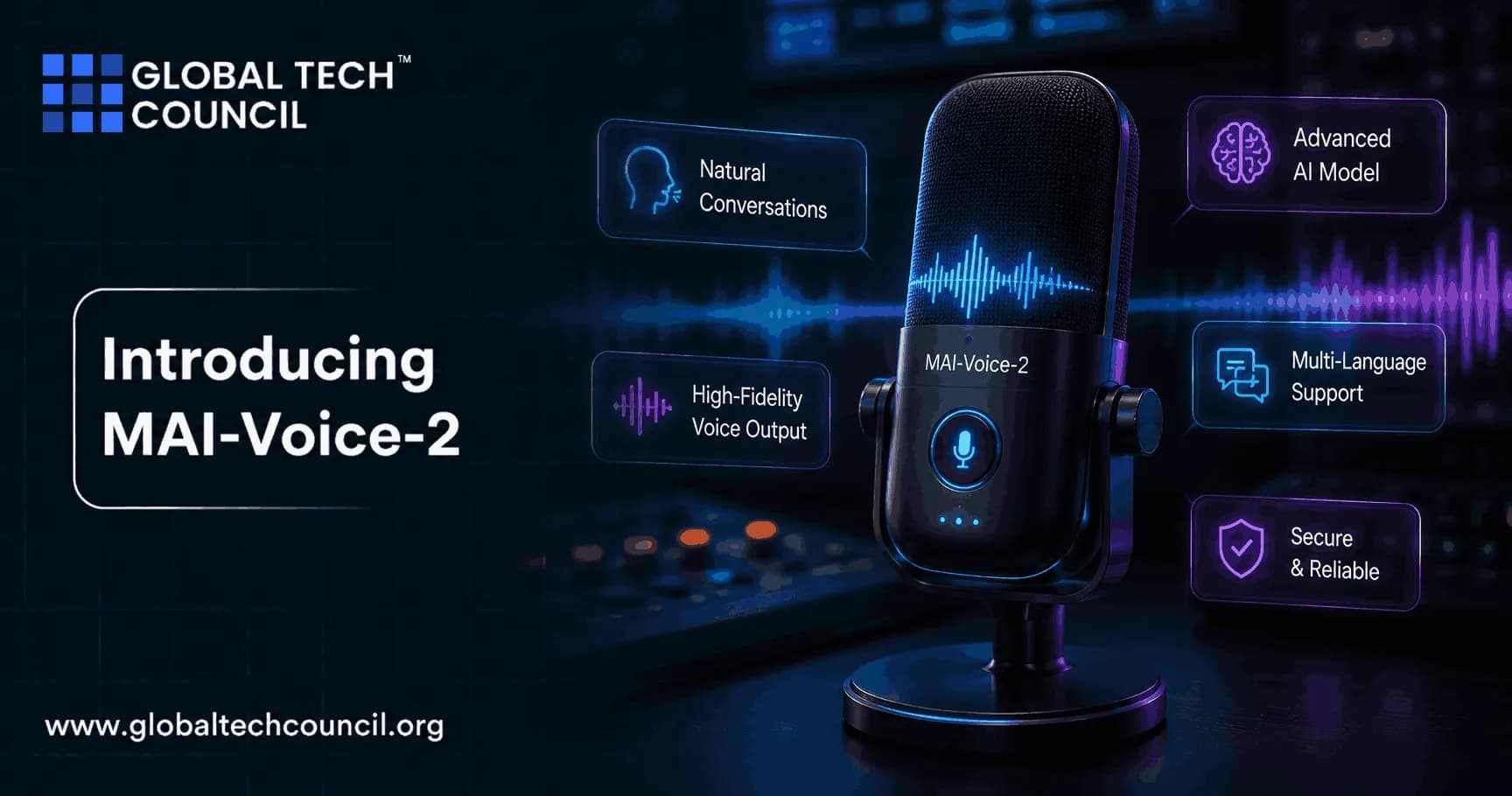
Introduction
Microsoft's AI strategy has entered a fundamentally different phase. Furthermore, the clearest evidence of that shift arrived at Microsoft Build 2026 in San Francisco on June 2, 2026, when the company announced seven new proprietary models from its MAI Superintelligence team in a single keynote. At the center of that announcement and arguably the most practically significant product for global developers and enterprise teams was MAI-Voice-2: the most expressive, highest-fidelity text-to-speech model Microsoft has ever shipped. Consequently, for product developers, content teams, voice application builders, accessibility engineers, and enterprise AI architects, understanding the full scope of what MAI-Voice-2 delivers is now essential. This guide covers every dimension of the model: its technical capabilities, its 15-language coverage, zero-shot voice cloning, emotional style system, consent guardrails, pricing, competitive position, and the strategic context that produced it.
The Origin: MAI Superintelligence and Microsoft's First-Party AI Strategy
To fully understand MAI-Voice-2, the organizational context that produced it matters. In November 2025, Microsoft formed the MAI Superintelligence team an internal AI research and engineering unit operating entirely separately from external model partnerships. Mustafa Suleyman, CEO of Microsoft AI and co-founder of DeepMind and Inflection AI, leads the team with a stated design philosophy he calls "Humanist AI." The philosophy centers on a single principle: build AI that optimizes for how people actually communicate with rhythm, emotional nuance, and natural variation rather than how synthetic systems have historically approximated human speech.

The team's first major release came on April 2, 2026: MAI-Voice-1 for speech synthesis, MAI-Transcribe-1 for transcription, and MAI-Image-2 for image generation. These three models represented Microsoft's first independent foundational model deployment AI capabilities built entirely in-house without external model involvement. The Build 2026 announcement on June 2, 2026 delivered the second wave: seven new models including MAI-Voice-2 as the upgraded voice synthesis component of what Microsoft now describes as its most complete first-party AI stack.
What Is MAI-Voice-2?
MAI-Voice-2 is Microsoft's second-generation text-to-speech model. According to Microsoft's official model description, it generates high-fidelity, natural, and expressive speech across 15 languages. It captures human-like intonation, rhythm, and emotional nuance enabling engaging, lifelike voice output for conversational applications, customer support systems, audiobooks, accessibility tools, branded voice experiences, and production-grade voice agents.
The model was built specifically for production environments where voice quality directly shapes user experience. Microsoft designed it with three categories of use case in mind: assistants and customer support tools where voice represents a brand to users, long-form audio content where voice consistency must hold across hours rather than seconds, and accessibility experiences where voice is the only available interface for the user.
The Complete Numbered Feature List: Everything MAI-Voice-2 Delivers
1. Multilingual Support Across 15 Languages
MAI-Voice-2 generates natural, expressive speech in 15 languages at launch. The full language set includes German, Australian English, US English, Spanish, French, Hindi, Indonesian, Italian, Japanese, Korean, Dutch, Portuguese, Turkish, Vietnamese, and Chinese. Each language is supported with regional dialect variants that reflect local prosodic patterns, rhythm, and phonetic characteristics rather than a standardized neutral accent applied uniformly across all speakers of that language.
2. Regional Dialect Variants Within Each Language
Within each supported language, MAI-Voice-2 distinguishes between geographic and regional speech patterns. Australian English and US English are treated as separate variants with distinct prosodic signatures. Spanish variants distinguish between European and Latin American speech patterns. This regional specificity enables applications serving diverse global populations to produce voice output that sounds genuinely native rather than generically international.
3. Zero-Shot Voice Cloning From Short Reference Audio
MAI-Voice-2 supports zero-shot voice cloning, the ability to replicate any speaker's voice from a short audio reference clip of five to sixty seconds, without any custom model training or per-speaker fine-tuning. Developers provide the reference clip and the target text, and the model generates speech in the cloned voice across all supported languages. This means a single reference recording creates a consistent brand voice that carries naturally into every language the product serves without maintaining a separate voice model per market.
4. Zero-Shot Voice Prompting for Tone and Style Control
Alongside cloning, MAI-Voice-2 supports zero-shot voice prompting a technique where a short audio sample serves as a reference for the model to match a specific tone, emotion, accent, pacing, and speaking style without requiring a separate voice library. Voice prompting allows developers to direct delivery at the query level without any persistent configuration, making it practical for dynamic applications where the desired voice style changes based on context.
5. Granular Emotion Tags for Fine-Grained Delivery Control
MAI-Voice-2 introduces a structured emotion tagging system for direct, granular control over vocal delivery. Supported emotion tags include sad, whispered, excited, embarrassed, confused, angry, and joyful. These tags are not post-processing overlays applied to a neutral base voice; they are embedded in the generation process and produce acoustic outputs where the emotional quality emerges naturally from the phonetic content. Consequently, emotional outputs in MAI-Voice-2 avoid the mechanical artificiality that characterizes systems where tonal modification is applied as a secondary transform after speech generation.
6. Speaker Role Personas
Beyond individual emotion tags, MAI-Voice-2 provides named speaker role personas pre-configured delivery archetypes whose energy level, pacing, and linguistic register are calibrated for specific professional and content contexts. Launch roles include Motivational Trainer and Sports Commentator. These personas encode a complete delivery pattern for their role rather than simply applying a tonal filter producing output that feels contextually appropriate for its intended setting and audience.
7. Cross-Language Code-Switching
MAI-Voice-2 supports natural code-switching fluid, mid-sentence transitions between two languages within a single generation pass. Supported code-switching pairs at launch include Hindi-English and Spanish-English. Code-switching capability is essential for applications serving bilingual populations where users naturally shift between languages mid-conversation, and for contact center tools that serve markets with high bilingual speaker density.
8. Stable Speaker Identity Across Long-Form Content
MAI-Voice-2 maintains consistent speaker identity across extended audio output including audiobooks, multi-hour podcasts, full training course narration, and long-form documentation narration. Voice identity does not drift across chapters, episodes, or sessions. This stability is a direct production requirement for long-form content applications and a significant limitation of earlier voice synthesis systems that maintained identity reliably over short clips but produced audible inconsistency over longer sequences.
9. Generation Speed: One Minute of Audio in Under One Second
MAI-Voice-2 generates sixty seconds of audio in under one second on a single GPU even when producing multilingual output, applying emotion tags, or generating cloned voices. This speed architecture is inherited from MAI-Voice-1 and extended to multilingual production. For real-time voice agents, interactive customer service systems, and live voice interfaces where latency directly affects user experience, this generation speed is a critical production enabler.
10. MAI-Voice-2 Flash Variant Coming Soon
A faster and more efficient variant MAI-Voice-2 Flash is announced for release shortly after the base model. This variant targets high-frequency, cost-sensitive workloads where generation speed and throughput are prioritized over the maximum expressiveness achievable with the full model. The Flash tier follows the same architectural pattern established by other Flash model variants in the MAI family.
11. Consent Guardrails Built Into Voice Cloning
MAI-Voice-2 embeds consent controls directly into the voice cloning pathway. Accessing personal voice cloning through the model requires submitting a formal request through the Azure AI Custom Neural Voice and Custom Avatar Limited Access Review. The process requires uploading a recorded audio consent statement from the voice talent alongside the required prompt to create the personal voice profile. Microsoft describes these controls as ensuring the technology is "as trustworthy as it sounds" a design decision that directly addresses ethical concerns around synthetic voice replication.
12. Preferred Over MAI-Voice-1 in 72.1% of Listening Tests
Microsoft conducted approximately 2,500 listening tests comparing MAI-Voice-2 directly against MAI-Voice-1. The second-generation model was preferred in 72.1% of those tests, a substantial preference margin reflecting cumulative improvements across naturalness, emotional expressiveness, multilingual consistency, and voice identity stability rather than any single isolated feature.
13. Pricing at $22 Per Million Characters
MAI-Voice-2 is priced at $22 per million characters on Azure AI Foundry. This positions the model between OpenAI's standard TTS tier at $15 per million characters and ElevenLabs' subscription tiers at substantially higher per-character costs for comparable quality. For production enterprise workloads generating high volumes of voice output, this pricing represents a meaningful cost advantage over premium-tier alternatives.
14. Azure AI Foundry Integration
MAI-Voice-2 is fully integrated with Azure AI Foundry Microsoft's unified API surface for deploying and managing AI models at enterprise scale. Developers working within the Azure ecosystem access the model through the same deployment patterns, authentication systems, and SDK workflows used for other Azure AI Speech services. No new infrastructure setup is required for organizations already operating on Azure. Additionally, the model is available through the MAI Playground, a no-code browser interface for testing voice generation, cloning, emotional styles, and language selection before any API integration work begins.
15. Full Integration Across Microsoft's Product Ecosystem
MAI-Voice-2 powers voice synthesis across Microsoft's consumer and enterprise product surfaces. It drives Copilot audio features, supports voice narration in Teams meeting summaries, and enables multilingual voice interfaces in Dynamics 365 Contact Center customer engagement tools. It integrates with VSCode for developer workflow audio and will eventually power accessibility features in Windows that require high-quality voice output. As a first-party model, Microsoft controls the full update, improvement, and customization cycle without external coordination or dependency on third-party model providers.
MAI-Voice-2 in the Full Context of Build 2026
MAI-Voice-2 arrived as one of seven models announced at Build 2026, the largest single-day model release in Microsoft's AI history. Understanding it alongside the companion models clarifies the broader strategy:
MAI-Transcribe-1.5 is the speech-to-text counterpart, covering 43 languages with a 2.4% word error rate placing it third on the Artificial Analysis leaderboard and transcribing one hour of audio in under fifteen seconds. It uses a mixture-of-experts architecture and operates up to five times faster than competing transcription models.
MAI-Image-2.5 is the updated image generation model, ranking third on LM Arena for text-to-image and second for image editing. It adds image-to-image editing and control-with-preservation capabilities. A faster MAI-Image-2.5-Flash variant is available in Azure Foundry, the MAI Playground, and OpenRouter.
MAI-Thinking-1 is Microsoft's first large language model, delivering strong reasoning and mathematical performance at a fraction of the cost of comparable frontier reasoning models.
MAI-Code-1-Flash is a five-billion-parameter coding model integrated directly into GitHub Copilot, available to developers for free.
Together these seven models form the most complete first-party AI stack Microsoft has ever deployed covering voice synthesis, transcription, image generation, text reasoning, and code generation across a unified Azure API surface.
Competitive Positioning in the AI Voice Synthesis Market
The AI voice synthesis market reached approximately $4.6 billion in 2024 and is projected to grow to $9.7 billion by 2028. MAI-Voice-2 enters a competitive field that includes ElevenLabs, OpenAI's TTS and Realtime API, Google Cloud Text-to-Speech, and Amazon Polly. Each competitor delivers overlapping but differently weighted combinations of language coverage, voice cloning capability, emotional range, latency, and pricing.
MAI-Voice-2 differentiates through three combined advantages that no single competitor fully matches at the same price point: production-grade generation speed at enterprise scale, zero-shot voice cloning without fine-tuning from reference clips as short as five seconds, and deep architectural integration with Microsoft's enterprise product ecosystem. For organizations already operating within Teams, Copilot, Dynamics 365, and Azure, MAI-Voice-2 provides voice synthesis without procurement friction, separate contract overhead, or integration complexity; the model is already embedded in the infrastructure those teams use daily.
Real-World Use Cases for MAI-Voice-2
Conversational AI Agents and Voice Assistants
Production voice agents serving users through natural-language audio interaction require a synthesis layer that responds quickly, maintains consistent identity across long sessions, and adapts emotional register to conversational context. MAI-Voice-2 meets all three requirements within a single model enabling agents to feel genuinely responsive rather than mechanically functional.
Content Localization at Scale
Content teams producing training videos, product tutorials, audiobooks, and marketing audio for global audiences can use MAI-Voice-2 to generate localized narration across 15 languages from a single reference voice. Zero-shot cloning eliminates per-language recording sessions, compressing localization timelines from weeks to hours without sacrificing voice consistency across markets.
Contact Center and Customer Experience
Contact center IVR systems, callback narration, and outbound communication tools benefit from emotional style capabilities that align tone to conversational context, de-escalating tense interactions, warming confirmation messages, and adding appropriate energy to positive customer engagement scenarios.
Accessibility Applications
For accessibility experiences where voice is the primary interface, MAI-Voice-2 delivers high-fidelity, emotionally calibrated speech that reduces listener fatigue over extended sessions and maintains the natural prosodic variation that makes audio content genuinely comfortable to process over time.
Building the Skills to Work With Advanced Voice AI Systems
As voice AI becomes embedded in agentic applications, contact centers, and enterprise productivity tools, professionals across every discipline need structured knowledge to work with it effectively. Those pursuing a Tech Certification develop recognized expertise across the technology domains that power MAI-Voice-2 and the broader MAI ecosystem including cloud AI deployment, Azure infrastructure, API integration patterns, and enterprise AI governance creating a verifiable professional foundation across the full technology stack.
Furthermore, MAI-Voice-2 is not simply a standalone synthesis tool. It functions as a component of agentic AI systems powering Copilot agents, voice-enabled automation pipelines, and customer service workflows that execute multi-step tasks autonomously. Professionals who understand how these systems are designed and managed hold a clear advantage in building and overseeing them responsibly. An Agentic AI certification builds exactly this capability equipping practitioners to architect, deploy, and evaluate voice-enabled agentic workflows with genuine structural understanding.
Additionally, understanding the foundational principles of AI model architecture, how neural TTS models are trained, how emotional style is embedded at the model level rather than applied as post-processing, and where synthetic voice systems reach their limitations is increasingly expected of any professional working with AI in a production capacity. An AI Certification provides this technical grounding, enabling professionals to evaluate voice AI systems like MAI-Voice-2 with the kind of architectural confidence that surface-level familiarity cannot replicate.
Finally, marketers and brand strategists using MAI-Voice-2 to produce localized campaign audio, branded voice experiences, and multilingual content at scale need strategic frameworks to connect these capabilities to measurable audience outcomes. A Marketing Certification equips professionals to integrate AI voice tools into campaign planning, audience targeting, content production workflows, and performance measurement translating the technical capabilities of MAI-Voice-2 into commercial results.
Pricing, Access, and Availability
MAI-Voice-2 is available in public preview from June 2, 2026, through Azure AI Foundry and the MAI Playground at microsoft.ai. The model is priced at $22 per million characters representing competitive enterprise pricing relative to comparable alternatives. Accessing zero-shot voice cloning requires submitting a gated access application through the Azure AI Custom Neural Voice and Custom Avatar Limited Access Review, with audio consent documentation from voice talent required before a personal voice profile can be created. Standard voice generation without cloning is available immediately upon Azure account setup without any gating requirements.
FAQs
What is MAI-Voice-2?
MAI-Voice-2 is Microsoft's second-generation text-to-speech model, developed by the MAI Superintelligence team. It generates high-fidelity, emotionally expressive speech across 15 languages with zero-shot voice cloning, granular emotion tags, speaker role personas, and stable identity across long-form content.
When was MAI-Voice-2 announced?
MAI-Voice-2 was officially announced at Microsoft Build 2026 on June 2, 2026, in San Francisco, as part of a seven-model release from the MAI Superintelligence team.
How many languages does MAI-Voice-2 support?
MAI-Voice-2 supports 15 languages at launch: German, Australian English, US English, Spanish, French, Hindi, Indonesian, Italian, Japanese, Korean, Dutch, Portuguese, Turkish, Vietnamese, and Chinese.
What is zero-shot voice cloning in MAI-Voice-2?
Zero-shot voice cloning allows the model to replicate a target speaker's voice from five to sixty seconds of reference audio without any fine-tuning or model retraining. The cloned voice carries consistently across all 15 supported languages.
What is zero-shot voice prompting?
Voice prompting uses a short audio sample as a reference for tone, emotion, accent, pacing, and speaking style allowing developers to direct delivery at the query level without managing a persistent voice library or cloning identity.
What emotion tags does MAI-Voice-2 support?
MAI-Voice-2 supports granular emotion control through tags including sad, whispered, excited, embarrassed, confused, angry, and joyful embedded in the generation process rather than applied as post-processing effects.
What speaker role personas are available at launch?
Launch personas include Motivational Trainer and Sports Commentator pre-configured delivery archetypes whose energy, pacing, and register are calibrated for their specific professional context. Additional roles are expected in future updates.
What is code-switching in MAI-Voice-2?
Code-switching enables fluid, mid-sentence transitions between two languages within a single generation pass without losing prosody or speaker identity. Supported pairs at launch are Hindi-English and Spanish-English.
How fast does MAI-Voice-2 generate audio?
MAI-Voice-2 generates sixty seconds of audio in under one second on a single GPU including multilingual outputs, cloned voices, and emotion-tagged delivery.
How does MAI-Voice-2 compare to MAI-Voice-1?
MAI-Voice-1 generated English-only audio. MAI-Voice-2 adds 15-language support, zero-shot cloning and voice prompting, granular emotion tags, speaker role personas, code-switching, and stable long-form identity. It is preferred over MAI-Voice-1 in 72.1% of approximately 2,500 listening tests.
What is the MAI-Voice-2 Flash variant?
MAI-Voice-2 Flash is a faster and more cost-efficient variant of the model announced at Build 2026 and scheduled for release shortly after the base version. It targets high-volume, cost-sensitive production workloads.
What consent controls apply to voice cloning?
Accessing personal voice cloning requires a formal application through the Azure AI Custom Neural Voice and Custom Avatar Limited Access Review. Voice talent must provide a recorded audio consent statement before a personal voice profile can be created.
How much does MAI-Voice-2 cost?
MAI-Voice-2 is priced at $22 per million characters on Azure AI Foundry positioned between OpenAI's standard TTS pricing at $15 per million characters and ElevenLabs' subscription tiers.
Where can developers access MAI-Voice-2?
Developers access MAI-Voice-2 through Azure AI Foundry and the MAI Playground at microsoft.ai. Standard voice generation is available without gating. Personal voice cloning requires a separate gated access application.
What Microsoft products does MAI-Voice-2 power?
MAI-Voice-2 powers Copilot audio features, Teams meeting summary narration, Dynamics 365 Contact Center voice interfaces, and Windows accessibility tools. VSCode integration for developer audio workflows is also available.
What other models launched alongside MAI-Voice-2 at Build 2026?
The seven-model Build 2026 release includes MAI-Voice-2, MAI-Voice-2 Flash, MAI-Transcribe-1.5, MAI-Image-2.5, MAI-Image-2.5 Flash, MAI-Thinking-1, and MAI-Code-1-Flash.
What is MAI-Transcribe-1.5?
MAI-Transcribe-1.5 is Microsoft's updated speech-to-text model covering 43 languages with a 2.4% word error rate. It transcribes one hour of audio in under 15 seconds and is up to five times faster than competing transcription models.
How does MAI-Voice-2 handle long-form audio?
MAI-Voice-2 maintains stable speaker identity across extended audio sessions including full audiobooks, multi-episode podcasts, and hour-long training narrations without the prosodic drift that affects many shorter-context voice synthesis systems.
What is the Humanist AI philosophy behind MAI-Voice-2?
Humanist AI is the design principle of the MAI Superintelligence team: build AI that optimizes for how people actually communicate with rhythm, emotion, and natural variation rather than how synthetic systems have historically approximated speech. For MAI-Voice-2, this means emotional qualities are trained into generation rather than applied as post-processing overlays.
Is MAI-Voice-2 available globally?
Yes. MAI-Voice-2 is available globally through Azure AI Foundry and the MAI Playground from June 2, 2026. Regional deployment follows standard Azure infrastructure availability, with specific regional pricing subject to Azure regional pricing guidelines.
Related Articles
View All
AI & ML
Introducing Claude Sonnet 5
Claude Sonnet 5 represents the next evolution of Anthropic's AI models, delivering faster performance, stronger reasoning, enhanced coding capabilities, and improved multimodal understanding. Designed for developers, businesses, and everyday users, it offers more accurate responses, better instruction following, and advanced AI assistance for a wide range of tasks. This guide explores Claude Sonnet 5's features, improvements, real-world applications, and how it compares with previous Claude models.
AI & ML
Introducing Majorana 2
Majorana 2 is Microsoft's latest quantum computing innovation, leveraging topological qubits to improve stability, scalability, and reliability. This breakthrough brings the industry closer to practical quantum computing capable of solving complex scientific and industrial challenges beyond the reach of classical computers.
AI & ML
Introducing Workspace Agents in ChatGPT
Introduction Artificial Intelligence is no longer just a personal productivity tool. Furthermore, on April 22, 2026, OpenAI announced a shift that changes how entire teams work together. The launch of Workspace Agents in ChatGPT marks the most significant update to the platform since custom GPTs…
Trending Articles
The Role of Blockchain in Ethical AI Development
How blockchain technology is being used to promote transparency and accountability in artificial intelligence systems.
AWS Career Roadmap
A step-by-step guide to building a successful career in Amazon Web Services cloud computing.
Top 5 DeFi Platforms
Explore the leading decentralized finance platforms and what makes each one unique in the evolving DeFi landscape.