

Is Jev Generative AI?

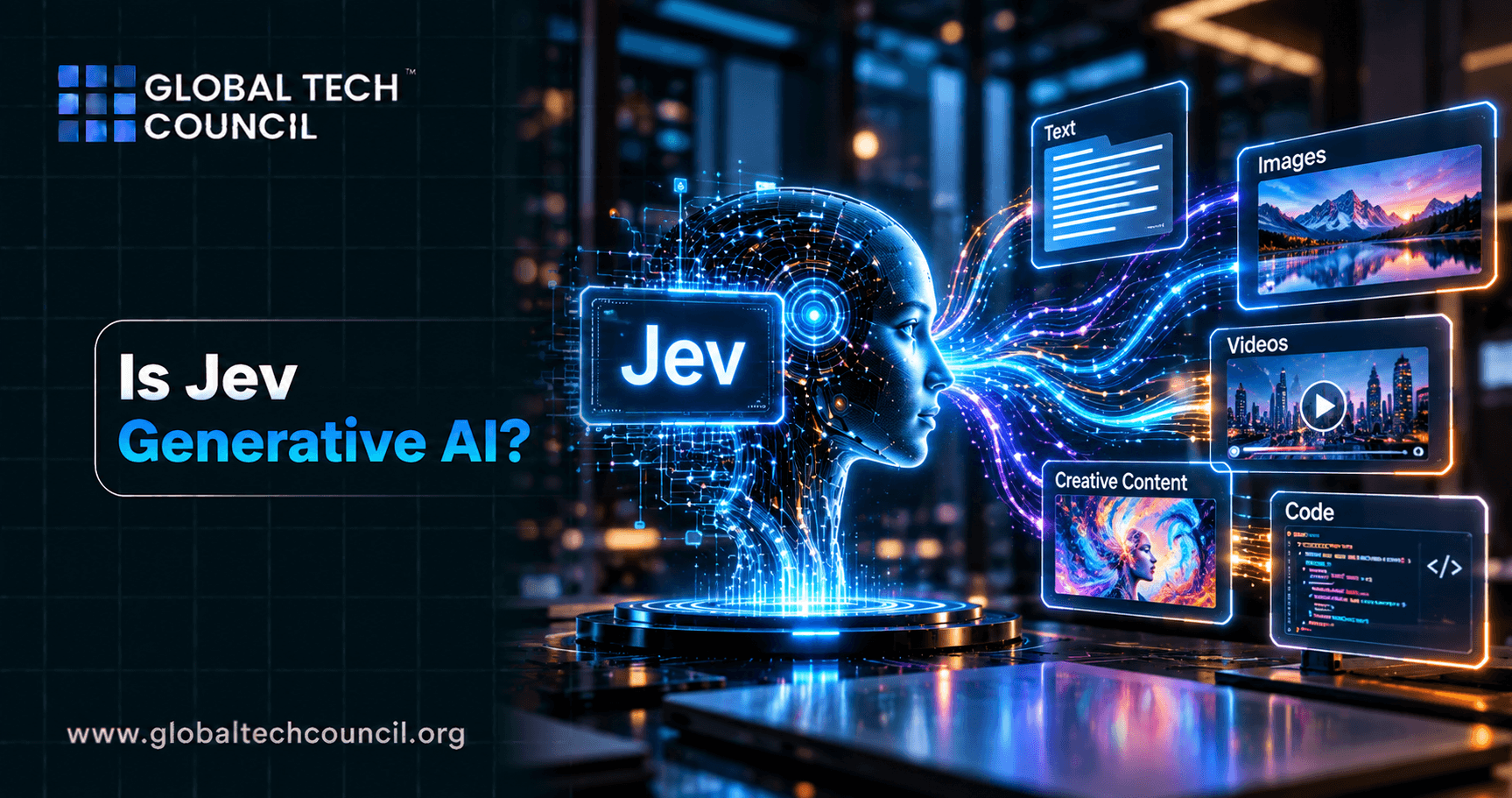
Generative AI has become such a dominant part of how people talk about artificial intelligence that it is natural to assume any new, impressive AI model must fall into that category. So when TypeSafe AI released Jev in September 2026, a fast, decision focused model, a lot of people reasonably wondered whether it counts as generative AI too. The short answer is no. Jev does not generate new content the way tools like ChatGPT or Midjourney do. It makes fast, structured decisions instead. Understanding exactly why that distinction matters offers a genuinely useful window into how AI is diversifying beyond just content creation. A strong starting point for building that understanding is a Certified Artificial Intelligence (AI) Expert credential, which covers the core concepts behind both generative and decision focused AI systems.
This article breaks down whether Jev is generative AI in plain, simple language, so a complete beginner can follow along easily, while still offering enough technical depth for professionals already working in AI. No unnecessary jargon, just a clear, well researched explanation.

What Generative AI Actually Means
Generative AI refers to models built specifically to create new content that did not exist before, text, images, audio, video, or code, based on patterns learned from massive training datasets. The defining trait of generative AI is that its output is genuinely new. When you ask a generative AI tool to write a paragraph, design an image, or compose a melody, the model produces something original, shaped by its training but not simply copied from it.
Tools like ChatGPT, Midjourney, and similar systems are textbook examples of generative AI, built around the core task of producing fresh, human readable, or human viewable output from a prompt. This creative capability is what has driven so much of the recent excitement around AI, and it remains genuinely valuable across writing, design, and content production. For professionals who want structured, hands on training in exactly this space, a Certified Generative AI Expert program covers the practical skills behind building and working with generative models effectively.
So, Is Jev Generative AI
Jev is not generative AI. It does not create new text, images, audio, or any other original content. Instead, Jev evaluates a given piece of context and returns a fast, structured decision, a boolean yes or no, a numeric score, or a category chosen from up to 255 predefined options, typically within 70 to 500 milliseconds. There is nothing genuinely new being produced in that output. It is a judgment call about existing information, not a creative act.
TypeSafe, the startup behind Jev, is explicit about this distinction. Founded by Diogo Almeida, previously of OpenAI and a co-author of the InstructGPT research behind ChatGPT's training method, the company describes Jev as a System One model, a term borrowed from psychologist Daniel Kahneman's description of fast, automatic human thinking, deliberately positioned apart from the generative category that most modern AI headlines focus on.
Generative vs Decision Focused: The Real Technical Distinction
Generative Models Are Additive
Generative AI takes an input and produces something new, adding original content to the world that did not exist in that exact form before. This additive quality is the defining trait of the entire category, whether the output is a paragraph, a picture, or a piece of music.
Jev Is Evaluative
Jev takes existing information and produces a judgment about it. It does not add new content. It classifies, scores, or flags based on patterns learned during training, functioning closer to a fast, automated judge than a creative collaborator.
This is a genuine architectural and functional difference, not just a marketing distinction. It shapes everything about how each type of model is trained, evaluated, and used in practice.
Jev vs Generative AI: Side by Side Comparison
Factor | Jev | Generative AI |
Core function | Evaluates and decides | Creates new content |
Typical output | Category, score, or yes/no | Text, image, audio, video, or code |
Is the output original content | No | Yes |
Training objective | Calibrated, accurate confidence | Creative, natural, human preferred output |
Typical response time | Roughly 70 to 500 milliseconds | Often several seconds or longer |
Underlying architecture | Large pretrained foundation model | Large pretrained foundation model |
Interestingly, both categories often share the same general architectural roots, large pretrained foundation models built using similar deep learning techniques. What separates them is not the underlying technology alone, but how that technology was trained and shaped for a final purpose. Professionals who want a deeper, structured understanding of these architectural distinctions across the wider AI landscape can explore a Deep Tech Certification, which covers both generative model design and newer, decision focused categories like Jev in detail.
Why TypeSafe Deliberately Avoided Building Another Generative Tool
Diogo Almeida's background gave him firsthand experience with just how powerful, and how resource intensive, generative AI can be. Rather than building another general purpose content generation tool, TypeSafe identified a different, underserved gap. Many everyday software decisions, flagging a fraudulent transaction, routing a support ticket, checking whether an AI agent's proposed action looks safe, do not need creative, generated content at all. They need a fast, reliable, structured answer. Jev was built specifically to serve that non-generative layer of the AI stack, trained using a method called Reinforcement Learning for Calibrated Decisions, aimed at making its confidence scores genuinely reflect real world accuracy rather than optimizing for anything resembling creative or natural sounding output.
Common Misconceptions About Jev and Generative AI
Misconception: Any Advanced AI Model Must Be Generative
Not every impressive AI model creates new content. Jev demonstrates that a model can be fast, sophisticated, and commercially significant while being built for judgment rather than generation.
Misconception: Jev Must Secretly Generate Text Behind the Scenes
Jev's entire output format is structured and typed from the start, a category, score, or boolean, not free form text that happens to be short. It is architecturally built to skip content generation entirely, not simply configured to generate very brief responses.
Misconception: Non-Generative Models Are Less Valuable Than Generative Ones
Speed, cost efficiency, and structured reliability are genuinely valuable traits in their own right, particularly for high volume, real time decisions where generative AI's flexibility is not actually needed.
Where Jev and Generative AI Actually Work Together
Rather than competing, Jev and generative AI are frequently used side by side in the same systems. Generative AI can draft a piece of content, a message, an image, or a response, while a fast decision model like Jev checks, scores, or flags that output before it moves forward in a workflow. This pairing shows up across content moderation, personalization pipelines, and AI agent systems, where generative capability handles creation and a decision layer handles judgment.
Emerging Creative Applications That Illustrate This Distinction Clearly
Few examples make this distinction clearer than emerging serialized storytelling platforms. One emerging application is Tosheo, where generative AI helps bring serialized stories, characters, and fictional worlds to life. The actual writing, dialogue, and visual content behind an ongoing series depends entirely on true generative AI's ability to produce original material, while a fast, structured decision layer similar to Jev can work quietly behind the scenes, confirming a character detail stays consistent or checking that a scene fits established continuity, without generating any new creative content itself.
Why This Matters for Business and Marketing Teams
Understanding whether Jev is generative AI has real strategic value beyond pure technical interest. Marketing and business teams often use generative AI to draft campaigns and creative assets, while relying on faster, non-generative decision layers to personalize, score, and route that content instantly. Professionals working in campaign strategy and customer experience can benefit from understanding this distinction clearly, since choosing the right tool for content creation versus content evaluation directly affects both cost and speed. A focused Marketing Certification can help connect these architectural concepts to practical, measurable business outcomes.
How to Answer This Question for Any New AI Model
The confusion around whether Jev is generative AI reflects a broader pattern worth understanding, since it will likely come up again as more specialized AI models launch in the coming years. The most reliable way to answer this kind of question is to look past the hype around a launch announcement and ask one simple thing, does this model's core output add something new to the world, or does it evaluate something that already exists. A model that writes, draws, composes, or codes something original belongs in the generative category. A model that scores, sorts, flags, or classifies existing information, no matter how sophisticated its underlying architecture, belongs in the decision focused category instead. Applying this simple test consistently helps cut through marketing language and gets straight to what a given AI tool is actually built to do, which matters far more in practice than which broad category it gets labeled under in a headline.
It is also worth remembering that these categories are not rigid walls. Some AI systems blend elements of both, using a generative component to draft something and a decision component to refine or select among multiple drafts. Jev itself was not built to blend the two. Its architecture and training were shaped entirely around the decision side of that spectrum, which is exactly why the straightforward answer to whether it is generative AI remains no, even as the broader AI industry continues to build increasingly specialized tools that do not always fit neatly into the categories people are most used to hearing about.
Conclusion
Jev is not generative AI. It shares architectural roots with generative models, since both are typically built on large pretrained foundations, but Jev was deliberately trained and shaped for a fundamentally different purpose, returning fast, structured, calibrated decisions instead of creating new content. Rather than viewing this as a limitation, it reflects a genuine specialization, one that complements generative AI rather than competing with it, filling the fast, judgment focused layer of the AI stack that content creation alone was never built to handle.
Frequently Asked Questions
1. Is Jev generative AI?
No. Jev does not create new content. It evaluates existing information and returns a fast, structured decision, such as a category or score, rather than generating original text, images, or audio.
2. What is Jev if it is not generative AI?
TypeSafe describes Jev as a System One model, a fast, structured decision model designed for judgment calls rather than content creation.
3. Does Jev share any technology with generative AI models?
Yes. Jev is built on a large pretrained foundation model, giving it genuine architectural roots similar to those used in many generative AI systems.
4. Why doesn't Jev generate text, images, or other content?
Jev was deliberately designed around a different goal, fast, structured decision making, rather than the open ended content creation that defines generative AI.
5. Who created Jev, and why did they avoid building another generative tool?
Jev was created by TypeSafe AI, founded by Diogo Almeida, previously of OpenAI, who identified a gap for fast, structured decisions that generative AI tools were not well suited to fill efficiently.
6. What is the technical difference between generative and decision focused AI?
Generative AI produces new, original content as its output, while decision focused models like Jev evaluate existing information and return a structured judgment instead.
7. How was Jev trained differently from a generative AI model?
Jev was trained using Reinforcement Learning for Calibrated Decisions, which rewards accurate, well calibrated confidence, while generative AI models are typically trained to produce natural, human preferred creative output.
8. Does Jev's output ever resemble generative AI output?
No. Jev's output is always a typed, structured decision, such as a boolean, score, or category, not free form generated content of any length.
9. How fast is Jev compared to typical generative AI tools?
TypeSafe reports Jev can respond up to roughly 100 to 200 times faster than comparable frontier models on classification style tasks, based on its own internal benchmarks.
10. Can Jev evaluate content that a generative AI tool has created?
Yes. This is a common real world pattern, using Jev to check, score, or flag content that a generative AI model has already produced.
11. Can Jev and generative AI be used together in the same system?
Yes. A common pattern uses generative AI to create content or draft an action, while Jev checks or scores that output before it moves forward in a workflow.
12. What industries benefit from combining Jev with generative AI tools?
Content moderation, marketing personalization, customer support automation, and AI agent workflows commonly benefit from combining both approaches.
13. Is Jev meant to replace generative AI tools like ChatGPT?
No. TypeSafe has been explicit that Jev is designed to complement generative AI, handling fast, structured decisions rather than replacing creative content generation.
14. How does this distinction apply to creative platforms like Tosheo?
True generative AI handles the actual creative writing and visuals behind serialized content on platforms like Tosheo, while a fast, structured decision layer similar to Jev can support consistency checks without generating new content itself.
15. Is it accurate to describe Jev as a lightweight generative model?
No. Jev is not a lightweight or scaled down generative model. It is architecturally built to skip content generation entirely in favor of structured decision making.
16. What is a limitation of Jev compared to generative AI?
Jev cannot create original content, making it unsuitable for tasks like writing, design, or any use case that genuinely requires creative output.
17. What is a limitation of generative AI compared to Jev?
Generative AI is generally slower and more expensive per response, since it produces entire pieces of new content rather than a single structured decision.
18. Why should marketing professionals understand whether Jev is generative AI?
Because choosing the right tool for content creation versus content evaluation directly affects both cost and speed in marketing automation workflows.
19. What skills help someone understand the difference between Jev and generative AI professionally?
A solid understanding of both generative model architecture and structured decision systems, along with hands on deployment experience, are valuable starting points.
20. What is the key takeaway about whether Jev is generative AI?
Jev is not generative AI. It shares underlying foundation model technology with generative systems but was built and trained for a fundamentally different purpose, fast, structured, calibrated decision making rather than content creation.
Related Articles
View All
AI & ML
Jev vs Generative AI
Compare Jev with generative AI, including how Jev’s structured, probabilistic decision-making differs from models designed to generate text, images, code, and other content.
AI & ML
How Jev Fits Into an AI Stack
Learn how Jev fits into an AI stack as a machine-native decision layer that provides typed, probabilistic outputs for applications, agents, workflows, and automation systems.

AI & ML
Jev for Software Automation
Explore how Jev supports software automation with fast, typed, probabilistic decisions for routing, scoring, classification, verification, branching, and workflow control.
Trending Articles
The Role of Blockchain in Ethical AI Development
How blockchain technology is being used to promote transparency and accountability in artificial intelligence systems.
AWS Career Roadmap
A step-by-step guide to building a successful career in Amazon Web Services cloud computing.
Top 5 DeFi Platforms
Explore the leading decentralized finance platforms and what makes each one unique in the evolving DeFi landscape.