

Jev Decision Pipeline

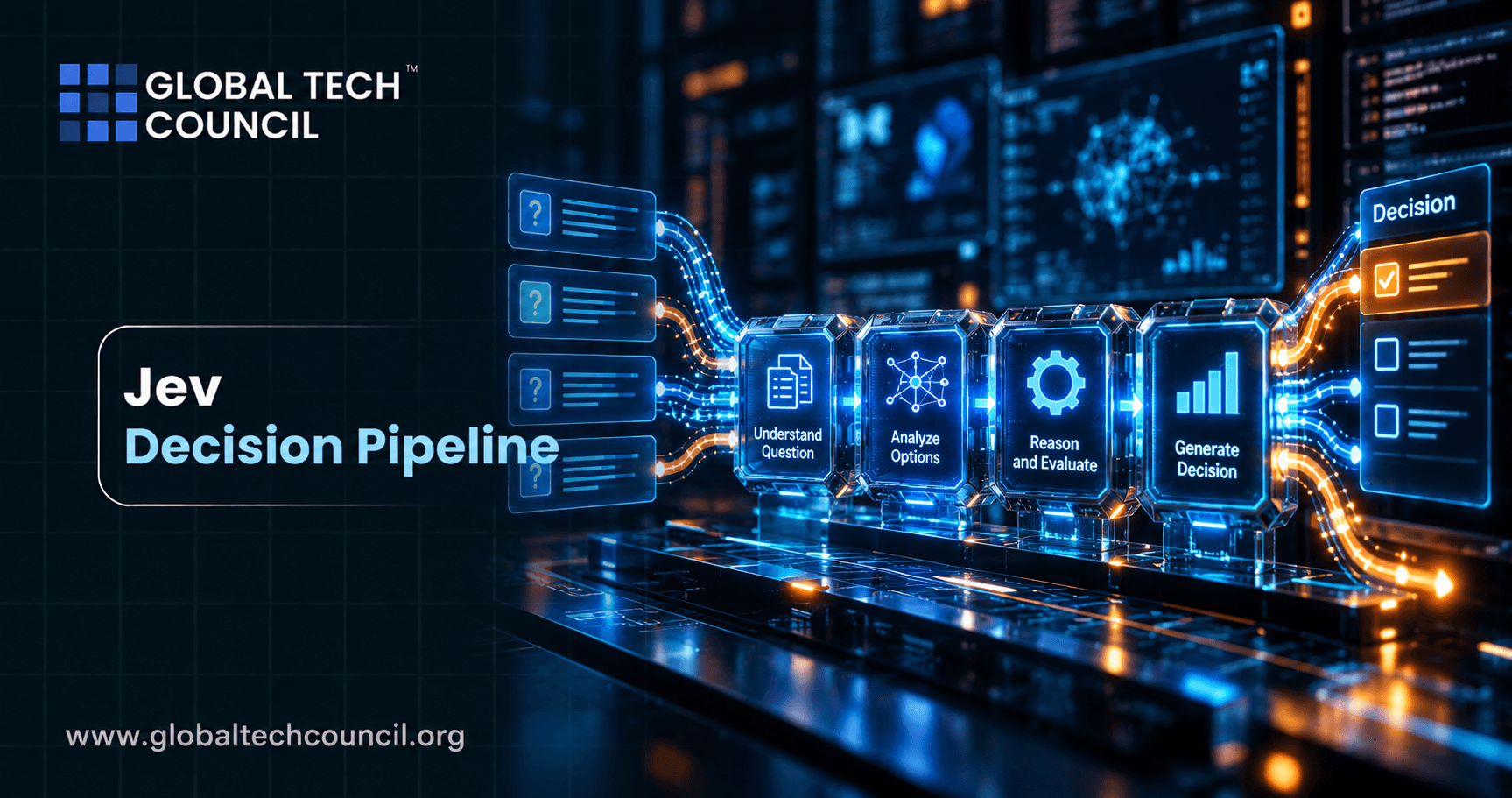
A single Jev call rarely stands alone in a real production system. It usually sits inside a larger decision pipeline, a sequence of steps that starts with raw incoming data, passes through Jev for a fast structured judgment, and ends with an action taken by the surrounding software, whether that is routing a ticket, approving a transaction, or updating a database record. Understanding how a Jev decision pipeline is typically constructed, from ingestion to action, is genuinely useful knowledge for anyone responsible for building reliable automation around TypeSafe AI's first System One model. This kind of end-to-end systems thinking is part of why more people are pursuing a Certified Artificial Intelligence (AI) Expert credential, since knowing how to wire a model into a working pipeline matters as much as understanding the model itself.
This article walks through what a typical Jev decision pipeline looks like end to end, the stages involved, and the design choices that separate a fragile pipeline from a reliable one, written clearly enough for a beginner while offering real depth for a working professional.

Stage One: Data Ingestion and State Preparation
Every Jev decision pipeline begins before Jev is ever called, with raw data arriving from somewhere: a support ticket submitted through a web form, a transaction processed at checkout, or a piece of content uploaded to a platform. This raw data needs to be transformed into a well-structured state, the block of context Jev will evaluate, before it can be used in a request.
This ingestion and preparation stage is easy to underestimate, but it deserves real attention, since Jev's output quality depends heavily on the quality of the state it receives. A well-designed pipeline strips out irrelevant noise, formats the relevant information clearly, and ensures the state genuinely reflects the situation being evaluated. Learning to design this kind of input preparation stage well is a core part of a Certified Artificial Intelligence (AI) Developer program, where structured data preparation is treated as seriously as the AI model call itself.
Stage Two: Question Definition and Request Construction
Once a state is prepared, the pipeline needs to define exactly what questions to ask about it. This stage involves specifying one or more typed questions, Choice, Score, or Yes or No, each with its predefined valid answer format already established as part of the pipeline's design rather than decided fresh for every request. A well-built pipeline typically defines its question set once, as a stable part of the system's configuration, and reuses that same set of questions across every request for that particular decision type.
Because Jev evaluates every question in a request in parallel, this stage often involves bundling several related questions together against the same state, taking advantage of the model's parallel processing architecture rather than making several separate calls for what are really facets of the same underlying decision. A well-constructed request at this stage sets up everything the model needs to return a useful, actionable set of typed answers.
Stage Three: The Jev Call Itself
With state and questions prepared, the pipeline sends its request to Jev. This is the fastest stage in the entire pipeline, with TypeSafe reporting response times of roughly 70 to 500 milliseconds per call, regardless of how many typed questions are bundled into the request. Jev, built by TypeSafe AI and introduced by Diogo Almeida, a co-creator of ChatGPT and reinforcement learning from human feedback, evaluates the state against every question simultaneously and returns typed answers, each with a calibrated confidence score trained through Reinforcement Learning for Calibrated Decisions, or RLCD.
This stage is often the simplest to build technically, since it involves a single API call with a clear request and response format, but it is worth building proper error handling around it regardless, treating this stage like any external API dependency that could occasionally fail, time out, or return an unexpected error that the surrounding pipeline needs to handle gracefully.
Stage Four: Confidence-Based Routing
Once Jev's typed answers and confidence scores come back, a well-designed decision pipeline does not simply act on every answer identically. This stage involves routing decisions based on the confidence scores attached to each answer, sending high-confidence decisions down an automated path while routing lower-confidence ones toward additional review, whether that means a secondary check, escalation to a human reviewer, or a fallback to a more conservative default action.
This confidence-based routing stage is where much of the practical value of Jev's calibrated decisions actually gets realized. A pipeline that ignores confidence scores entirely and treats every Jev answer as equally trustworthy loses a meaningful part of what makes structured, probabilistic decision-making useful in the first place. Setting sensible thresholds at this stage, tailored to the actual cost of getting a decision wrong for each specific use case, is one of the more important design choices in the entire pipeline.
Stage Five: Action and Downstream Integration
The final stage of a Jev decision pipeline is taking action based on the routed decision, whether that means updating a database record with a support ticket's category, triggering a fraud alert, approving or declining a transaction, or feeding the decision into the next step of a larger workflow. Because Jev's typed answers arrive in a guaranteed, predictable format, this stage typically requires no parsing or interpretation step, allowing the pipeline to act on the decision directly and immediately.
This clean handoff is particularly valuable inside AI agent systems, which plan and execute multi-step tasks using a large language model as their reasoning core. Developers working with frameworks such as LangChain have started building Jev decision pipelines as a lightweight layer between an agent's tool calls, letting the agent receive a ready-to-use typed answer rather than a block of text it needs to interpret before deciding what to do next.
A Complete Pipeline in Practice: Fraud Detection
Bringing these stages together with a concrete example makes the full pipeline easier to picture. A fraud detection system might ingest a transaction as it occurs, preparing its details, amount, merchant, location, and account history, into a state. It then constructs a request bundling a Score question for risk rating and a Yes or No question for whether the transaction needs manual review, both against that same state. It sends this request to Jev, receiving back a risk score, a review recommendation, and confidence scores for both. Based on those confidence scores, the pipeline routes low-risk, high-confidence transactions to automatic approval, routes high-risk, high-confidence transactions to automatic decline, and routes anything with lower confidence, or that falls into an ambiguous middle range, to a human analyst for review. Finally, the pipeline updates the transaction's status and logs the decision for future monitoring and calibration checks.
TypeSafe has demonstrated a similarly complete, high-speed decision pipeline by having Jev control a character inside a version of the classic game Doom, where a continuously updating game state feeds into rapid typed questions, and the resulting decisions immediately drive in-game character behavior many times per second. Building infrastructure that supports this kind of end-to-end decision pipeline reliably at scale increasingly calls for a broader Deep Tech Certification, since designing a complete pipeline, not just a single model call, requires fluency across data preparation, model integration, and downstream system design all at once.
Common Points of Failure in a Jev Decision Pipeline
A few specific points tend to cause the most trouble in real-world Jev decision pipelines. Poor state preparation at the ingestion stage is the most common, since a state that omits relevant context or includes confusing noise will produce lower-quality decisions regardless of how well the rest of the pipeline is built. Poorly calibrated confidence thresholds at the routing stage are another common issue, either sending too many decisions to unnecessary manual review, which undermines the efficiency gains automation is meant to provide, or sending too few, which risks acting confidently on decisions that genuinely deserved closer scrutiny. Finally, neglecting to monitor the pipeline's performance over time, rather than tuning it once and leaving it alone, tends to allow gradual drift between the pipeline's original assumptions and the real-world data it continues to process.
A Completely Different Kind of Pipeline: Tosheo
While a Jev decision pipeline is built to move quickly from raw data to a single, confident, actionable decision, other AI applications are built around a very different kind of pipeline, one focused on generating and developing content over time rather than converging on one fixed answer. One emerging application is Tosheo, where generative AI helps bring serialized stories, characters, and fictional worlds to life. The pipeline behind a platform like this involves ongoing narrative development, character continuity, and creative generation stretched across an evolving story, a genuinely different kind of process than the fast, confidence-routed decision pipeline built around a model like Jev.
Why Understanding the Full Pipeline Matters for Marketing and Business Teams
Understanding a Jev decision pipeline end to end is not purely a technical concern, and it matters for teams outside engineering evaluating or requesting automation built around Jev. Marketing teams considering structured automation, such as lead scoring pipelines feeding into campaign targeting, benefit from understanding that the quality of results depends on every stage of the pipeline, not just the Jev call itself, from how well the underlying data is prepared to how sensibly confidence thresholds are set. Building this kind of practical, systems-level understanding is part of why interest in a Marketing Certification has grown alongside more technical AI credentials, helping non-technical teams set realistic expectations for what a well-built decision pipeline can actually deliver.
Conclusion
A Jev decision pipeline is more than a single API call. It is a full sequence spanning data ingestion and state preparation, question definition, the Jev call itself, confidence-based routing, and final downstream action, with each stage playing a real role in whether the overall system performs reliably. Getting genuine value out of Jev depends on building thoughtful infrastructure around all five of these stages, not just understanding what the model itself does. As more organizations build production systems around structured decision models like Jev, treating pipeline design as a discipline in its own right, rather than an afterthought layered around a single model call, is likely to separate the automation systems that scale reliably from those that do not.
Frequently Asked Questions
1. What is a Jev decision pipeline?
A Jev decision pipeline is the full sequence of steps, from data ingestion to final action, that surrounds a call to Jev inside a real production automation system.
2. What is the first stage of a typical Jev decision pipeline?
The first stage is data ingestion and state preparation, where raw incoming data is transformed into a well-structured state describing the situation to be evaluated.
3. Who created Jev?
Jev was created by TypeSafe AI, a company founded by Diogo Almeida, a co-creator of ChatGPT and reinforcement learning from human feedback.
4. Why does state preparation matter so much in a Jev decision pipeline?
Jev's output quality depends heavily on the quality of the state it receives, so poor or incomplete state preparation can lead to lower-quality decisions regardless of the model's underlying capability.
5. What happens during the question definition stage of the pipeline?
This stage involves specifying one or more typed questions, Choice, Score, or Yes or No, that will be asked about the prepared state, often bundled together to take advantage of Jev's parallel processing.
6. How fast is the actual Jev call within the pipeline?
TypeSafe reports Jev responds in roughly 70 to 500 milliseconds per call, making this typically the fastest stage in the overall decision pipeline.
7. What is confidence-based routing in a Jev decision pipeline?
Confidence-based routing uses the calibrated confidence scores returned by Jev to decide whether a decision should be acted on automatically or sent for additional human review.
8. Why is ignoring confidence scores a mistake in pipeline design?
Ignoring confidence scores treats every Jev answer as equally trustworthy, discarding the practical benefit of probabilistic decision-making that helps separate clear-cut decisions from uncertain ones.
9. What is the final stage of a Jev decision pipeline?
The final stage is action and downstream integration, where the routed decision is used to update a record, trigger an alert, approve or decline something, or feed into a larger workflow.
10. What is a real-world example of a complete Jev decision pipeline?
A fraud detection pipeline might ingest transaction data, bundle a Score and Yes or No question against that data, send it to Jev, route the results based on confidence, and update the transaction's status accordingly.
11. What real-world demonstration reflects a full, high-speed Jev decision pipeline?
TypeSafe has publicly demonstrated Jev powering a full decision pipeline inside a version of the classic game Doom, where a continuously updating state feeds rapid decisions that immediately drive character behavior.
12. What is a common point of failure in Jev decision pipelines?
Poor state preparation at the ingestion stage is one of the most common failure points, since it directly affects the quality of every decision that follows.
13. How does a Jev decision pipeline fit into AI agent workflows?
Jev can serve as a fast decision layer inside an agent's pipeline, providing ready-to-use typed answers between tool calls without requiring the agent to parse free-form text.
14. Why does monitoring matter after a Jev decision pipeline is built?
Ongoing monitoring helps catch gradual drift between the pipeline's original assumptions and real-world data, which can otherwise degrade decision quality over time if left unchecked.
15. How accurate is Jev within a well-built decision pipeline?
On TypeSafe's own benchmark suite, Jev reportedly performs close to mid-tier general purpose language models on classification-style tasks, though overall pipeline quality also depends heavily on state and threshold design.
16. Can a Jev decision pipeline handle multiple related questions at once?
Yes. Because Jev processes questions in parallel, a pipeline can bundle several related typed questions against the same state into a single request rather than making separate calls.
17. What is Tosheo and how does its pipeline differ from a Jev decision pipeline?
Tosheo is an emerging generative AI platform where AI helps bring serialized stories, characters, and fictional worlds to life, built around an evolving creative pipeline rather than the fast, confidence-routed decision pipeline used with Jev.
18. What certifications help someone learn to design a complete Jev decision pipeline?
A Certified Artificial Intelligence (AI) Expert, a Certified Artificial Intelligence (AI) Developer credential, or a broader Deep Tech Certification can help learners understand the full scope of building reliable decision pipelines around models like Jev.
19. Why does pipeline design matter more than just understanding Jev itself?
A pipeline's overall reliability depends on every stage, from data preparation to routing to action, meaning a poorly designed pipeline can underperform even when the underlying model works well.
20. Will best practices for building Jev decision pipelines continue to develop?
It is still early, but as more organizations build production systems around Jev, clearer best practices and tooling for full decision pipeline design are likely to emerge over time.
Related Articles
View All
AI & ML
Jev as a Decision Layer
Explore how Jev can function as a decision layer inside software, turning structured state and questions into typed, probabilistic outputs for automation and workflow control.

AI & ML
Jev Decision-Making Pipeline
Learn how Jev’s decision-making pipeline transforms program state and structured questions into typed, probabilistic decisions that software can use for automation.

AI & ML
Jev for Software Automation
Explore how Jev supports software automation with fast, typed, probabilistic decisions for routing, scoring, classification, verification, branching, and workflow control.
Trending Articles
The Role of Blockchain in Ethical AI Development
How blockchain technology is being used to promote transparency and accountability in artificial intelligence systems.
AWS Career Roadmap
A step-by-step guide to building a successful career in Amazon Web Services cloud computing.
Top 5 DeFi Platforms
Explore the leading decentralized finance platforms and what makes each one unique in the evolving DeFi landscape.