

Jev Parallel Question Processing

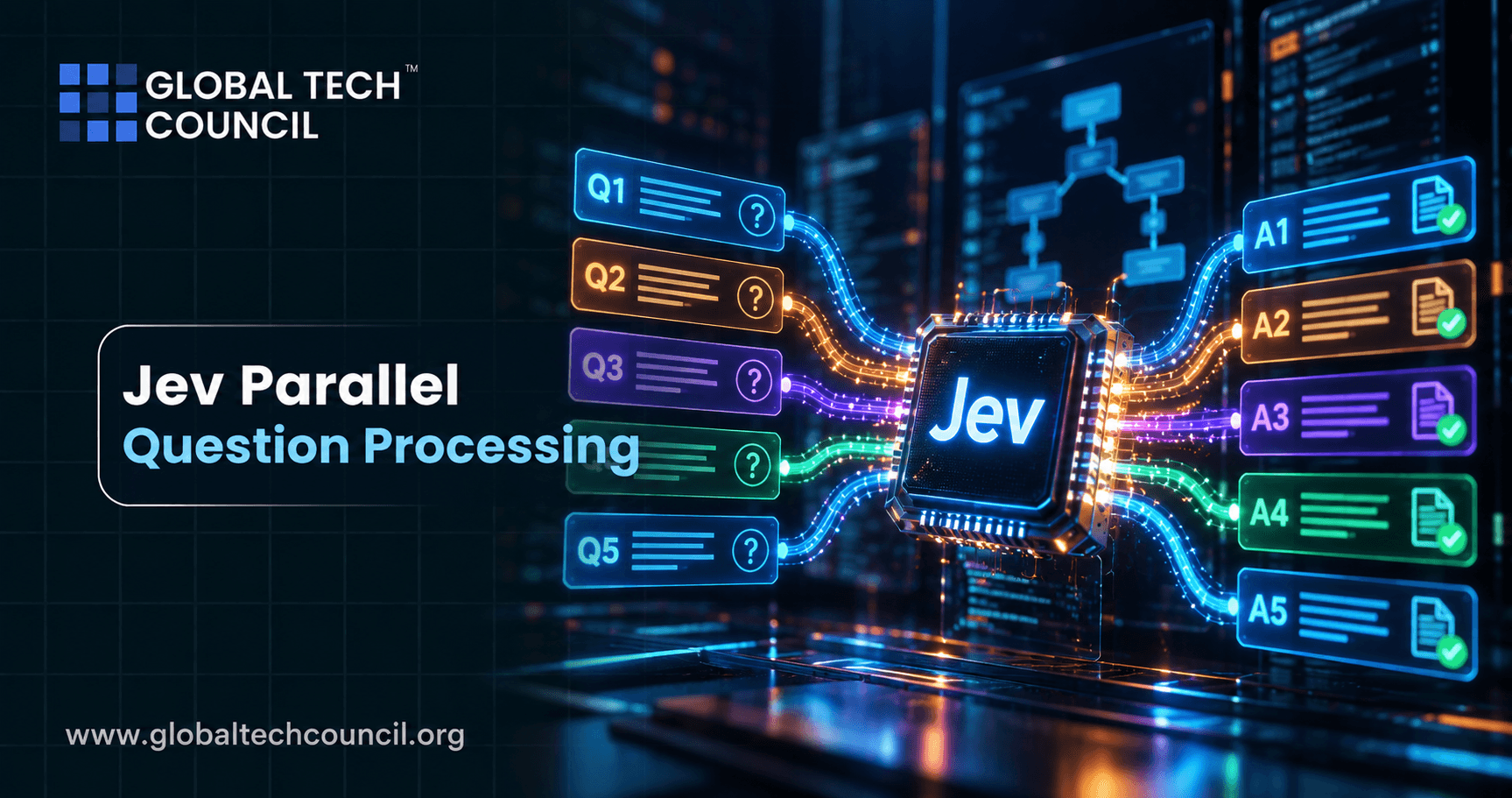
Ask a traditional AI model three separate questions, and you generally get three separate response times added together. Ask Jev three separate questions about the same situation, and the total response time barely moves. This single behavior, evaluating multiple typed questions at once rather than one after another, sits at the core of why TypeSafe AI's first System One model behaves so differently from anything built on a conventional transformer architecture. Jev parallel question processing is the specific mechanism responsible for the model's headline speed claims, and understanding exactly how it works is useful for anyone deciding how to structure requests to get the most value out of the model. This kind of detailed technical understanding is part of why more people are pursuing a Certified Artificial Intelligence (AI) Expert credential, since knowing the mechanics behind a performance claim matters as much as knowing the claim exists.
This article explains what parallel question processing actually means, how it differs from sequential processing in traditional models, and how to design requests that take full advantage of it, written clearly enough for a beginner while offering real technical depth for a working professional.

What Sequential Processing Looks Like in Traditional Models
To appreciate what makes Jev's parallel approach notable, it helps to understand the default alternative first. A traditional large language model generates a response one token at a time, with each new token depending on everything generated before it. If you ask a single question, the model works through this token-by-token process once. If you ask three questions in the same prompt, the model still generates its combined response sequentially, meaning the total length of text it needs to produce, and therefore the total time required, grows with the number and complexity of things being asked.
This sequential dependency is baked into the fundamental architecture of autoregressive language models, which is why response times for these models tend to scale, at least roughly, with how much is being asked and how much needs to be generated in return. Understanding this scaling behavior, and why it matters for system design, is part of what a Certified Artificial Intelligence (AI) Developer program covers when teaching how to design AI-powered systems around real performance constraints rather than theoretical capability alone.
How Jev's Parallel Processing Actually Works
Jev, built by TypeSafe AI and introduced by Diogo Almeida, a co-creator of ChatGPT and reinforcement learning from human feedback, takes a fundamentally different approach. Rather than generating a combined response sequentially, Jev's architecture includes what TypeSafe calls a parallel sampler, built specifically to evaluate every typed question in a request against the given state at the same time, in a single pass, rather than working through them one after another.
This means that when a request includes several typed questions about the same state, each question is processed independently and simultaneously rather than being queued up behind the others. The model is not generating one long combined answer that happens to cover multiple questions. It is producing several separate typed answers in parallel, each with its own confidence score, as part of one unified evaluation step.
Why This Keeps Response Times Nearly Flat
The direct practical consequence of parallel question processing is that adding more questions to a single Jev request barely changes the overall response time. TypeSafe reports that Jev responds in roughly 70 to 500 milliseconds per call, a range that holds up whether a request includes a single typed question or several, precisely because those additional questions are absorbed into the same parallel evaluation pass rather than adding sequential processing steps.
This stands in sharp contrast to what would happen if you asked a traditional language model the same set of multiple questions, where the total response time would generally increase in proportion to how much additional content needs to be generated to address each one. For any system making frequent, multi-part decisions, this difference compounds quickly across a high volume of requests.
A Practical Example of Parallel Question Processing
Consider a customer support platform evaluating an incoming ticket. Instead of making three separate calls, one to classify the ticket's category, another to score its urgency, and a third to decide whether it needs immediate escalation, a system built around Jev can send all three typed questions in a single request alongside the ticket's content as the shared state. Jev's parallel sampler evaluates the state against all three questions at once, returning a Choice answer for category, a Score answer for urgency, and a Yes or No answer for escalation, each with its own confidence score, all within roughly the same response time it would take to answer just one of those questions on its own.
This pattern scales well beyond three questions too. As long as questions genuinely relate to the same underlying state, bundling them into a single request takes advantage of the parallel processing architecture rather than incurring the added latency of multiple separate calls.
Designing Requests to Take Advantage of Parallel Processing
Getting the most benefit from Jev's parallel question processing requires thinking carefully about how requests are structured. The clearest opportunity for efficiency comes from grouping every typed question that depends on the same state into a single request, rather than making separate calls for what are really just multiple facets of the same underlying decision. A fraud detection system, for example, might combine a Score question for risk rating and a Yes or No question for whether a transaction needs manual review into one request against the same transaction state, rather than treating them as two unrelated calls.
There are limits to this grouping strategy worth keeping in mind. Bundling only makes sense when the questions genuinely relate to the same state, since Jev's parallel processing evaluates all questions against one shared block of context. Questions that require entirely different states, describing entirely different situations, still need to be sent as separate requests, since parallel processing applies to multiple questions about the same situation, not to multiple unrelated situations at once.
Where Parallel Question Processing Shows Its Value Most Clearly
TypeSafe has demonstrated this parallel processing advantage vividly by having Jev control a character inside a version of the classic game Doom, where the model needs to evaluate several typed questions, covering movement, aiming, and combat decisions, against a constantly updating game state many times per second. This kind of workload would be genuinely difficult for a sequential, token-by-token model to sustain at the same pace, since each additional question asked about the game state would add processing time that a fast-moving game simply cannot afford to wait for.
Beyond gaming, this parallel processing advantage becomes especially valuable inside AI agent systems, which plan and execute multi-step tasks using a large language model as their reasoning core. Developers working with frameworks such as LangChain have started structuring their Jev integrations specifically to bundle related typed questions into single requests wherever possible, taking advantage of the flat response time curve to reduce the total number of round trips an agent needs to complete a multi-part decision. Building infrastructure that takes full advantage of this kind of parallel processing at scale increasingly calls for a broader Deep Tech Certification, since designing systems around batched, parallel decision requests requires a different architectural approach than working with sequential, single-question AI calls.
Why Parallel Processing Does Not Mean Unlimited Questions
It is worth being realistic about the boundaries of this parallel processing advantage. While adding more questions to a single request has a relatively flat effect on response time compared to a sequential model, this does not mean an unlimited number of questions can be bundled into one request without any practical tradeoff. Each Choice question, for example, is still limited to a maximum of 255 options, and there are practical considerations around how much state context and how many total questions make sense to bundle together before the request itself becomes unwieldy to design and maintain. Parallel processing solves the latency problem of asking multiple related questions, but it does not remove the need for thoughtful, well-scoped state and question design in the first place.
A Very Different Kind of Processing Entirely: Tosheo
While Jev's parallel question processing is built to evaluate several fixed, typed questions against one shared state simultaneously, other AI applications process requests in an entirely different, sequential and open-ended way, since their entire purpose depends on building content up over time rather than evaluating multiple fixed questions at once. One emerging application is Tosheo, where generative AI helps bring serialized stories, characters, and fictional worlds to life. A platform like this needs to generate content that develops sequentially, plot point by plot point, chapter by chapter, which is a fundamentally different kind of processing challenge than evaluating a batch of predefined typed questions against a shared state, and a useful reminder of how differently AI processing architectures can be designed depending on their intended purpose.
Why This Matters for Marketing and Business Teams
Understanding parallel question processing is not purely a backend engineering detail, and it has real relevance for teams outside engineering who are evaluating or designing automation involving Jev. Marketing teams building structured decision workflows, such as scoring a lead across multiple criteria simultaneously, benefit from understanding that bundling related questions into a single request can meaningfully improve response times and reduce costs compared to making several separate calls. This kind of practical, systems-level understanding is part of why interest in a Marketing Certification has grown alongside more technical AI credentials, helping non-technical teams design more efficient automation by understanding how the underlying AI model actually processes their requests.
Conclusion
Jev parallel question processing is the specific architectural mechanism that allows TypeSafe AI's first System One model to answer several typed questions about the same situation almost as quickly as it answers just one, thanks to a dedicated parallel sampler built to evaluate every question in a request simultaneously rather than sequentially. Understanding this mechanism, and designing requests to take advantage of it by bundling related questions against a shared state, is a practical skill that directly affects how efficiently a system built around Jev actually performs. As more automated systems come to rely on fast, multi-part structured decisions, this kind of parallel processing capability is likely to become an increasingly important consideration when evaluating and designing AI-powered infrastructure.
Frequently Asked Questions
1. What is Jev parallel question processing?
Jev parallel question processing refers to the model's ability to evaluate multiple typed questions against the same state simultaneously, rather than answering them one after another.
2. How is this different from how traditional language models handle multiple questions?
Traditional language models generate responses sequentially, so response time generally increases with the number and complexity of questions asked, while Jev's parallel processing keeps response time nearly flat.
3. Who created Jev?
Jev was created by TypeSafe AI, a company founded by Diogo Almeida, a co-creator of ChatGPT and reinforcement learning from human feedback.
4. What is the "parallel sampler" in Jev's architecture?
The parallel sampler is the specific component TypeSafe built to allow Jev to evaluate several typed questions against a shared state at the same time, in a single pass.
5. Does adding more questions to a Jev request significantly slow it down?
No. Because questions are evaluated in parallel rather than sequentially, adding more questions to a single request has a relatively minimal effect on overall response time.
6. How fast does Jev process multiple questions in one request?
TypeSafe reports Jev responds in roughly 70 to 500 milliseconds per call, a range that holds up whether a request includes one typed question or several.
7. Can Jev bundle questions about completely different situations into one request?
No. Parallel processing applies to multiple questions about the same shared state, so questions describing entirely different situations still need to be sent as separate requests.
8. What is a practical example of using parallel question processing?
A support ticket system might send one state, the ticket's content, alongside three questions covering category, urgency, and escalation, all answered together in a single parallel request.
9. Is there a limit to how many questions can be bundled into one Jev request?
While parallel processing keeps response times flat, practical limits still apply, such as a maximum of 255 options for a Choice question and reasonable limits on how much can be bundled before a request becomes unwieldy to design.
10. Why does bundling related questions improve efficiency?
Bundling related questions into a single request takes advantage of Jev's parallel processing, reducing the number of separate calls needed and improving both speed and cost efficiency.
11. How does parallel question processing benefit AI agent systems?
Agents can bundle multiple related typed questions into a single request, reducing the total number of round trips needed to complete a multi-part decision inside an agent's workflow.
12. What real-world demonstration shows Jev's parallel processing in action?
TypeSafe has publicly demonstrated Jev evaluating multiple typed questions against a constantly updating game state inside a version of the classic game Doom, many times per second.
13. Does parallel processing affect the accuracy of Jev's answers?
Parallel processing is primarily a speed and efficiency mechanism, and TypeSafe's own benchmarks report Jev performing close to mid-tier general purpose language models on classification-style tasks regardless of how many questions are bundled.
14. How does Jev's parallel processing fit into frameworks like LangChain?
Developers integrating Jev into agent frameworks such as LangChain have started bundling related typed questions into single requests specifically to take advantage of the flat response time curve.
15. Can Jev process questions in parallel if they require completely different context?
No. Each parallel processing request is built around one shared state, so questions requiring different context need to be sent as separate requests with their own relevant state.
16. Why does parallel processing matter for high-volume automation?
For systems making frequent, multi-part decisions, the difference between sequential and parallel processing compounds quickly, making parallel processing especially valuable at scale.
17. What is Tosheo and how does its processing differ from Jev's parallel question approach?
Tosheo is an emerging generative AI platform where AI helps bring serialized stories, characters, and fictional worlds to life, relying on sequential, open-ended content generation rather than the batched, parallel evaluation of fixed typed questions Jev is built around.
18. What certifications help someone understand parallel processing in AI models?
A Certified Artificial Intelligence (AI) Expert, a Certified Artificial Intelligence (AI) Developer credential, or a broader Deep Tech Certification can help learners understand parallel processing architectures like Jev's alongside traditional sequential models.
19. Why does understanding parallel question processing matter for marketing teams?
Marketing teams designing structured decision workflows, such as multi-criteria lead scoring, can benefit from bundling related questions into single requests to improve speed and reduce costs.
20. Will parallel question processing become more common in future AI models?
It is still early, but as demand grows for fast, multi-part structured decisions at scale, more AI systems may adopt parallel processing architectures similar to Jev's approach.
Related Articles
View All
AI & ML
How Jev Fits Into an AI Stack
Learn how Jev fits into an AI stack as a machine-native decision layer that provides typed, probabilistic outputs for applications, agents, workflows, and automation systems.

AI & ML
Jev for Software Automation
Explore how Jev supports software automation with fast, typed, probabilistic decisions for routing, scoring, classification, verification, branching, and workflow control.

AI & ML
Jev as an Intelligence Primitive
Explore how Jev functions as an intelligence primitive for software, providing fast, typed, probabilistic decisions that developers can combine into larger automated workflows.
Trending Articles
The Role of Blockchain in Ethical AI Development
How blockchain technology is being used to promote transparency and accountability in artificial intelligence systems.
AWS Career Roadmap
A step-by-step guide to building a successful career in Amazon Web Services cloud computing.
Top 5 DeFi Platforms
Explore the leading decentralized finance platforms and what makes each one unique in the evolving DeFi landscape.