

Prompt vs Loop vs Context Engineering
 Suyash Raizada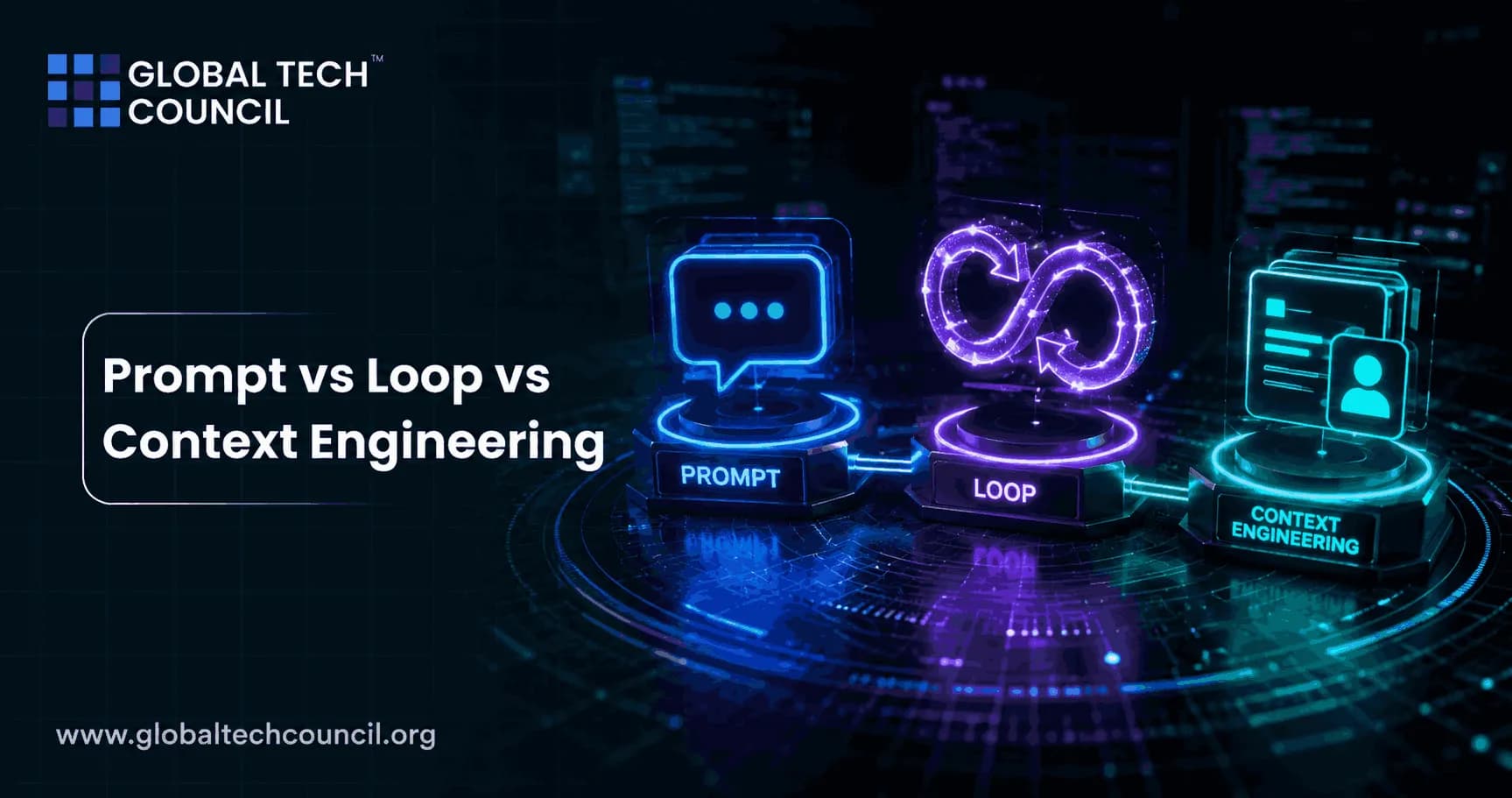
Artificial Intelligence has evolved far beyond asking a chatbot a simple question and receiving a response. Today's AI systems are capable of planning projects, writing code, analyzing documents, managing workflows, and even collaborating with other AI agents.
This evolution has introduced three important concepts that are shaping how modern AI applications are built:

Prompt Engineering
Loop Engineering
Context Engineering
Although these concepts are often mentioned together, they solve different problems. Understanding the difference between Prompt vs Loop vs Context Engineering is becoming essential for developers, AI professionals, business leaders, and anyone building intelligent AI-powered applications.
In this guide, we'll explore how each approach works, when to use it, and why they represent the next phase of AI development.
What is Prompt Engineering?
Prompt Engineering is the practice of designing clear and effective instructions that guide an AI model toward producing accurate, relevant, and high-quality outputs.
Rather than relying on technical programming, prompt engineering focuses on communicating with AI in a structured way.
A well-crafted prompt provides:
Clear objectives
Relevant context
Constraints
Output format
Examples when necessary
For example, instead of asking:
"Write about cybersecurity."
An optimized prompt would be:
"Write a 1,000-word beginner-friendly article explaining cybersecurity threats for small businesses. Include examples, preventive measures, FAQs, and a conclusion."
The second prompt produces significantly better results because it reduces ambiguity.
Why Prompt Engineering Matters
As organizations increasingly adopt AI, the ability to communicate effectively with language models becomes a valuable professional skill.
From content creation and software development to customer support and marketing, prompt engineering improves productivity while reducing repetitive revisions.
Professionals interested in mastering advanced prompting techniques can strengthen their expertise through the Prompt Engineer Certification offered by Global Tech Council.
Learning prompt engineering is no longer just about asking better questions-it's about designing reliable AI workflows.
What is Loop Engineering?
Prompt Engineering focuses on giving instructions once.
Loop Engineering focuses on creating continuous reasoning cycles.
Instead of generating one answer and stopping, an AI repeatedly evaluates, improves, verifies, and refines its own outputs until it reaches a better solution.
Think of Loop Engineering as giving AI the ability to think through multiple iterations before producing a final response.
This approach enables AI systems to:
Self-review responses
Detect mistakes
Refine code
Improve reasoning
Break down complex tasks
Execute multi-step workflows
Loop Engineering has become increasingly important for autonomous AI agents capable of planning projects, writing software, conducting research, and automating enterprise tasks.
Claude and Loop-Based AI
Modern AI models such as Claude have demonstrated impressive capabilities in long-form reasoning and iterative problem-solving.
Instead of relying on a single prompt, they can analyze previous responses, identify missing information, and continuously improve outputs.
Professionals interested in understanding advanced Claude workflows and iterative AI systems can explore the Claude AI Expert certification:
As AI agents become more autonomous, Loop Engineering will play an increasingly important role in enterprise automation.
What is Context Engineering?
Large Language Models perform best when they understand the complete situation surrounding a task.
This is where Context Engineering becomes essential.
Context Engineering is the process of providing AI systems with the right information, memory, documents, previous conversations, tools, and business rules before they generate a response.
Rather than improving the wording of prompts, Context Engineering improves the quality of information available to the model.
Examples include:
Company documentation
Customer history
Internal databases
Previous conversations
APIs
Knowledge bases
Business policies
The better the context, the better the AI's reasoning.
Context Engineering is becoming one of the most valuable skills for building enterprise AI systems because it reduces hallucinations while improving personalization and accuracy.
Professionals looking to specialize in this growing field can develop practical expertise through the AI Context Engineer certification.
Prompt vs Loop vs Context Engineering: Key Differences
Feature | Prompt Engineering | Loop Engineering | Context Engineering |
Primary Focus | Writing effective instructions | Iterative reasoning and refinement | Supplying relevant information |
Goal | Better responses | Better decision-making | Better understanding |
Interaction | Single request | Multiple reasoning cycles | Continuous contextual awareness |
Best Use Cases | Content creation, coding, summarization | AI agents, automation, research | Enterprise AI, copilots, customer support |
Complexity | Beginner-friendly | Intermediate to Advanced | Advanced |
Rather than replacing one another, these approaches work together.
A powerful AI application often combines all three.
Why Businesses Need All Three
Organizations implementing AI rarely succeed by relying on prompts alone.
Enterprise AI requires:
Effective prompts
Intelligent reasoning loops
Rich contextual knowledge
For example, an AI customer support assistant might use:
Prompt Engineering to structure responses.
Loop Engineering to verify accuracy before replying.
Context Engineering to access customer history and company policies.
Together, these capabilities create AI systems that are more reliable, personalized, and efficient.
The Future of AI Engineering
As AI evolves from chatbots into intelligent digital collaborators, Prompt Engineering alone will no longer be enough.
Businesses are increasingly building AI systems capable of reasoning, planning, retrieving information, and adapting to changing environments.
This shift is driving demand for professionals who understand Prompt Engineering, Loop Engineering, and Context Engineering as complementary disciplines rather than competing concepts.
Continuous learning is becoming essential for anyone pursuing a career in AI.
Professionals seeking broader Tech Certification opportunities across Artificial Intelligence, Data Science, Cybersecurity, Cloud Computing, and emerging technologies can explore: Global Tech Council.
Likewise, professionals interested in combining AI with business growth, digital strategy, and customer engagement can expand their expertise through Marketing Certification programs offered by Universal Business Council.
Conclusion
The debate around Prompt vs Loop vs Context Engineering isn't about choosing one over another.
Each addresses a different layer of modern AI development.
Prompt Engineering teaches AI what to do.
Loop Engineering teaches AI how to think through complex tasks.
Context Engineering gives AI the information it needs to make better decisions.
Together, they form the foundation of next-generation AI systems.
As organizations continue investing in intelligent automation and agentic AI, professionals who understand all three approaches will be better positioned to design, deploy, and manage the AI solutions of tomorrow.
Frequently Asked Questions (FAQs)
1. What is the difference between Prompt, Loop, and Context Engineering?
Prompt Engineering focuses on creating effective instructions for AI models. Loop Engineering enables AI to iteratively refine and improve its responses through multiple reasoning cycles. Context Engineering ensures AI has access to the right information, memory, and external knowledge to produce accurate and relevant outputs. Together, they form the foundation of modern AI systems.
2. Why is Prompt Engineering important?
Prompt Engineering helps users communicate effectively with AI models. Well-structured prompts improve response quality, reduce ambiguity, and increase productivity across content creation, software development, customer support, research, and business automation.
3. What is Loop Engineering in AI?
Loop Engineering is the practice of designing AI workflows where models repeatedly analyze, evaluate, and refine their outputs before delivering a final response. This approach is commonly used in autonomous AI agents and complex reasoning tasks.
4. What is Context Engineering?
Context Engineering is the process of supplying AI models with relevant information such as documents, previous conversations, databases, APIs, business rules, and organizational knowledge. Better context enables AI to generate more accurate, personalized, and reliable responses.
5. Which is more important: Prompt Engineering or Context Engineering?
Neither is universally more important. Prompt Engineering helps AI understand what to do, while Context Engineering provides the information needed to complete the task effectively. The best AI applications combine both approaches.
6. Can Prompt Engineering work without Context Engineering?
Yes, but its effectiveness may be limited. Even well-written prompts can produce incomplete or inaccurate responses if the AI lacks sufficient context or access to relevant information.
7. Where is Loop Engineering commonly used?
Loop Engineering is widely used in AI agents, software development assistants, autonomous research systems, workflow automation, code generation, planning systems, and enterprise AI applications requiring iterative reasoning.
8. Why is Context Engineering becoming increasingly important?
As organizations deploy AI in real-world environments, models must access business knowledge, customer information, and organizational data. Context Engineering improves accuracy, reduces hallucinations, and enables AI to deliver more relevant responses.
9. How does Prompt Engineering improve AI responses?
Prompt Engineering improves AI responses by providing clear instructions, defining objectives, specifying constraints, and including examples where necessary. This helps AI generate outputs that are more precise and aligned with user expectations.
10. Can these three engineering approaches work together?
Yes. Modern AI systems often combine Prompt Engineering, Loop Engineering, and Context Engineering. Prompts guide the AI, loops improve reasoning, and context provides the knowledge needed for informed decision-making.
11. Which industries benefit most from Prompt vs Loop vs Context Engineering?
Industries such as healthcare, finance, education, legal services, software development, cybersecurity, manufacturing, retail, and customer service increasingly use these AI engineering techniques to improve automation, productivity, and decision-making.
12. What skills are required to become a Prompt Engineer?
Prompt Engineers benefit from strong communication, logical thinking, problem-solving, AI model understanding, experimentation, and domain expertise. Familiarity with large language models and AI workflows is also valuable. Professionals can further develop these capabilities through the Prompt Engineer Certification.
13. How does Loop Engineering support AI agents?
Loop Engineering enables AI agents to break complex tasks into smaller steps, evaluate intermediate results, correct errors, and continuously improve outputs before reaching a final solution.
14. Is Context Engineering only useful for enterprise AI?
No. While enterprise AI relies heavily on Context Engineering, developers, researchers, educators, startups, and individual AI builders also use contextual data to improve AI performance and personalization.
15. How is Claude used in Loop Engineering?
Claude is recognized for handling extended reasoning and multi-step problem-solving, making it well suited for iterative AI workflows. Professionals interested in these techniques can expand their expertise through the Claude AI Expert certification.
16. What role does AI Context Engineering play in enterprise AI?
AI Context Engineering enables AI systems to retrieve relevant business information, connect with organizational knowledge bases, maintain conversation history, and deliver responses tailored to specific users and scenarios. Professionals can deepen their expertise through the AI Context Engineer certification.
17. What are the biggest challenges in Prompt vs Loop vs Context Engineering?
Common challenges include designing reliable prompts, managing context windows, integrating external knowledge sources, preventing hallucinations, optimizing reasoning loops, ensuring data security, and maintaining response consistency across different AI models.
18. What is the future of Prompt, Loop, and Context Engineering?
As AI systems become more autonomous and capable of handling complex workflows, Prompt Engineering, Loop Engineering, and Context Engineering will increasingly work together to power intelligent assistants, enterprise automation, AI agents, and decision-support systems.
19. Where can professionals learn AI engineering skills?
Professionals interested in Artificial Intelligence, Prompt Engineering, Cloud Computing, Data Science, Cybersecurity, and other emerging technologies can explore Tech Certification programs offered by Global Tech Council to build practical, industry-relevant skills.
20. Why should professionals learn Prompt vs Loop vs Context Engineering?
Understanding Prompt vs Loop vs Context Engineering helps professionals build more effective AI applications, improve business workflows, design intelligent automation systems, and stay competitive as AI continues to transform industries. These skills are becoming increasingly valuable for developers, AI engineers, business leaders, and technology professionals.
Related Articles
View All
AI & ML
What Is an RSI Loop in Artificial Intelligence?
Learn what an RSI loop is in artificial intelligence, how recursive self-improvement could operate through repeated cycles, and why the concept matters for AGI and AI safety.

AI & ML
OpenAI Dots vs Grok Bot vs Muse
Compare OpenAI Dots, Grok Bot, and Meta Muse to understand how these persistent AI agents differ in cloud computer use, connected apps, automation, memory, and long-running workflows.
AI & ML
What Is OpenAI Dots?
Learn what OpenAI Dots are, how these always-on AI agents work, and how they use GPT-6 Astra, cloud computers, connected apps, and persistent context to manage ongoing tasks.
Trending Articles
The Role of Blockchain in Ethical AI Development
How blockchain technology is being used to promote transparency and accountability in artificial intelligence systems.
AWS Career Roadmap
A step-by-step guide to building a successful career in Amazon Web Services cloud computing.
Top 5 DeFi Platforms
Explore the leading decentralized finance platforms and what makes each one unique in the evolving DeFi landscape.