

Types of Machine Learning
 Tosh Marketing

Machine learning (ML) is a field within artificial intelligence (AI). It focuses on training machines to enhance their abilities by processing the data they are provided. This allows them to predict or make decisions with minimal human help. Over time, ML has evolved and is now widely applied in sectors like healthcare, finance, and technology.

To get a clearer idea of its possibilities, it’s important to break down the key types of machine learning. There are four main types: supervised, unsupervised, semi-supervised, and reinforcement learning.
Supervised Learning
What Does It Mean
Supervised learning is a basic and widely used type of ML. It works with labeled data, meaning the system is given both input information and the related output. The model learns by studying this data to detect patterns, enabling it to make predictions on new, unseen inputs.
Example
A good example of this method is email spam detection. For example, a system can be trained using emails that are labeled either “spam” or “not spam.” By analyzing these labels, it learns the characteristics that help differentiate the two types. Once trained, it can then classify new emails correctly.
Common Uses
- Fraud detection: Checking transaction data to guess which activities might be fraudulent.
- Medical diagnosis: Predicting diseases by analyzing symptoms and medical history of patients.
Unsupervised Learning
What Does It Mean
Unsupervised learning is different in that it doesn’t use labeled data. The aim is to discover hidden patterns or relationships in the data. This method allows the system to explore the data on its own, without knowing what it’s supposed to find ahead of time.
Example
A popular example is customer segmentation. Companies use this approach to group their customers based on behavior, like purchase patterns, or based on demographics. The system identifies these groups without being told which people belong in which group from the start.
Common Uses
- Anomaly detection: This helps find unusual behavior in data, useful for spotting fraud or improving security.
- Recommendation systems: Users are grouped based on their preferences to provide them with tailored suggestions.
Semi-Supervised Learning
What Does It Mean
Semi-supervised learning merges elements from both supervised and unsupervised methods. It utilizes a small portion of labeled data along with a larger set of unlabeled data. This approach is helpful when labeling data takes a lot of time or is costly. The labeled data helps the system learn, and then it uses the larger unlabeled set to improve its accuracy.
Example
A real-world example is in speech recognition. The system might be trained on a small set of spoken words that have been transcribed. It can then use what it learned to analyze a much larger set of spoken words without transcriptions.
Common Uses
- Text classification: Sorting documents into categories such as “news” or “blog” when labeled data is limited.
- Fraud detection: Boosting fraud detection by improving models using limited known examples of fraud.
Reinforcement Learning
What Does It Mean
Reinforcement learning is inspired by behavioral psychology. In reinforcement learning, machines gain knowledge through interaction with their environment. They get feedback in the form of rewards or penalties based on their actions.The system’s aim is to learn a policy, or strategy, that will maximize the rewards it receives over time.
Example
A common use of reinforcement learning is in AI developed for playing games. For instance, AlphaGo, which became famous for beating the world champion at the game Go, learns by playing multiple games. It earns rewards for winning and receives penalties for losing, refining its approach over time.
Common Uses
- Robotics: Machines are trained to do tasks like moving objects from one location to another.
- Autonomous vehicles: Helping self-driving cars learn to manage traffic and avoid collisions.
Conclusion
Machine learning offers various techniques that enable systems to learn from data and improve gradually. By understanding the differences among supervised, unsupervised, semi-supervised, and reinforcement learning, you can see how each type is useful for specific tasks.
Supervised learning works best when there’s a lot of labeled data, while unsupervised learning is great for finding hidden patterns without labels. Semi-supervised learning connects the two methods by utilizing both labeled and unlabeled data. Meanwhile, reinforcement learning helps systems learn through feedback from their environment. All of these methods are now widely used across many industries, helping solve problems like spam filtering and autonomous driving.
Related Articles
View All
AI & ML
Generative AI vs. Traditional Machine Learning: Key Differences, Use Cases, and Career Paths
Learn the key differences between generative AI and traditional machine learning, including model goals, data needs, enterprise use cases, and career paths.

AI & ML
Machine Learning Security
Machine learning has quietly become the engine behind modern technology. It powers recommendation systems, fraud detection, medical diagnostics, and even the tools used to write code itself. Convenient, efficient, and occasionally a bit too trusting of whatever data you feed it. That trust is…
AI & ML
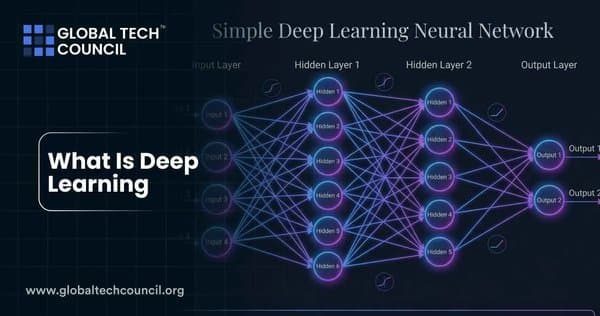
What is Deep Learning
Deep learning has become one of the most influential technologies in artificial intelligence. It supports virtual assistants, recommendation engines, medical image analysis, fraud detection, language models, content generation, and advanced automation systems. Although the term sounds highly…
Trending Articles
The Role of Blockchain in Ethical AI Development
How blockchain technology is being used to promote transparency and accountability in artificial intelligence systems.
AWS Career Roadmap
A step-by-step guide to building a successful career in Amazon Web Services cloud computing.
Top 5 DeFi Platforms
Explore the leading decentralized finance platforms and what makes each one unique in the evolving DeFi landscape.