

Artificial Intelligence in Food Technology
 Aman Singh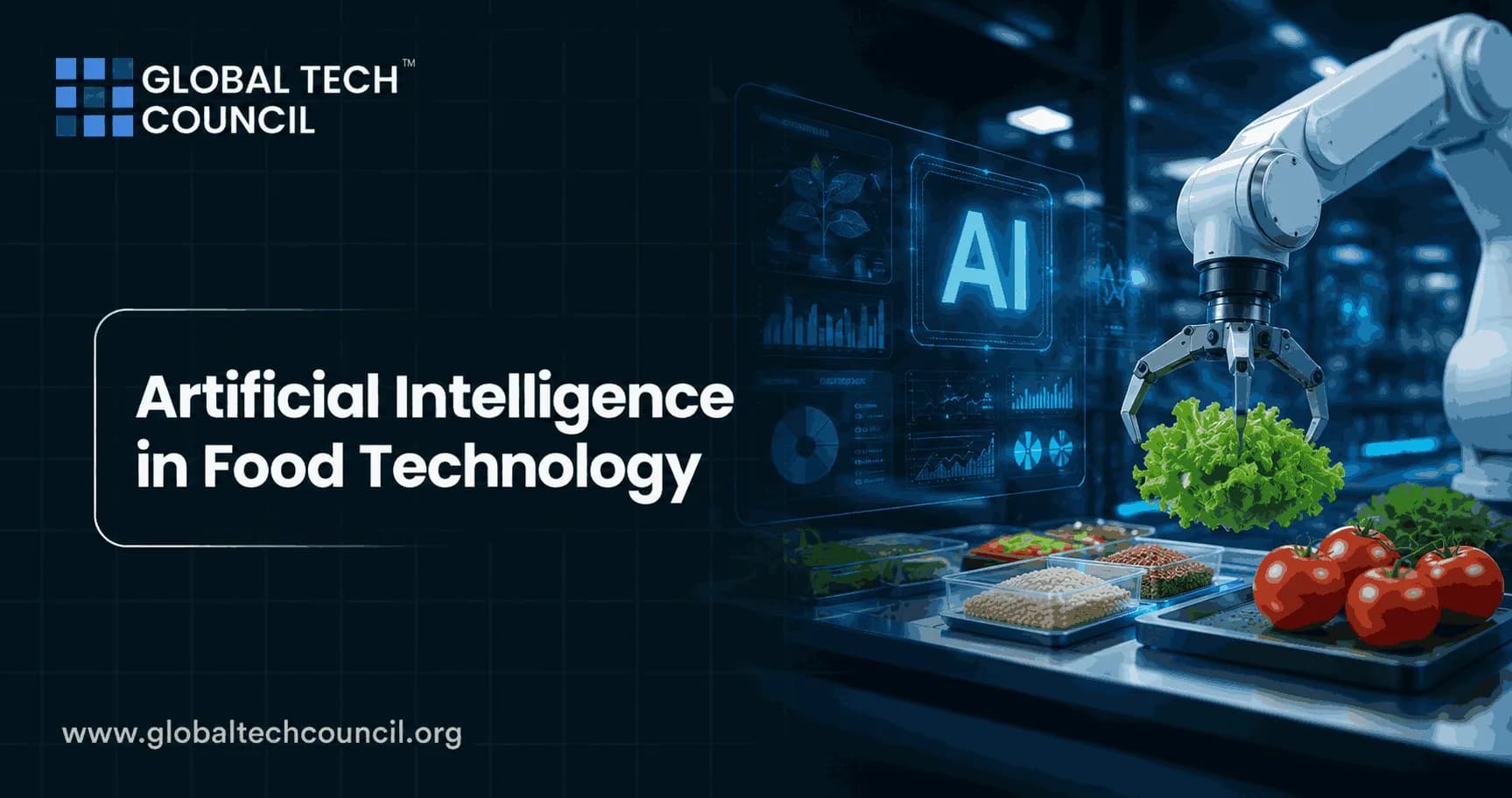
Artificial intelligence has moved well past the experimental stage in food technology and become genuine operational infrastructure. The global AI in foodtech market is projected to grow from 8.58 billion dollars in 2025 to 11.53 billion dollars in 2026, a compound annual growth rate above 34 percent, and forecasts put the market at more than 37 billion dollars by 2030. That growth is not being driven by novelty. It reflects real pressure on food businesses to cut waste, improve safety, and manage supply chains that have grown more complex and more scrutinized in recent years. For professionals looking to understand this shift at a technical level, a credential such as the Certified Artificial Intelligence (AI) Expert offers a structured way to build that foundation before working through the specific applications reshaping this industry.
The scale of the underlying problem explains why adoption is accelerating so quickly. The United Nations Environment Programme reported that 1.05 billion tonnes of food were wasted globally in 2022 alone, across households, food service, and retail. AI is increasingly seen not as an optional upgrade but as one of the few tools capable of addressing waste, safety, and efficiency problems at the scale the food industry actually operates on.

Where AI Is Actually Being Used Across the Food System
AI in food technology today functions as a connected intelligence layer spanning the entire food ecosystem, not a single tool applied to one part of the process.
Precision agriculture: AI analyzes soil data, climate patterns, and crop health to optimize planting, irrigation, and harvesting decisions, improving yield while reducing resource consumption and supporting more sustainable farming practices.
Quality control and safety inspection: computer vision systems detect defects, contamination, and inconsistencies at scale on production lines, reducing recalls and helping manufacturers stay compliant with food safety standards.
Predictive maintenance: AI models flag equipment issues before they cause downtime, a growing priority as manufacturers work to keep production lines running reliably.
Demand forecasting and supply chain optimization: AI improves inventory planning and reduces the mismatch between what gets produced and what actually sells, directly addressing one of the leading causes of food waste.
Personalized nutrition and product development: AI-enabled platforms are increasingly used to develop and validate new products, including analyzing consumer trend data before physical prototyping even begins.
Getting real value out of these applications requires more than buying software off the shelf. It requires people who understand how these systems are actually built and trained. This is where a credential like the Certified Artificial Intelligence (AI) Developer becomes genuinely relevant for food technologists and engineers who need to build, customize, or evaluate AI models rather than simply operate finished tools.
Food Safety and Quality Control: Where AI Has Matured the Most
Quality control and inspection represent one of the most established use cases for AI in food technology, and the research backs that up. A systematic review of AI applications in food processing and preservation, covering literature from 2015 through 2025, found that AI has been widely applied across quality control and inspection, process optimization, shelf-life prediction, intelligent packaging, predictive maintenance, and cold-chain monitoring.
Computer vision in particular has become a standard tool on modern production lines. Systems that once relied entirely on manual visual inspection now use trained models to catch contamination or inconsistency far faster and more consistently than a human inspector working the same line for a full shift.
Where the Industry Is Heading Next: Agentic AI and Deeper Integration
The next phase of AI in food technology is not just more automation of existing tasks. It involves what the industry is calling agentic AI, systems capable of autonomously reasoning, planning, and taking action rather than simply executing a fixed rule. Gartner projects that 33 percent of enterprise software applications will include agentic AI capability by 2028, up from just 1 percent in 2024, and food manufacturers are expected to be among the industries adopting this shift.
This next wave depends heavily on food-specific AI, meaning models trained specifically to understand food safety standards, ingredient behavior, and regulatory requirements, rather than generic AI tools adapted after the fact. That specificity is exactly why deep technical training matters so much right now. Programs under Deep Tech Certification are built around applied, hands-on engineering skill development, the kind of practical grounding that helps food technology teams build and deploy AI systems correctly rather than bolting a generic model onto a specialized industry and hoping it performs.
AI & Technology
As artificial intelligence continues to transform education, students are getting more opportunities to explore technology beyond traditional classroom learning. A Tech Olympiad can help students develop their understanding of AI, logical reasoning, problem-solving, and other technology skills through structured competition.
The problem-solving instincts built through this kind of early, structured exposure to AI and technology often carry directly into specialized fields like food science and food technology, where understanding how intelligent systems actually reason has become just as important as understanding the underlying science of food itself.
The Business Case: Why Food Companies Are Investing Now
The commercial pressure behind AI adoption in food technology is becoming difficult to ignore. Products marketed around sustainability claims validated by AI-driven consumer and trend analysis are growing nearly six times faster than conventionally marketed products, according to recent industry trend reporting. That statistic reflects a broader shift: AI-validated claims around sustainability and health are now genuine commercial differentiators, not just marketing language layered on top of a product after the fact.
AI's role in the food and beverage market specifically is expected to reach as much as 67.73 billion dollars by 2030 according to some market forecasts, driven by pressure to address labor shortages, supply chain disruption, and rising costs simultaneously. Predictive AI tools that reduce spoilage and equipment downtime, combined with AI systems that optimize beverage production by monitoring ingredient ratios and temperatures in real time, are becoming standard rather than experimental.
That scale of investment only pays off if companies can clearly explain the value of these AI-driven claims and improvements to retailers, regulators, and consumers who may be skeptical of new technology in something as personal as their food supply. A Marketing Certification helps food technology and product teams build that communication skill, translating technical AI capability into language that builds consumer and retail partner trust rather than confusion or suspicion.
The Bottom Line on AI in Food Technology
Artificial intelligence has become core infrastructure across the food industry, spanning agriculture, manufacturing, quality control, supply chain management, and product development. The companies seeing the strongest results are not the ones simply adding AI features to existing systems. They are the ones investing in real technical understanding, food-specific model training, and the communication skills needed to explain what these systems actually do to the people who depend on a safe, reliable food supply. As agentic AI and deeper system integration continue to mature through the rest of this decade, that combination of technical depth and clear communication will likely define which food technology companies lead the next phase of this transformation.
FAQs
1. What is artificial intelligence in food technology?
Artificial intelligence (AI) in food technology refers to using machine learning, computer vision, robotics, and data analytics to improve food production, processing, quality control, safety, supply chains, and product development.
2. How is AI used in the food industry?
AI is used for quality inspection, demand forecasting, food safety monitoring, automated sorting, predictive maintenance, inventory management, supply-chain optimization, and developing new food products.
3. What are the benefits of AI in food technology?
Key benefits include improved food quality, faster production, reduced waste, better resource utilization, improved safety, more accurate forecasting, and greater operational efficiency.
4. How does AI improve food quality control?
AI-powered computer vision systems can inspect food products for defects, size, color, shape, and other quality characteristics. This allows manufacturers to identify products that do not meet defined quality standards.
5. Can AI improve food safety?
Yes. AI can analyze production and environmental data to identify patterns associated with potential food-safety risks. It can also support contamination monitoring, quality checks, and predictive risk assessment.
6. How is machine learning used in food technology?
Machine learning can analyze historical and real-time data to predict demand, detect anomalies, optimize production processes, forecast equipment failures, and improve food-quality assessment.
7. What role does computer vision play in food processing?
Computer vision enables machines to analyze images and video to identify food products, detect defects, sort items, assess appearance, and monitor production processes with limited human intervention.
8. How does AI help reduce food waste?
AI can improve demand forecasting, inventory management, production planning, and quality inspection. Better predictions can help businesses produce and order quantities that more closely match demand.
9. How is AI used in food supply chain management?
AI can analyze sales, inventory, transportation, weather, and other data to improve demand forecasting, logistics planning, inventory management, and distribution decisions.
10. Can AI help develop new food products?
Yes. AI can analyze consumer preferences, ingredient data, nutritional information, and product characteristics to support the development and optimization of new food products and recipes.
11. How does AI help with food demand forecasting?
AI models can analyze historical sales, seasonal patterns, consumer behavior, promotions, and other relevant data to estimate future demand. This can help businesses improve production and inventory planning.
12. What is the role of robotics and AI in food technology?
AI-powered robots can perform tasks such as picking, sorting, packaging, inspection, and material handling. AI helps robots interpret information and make decisions within defined operating environments.
13. How can AI improve food packaging?
AI can support automated packaging inspection, product identification, quality control, labeling checks, and production-line optimization. It can also help businesses analyze packaging-related data and improve operational efficiency.
14. How is AI used in agriculture and food production?
AI can support crop monitoring, yield prediction, disease detection, precision agriculture, harvesting, livestock monitoring, and resource management. These applications connect agricultural production with the broader food-technology ecosystem.
15. What are the challenges of using AI in food technology?
Challenges include implementation costs, data-quality issues, integration with existing systems, cybersecurity, employee training, regulatory considerations, and the need for reliable human oversight.
16. Does AI replace workers in the food industry?
AI can automate certain repetitive or highly standardized tasks, but it does not eliminate the need for human workers across the food industry. Human expertise remains important for supervision, product development, quality decisions, maintenance, and management.
17. How does AI help restaurants and food businesses?
AI can support demand forecasting, inventory management, personalized recommendations, customer-service automation, kitchen operations, delivery optimization, and analysis of customer preferences.
18. How does AI contribute to sustainable food technology?
AI can help optimize energy and water use, improve production efficiency, reduce food waste, optimize transportation, and support better resource planning. Its sustainability impact depends on how the technology is designed and implemented.
19. What skills are needed for AI in food technology?
Useful skills include food science, data analysis, machine learning, computer vision, programming, automation, robotics, statistics, food safety, and knowledge of food-production processes.
20. What is the future of artificial intelligence in food technology?
The future is likely to involve more intelligent automation, real-time quality monitoring, predictive food-safety systems, personalized nutrition, AI-assisted product development, smarter supply chains, and greater integration between AI, robotics, and food science.
Related Articles
View All
Artificial Intelligence
How Can Blockchains Transform Artificial Intelligence?
Blockchain can complement artificial intelligence by providing tamper-resistant records, decentralized identity, data provenance, and programmable smart contracts. Together, the technologies can support auditable AI workflows, secure data sharing, decentralized AI marketplaces, and clearer tracking of models and digital assets. The combination has potential, although scalability, privacy, governance, and integration remain significant challenges.

Artificial Intelligence
How Artificial Intelligence Can Shape the Future of Transportation?
Artificial intelligence can shape the future of transportation through autonomous vehicles, smarter traffic management, predictive maintenance, route optimization, and safer mobility systems. AI can also help public transit agencies analyze real-time data, improve scheduling, reduce congestion, and make transportation networks more efficient and responsive.
Artificial Intelligence
How can you use Artificial Intelligence in Business?
Artificial intelligence can help businesses automate repetitive work, improve customer service, personalize marketing, forecast demand, detect fraud, analyze data, optimize supply chains, and support faster decision-making. Businesses are also adopting generative and agentic AI for document processing, software development, finance, HR, and workflow automation, though governance and human oversight remain important.
Trending Articles
The Role of Blockchain in Ethical AI Development
How blockchain technology is being used to promote transparency and accountability in artificial intelligence systems.
AWS Career Roadmap
A step-by-step guide to building a successful career in Amazon Web Services cloud computing.
Top 5 DeFi Platforms
Explore the leading decentralized finance platforms and what makes each one unique in the evolving DeFi landscape.