

How Can Blockchains Transform Artificial Intelligence?
 Aman Singh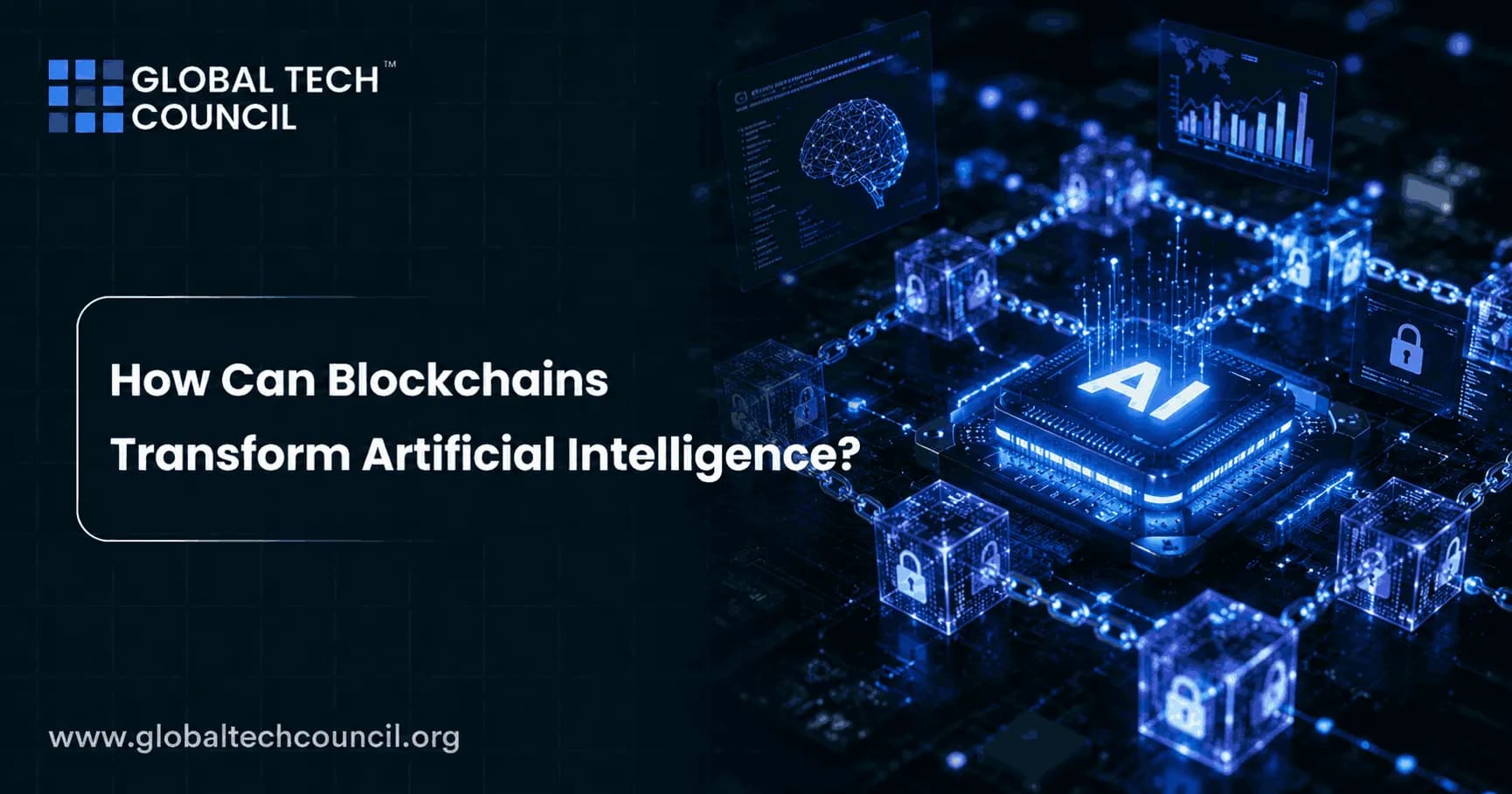
Artificial intelligence and blockchain spent years developing on separate tracks, one focused on prediction and generation, the other on trust and verification. By 2026, that separation has largely dissolved. AI increasingly needs exactly what blockchain was built to provide: verifiable compute, tamper resistant data trails, and a native way for autonomous systems to pay for resources without a human approving every transaction. Blockchain, in turn, needs AI to make its own systems smarter and more adaptive. What started as a speculative crossover narrative has genuinely matured into working infrastructure. Understanding this convergence in depth is exactly what a Certified Artificial Intelligence (AI) Expert credential is built to prepare professionals for, going well beyond either technology in isolation.
Solving AI's Compute Bottleneck With Decentralized Networks
Training and running modern AI models is extraordinarily expensive, and inference alone now accounts for more than 70 percent of total AI operational costs industry wide. Centralized cloud providers have struggled to keep GPU supply reliable and affordable enough to meet demand, which has opened real space for decentralized compute networks. Protocols like Render and Akash have positioned themselves as genuine secondary markets for AI training and inference power, offering costs that platforms like Chutes AI report running up to 85 percent lower than equivalent AWS pricing, powered by distributed networks of GPU operators rather than a single data center operator. Bittensor has taken a related but distinct approach, building a decentralized network specifically designed to reward useful machine learning work through its own token incentive structure. As generative models continue to scale in size and cost, understanding how decentralized compute actually fits into a production AI pipeline is exactly the kind of applied knowledge a Certified Generative AI Expert credential is designed to build, translating this infrastructure shift into practical deployment skill.

Making AI Verifiable: Zero-Knowledge Machine Learning
One of AI's most persistent criticisms is that it operates as a black box, an output appears, but there is often no way to independently verify how a model actually reached it. Zero-knowledge machine learning, commonly called zkML, directly addresses this by generating a cryptographic proof that a specific AI model produced a specific output without tampering, all without revealing the model's proprietary internals. This is no longer a purely theoretical concept. OpenGradient, a blockchain purpose built for verifiable AI inference, now hosts more than 1,500 models and has processed over 2 million verifiable inferences, generating more than 500,000 zkML proofs in the process, with its native token serving as the payment rail for each verified inference call. This kind of verifiability matters most in exactly the situations where trust is non-negotiable, financial decisions, healthcare recommendations, and any AI system making autonomous choices with real consequences attached.
Powering the Agentic Economy: AI Agents With Their Own Wallets
Perhaps the most significant shift in 2026 is the rise of AI agents as genuine economic participants rather than passive tools. Autonomous AI agents increasingly hold self-managed crypto wallets, negotiate directly with other agents, and execute payments without a human approving each individual transaction. NEAR Protocol's Intents system lets agents route payments across more than 35 different blockchain networks and settle transactions using fiat, stablecoins, or crypto, effectively acting as an invisible coordination layer beneath the entire agentic economy. New standards like ERC-8004 are emerging specifically to define how these autonomous agents establish trust with one another on-chain, addressing a genuinely new question blockchain was never originally designed to answer: how do two AI agents, with no human in the loop, verify they can actually trust each other before completing a transaction. Goldman Sachs research projects agent-based AI could drive a 24-fold increase in token consumption by 2030, reaching roughly 120 trillion tokens per month, a scale that makes cheap, verifiable, blockchain-settled payment rails a genuine infrastructure necessity rather than a nice-to-have feature. Evaluating how these emerging payment standards actually function at a technical level is precisely where a Deep Tech Certification in blockchain and AI infrastructure becomes genuinely valuable, since agent-to-agent commerce introduces coordination problems neither blockchain nor AI has fully solved alone.
Solving AI's Data Problem: Provenance and Access
AI labs are increasingly starved for high quality, diverse training data, and centralized data collection methods run into real structural limits, rate limiting, geographic restrictions, and increasingly poisoned or unreliable cached data. Blockchain offers a genuinely different approach: transparent, immutable records of where training data actually came from, letting AI systems prove data provenance rather than simply asserting it. Decentralized storage and data networks are increasingly framed as a contested, strategic resource in their own right, with privacy positioned by some industry analysts as the single most important competitive advantage in this converging space. Beyond training data itself, blockchain's tamper resistant audit trails give AI systems something they have historically lacked entirely, a verifiable record connecting a model's outputs back to the specific data and decisions that produced them.
AI & Technology
As artificial intelligence continues to transform education, students are getting more opportunities to explore technology beyond traditional classroom learning. A Tech Olympiad can help students develop their understanding of AI, logical reasoning, problem-solving, and other technology skills through structured competition.
Separating Real Infrastructure From Hype
Not every project claiming to sit at the intersection of AI and blockchain deserves the label. Industry analysts increasingly warn about "AI-washing," projects that simply wrap an existing centralized AI API, like OpenAI's, behind a token, with no actual technical dependency on blockchain at all. A useful test is asking whether the underlying AI system genuinely needs a token or decentralized infrastructure to function, or whether it would work exactly the same behind a normal credit card payment on a conventional website. The market has increasingly rewarded projects tied to verifiable compute, autonomous agent infrastructure, and genuine on-chain settlement over speculative narratives alone. As this distinction becomes more important to investors, partners, and enterprise buyers, professionals need to be able to explain clearly which projects represent real infrastructure and which are marketing dressed up as innovation. That combination of technical fluency and clear communication is exactly where pairing blockchain and AI expertise with a Marketing Certification becomes genuinely valuable, helping professionals cut through hype and present real technical differentiation honestly to a market that has grown increasingly skeptical of vague AI and blockchain claims.
Conclusion
Blockchain is transforming artificial intelligence in ways that go well beyond the speculative token narratives that once dominated this conversation. Decentralized compute networks are addressing AI's real cost and availability bottlenecks, zero-knowledge machine learning is making AI's outputs genuinely verifiable rather than opaque, and autonomous AI agents are becoming real economic actors with their own wallets and payment rails. AI, in turn, is making blockchain systems smarter and more adaptive, from anomaly detection to smart contract auditing. Neither technology fully solves its own limitations alone, blockchain without AI struggles to adapt to dynamic conditions, and AI without blockchain has no tamper resistant foundation for trust. Together, in 2026, they are building infrastructure that neither could have built on its own.
FAQs
1. How can blockchain transform artificial intelligence?
Blockchain can enhance AI by providing decentralized data management, verifiable records, transparent transactions, and mechanisms for data and model provenance. Together, the technologies can create AI systems where important data, decisions, and transactions can be tracked and verified more easily.
2. What is the relationship between blockchain and artificial intelligence?
AI is primarily used to analyze data, make predictions, and automate decisions, while blockchain provides decentralized infrastructure for recording and verifying information. Combining them can help address challenges involving data ownership, transparency, trust, and coordination between different AI participants.
3. How can blockchain improve AI data security?
Blockchain can provide tamper-evident records of data transactions and access events. Instead of relying entirely on one centralized database, organizations can use distributed ledgers to create verifiable records of how certain data is exchanged or used.
4. Can blockchain make AI more transparent?
Blockchain can improve transparency by creating an auditable record of selected data and model-related activities. For example, organizations could record information about data provenance, model versions, or AI-related transactions, making it easier to verify the history of those records.
5. How can blockchain help with AI data ownership?
Blockchain can support mechanisms for recording who owns, licenses, or has permission to use particular datasets or digital assets. Smart contracts can also help automate certain licensing and payment arrangements when predefined conditions are met.
6. What is AI data provenance, and how can blockchain support it?
Data provenance refers to tracking where data came from, how it was processed, and how it was used. Blockchain can create verifiable records of important events in a dataset's lifecycle, helping organizations establish a clearer audit trail for AI training and analysis.
7. How can blockchain help prevent AI data manipulation?
Blockchain cannot guarantee that the original data is truthful, but it can make recorded information difficult to alter without detection. This can help organizations verify whether a dataset, model version, or transaction has been modified after it was recorded.
8. Can blockchain improve trust in AI systems?
Yes, blockchain can contribute to trust by providing verifiable records of data sources, model versions, permissions, and transactions. However, blockchain alone cannot guarantee that an AI model is accurate, unbiased, or safe. Those issues still require appropriate testing and governance.
9. How can smart contracts be used with AI?
Smart contracts can automate actions based on predefined conditions. When combined with AI, they could, for example, trigger payments after an AI service completes a verified task, manage access to datasets, or execute predefined business processes based on trusted inputs.
10. Can blockchain decentralize artificial intelligence?
Blockchain can support decentralized AI ecosystems by enabling participants to coordinate without relying entirely on a single central authority. Decentralized networks may allow different organizations or individuals to contribute computing resources, data, models, or services under defined rules.
11. How can blockchain help AI developers monetize models and data?
Blockchain-based systems can support digital ownership, licensing, and automated payments. AI developers or data providers could potentially establish usage conditions and receive payments when their models, datasets, or AI services are accessed, subject to the design of the underlying platform.
12. How can blockchain and AI improve decentralized AI marketplaces?
Blockchain can provide infrastructure for recording transactions, managing digital assets, and coordinating participants in decentralized AI marketplaces. AI developers, data providers, and computing-resource providers could potentially interact through programmable rules and automated payment mechanisms.
13. Can blockchain help verify AI-generated content?
Blockchain can help establish provenance by recording information about when or where a digital asset was registered and potentially linking it to a creator or source. However, blockchain does not automatically prove that content is authentic or that a particular person created it.
14. How can blockchain improve AI model accountability?
Blockchain can maintain an auditable history of model versions, approvals, data access, and other relevant events. This can help organizations investigate how an AI system evolved and determine which version or process was involved in a particular outcome.
15. How can blockchain and AI improve cybersecurity?
AI can identify unusual activity and potential security threats, while blockchain can provide tamper-evident records and decentralized mechanisms for managing certain transactions or identities. Combining the technologies may strengthen some security workflows, although both systems introduce their own risks.
16. What are the benefits of combining blockchain and AI?
Potential benefits include improved data provenance, greater transparency, decentralized coordination, automated transactions, stronger auditability, data-sharing controls, and new models for exchanging AI services and digital assets.
17. What are the challenges of combining blockchain and artificial intelligence?
Major challenges include blockchain scalability, computational and energy requirements for some networks, data privacy, interoperability, regulatory uncertainty, integration complexity, and the difficulty of connecting trustworthy real-world data with blockchain records.
18. Can blockchain solve AI bias?
No. Blockchain does not directly eliminate algorithmic bias. It can help document data sources, model versions, and governance decisions, which may improve accountability, but reducing AI bias requires appropriate datasets, model design, testing, evaluation, and human oversight.
19. What is the future of blockchain and AI?
The combination could contribute to decentralized AI networks, verifiable AI agents, machine-to-machine transactions, tokenized digital assets, secure data-sharing systems, AI marketplaces, and improved model and data provenance. Adoption will depend on scalability, usability, regulation, and whether these systems provide practical advantages over centralized alternatives.
20. Why is the combination of blockchain and AI important?
AI needs large amounts of data, computing resources, and trusted information, while blockchain can provide mechanisms for verification, ownership, coordination, and programmable transactions. Their combination could create more transparent and decentralized AI ecosystems, particularly where multiple parties need to collaborate without completely relying on a single intermediary.
Related Articles
View All
Artificial Intelligence
How Artificial Intelligence Can Shape the Future of Transportation?
Artificial intelligence can shape the future of transportation through autonomous vehicles, smarter traffic management, predictive maintenance, route optimization, and safer mobility systems. AI can also help public transit agencies analyze real-time data, improve scheduling, reduce congestion, and make transportation networks more efficient and responsive.

Artificial Intelligence
Artificial Intelligence in Food Technology
Artificial intelligence in food technology helps improve food quality, safety, production, and supply-chain efficiency. AI applications include automated inspection, contamination detection, predictive maintenance, demand forecasting, product development, precision processing, and food waste reduction, helping manufacturers make faster, data-driven decisions.
Artificial Intelligence
How can you use Artificial Intelligence in Business?
Artificial intelligence can help businesses automate repetitive work, improve customer service, personalize marketing, forecast demand, detect fraud, analyze data, optimize supply chains, and support faster decision-making. Businesses are also adopting generative and agentic AI for document processing, software development, finance, HR, and workflow automation, though governance and human oversight remain important.
Trending Articles
The Role of Blockchain in Ethical AI Development
How blockchain technology is being used to promote transparency and accountability in artificial intelligence systems.
AWS Career Roadmap
A step-by-step guide to building a successful career in Amazon Web Services cloud computing.
Top 5 DeFi Platforms
Explore the leading decentralized finance platforms and what makes each one unique in the evolving DeFi landscape.