

Top 5 Innovative IoT Use Cases in Healthcare
 Toshendra Sharma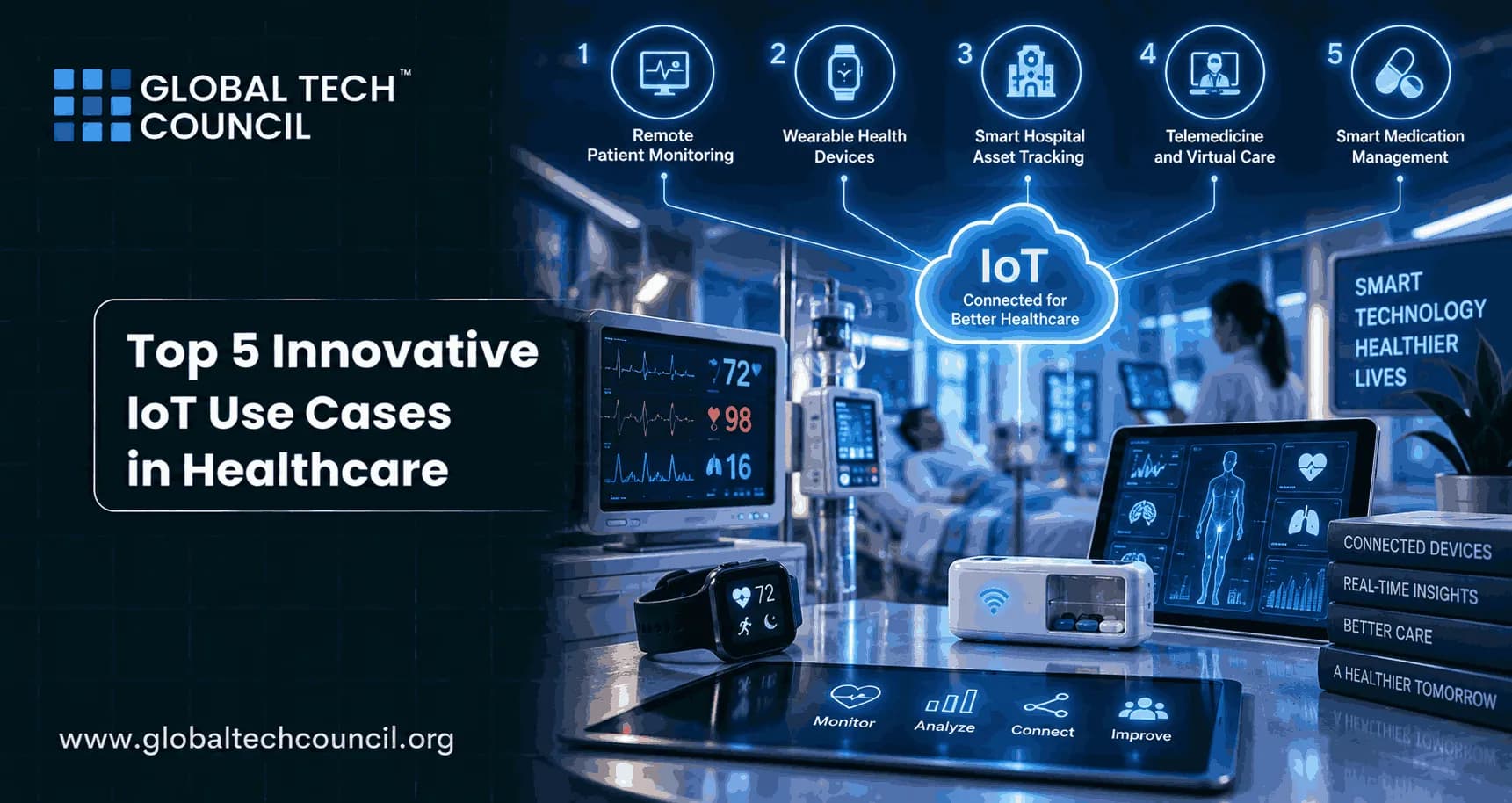
The Internet of Things has quietly transformed how healthcare providers monitor patients, manage equipment, and deliver treatment, moving medicine away from periodic checkups toward continuous, data driven care. Connected devices now track vital signs in real time, alert clinicians to emerging problems before they become emergencies, and give patients far more control over managing chronic conditions from home. Building genuine expertise in this rapidly growing field increasingly starts with structured training, and professionals pursuing a Certified Internet-of-Things (IoT) Expert credential gain the foundational knowledge needed to understand exactly how these connected healthcare systems function and where they are headed next.
Remote Patient Monitoring
Remote patient monitoring stands out as one of IoT's most impactful healthcare applications, allowing clinicians to track a patient's vital signs, blood pressure, heart rate, and blood oxygen levels continuously without requiring in person visits. Connected devices transmit this data directly to healthcare providers in real time, letting doctors catch concerning trends early and intervene before a minor issue becomes a serious complication. This capability proved especially valuable for managing chronic conditions like heart disease and diabetes, where continuous monitoring genuinely changes outcomes compared to occasional office visits. Building systems this reliable requires serious engineering discipline, and professionals pursuing a Certified Internet-of-Things (IoT) Developer credential learn exactly the kind of hands on skills needed to design and build these monitoring devices so they transmit accurate data securely and consistently.

Wearable Health Trackers
Everyday Devices Delivering Clinical Value
Wearable devices have moved well beyond counting steps, now capable of detecting irregular heart rhythms, tracking sleep quality, and monitoring blood oxygen saturation with a level of accuracy that increasingly supports genuine clinical decision making rather than just casual fitness tracking. Smartwatches equipped with electrocardiogram sensors have already flagged early signs of atrial fibrillation in users who had no prior symptoms, prompting medical evaluation that caught the condition before it led to a more serious event.
Expanding Beyond the Wrist
Newer wearable formats, including smart rings, patches, and even connected clothing, are extending this continuous monitoring capability to more specific health applications, from tracking glucose levels for diabetics to monitoring recovery metrics for post surgical patients. This expansion reflects a broader shift toward passive, continuous health data collection that fits naturally into a patient's daily routine rather than requiring deliberate effort.
Smart Asset and Equipment Management in Hospitals
Hospitals manage enormous inventories of expensive, often life critical equipment, and IoT based real time location systems have become genuinely essential for tracking where that equipment actually is at any given moment. Connected sensors attached to wheelchairs, infusion pumps, and diagnostic devices let staff locate needed equipment within seconds rather than searching through hallways and storage rooms, saving valuable time in situations where minutes genuinely matter. This same tracking infrastructure also monitors equipment usage patterns, helping hospitals identify maintenance needs proactively before a critical device fails during use. Designing these interconnected tracking systems well requires genuine technical depth, and a broader Deep Tech Certification helps professionals understand the underlying data architecture and security considerations that keep sensitive hospital systems both efficient and protected from interference.
Connected Drug Delivery and Smart Insulin Management
Smart insulin pumps and connected drug delivery systems represent one of the more sophisticated applications of IoT in healthcare, continuously monitoring a patient's glucose levels and automatically adjusting insulin delivery in response, effectively functioning as an artificial pancreas for many diabetic patients. These closed loop systems communicate constantly between a glucose sensor and an insulin pump, making dosing adjustments throughout the day without requiring the patient to manually calculate and administer doses themselves. Beyond diabetes management, connected inhalers and smart pill bottles are helping improve medication adherence more broadly, tracking whether patients actually take prescribed medications on schedule and alerting caregivers when doses get missed.
AI Innovation Extending Across Industries
The same generative AI advances reshaping healthcare diagnostics and data analysis are also reaching into entirely different creative industries, illustrating just how broadly this technology is expanding beyond any single sector. One emerging application is AI microdrama, where generative AI helps bring serialized stories, characters, and fictional worlds to life, a genuinely different use case from healthcare monitoring but one that draws on many of the same underlying advances in machine learning and automated content generation. Seeing AI applied this broadly, from continuous health monitoring to entertainment, underscores just how foundational this technology has become across seemingly unrelated fields.
AI Enabled Diagnostic and Surgical Support Devices
IoT connected diagnostic devices increasingly incorporate artificial intelligence to analyze data in real time rather than simply collecting and transmitting it for later review. Smart imaging devices can now flag potential abnormalities during a scan itself, giving radiologists a second layer of analysis that helps catch findings that might otherwise be missed. In surgical settings, connected robotic systems provide surgeons with real time data feedback during procedures, improving precision and helping reduce complications in complex operations. As these AI enabled devices continue reaching patients and providers, communicating their genuine clinical value clearly, without overstating capabilities or glossing over limitations, has become an important skill in its own right, and healthcare technology companies increasingly rely on professionals who pair technical understanding with a Marketing Certification to explain these innovations honestly to clinicians, patients, and regulators who need to trust the technology before adopting it. As IoT continues reshaping healthcare delivery, the organizations building genuine trust around these devices, rather than just impressive specifications, are the ones most likely to see lasting adoption.
FAQs
1. What are the top 5 IoT use cases in healthcare?
Five important IoT use cases in healthcare are remote patient monitoring, smart hospitals, connected medical devices, medication management, and predictive maintenance. These applications use connected sensors and devices to collect real-time information and support clinical care and hospital operations.
2. What is IoT in healthcare?
IoT in healthcare, often called the Internet of Medical Things (IoMT), connects medical devices, sensors, software, and healthcare systems to collect and exchange data. These technologies can support patient monitoring, clinical workflows, asset management, and remote care.
3. How does IoT help with remote patient monitoring?
IoT-enabled wearables and connected medical devices can continuously collect measurements such as heart rate, blood pressure, glucose levels, temperature, and oxygen saturation. The information can be transmitted to healthcare teams, allowing them to monitor patients remotely and respond when readings require attention.
4. How are IoT devices used in smart hospitals?
Smart hospitals use connected devices and sensors to monitor patients, equipment, rooms, environmental conditions, and other hospital operations. IoT can support patient-flow management, equipment tracking, predictive maintenance, infection-control monitoring, and environmental monitoring.
5. What are connected medical devices?
Connected medical devices are healthcare devices capable of collecting and transmitting data through a network. Examples can include connected patient monitors, infusion equipment, glucose-monitoring devices, wearable sensors, and other medical technologies.
6. How does IoT improve medication management?
IoT can connect medication dispensers, inhalers, insulin devices, and other medication-related equipment to digital systems. These devices can provide reminders, record medication activity, and share relevant information with patients or healthcare professionals, helping support medication adherence.
7. What is predictive maintenance in healthcare IoT?
Predictive maintenance uses sensor data from medical equipment to identify signs of potential problems before equipment fails. Healthcare organizations can use this information to plan maintenance, reduce unexpected downtime, and keep critical equipment available.
8. How does IoT help hospitals track medical equipment?
Hospitals can attach RFID tags, Bluetooth Low Energy beacons, or other connected sensors to equipment such as wheelchairs, portable imaging devices, and medical instruments. Location and usage information can then be displayed through centralized systems, helping staff find equipment more efficiently.
9. Can IoT help manage chronic diseases?
Yes. Connected health devices can continuously collect relevant health information from patients managing chronic conditions. Healthcare providers can use this information for remote monitoring, follow-up care, and earlier identification of potentially concerning changes.
10. How can IoT improve emergency healthcare?
Connected devices can transmit patient information to healthcare teams while an emergency is being managed. IoT applications can also support connected ambulances, emergency equipment, remote monitoring, and communication between different points of care.
11. How is IoT used in elderly care?
IoT-enabled wearables and home sensors can support elderly people through fall detection, activity monitoring, health tracking, and independent-living applications. These systems can alert caregivers or healthcare professionals when predefined conditions require attention.
12. How does IoT support telemedicine?
IoT can complement virtual consultations by providing healthcare professionals with data collected from connected medical devices. Instead of relying only on information provided verbally by a patient, clinicians can potentially review device-generated measurements during remote care.
13. Can IoT help prevent hospital infections?
IoT can support infection-control activities through environmental and facility monitoring. Connected sensors can monitor conditions such as temperature, humidity, air quality, and other relevant environmental factors, helping healthcare organizations identify conditions that may require intervention.
14. How can IoT improve healthcare inventory management?
Connected sensors and tracking technologies can provide information about the location, movement, and availability of medical supplies and equipment. This can improve inventory visibility and help healthcare organizations manage resources more efficiently.
15. What are the benefits of IoT in healthcare?
Major benefits include continuous monitoring, faster access to patient information, improved asset utilization, more efficient hospital operations, remote care, and predictive maintenance. The NHS identifies applications ranging from remote monitoring and telemedicine to equipment tracking and predictive maintenance.
16. What role does AI play in healthcare IoT?
AI can analyze the large amounts of data generated by connected healthcare devices and identify patterns, anomalies, or trends. Combining IoT with AI can support predictive monitoring, clinical decision support, operational optimization, and more intelligent healthcare workflows.
17. What are the security risks of IoT in healthcare?
Healthcare IoT systems can introduce risks involving unauthorized access, data breaches, insecure devices, weak authentication, and compromised network connections. Because connected medical devices can handle sensitive health information and may interact with clinical workflows, security and privacy need to be considered throughout their lifecycle.
18. What challenges can hospitals face when implementing IoT?
Common challenges include interoperability with existing systems, cybersecurity, data privacy, connectivity, infrastructure costs, device management, and data governance. Integrating continuous device data into complex healthcare environments can be particularly challenging.
19. What is the future of IoT in healthcare?
The future of healthcare IoT is likely to involve greater integration of connected devices with AI, remote patient monitoring, smart hospitals, predictive analytics, and digital health platforms. As healthcare systems become more connected, secure interoperability and responsible data management will remain important.
20. Why is IoT important for the future of healthcare?
IoT enables healthcare organizations to move from periodic data collection toward more continuous, connected monitoring and operational management. By turning real-world measurements into timely digital information, IoT can support more responsive care, efficient resource management, and data-driven healthcare services.
Related Articles
View All
Blockchain
World’s Top 10 Cyber Crime Hotspots
Have you ever wondered about the countries that face the most cybercrime instances? If you ever wondered about the countries that face the most cybercrime, you will be surprised to learn that there are a few significant contributing factors attracting cybercriminals to specific regions of the…
Blockchain
AI Tools List for Productivity
Artificial intelligence has moved far beyond being a trend. It is now a practical business advantage that helps professionals save time, reduce repetitive work, improve output quality, and make faster decisions. Whether someone works in marketing, software development, consulting, operations, or…

Blockchain
4 Ways AI Is Reshaping Digital Fundraising Efforts
Let’s not sugarcoat this: digital fundraising has leveled up. Your junk mail push and beige class-email just aren’t cutting through anymore, everyone expects If-Spotify-Was-Generous-level personalization and lightning-speed comms. AI is the overcaffeinated campaign manager you didn’t know you…
Trending Articles
The Role of Blockchain in Ethical AI Development
How blockchain technology is being used to promote transparency and accountability in artificial intelligence systems.
AWS Career Roadmap
A step-by-step guide to building a successful career in Amazon Web Services cloud computing.
Top 5 DeFi Platforms
Explore the leading decentralized finance platforms and what makes each one unique in the evolving DeFi landscape.