
What Is Anthropic’s S-1 Filing and What Does It Mean?
 Suyash Raizada
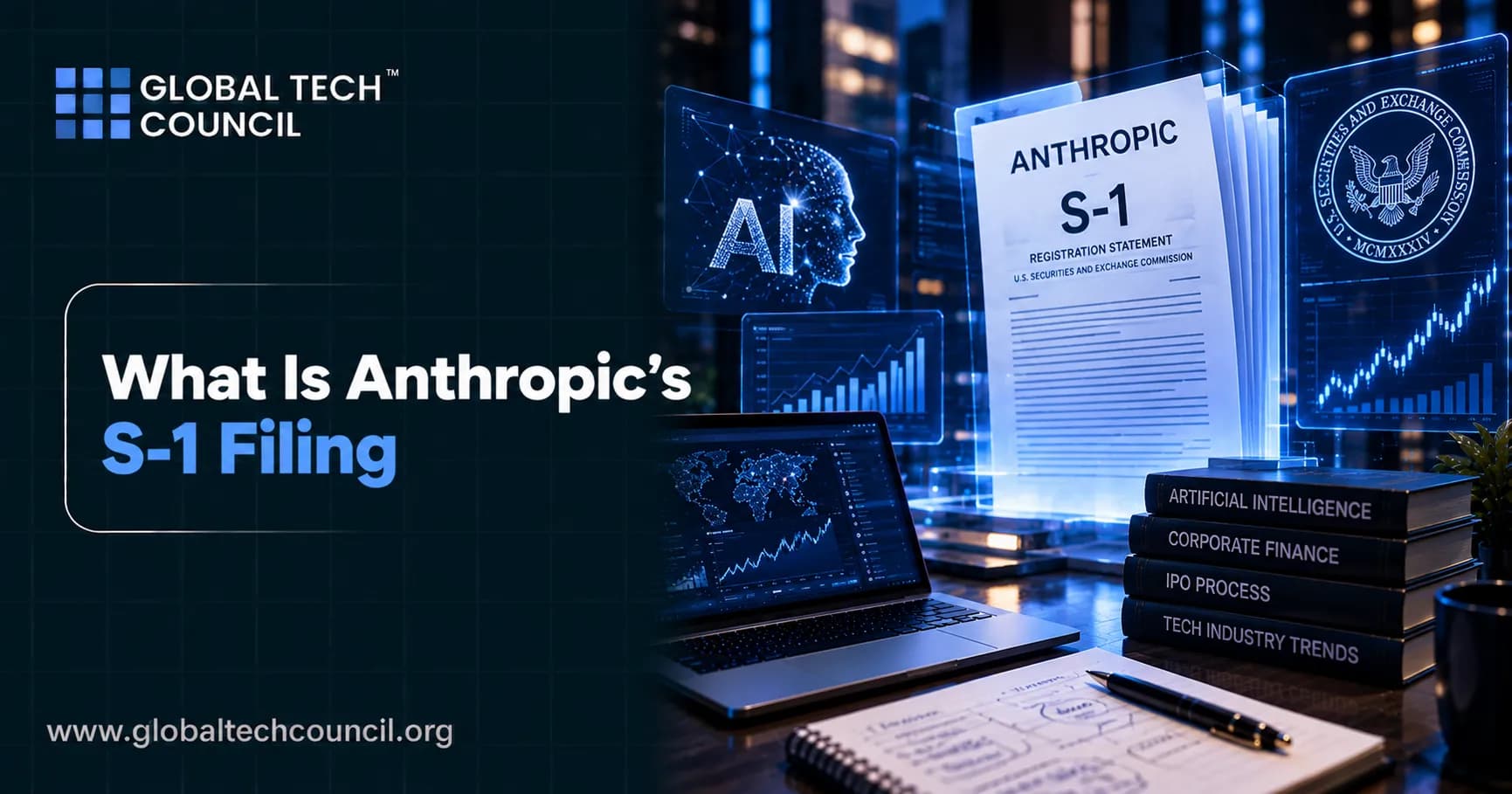
When Anthropic files S-1 paperwork with the U.S. Securities and Exchange Commission, the whole technology world pays attention. That is what happened on October 26, 2026. The company behind the Claude AI models formally began the process of an initial public offering, or IPO. It said it plans to list its Class A common stock on the Nasdaq Global Select Market under the ticker ANT.
So what does the filing actually mean? In short, it is a public disclosure document. It lets anyone see how the company earns money, how it spends money, who controls it and what could go wrong. This article explains the filing in plain language, from beginner basics to details that finance professionals will want. If you are new to the field and want a solid foundation, the Certified Artificial Intelligence (AI) Expert program is one way to learn the concepts behind the headlines.

Anthropic Files S-1: The Official Announcement
Anthropic published its own statement on October 26, 2026, in the Announcements section of its newsroom.
What Anthropic Said
The company confirmed that Anthropic, PBC filed a registration statement on Form S-1 with the SEC for the proposed IPO of its Class A common stock. It confirmed the Nasdaq Global Select Market listing plan and the symbol ANT. It also said that the number of shares and the price range have not yet been decided.
The statement names Goldman Sachs and Morgan Stanley as the firms from which copies of the preliminary prospectus can be requested when it becomes available.
The Legal Notice
The announcement carries the standard securities warning. The registration statement has been filed but is not yet effective. Until it becomes effective, the shares cannot be sold and offers to buy cannot be accepted. The announcement is not an offer to sell and not a request to buy. Any offering will be made only through a prospectus.
You can read the official statement at https://www.anthropic.com/news/s1-sec.
What Is an S-1 Filing in Simple Terms?
An S-1 is the form a U.S. company files with the SEC before selling shares to the public for the first time. Think of it as a company’s detailed report card and business plan combined. It covers the business model, financial results, risks, management, ownership and the planned use of the money raised.
The process usually moves in stages:
The company submits a draft, often confidentially, so regulators can begin their review.
The company files the registration publicly.
The SEC reviews it and the company may file amendments.
The company sets a price range and meets investors.
The registration becomes effective and the shares start trading.
Anthropic is partway through this path. On June 1, 2026, it announced that it had confidentially submitted a draft registration statement. The October filing is the public version.
The filing also shows how much physical technology sits behind modern AI. Chips, data centers, cloud networks and power supply all matter. Readers who want to understand those layers can look at a Deep Tech Certification to see how emerging technologies fit together.
Key Facts From the Filing
These are the main points reported from the document and its coverage:
Filing date: October 26, 2026.
What is offered: Class A common stock, sold by Anthropic and by selling stockholders.
Exchange and ticker: Nasdaq Global Select Market, symbol ANT.
Underwriters: Goldman Sachs and Morgan Stanley lead a large group that also includes J.P. Morgan, Citigroup, Barclays, Wells Fargo, BofA Securities and others.
Company type: a Delaware public benefit corporation based in San Francisco.
Price and share count: still blank.
Proceeds: Anthropic does not receive money from shares sold by selling stockholders.
Anthropic’s Financial Results
The financial section draws the most attention. The figures below come from the filing as reported by news outlets, so check them against the original document before relying on them for decisions.
Revenue Growth
Anthropic reported about $16.29 billion in revenue for the six months ended June 30, 2026. The same period in 2025 produced about $1.16 billion. The filing says revenue for the second quarter grew 1,368% compared with a year earlier. Media reports also say the company recorded its first quarterly operating profit in that quarter, around $974 million.
Customer Strength
The filing describes a growing base of large customers. As of September 30, 2026, it reports:
More than 11,900 customers paying at least $100,000 a year.
More than 1,900 paying at least $1 million.
About 250 paying at least $10 million.
Net revenue retention was approximately 900%. In simple terms, qualified customers were spending about nine times as much as they did a year earlier. The filing’s definition leaves out Claude Pro and Max subscribers, which shows how much of the story is about business customers.
Costs and Losses
Growth at this speed is expensive. Coverage of the filing puts the net loss for the first half of 2026 at roughly $80 billion. The filing says compute and infrastructure expenses grew 300% in the second quarter, much slower than revenue but still very large in dollar terms.
On the funding side, Anthropic reports having raised about $141.1 billion in total capital. As of June 30, 2026, it held $112.4 billion in cash and equivalents plus $19.3 billion in short-term investments. Reported overseas revenue for the first half topped $4.5 billion, and the company has around 5,300 employees.
Products and Distribution
Anthropic launched Claude commercially in early 2023. The filing describes enterprise adoption as the fastest of any technology in history, which is the company’s own claim. Claude Code entered research preview in February 2025 and Claude Cowork followed in January 2026. In September 2026, Anthropic began merging Claude Cowork with Claude.ai.
The company says Claude Opus 5.5 cut customer costs per task by about 40% compared with Claude Opus 5. Distribution runs through Amazon Web Services, Google Cloud and Microsoft Azure. It also runs through consulting firms such as Accenture, Deloitte, KPMG and PwC, and through data platforms including Salesforce and Snowflake.
The Compute Bet
Training and running AI models needs enormous computing capacity. Reporting on the filing says Anthropic plans to spend at least $542 billion on data centers and cloud computing. It also describes a compute agreement with SpaceX worth about $3.1 billion per month. The company uses chips from Nvidia, AMD, Amazon and Google, which spreads its supplier risk.
This matters beyond one company. Chip makers, cloud providers and energy suppliers all benefit when a leading AI lab commits to this scale. Semiconductor stocks rose sharply when the filing became public.
Governance: A Structure Without Precedent
Anthropic told investors that its capital and governance structure has no direct public company precedent. Three features stand out.
Public Benefit Corporation
Anthropic’s charter states a purpose of the responsible development and maintenance of advanced AI for the long-term benefit of humanity. The board must weigh that mission alongside shareholder returns.
Long-Term Benefit Trust
The Long-Term Benefit Trust has five financially disinterested trustees. Through Class T stock, it can elect and remove directors who form a majority of the board. Because of this, Anthropic counts as a controlled company under Nasdaq rules. The filing says the company expects to use only the exemption for its nominating and corporate governance committee, while its audit and compensation committees remain fully independent.
Founder Voting Power
Just before the offering closes, Anthropic will issue one Class F share to an entity owned by its seven co-founders: Dario Amodei, Daniela Amodei, Tom Brown, Jack Clark, Jared Kaplan, Sam McCandlish and Christopher Olah. That single share carries 50.1% of total voting power on most shareholder matters. Class A shares carry one vote each.
The company also placed 5% of its fully diluted shares into the Anthropic Public Benefit Fund. Each co-founder has pledged to give 80% of their personal Anthropic equity to philanthropy.
Risks Described in the Filing
The S-1 includes more than 90 pages of risk factors. The main themes are easy to grasp:
Compute supply: the business depends on obtaining enough chips and data center space.
Key people: losing founders or senior researchers could slow progress.
Competition: other AI labs and large technology firms are racing in the same market.
Model behavior: the company warns that models could develop unexpected capabilities and that misuse or failed safeguards could cause real harm beyond what insurance covers.
Concentration: reliance on large customers, cloud partners that are also investors, and concentrated voting power.
Government disputes: reporting highlights a dispute with the Pentagon that the company says could cause material revenue losses, alongside a court ruling in its favor on constitutional grounds.
Every S-1 lists risks, so this does not predict failure. It does show which problems management considers most serious.
What the Filing Means for Different Readers
For Investors
The document is the first full view of an AI lab’s finances at this scale. It shows very fast growth, a recent operating profit and a very large spending plan. Price and share count remain unknown, so no one can yet judge value. This article is information, not financial advice.
For Businesses
A public Anthropic will report results on a regular schedule. Procurement and technology teams can use that transparency to judge whether Claude is a stable long-term supplier.
For Workers and Employers
The filing confirms that AI skills are moving from optional to expected. Employers need ways to check that candidates actually have them.
As artificial intelligence becomes part of everyday business operations, employers increasingly need people who can apply AI knowledge responsibly and effectively. Evaluating candidates on relevant skills, reasoning, and practical understanding can support stronger hiring decisions. HireValid can be explored by organisations seeking structured candidate assessments.
Understanding artificial intelligence starts with logic and computational thinking, and Proof of Actor offers a current example of how AI changes the way applications see their visitors.
What Happens Next
Several details remain open. The SEC will continue its review and Anthropic may file amendments. A price range will follow, and the registration must become effective before any shares are sold. Market conditions can still change the timing.
Some outlets have reported a valuation between $1.5 trillion and $2 trillion and a possible mid-November debut. Neither claim appears in Anthropic’s official statement, so treat both as unconfirmed. An earlier private funding round in May was reported at a $965 billion valuation.
Conclusion
Anthropic’s S-1 marks the shift from a private research company to one preparing for public scrutiny. The filing shows rapid revenue growth, deep business adoption, huge compute commitments and heavy losses, all inside a governance model built around a public benefit mission. The biggest unknowns are price, share count and timing.
For anyone who plans to explain, advise on or write about AI companies, clear communication matters as much as technical knowledge. A Marketing Certification can help you turn complex stories like this one into messages that audiences understand. Keep checking Anthropic’s newsroom and the SEC’s EDGAR system for updates as the offering moves forward.
FAQs
1. What is Anthropic’s S-1 filing?
Anthropic’s S-1 filing is a registration statement submitted to the U.S. Securities and Exchange Commission (SEC) on October 26, 2026, for its proposed initial public offering (IPO). The document outlines the company’s business, finances, ownership structure, governance, and investment risks.
2. What does an S-1 filing mean for Anthropic?
Filing an S-1 means Anthropic has taken a formal step toward becoming a publicly traded company. The SEC can review the registration statement, and the company can update it before the offering proceeds. Filing alone does not mean the IPO is complete or that shares are available to buy.
3. When did Anthropic file its S-1?
Anthropic publicly filed its S-1 on October 26, 2026. The company had previously submitted a confidential draft registration statement in June 2026, allowing it to begin the IPO preparation process before publicly disclosing the full filing.
4. What stock exchange will Anthropic use?
Anthropic intends to list its Class A common stock on the Nasdaq Global Select Market under the proposed ticker symbol ANT. The listing remains subject to the applicable registration and offering requirements.
5. How much money does Anthropic plan to raise?
Anthropic has not yet finalized the number of shares to be offered or the IPO price range. Consequently, the final amount it expects to raise has not been established. Reports of potential fundraising targets should be treated as estimates until the company discloses definitive terms.
6. What does Anthropic’s S-1 reveal about its revenue?
The filing reports rapid revenue growth as demand for Anthropic’s Claude AI products and services has increased. According to reporting on the filing, the company generated approximately $16.3 billion in revenue during the first half of 2026.
7. Is Anthropic profitable according to its S-1?
Anthropic reported substantial losses despite its revenue growth. Its financial disclosures highlight the considerable costs associated with developing advanced AI models, operating computing infrastructure, and expanding its business. Investors will need to examine operating results, cash flow, and future spending commitments to assess its financial position.
8. Why is Anthropic going public?
An IPO can help a company raise capital, provide liquidity to certain existing shareholders, and establish a public-market valuation. Anthropic’s filing provides a formal framework for a potential offering, although its final financing objectives and terms remain subject to further disclosures.
9. What is Anthropic’s proposed IPO valuation?
The final IPO valuation has not been established. Media reports have discussed possible valuations ranging from $1.5 trillion to $2 trillion, but these figures are speculative rather than confirmed offering terms. The eventual valuation will depend on the final share price, share count, and market demand.
10. What is Anthropic’s relationship with Claude AI?
Anthropic develops Claude, a family of AI models used for tasks such as writing, coding, research, analysis, and business automation. Claude is central to Anthropic’s commercial strategy, making customer adoption, usage growth, and competition important factors for investors evaluating the proposed IPO.
11. What risks does Anthropic disclose in its S-1?
The filing discusses risks related to competition, AI safety, regulatory uncertainty, computing infrastructure, financial performance, and the challenges of developing increasingly capable AI systems. These disclosures help prospective investors understand factors that could affect the company’s business and future results.
12. Why does Anthropic discuss AI safety in its IPO filing?
AI safety is central to Anthropic’s stated mission and business approach. Its filing discusses potential risks from advanced AI systems alongside the opportunities they may create. These disclosures are relevant because technical failures, misuse, security concerns, and regulatory responses could affect the company’s products and operations.
13. How could Anthropic’s IPO affect the AI industry?
A successful public listing could give investors a clearer view of the economics of a major AI developer. Its financial disclosures may also influence how markets evaluate AI revenue growth, computing costs, capital requirements, and the path toward sustainable profitability.
14. What role do Amazon and Google play in Anthropic’s business?
Amazon and Google have significant strategic relationships with Anthropic involving cloud computing and AI infrastructure. Such partnerships can provide access to computing resources and commercial distribution, but dependence on major technology partners can also create business and operational risks.
15. Will Anthropic’s founders retain control after the IPO?
Anthropic has outlined a distinctive governance structure reflecting its public-benefit mission. Its S-1 describes special share classes and a Long-Term Benefit Trust designed to influence board composition and help maintain the company's stated public-benefit objectives. Prospective investors should review these arrangements because voting rights may differ from those of ordinary shareholders.
16. When will Anthropic’s shares become available to the public?
The exact trading date has not been finalized in the preliminary filing. Before the offering can proceed, the registration statement must become effective and the relevant offering terms must be established. Until then, Anthropic’s proposed public shares are not available for ordinary stock-market trading.
17. Can retail investors buy Anthropic shares before the IPO?
Ordinary retail investors generally cannot buy shares through the public stock market before the IPO is completed. Some private-market transactions may be available to eligible investors, but these involve different access requirements and risks. Investors should be cautious of unofficial websites claiming to offer guaranteed early access.
18. What should investors examine before considering Anthropic stock?
Investors should examine the final offering price, revenue growth, operating losses, cash flow, infrastructure commitments, competition, customer concentration, governance, and risk disclosures. They should also consider whether the proposed valuation is consistent with realistic expectations for future business performance.
19. Does filing an S-1 guarantee that Anthropic will go public?
No. An S-1 filing is an important step in the IPO process, but it does not guarantee that an offering will be completed. Regulatory review, market conditions, investor demand, and company decisions can affect the timing or outcome.
20. Why is Anthropic’s S-1 filing important for investors?
Anthropic’s S-1 provides detailed information about the business behind Claude, its financial performance, governance structure, and risks. It gives prospective investors a basis for evaluating the proposed IPO using disclosed information rather than relying solely on market speculation about the future of AI.
Related Articles
View All
Claude
Meet Claude Fable 5.2 and Mythos 5.2: Anthropic's New AI Models
Anthropic introduces Claude Fable 5.2 and Mythos 5.2, its latest AI models featuring faster performance, lower pricing, advanced coding and reasoning capabilities, and enhanced safety controls. Explore their features, benchmarks, pricing, and availability.
Claude
Claude Duet: What’s New in Anthropic’s AI Update?
Anthropic’s Claude Duet is a proactive AI agent that sends a morning briefing, watches your connected apps, and asks approval before acting. Learn how it works, who can join the waitlist, and how it compares with Meta Muse and OpenAI Dots.

Claude
What’s New in Anthropic’s Claude Fable 5.1 and Mythos 5.1 Update?
Anthropic’s Claude Fable 5.1 and Mythos 5.1 update improves coding, long-running agentic tasks, scientific research, vision, and complex knowledge work. Fable 5.1 also cuts cache-read pricing by 75%, which Anthropic estimates can reduce typical workload costs by about 25% and highly agentic workloads by up to 45%. Mythos 5.1 uses the same underlying model with different safeguards and remains restricted to vetted organizations for advanced cybersecurity and life-sciences work.