

What’s New in Anthropic’s Claude Fable 5.1 and Mythos 5.1 Update?

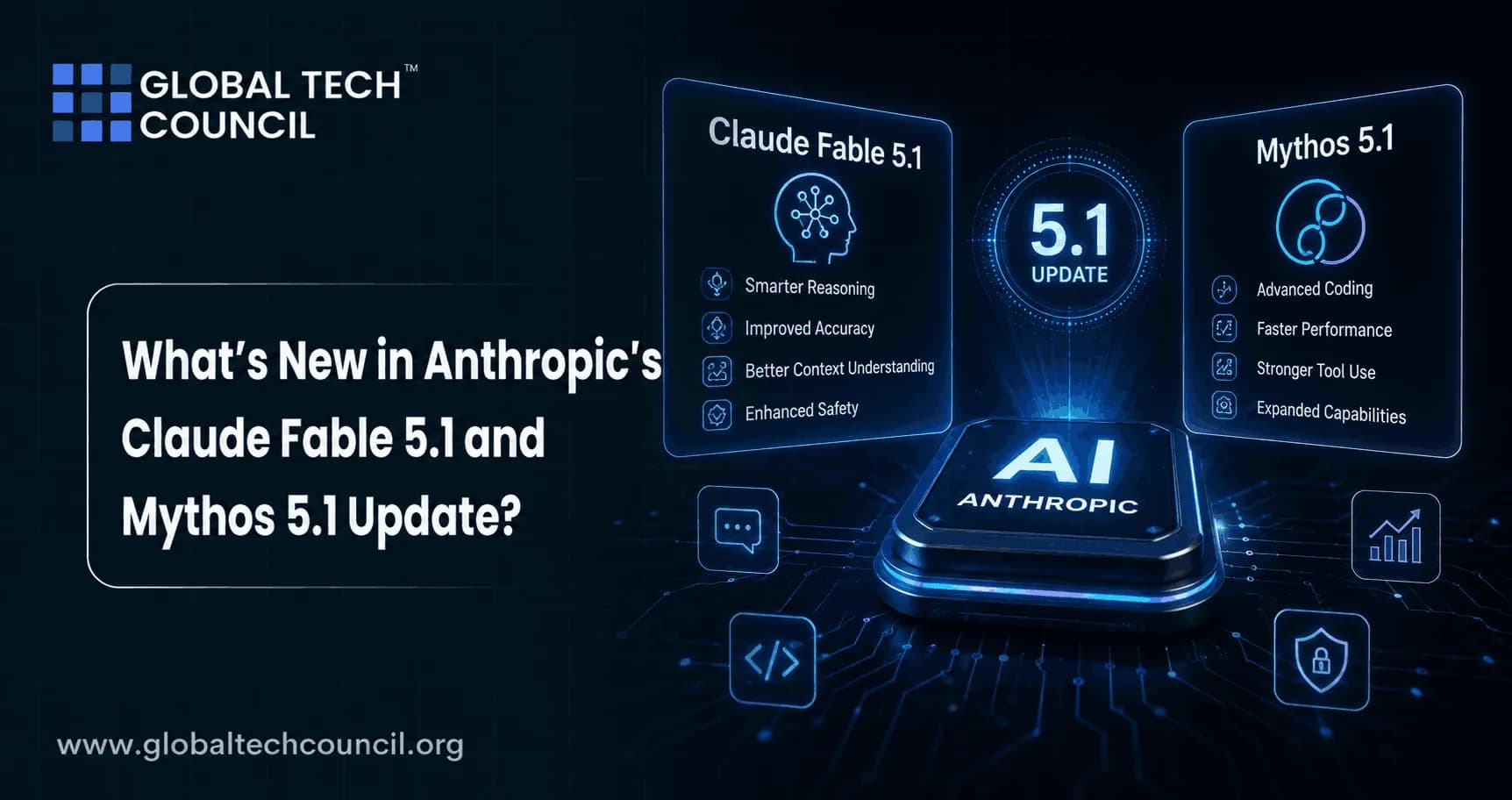
Anthropic shipped Claude Fable 5.1 and its restricted counterpart Mythos 5.1 on September 1, 2026, roughly three months after Fable 5 first went live on June 9. Rather than a full rebuild, this release functions as a focused, mid-cycle refinement, the kind of update companies push out once they have found genuine ways to squeeze more performance and efficiency out of an existing foundation. This guide walks through everything that actually changed, organized by category rather than a single feature list, so both newcomers and experienced developers can quickly find what matters to them. For anyone who wants formal, structured knowledge of the underlying AI concepts behind updates like this, a Certified Artificial Intelligence (AI) Expert certification offers a practical starting point.
A Quick Overview of the Release
Fable 5.1 and Mythos 5.1 are, according to Anthropic, the exact same underlying model, with the difference between them coming entirely from which safety filters get applied. Fable 5.1 is the version available to essentially everyone, reachable through Claude.ai, the Claude API, paid subscription plans, and AWS Bedrock. Mythos 5.1 remains reserved for a narrow group of vetted U.S. organizations working in cybersecurity defense and life sciences research, accessed through Anthropic's trusted access programs rather than general signup.

This release lands within a fairly eventful three-month stretch for the Mythos-class model line, which also included an eighteen-day shutdown triggered by U.S. export control actions before access was restored. Understanding this broader context helps explain why Anthropic is emphasizing stability and refinement with 5.1 rather than introducing a dramatically different architecture so soon after that disruption.
Performance Improvements: Where Fable 5.1 Actually Gets Better
The most talked-about change in this release involves raw benchmark performance. Anthropic reports that Fable 5.1 now beats its own Opus 5 model across every benchmark the company has published, a reversal from Fable 5, which had previously trailed Opus 5 on a handful of specific tests. The single most dramatic jump shows up on a scientific research benchmark, where Fable 5.1 scored 52.6 percent compared to 24.7 percent for Fable 5, more than doubling performance on that particular measure.
Beyond headline benchmark numbers, Anthropic points to improvements in three core areas that shape everyday usability: reasoning, accuracy, and response speed. These are not flashy, visible new features so much as steady quality improvements that show up gradually in how consistently the model handles multi-step logic and layered questions, particularly across long coding sessions and extended research tasks. Real-world testing cited by outside reporting, including a case involving an investment firm using Fable 5.1 to track down a rare internal system bug that had stumped human engineers and competing AI models alike, reflects this kind of practical reasoning improvement rather than a purely synthetic benchmark gain.
One genuinely new capability worth highlighting is mid-conversation effort control, currently in beta. This lets a user adjust how much computational effort the model applies to a specific step mid-session, without needing to close out and restart an entirely new conversation. For longer, more complex sessions where task difficulty varies significantly from one step to the next, this kind of flexibility can meaningfully improve both efficiency and cost control.
Safety and Filtering Changes: Fewer False Positives
A quieter but genuinely significant part of this update involves how Anthropic tuned its safety filtering systems. Rather than loosening restrictions broadly, the company reports making its filters considerably more precise, reducing unnecessary refusals without removing the underlying protections themselves.
Specifically, the cybersecurity-related filter now triggers roughly 60 percent less often per session within Claude Code, meaning legitimate security research and defensive vulnerability work should encounter far fewer unnecessary interruptions than under Fable 5. On the biology side, the filter tied to medical and health-related questions reportedly fires about 85 percent less often on ordinary, non-sensitive medical queries, addressing a common complaint that earlier filtering sometimes flagged completely benign healthcare questions.
It's worth being clear about what did not change here. Fable 5.1 will still decline or redirect requests that touch on cyberattacks or dangerous biology, and functions like exploit writing or penetration testing generation remain routed specifically to Anthropic's Opus model line rather than being available through either Fable 5.1 or Mythos 5.1. The improvement is precision, not permissiveness.
Developing genuine familiarity with how Claude specifically applies these kinds of safety systems, rather than relying on secondhand summaries, benefits considerably from focused, hands-on study. A Certified Claude AI Expert certification covers exactly this kind of platform-specific depth, helping professionals understand not just what changed but why Anthropic designed the system this particular way.
Access and Availability: Who Gets What
Availability is one of the more layered aspects of this release, and it is worth spelling out clearly. Fable 5.1 is generally available today to anyone with a paid Claude plan or Claude API access, and it is also offered through AWS Bedrock for teams already working within that cloud ecosystem.
Mythos 5.1, by contrast, requires enrollment in one of two specific trusted access programs. The first covers cybersecurity professionals working in a defensive capacity, allowing Mythos 5.1 to assist with identifying software vulnerabilities as legitimate security research rather than offensive exploit development. The second, newly introduced with this release, is the Life Sciences Verification Program, which allows vetted scientists to access Mythos 5.1's expanded biology capabilities for genuine research purposes. Anthropic has indicated that broader, open enrollment for scientists is coming, though no specific date has been announced publicly.
This structure reflects a deliberate choice on Anthropic's part: rather than making the more permissive version of the model widely available, access stays limited to people and organizations who have gone through a specific vetting process tied to their professional context.
Pricing: What Costs the Same and What Got Cheaper
For anyone budgeting around this model, the headline token pricing has not moved. Input tokens remain priced at ten dollars per million, and output tokens remain priced at fifty dollars per million, identical to Fable 5's rates. The meaningful pricing change sits specifically in cache read costs, which dropped 75 percent, from one dollar per million tokens down to twenty-five cents per million tokens.
This distinction matters because cache pricing disproportionately affects certain kinds of workloads. Long coding sessions, multistep research tasks, and agentic workflows that repeatedly reference earlier context all rely heavily on cached tokens rather than fresh input every time. Anthropic estimates this change delivers roughly a 25 percent overall cost reduction for typical workloads, climbing to as much as 45 percent for heavily agentic use cases that lean hardest on cached context.
For teams and consultants who need to explain a change like this clearly to clients or leadership who may not follow token pricing closely, a Marketing Certification builds the communication skills needed to translate a technical pricing shift into a clear, compelling business case.
Transparency Features: Watermarking and Content Tracking
A new addition in this release involves content provenance, specifically an embedded watermark applied to Fable 5.1's outputs. This feature ties directly to compliance obligations under the EU AI Act, which requires certain AI-generated content to carry identifiable markers. Alongside the watermark itself, Anthropic has introduced a detection API, though it remains in private preview and is currently limited to a specific set of eligible groups, including regulators, media organizations, academic researchers, and EU civil society organizations rather than being broadly accessible.
This kind of transparency infrastructure reflects a broader trend across the AI industry, where regulatory requirements increasingly shape not just what models can generate, but how that generated content gets tracked and verified after the fact.
AI & Technology
As artificial intelligence continues to transform education, students are getting more opportunities to explore technology beyond traditional classroom learning. A Tech Olympiad can help students develop their understanding of AI, logical reasoning, problem-solving, and other technology skills through structured competition.
What This Update Signals Going Forward
Taken together, these changes suggest Anthropic is prioritizing refinement and precision over dramatic architectural shifts at this stage in the Mythos-class model line's development. Rather than expanding what the model can do in some entirely new direction, most of this release focuses on doing the existing job better: fewer unnecessary refusals, stronger performance on demanding technical tasks, meaningfully lower costs for the workloads that matter most, and new transparency infrastructure required by expanding global regulation.
For professionals trying to track how this fits into the broader landscape of frontier AI development, including how safety filtering, regulatory compliance, and model capability continue to intersect and evolve together, exploring Deep Tech Certification options provides useful context for understanding where this kind of iterative model development is likely heading next.
Conclusion
Claude Fable 5.1 delivers a meaningful, if incremental, upgrade over Fable 5, combining stronger benchmark performance, considerably fewer unnecessary safety refusals, a significant cache pricing cut, and new transparency features tied to emerging regulation, all without changing the model's context window, output limits, or headline token pricing. Mythos 5.1 remains the same core system with loosened filters reserved specifically for vetted cybersecurity and life sciences professionals. Anyone looking to stay current on releases like this benefits from pairing genuine hands-on use with structured learning, since Anthropic's release pace over the past few months shows little sign of slowing down.
FAQs
1. What is new in Anthropic’s Claude Fable 5.1 update?
Claude Fable 5.1 introduces stronger capabilities for long-running agentic work, advanced coding, research, document analysis, and complex knowledge-work tasks. Anthropic positions it as its most capable generally available model, with improvements designed to help Claude work independently for longer periods.
2. What is Claude Mythos 5.1?
Claude Mythos 5.1 is Anthropic’s latest model focused on advanced cybersecurity and biology research. It uses the same underlying model as Fable 5.1 but has different safeguards and remains available only to vetted organizations through Anthropic’s trusted access programs.
3. What is the difference between Claude Fable 5.1 and Mythos 5.1?
Fable 5.1 and Mythos 5.1 use the same underlying model, but their safeguards and availability differ. Fable 5.1 is generally available for demanding coding and knowledge work, while Mythos 5.1 provides more advanced access for approved cybersecurity and life sciences research.
4. Is Claude Fable 5.1 better than Fable 5?
Claude Fable 5.1 is designed to improve on Fable 5 in long-horizon agentic coding, research, and complex professional workflows. Anthropic also reduced cache-read pricing by 75%, which can make many workloads substantially more cost-efficient.
5. How does Claude Fable 5.1 improve AI coding?
Fable 5.1 is designed for large, complex coding projects that can span an entire codebase. It can write tests, review and improve code, identify root causes of problems, implement designs, and use visual information to check whether its output matches the intended result.
6. Can Claude Fable 5.1 work autonomously?
Yes. Fable 5.1 is designed for long-running agentic workflows that can continue for hours and involve multiple applications or tools. It can plan tasks, use tools, recover from failed steps, and provide progress updates while working.
7. What are the main use cases for Claude Fable 5.1?
Key use cases include advanced software development, deep research, document analysis, enterprise knowledge work, browser-based tasks, and complex multi-stage projects. Its long-horizon capabilities make it particularly suitable for work that requires sustained reasoning and limited human supervision.
8. Does Claude Fable 5.1 support vision?
Yes. Fable 5.1 can work with visual information such as diagrams, charts, tables, files, and PDFs. This can be particularly useful for document-heavy workflows in areas such as finance, legal analysis, architecture, and analytics.
9. How much does Claude Fable 5.1 cost?
Claude Fable 5.1 costs $10 per million input tokens and $50 per million output tokens. Cache reads are priced at $0.25 per million tokens, which is 75% lower than Fable 5 and can reduce typical workload costs by about 25%, with highly agentic workloads potentially seeing reductions of up to approximately 45%.
10. Is Claude Fable 5.1 available to the public?
Yes. Claude Fable 5.1 is available to Pro, Max, Team, and Enterprise users. Developers can also access it through Anthropic’s Claude Platform and supported cloud marketplaces, including Amazon Web Services, Google Cloud, and Microsoft Foundry.
11. Who can access Claude Mythos 5.1?
Mythos 5.1 is currently restricted to vetted organizations through Anthropic’s trusted access programs. The programs are aimed at qualified cyberdefenders and life sciences researchers because of the model’s advanced capabilities and associated safety considerations.
12. Why did Anthropic create both Fable 5.1 and Mythos 5.1?
Anthropic created separate versions to balance advanced AI capabilities with safety requirements. Fable 5.1 makes Mythos-level capabilities more broadly available while adding safeguards that limit or redirect certain high-risk cybersecurity and biology requests.
13. What cybersecurity capabilities does Claude Fable 5.1 have?
Fable 5.1 can assist with identifying software vulnerabilities in source code. However, Anthropic says its safeguards restrict areas such as penetration testing, exploit generation, and binary-based vulnerability scanning, with certain requests routed to other Claude models.
14. How does Anthropic’s new safety system work in Fable 5.1?
Fable 5.1 uses more targeted safeguards for sensitive areas such as cybersecurity, biology, and chemistry. Instead of broadly blocking entire categories of requests, Anthropic says some queries can be routed to other models with appropriate safeguards, allowing more benign work to proceed.
15. What improvements does Mythos 5.1 bring to biology research?
Mythos 5.1 is designed to provide advanced capabilities for biology and life sciences research. Anthropic has made access more controlled because these capabilities could potentially be used for both beneficial research and harmful applications.
16. What is the cache pricing change in Claude Fable 5.1?
One of the notable changes is a 75% reduction in cache-read pricing compared with Fable 5. Cache reads now cost $0.25 per million tokens, helping reduce the cost of workloads that repeatedly use large amounts of context, particularly long-running agentic applications.
17. What is the context window of Claude Fable 5.1?
Claude Fable 5.1 has a 1 million token context window and supports a maximum output of 128,000 tokens. This large context capacity is intended to support complex projects involving substantial amounts of code, documents, research material, and other information.
18. Can Claude Fable 5.1 help with research and knowledge work?
Yes. Fable 5.1 is designed for multi-stage research, analysis, document processing, and other professional knowledge-work tasks. Teams can use it for complex projects where Claude can perform multiple steps and deliver work for human review rather than requiring constant supervision.
19. What makes the Claude Fable 5.1 and Mythos 5.1 update important?
The update demonstrates Anthropic’s move toward AI systems capable of handling longer, more autonomous workflows rather than simply answering individual prompts. It also highlights the growing importance of combining advanced reasoning, lower operating costs, enterprise access, and specialized safety controls in frontier AI models.
20. What can users expect from Anthropic’s Claude models after the Fable 5.1 and Mythos 5.1 update?
Users can expect increasingly capable AI systems that can handle more complex coding, research, analysis, and agentic tasks with less continuous supervision. At the same time, Anthropic’s approach suggests that access and safeguards will continue to vary depending on how powerful a model is in sensitive areas such as cybersecurity and biology.
Related Articles
View All
Claude
Claude Fable 5 Vs Claude Opus 4.8
Claude Fable 5 and Claude Opus 4.8 are advanced AI models designed for different performance priorities. This comparison examines their reasoning, creativity, efficiency, and suitability for enterprise and agentic AI applications.

Claude
Why was Fable 5 banned? What the Claude shutdown means
Fable 5 was banned after a US export control directive raised national security concerns about Claude models, jailbreaking, and cyber misuse.
Claude
How Claude Fable 5 Could Transform Generative AI Workflows in 2026
Explore how Claude Fable 5 could reshape 2026 generative AI workflows through goal-driven planning, autonomous coding, governance, and enterprise AI orchestration.
Trending Articles
The Role of Blockchain in Ethical AI Development
How blockchain technology is being used to promote transparency and accountability in artificial intelligence systems.
AWS Career Roadmap
A step-by-step guide to building a successful career in Amazon Web Services cloud computing.
Top 5 DeFi Platforms
Explore the leading decentralized finance platforms and what makes each one unique in the evolving DeFi landscape.