

Claude Will Mark AI Content Globally: Here's What Changed
 Suyash Raizada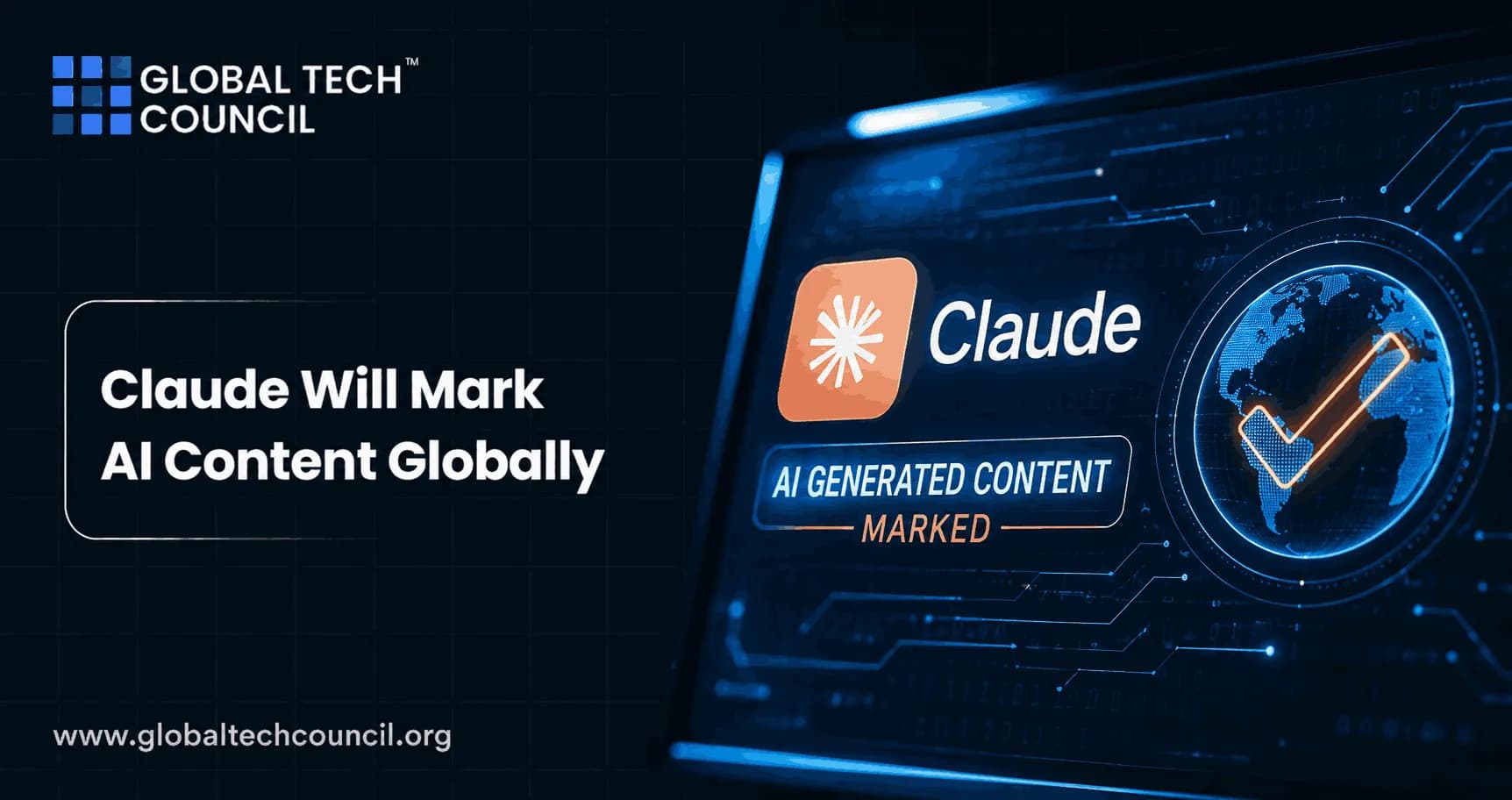
Something quietly shifted in how Claude produces content, and it affects anyone who has ever asked the AI to write, edit, or design something. Anthropic has rolled out a global system for marking Claude's output, moving from a company that generated text and files with no built-in identifier to one that now embeds hidden signals into much of what it creates. Understanding Watermarks for Claude is no longer optional background knowledge. It has become practical information for writers, marketers, developers, and business owners who rely on Claude in their daily work.
This article walks through exactly what changed, why Anthropic made this move, and what it practically means going forward, explained in a way that works whether you are brand new to AI tools or a seasoned professional. For readers who want to build recognized, structured skills around AI platforms rather than just following the news, a broader Tech Certification can provide a solid foundation for understanding how tools like Claude fit into the wider technology landscape.

The Short Version: What Actually Changed
Before this update, Claude generated text and files without any embedded identifier tying the output back to AI. Now, that has changed in a specific and deliberate way. Claude models released on or after August 2, 2026 automatically weave a hidden, machine-readable signal into generated text, and attach signed authenticity metadata to certain generated file types, including SVG, PNG, and JPG formats.
The shift did not happen quietly within a single market. Anthropic extended this marking system across its entire product line, worldwide, rather than limiting it to any one region. That detail surprised many users who assumed a compliance-driven feature like this would stay confined to the jurisdiction that required it.
Why Anthropic Made This Change Now
This update was not simply a product decision made in isolation. It traces back directly to new regulation in the European Union. The EU AI Act's Transparency Code took effect on August 2, 2026, requiring AI companies operating in the region to mark AI-generated or AI-edited content in a way that other systems can recognize and verify.
This requirement falls under Article 50 of the EU AI Act, part of a broader framework known as the Code of Practice on Transparency of AI-Generated Content. The code lays out rules for identifying generated and manipulated material, including specific provisions for labeling deepfakes and other altered content. By late July 2026, close to 200 companies had already agreed to comply with this code, a list that includes Anthropic alongside Meta, Microsoft, and OpenAI.
Rather than building one system exclusively for European users and leaving the rest of its platform untouched, Anthropic chose a unified global approach. This likely reflects a simpler engineering path, since maintaining two separate versions of the same underlying model behavior would add unnecessary complexity, along with a broader industry trend toward treating content transparency as a baseline expectation rather than a regional requirement.
How the New Marking System Actually Works
To understand what changed, it helps to break the system into its two separate components, since text and files are handled differently.
Invisible Signals Inside Generated Text
When Claude produces written content, a pattern gets woven directly into the text itself. Anthropic describes this signal as imperceptible, meaning it does not alter how the writing reads, looks, or sounds to a human reader. There are no strange word choices or awkward phrasing introduced as a side effect.
What makes this particular approach notable is durability. Because the signal lives inside the text rather than in a separate wrapper or file property, it travels along with the content whenever it gets copied and pasted somewhere else. It can also survive certain kinds of editing, at least up to a point.
Signed Metadata Attached to Files
For generated files rather than plain text, Claude instead attaches cryptographically signed metadata using the Coalition for Content Provenance and Authenticity standard, commonly known as C2PA. This is the same open standard used elsewhere in the industry for labeling AI-generated images, which gives Anthropic's approach some consistency with tools people may already be familiar with.
This signed manifest confirms that a file passed through Claude and allows anyone checking it to detect whether the file has since been altered. However, this method is inherently more fragile than the text-based approach. Simple actions such as re-saving the image in different software, converting it to another format, taking a screenshot of it, or uploading it to a platform that automatically strips metadata can remove this signature entirely.
Which Claude Products Are Affected
One of the more surprising parts of this rollout is just how broadly it applies. The marking system now covers Claude across the API and Claude Platform, the standard Claude chat interface, Claude Code, Claude Cowork, and Claude Tag, essentially everywhere Claude is offered, regardless of country.
That said, coverage is not instantly complete across every version of Claude in existence. Only models released on or after August 2, 2026 support the marking system automatically from day one. Anthropic has indicated it is actively working to extend this capability backward to earlier models, though that rollout is happening gradually rather than all at once.
For professionals who work specifically with Claude on a regular basis, building deeper, verified knowledge of how the platform behaves, including features like this one, can be genuinely useful. A Certified Claude AI Expert certification offers a structured way to develop that specialized understanding rather than piecing it together from scattered news articles.
Where the System Falls Short
No transparency mechanism is flawless, and this one has clear, acknowledged limitations worth understanding before relying on it too heavily.
The text-based signal can weaken or disappear entirely if the content undergoes substantial editing, gets paraphrased, is translated into another language, or is blended together with writing from other sources. Very short snippets of text may also simply not contain enough material for the signal to register reliably in the first place.
This creates a genuinely tricky gray area. Content that Claude only lightly touched, such as proofreading a paragraph a human already wrote, formatting an existing document, or translating text originally drafted by a person, might still trigger a detectable mark. That means the presence of a signal does not necessarily indicate the content was originally AI-authored from scratch, only that Claude interacted with it in some capacity.
On the file side, the weakness is more mechanical. Since the C2PA metadata lives outside the actual pixel or vector data of an image, common everyday actions like re-saving, converting formats, or screenshotting will strip it away without much effort. Anyone who genuinely wants to remove this particular signal from a file can generally do so without specialized tools.
How Claude's Approach Compares to Other AI Platforms
Anthropic is not charting entirely new territory here. Google has already deployed its own SynthID technology to embed similar invisible watermarks into AI-generated text. OpenAI, by contrast, has concentrated its transparency efforts primarily on images and audio, and had not publicly detailed an equivalent text-marking system at the time of Anthropic's announcement.
This positions Claude among a smaller group of major AI platforms actively watermarking text output specifically, rather than focusing exclusively on visual or audio media. Given that text remains the most common form of output people request from tools like Claude, this focus arguably carries more everyday relevance for typical users than image or audio marking alone would.
How People Are Reacting
The response to this announcement has been mixed, and not entirely positive. Criticism spread quickly across social platforms, with many users expressing discomfort at the idea that their AI-assisted writing could now be identified after the fact, even in cases involving substantial personal revision.
Part of the concern stems from uncertainty rather than the feature itself. Because the exact threshold for how much editing removes the watermark remains unclear publicly, some users worry that heavily rewritten, largely human-authored work could still get flagged simply because Claude was involved somewhere early in the process. This ambiguity has fueled ongoing debate about where the line between AI assistance and AI authorship should actually sit.
What This Means for Everyday Users
For casual use, the practical impact of this change is minimal. Someone using Claude to draft a quick email or brainstorm ideas is unlikely to notice or care that a hidden signal now exists somewhere in that text.
The impact grows more meaningful for people working in contexts where AI disclosure carries real consequences. Journalists, academic writers, and client-facing marketing professionals in particular should pay closer attention to how this system behaves, since expectations around AI transparency are becoming stricter across many industries, not just within regulated sectors.
Building a stronger foundational understanding of how artificial intelligence systems work more broadly, beyond just Claude specifically, can help professionals navigate these changes with more confidence. A Certified Artificial Intelligence (AI) Expert certification covers the underlying concepts behind generative AI, machine learning, and related technologies, giving learners better context for understanding why features like watermarking exist and how they fit into the bigger picture.
Practical Steps for Working With This Change
Rather than treating this update as something to simply worry about, a few practical adjustments can help individuals and organizations adapt smoothly.
Default to transparent disclosure about AI involvement in your work regardless of whether a watermark exists, since many audiences and clients now expect this openly rather than relying on hidden technical signals. Treat the presence or absence of a detected watermark as one piece of evidence rather than absolute proof, given how easily heavy editing or file conversion can affect detection either way. Keep an eye on Anthropic's ongoing rollout to older Claude models, since coverage will likely keep expanding over the coming months rather than remaining static. Review internal content policies at your organization, particularly if client-facing materials are involved, since this development adds a new technical layer to conversations about AI usage that previously relied purely on internal honesty.
What Comes Next for AI Content Transparency
This change from Anthropic is unlikely to be the last major shift in how AI-generated content gets identified. As similar regulatory pressure continues building in other regions beyond the EU, more AI companies will likely refine and expand their own marking systems over time. The current gaps, including vulnerability to heavy editing and easily stripped file metadata, represent open problems the entire industry will probably keep working to solve rather than issues unique to any single company.
For now, this global rollout of Watermarks for Claude stands as an early but meaningful attempt to make AI-generated content more identifiable at scale, extending well beyond the specific region that originally triggered the requirement.
Learning Path: Turning This Knowledge Into Real Expertise
Understanding a single news development is useful, but building lasting, career-relevant expertise requires going further. A structured path helps turn scattered knowledge into something genuinely valuable professionally.
Start by strengthening your general technology literacy through a Tech Certification, which builds the broader foundation needed to understand how developments like AI watermarking fit into the wider technology landscape. From there, deepen your platform-specific knowledge with a Certified Claude AI Expert certification, focused specifically on how Claude works, including features like content marking and transparency tools.
Once that foundation is solid, broaden further with a Certified Artificial Intelligence (AI) Expert certification to understand the wider principles behind generative AI and machine learning systems as a whole. Finally, professionals responsible for communicating these changes to clients, teams, or audiences can benefit from a Marketing Certification, which helps translate technical AI knowledge into clear, practical business communication.
Following this sequence, from general technology grounding, to platform-specific Claude expertise, to broader AI knowledge, to communication skills, builds a well-rounded professional profile suited to an industry where transparency requirements are only becoming more common.
Conclusion
Claude marking AI-generated content globally represents a real, practical shift rather than a minor technical footnote. What changed is significant: text now carries an embedded, portable signal, files carry signed authenticity metadata, and this behavior applies across every major Claude product worldwide rather than staying confined to Europe. Genuine limitations remain, particularly around heavy editing and file metadata that can be stripped fairly easily, but the direction is clear.
Anyone who wants to stay ahead of these changes benefits from combining hands-on Claude experience with structured learning. Starting with a broad Tech Certification and building toward specialized, verified knowledge helps professionals understand not just how to use Claude effectively, but how its evolving transparency features actually function in practice.
Building Technology Skills Through Competitions
Technology learning can also begin at an early stage through structured academic competitions. The World Tech Olympiad (WTO) is a global technology competition for students from Class 2 to Class 12, offering age-appropriate tracks in areas such as Robotics, Artificial Intelligence, Coding, Computational Thinking, and Cybersecurity.
The Robotics track gives students an opportunity to explore how machines work, how programmed instructions control robotic systems, and how technology can be used to solve real-world problems. Through structured learning and competition, students can develop practical technology awareness along with problem-solving, logical-thinking, and computational skills.
The World Tech Olympiad provides both individual and institutional participation pathways. Parents can directly enroll their children, while schools can register their institution and bring eligible students into the competition. This makes the Robotics Olympiad a practical way for schools and families to introduce students to emerging technologies and encourage early interest in technology-driven learning.
FAQs
1. What does it mean that Claude will mark AI-generated content globally?
Marking Claude-generated content globally would mean introducing provenance, labeling, watermarking, or related mechanisms that help users and platforms identify content created with Anthropic’s AI systems across supported markets. The important distinction is how the marking works. It could involve visible disclosures, machine-readable metadata, cryptographic credentials, or embedded signals. Each approach provides different levels of transparency, persistence, and verification.
2. What changed with Claude’s AI content marking approach?
The key change would be a move toward more systematic identification or provenance of AI-generated content rather than relying entirely on users to disclose AI involvement themselves. Depending on Anthropic’s implementation, markers could travel with supported outputs or provide verification of their origin. This reflects the broader AI industry’s attempt to address content authenticity as synthetic media becomes increasingly difficult to distinguish from human-created material.
3. Why is Anthropic marking Claude-generated content?
AI content marking can improve transparency and help address misinformation, impersonation, fraud, and uncertainty about digital content origins. Provenance signals can give users, publishers, platforms, and organizations additional information when evaluating material created with AI. They can also support responsible AI governance and disclosure policies. The objective is not necessarily to declare AI content untrustworthy, but to make its origin less mysterious, a surprisingly ambitious goal for the modern internet.
4. Will all Claude-generated content receive an AI label?
That depends on the scope and technical design of Anthropic’s system. Different types of Claude outputs may support different provenance mechanisms, and third-party applications using Claude models may handle disclosure differently from Anthropic’s own products. Content that is copied, edited, reformatted, or passed through other systems may also lose certain markers. Users should therefore distinguish a broad content-marking policy from a guarantee that every Claude-generated sentence will permanently carry an identifiable label.
5. Will Claude AI labels be visible to everyone?
Not necessarily. AI content marking can be visible, such as a disclosure shown directly to users, or invisible and machine-readable, such as metadata or cryptographic provenance information. Some systems combine both approaches. Machine-readable signals are useful for platforms and verification tools, while visible disclosures are easier for ordinary users to understand. The effectiveness of a global system depends partly on whether downstream services preserve and display the relevant information.
6. How will Claude identify content created by AI?
AI-generated content can be identified through techniques such as metadata, digital signatures, cryptographic provenance, embedded watermarks, or standardized Content Credentials. Statistical watermarking may also be possible for certain content types. The exact mechanism matters because different techniques respond differently to editing and redistribution. A cryptographically authenticated original file, for example, provides a different kind of evidence from a detector estimating whether a paragraph statistically resembles AI-generated text.
7. Is Claude’s AI content marking the same as watermarking?
Not necessarily. Watermarking typically involves embedding or associating a detectable signal with content, while content marking can include visible labels, metadata, digital signatures, or provenance credentials. Provenance is broader still, potentially documenting how content was generated and modified. These terms are frequently thrown into the same conversational blender, but technically they can describe quite different approaches to establishing content origin.
8. Can Claude’s AI content markers be removed?
Some markers may be lost or weakened when content is copied, edited, translated, paraphrased, compressed, screenshotted, or converted into another format. Metadata-based markers can disappear when platforms strip metadata, while embedded watermarks may have varying levels of robustness. This is why content-authenticity systems increasingly combine multiple approaches. No marker should be assumed to survive every possible transformation or deliberate attempt at removal.
9. What happens when someone edits Claude-generated content?
Editing can affect whether an AI-origin signal remains detectable. Minor modifications may preserve robust provenance or watermark information, while substantial rewriting can break certain text-based signals. File-level provenance may remain attached to an original document but disappear when its contents are copied elsewhere. Systems therefore need to distinguish between verifying an original artifact and attempting to determine the origin of substantially transformed content.
10. Will Claude’s AI marking work across different countries?
A global rollout implies broad geographic availability, but implementation may still vary according to product, content type, platform, and local regulatory requirements. Privacy, AI transparency, consumer protection, and data laws differ significantly between jurisdictions. Anthropic may therefore need technical and policy mechanisms that work internationally while accommodating regional requirements. “Global” in technology remains a wonderfully compact word for a considerable quantity of legal paperwork.
11. How could Claude AI labels help fight misinformation?
AI labels and provenance signals can help users determine whether content originated from a generative system, providing useful context when assessing suspicious material. This can be valuable during elections, conflicts, emergencies, or major news events. However, AI-generated content can be factually accurate, while human-created content can be false. Provenance tells users something about origin, not truthfulness, so fact-checking and source evaluation remain necessary.
12. Can Claude content marking prevent deepfakes and impersonation?
Content marking cannot prevent all deepfakes or impersonation, but it can make authenticated or AI-generated media easier to identify in supported environments. Provenance systems may help show which tools created or modified an image, video, audio file, or other digital artifact. Effective protection against impersonation still requires identity verification, platform enforcement, detection systems, user education, and reliable methods for authenticating genuine content.
13. How will Claude’s AI content marking affect businesses?
Businesses using Claude may need to review how content markers interact with marketing, customer communications, documentation, software workflows, and internal AI governance policies. Provenance can help organizations document responsible AI use, but companies may also need procedures for preserving markers and conducting human review. Organizations operating in regulated industries should pay particular attention to disclosure, recordkeeping, privacy, intellectual-property, and sector-specific requirements.
14. What does Claude’s AI labeling mean for publishers and bloggers?
Publishers using Claude-assisted content should continue prioritizing editorial review, factual accuracy, originality, and disclosure requirements applicable to their audiences or platforms. AI provenance could provide an additional transparency signal, but it does not determine whether an article is useful or trustworthy. Publishers should also avoid assuming that unlabeled content is necessarily human-written. Absence of a marker can result from unsupported systems, editing, metadata removal, or content generated by another model.
15. Will Claude AI labels affect SEO rankings?
An AI label by itself should not be assumed to cause higher or lower search rankings. Search engines generally evaluate content using numerous quality, relevance, authority, and user-experience signals. Publishers should focus on producing accurate, original, useful content that satisfies search intent rather than attempting to manipulate AI-origin indicators. Generating 4,000 words of generic material and then obsessing over whether a tiny provenance marker ruins SEO rather misses the larger quality problem.
16. How could Claude’s content marking affect schools and universities?
Educational institutions could potentially use AI-origin information as one signal when reviewing student work, but it should not be treated as conclusive evidence of academic misconduct. AI policies vary across institutions, and substantial editing can affect provenance signals. Universities should combine transparent AI-use policies with appropriate assessment design and evidence-based review. Automated systems should not make serious academic-integrity decisions solely from uncertain AI-detection results.
17. Does AI content marking create privacy concerns?
It can, particularly if provenance metadata contains unnecessary information about the person who created content, their account, device, location, or activity. Privacy-conscious systems should authenticate relevant facts about content origin without exposing unrelated personal information. Data minimization and clear access policies are therefore important. A mechanism intended to establish that AI helped create a document should not quietly become a mechanism for establishing everything else about the person who requested it.
18. How is Claude content marking different from AI detection tools?
AI detection tools typically analyze finished content and estimate whether it appears to have been generated by an AI model. Content marking introduces or associates provenance information during the creation process. This can provide stronger evidence when the marker is authentic and intact. Detection remains probabilistic, while cryptographically verified provenance can establish specific facts about origin. Neither approach guarantees that heavily transformed content can always be classified correctly.
19. Will global AI content marking become an industry standard?
AI content provenance is increasingly important as synthetic media becomes more sophisticated, and industry-wide standards could make authenticity signals more useful across platforms. Standardized approaches allow different applications, publishers, social networks, and verification services to interpret provenance consistently. Fragmented proprietary systems would be less effective because each platform would need separate verification methods. The long-term value of AI marking therefore depends heavily on interoperability and adoption across the broader digital ecosystem.
20. What does Claude’s global AI content marking mean for the future of generative AI?
Global content marking points toward a future where provenance may become a routine part of digital publishing. Instead of trying to determine whether every piece of content “looks AI-generated,” users may increasingly rely on authenticated information about how important digital material was created or modified. The difficult part will be preserving provenance through editing and distribution while protecting privacy. If implemented well, AI content marking could shift the debate from unreliable guesswork toward more verifiable content authenticity.
Related Articles
View All
Claude
How to Use Claude Fable 5.1 for Free: A Complete Guide
Want to use Claude Fable 5.1 for free? Learn about its current availability, supported Claude plans, access options, and what you need to know before getting started.

Claude
What’s New in Anthropic’s Claude Fable 5.1 and Mythos 5.1 Update?
Anthropic’s Claude Fable 5.1 and Mythos 5.1 update improves coding, long-running agentic tasks, scientific research, vision, and complex knowledge work. Fable 5.1 also cuts cache-read pricing by 75%, which Anthropic estimates can reduce typical workload costs by about 25% and highly agentic workloads by up to 45%. Mythos 5.1 uses the same underlying model with different safeguards and remains restricted to vetted organizations for advanced cybersecurity and life-sciences work.

Claude
Getting Started with Claude Sonnet 5: A Beginner's Guide to Prompting and Productivity
Learn how to use Claude Sonnet 5 for prompting, coding, research, document analysis, and daily productivity with practical beginner workflows.
Trending Articles
The Role of Blockchain in Ethical AI Development
How blockchain technology is being used to promote transparency and accountability in artificial intelligence systems.
AWS Career Roadmap
A step-by-step guide to building a successful career in Amazon Web Services cloud computing.
Top 5 DeFi Platforms
Explore the leading decentralized finance platforms and what makes each one unique in the evolving DeFi landscape.