

What is Data? Definition, Types, Examples, and Why Data Matters
 Suyash Raizada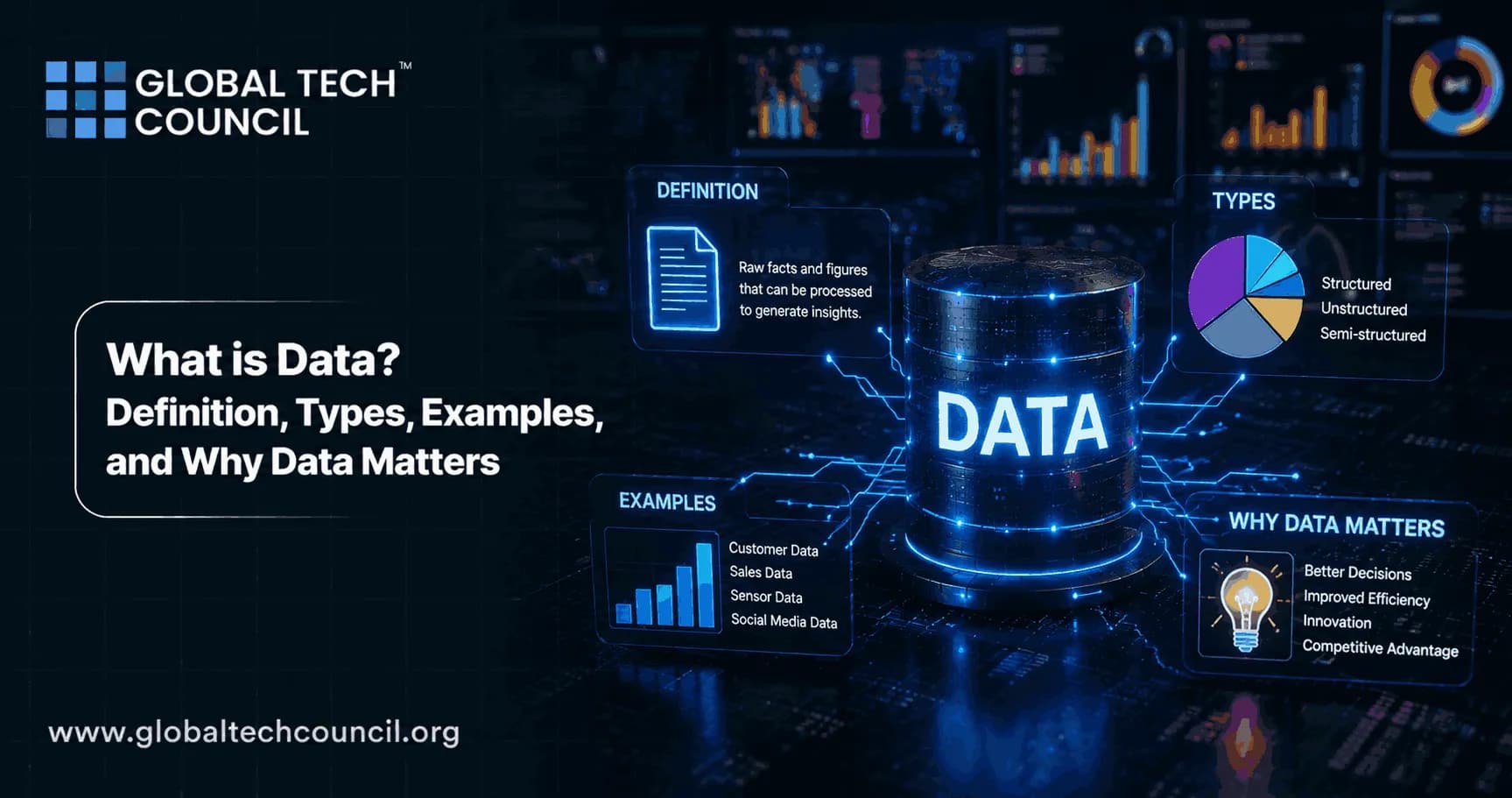
Data is the raw, unprocessed facts and observations collected from the physical world, digital systems, or human activity. On its own, data can appear as numbers, text, images, audio, logs, clicks, or sensor readings. Its real value emerges when data is organized, analyzed, and interpreted to support decisions, automate processes, and generate measurable insights.
Data is also tightly connected to AI, governance, and public accountability. The U.S. government maintains Data.gov as a major open data portal, listing hundreds of thousands of datasets, illustrating how large-scale data publishing can support transparency and innovation. Turn raw information into practical business value by building analytical expertise with a Data Science Certification, understanding intelligent systems through an AI Expert Course, and learning how to apply data-driven strategies with a Marketing Certification.

What is Data in Simple Terms?
At a practical level, data is the raw material that can be transformed into useful outcomes. A working professional definition is:
Data is the raw material that becomes information, insight, and action when it is collected, cleaned, organized, and analyzed.
This distinction matters in business, engineering, and analytics:
Data = raw facts (for example, a temperature reading of 22.4 degrees C)
Information = processed data with context (for example, "server room temperature is within normal range")
Insight = interpreted information that supports a decision (for example, "cooling settings can be reduced to save energy without risk")
Knowledge = repeated insights validated over time (for example, "this configuration reliably reduces energy costs in summer months")
The Current State of Data: Key Shifts in 2025
Organizations increasingly treat data as a strategic asset, comparable to capital equipment or intellectual property. Several shifts are shaping how enterprises manage and use data.
1) Data Volumes Continue to Grow
Cloud applications, mobile devices, connected infrastructure, digital payments, and IoT sensors generate continuous streams of data. This pushes demand for scalable storage, resilient pipelines, and efficient analytics.
2) Data is Increasingly Tied to AI
Modern AI systems depend on large, high-quality datasets for training, fine-tuning, and evaluation. This makes data quality, provenance, labeling accuracy, and bias management central concerns. Poor data quality tends to surface as unreliable outputs and degraded model performance.
3) Data Governance is a Board-Level Issue
Regulators and enterprise leaders focus on:
Privacy and consent management
Security controls and breach readiness
Data lineage and auditability
Retention, deletion, and purpose limitation
Cross-border data transfers
Ethical use of personal and sensitive data
EU GDPR remains a widely referenced benchmark for privacy governance, and sector-specific requirements in healthcare, finance, and telecom continue to influence how data is stored and shared.
4) Open Data Ecosystems are Expanding
Governments and global institutions publish more public datasets to support research, policy, and innovation. Notable examples include Data.gov in the United States, NTIA Data Central for internet-use research, and the World Bank Open Data ecosystem, which includes Data360 resources for development analysis.
Types of Data
Understanding the main types of data helps professionals choose the right storage systems, tools, and governance controls.
Data Types by Structure
Structured data: Organized in rows and columns, such as spreadsheets and SQL databases.
Semi-structured data: Has some structure but no rigid schema, such as JSON, XML, and many log formats.
Unstructured data: No predefined model, such as emails, PDFs, images, audio, video, and social media posts.
Data Types by Source
First-party data: Collected directly by an organization (for example, app events or customer transactions).
Second-party data: Shared by another organization (for example, a strategic partner providing aggregated demand signals).
Third-party data: Purchased or obtained from external providers.
Open data: Public datasets published by governments and institutions.
Data Types by Nature
Qualitative data: Descriptive, non-numeric information (for example, interview notes or written feedback).
Quantitative data: Numeric data that can be measured and analyzed (for example, conversion rates or sensor measurements).
Why Data Matters
Data enables organizations to move from intuition to evidence-based decision-making. When managed properly, data supports performance measurement, automation, personalization, risk management, and scientific discovery.
Better decisions: Leaders can evaluate outcomes based on metrics rather than assumptions.
Operational efficiency: Analytics can reveal bottlenecks and cost drivers.
Automation and AI: Well-governed data unlocks predictive models and intelligent workflows.
Personalized experiences: Product and marketing teams tailor experiences using behavioral and preference data.
Cybersecurity and fraud detection: Security teams use logs and anomaly detection to identify threats and suspicious activity.
Public transparency: Open data initiatives support accountability and research.
Real-World Examples of Data in Action
Data is used differently depending on the domain, but the core lifecycle is consistent: collect, store, clean, analyze, and act.
Business Intelligence and Analytics
Companies use sales, customer, and operational data to track performance and forecast demand. A retail business might combine transaction records, inventory data, and web clickstream data to optimize supply chain decisions.
Healthcare
Hospitals and research teams use patient records, imaging data, and clinical outcomes to improve care quality and resource allocation. Paired with strong privacy controls, data supports population health analysis and clinical research.
Finance and Banking
Banks use transaction data and behavioral signals for fraud detection, credit scoring, and anti-money laundering monitoring. High-quality, well-labeled datasets can improve detection accuracy while reducing false positives.
Government and Public Policy
Public agencies rely on census, labor, education, transportation, and health data to allocate budgets and evaluate programs. The U.S. Bureau of Labor Statistics regularly publishes employment indicators, and the U.S. Bureau of Economic Analysis reports national economic measures such as personal income, illustrating how official datasets underpin economic planning.
Web and Mobile Platforms
Digital platforms measure engagement using event data such as clicks, scrolls, and session duration. This data helps product teams improve user experience and build recommendation systems.
AI and Machine Learning
AI performance depends on data coverage, accuracy, and governance. Training and evaluation pipelines typically require:
Clear dataset documentation and provenance
Bias checks and representativeness testing
Labeling guidelines and quality audits
Access controls for sensitive attributes
Data Governance and Regulation: What Professionals Should Know
As data use expands, regulation and governance frameworks are tightening. Common governance requirements include data minimization, purpose limitation, user access and deletion rights, and stricter controls on sensitive data.
Effective governance requires operational capabilities, not just policies. In practice, this typically includes:
Data classification (public, internal, confidential, regulated)
Lineage and audit trails to explain where data originated and how it changed
Retention and deletion schedules aligned to legal and business needs
Access control using least privilege and role-based permissions
Security monitoring for misuse, exfiltration, or unusual access patterns
For teams building AI systems, governance increasingly extends to dataset documentation, training data controls, and traceability to support accountability.
Future Outlook: Where Data is Heading
Several trends are likely to shape the next phase of how organizations collect, manage, and use data.
Data Platforms Will Become More AI-Native
Data stacks are evolving to better support AI workflows through automated quality checks, metadata enrichment, and support for vector and multimodal data. Retrieval-augmented generation pipelines also increase demand for well-indexed, high-quality enterprise data.
Governance Will Tighten Further
More organizations will implement stronger controls over source verification, lineage, sensitive data exposure, and compliance reporting. This is especially relevant where AI outputs affect customers, hiring, credit, healthcare, or security decisions.
Synthetic Data Will Grow
Synthetic data is increasingly used for testing, privacy-preserving analytics, and AI training when real data is sensitive or limited. It can reduce exposure risks, but still requires validation to ensure it reflects accurate statistical properties.
Real-Time Data Will Become More Valuable
Industries such as logistics, manufacturing, finance, and cybersecurity benefit from real-time pipelines that reduce latency between detection and action.
Data Literacy Will Remain a Core Skill
As more roles depend on metrics and AI-assisted tools, data literacy is essential to avoid misinterpretation, poor KPI design, and biased conclusions.
Building Practical Skills in Data and Analytics
Professionals looking to strengthen their foundations in data should focus on a mix of technical and decision-oriented capabilities:
Data fundamentals: structure, formats, collection, and measurement basics
Data management: cleaning, validation, and integration across sources
Analytics: descriptive metrics, experimentation, and forecasting fundamentals
AI readiness: labeling, documentation, and bias-aware evaluation
Governance and security: privacy, access control, and lifecycle management
Explore how data powers modern decision-making, automation, and innovation by advancing your skills through a Machine Learning Certification, strengthening your foundation with a Data Science Certification, and expanding your AI knowledge with an AI Expert Course.
Conclusion
Data is the foundation of modern digital systems, analytics, AI, and evidence-based decision-making. It starts as raw facts but becomes valuable when organized, interpreted, and governed responsibly. Data volumes are expanding rapidly, AI dependence on high-quality datasets is growing, and regulatory expectations are tightening, while open data ecosystems like Data.gov, NTIA Data Central, and World Bank Open Data continue to make public datasets more accessible.
For professionals, the key is to treat data as a lifecycle: collect with purpose, maintain quality, secure access, document lineage, and convert analysis into action. This approach improves performance today and builds long-term resilience as data becomes even more central to technology and society.
FAQs
1. What is data?
Data refers to raw facts, figures, observations, or information collected for analysis and decision-making. It can exist in various forms, including numbers, text, images, audio, and video, and serves as the foundation for generating insights.
2. Why is data important?
Data helps individuals and organizations make informed decisions, identify trends, and improve processes. In today's digital world, data is considered a valuable asset that drives innovation, efficiency, and competitive advantage.
3. What are the main types of data?
The main types of data are structured, semi-structured, and unstructured data. Each type differs in how it is organized, stored, and processed within information systems.
4. What is structured data?
Structured data is highly organized and stored in predefined formats such as rows and columns within databases. Examples include customer records, financial transactions, and inventory data.
5. What is unstructured data?
Unstructured data lacks a predefined format and is often more difficult to analyze. Examples include emails, social media posts, videos, images, and audio recordings.
6. What is semi-structured data?
Semi-structured data contains some organizational elements but does not fit neatly into traditional database structures. Common examples include XML files, JSON documents, and web data.
7. What are examples of data in everyday life?
Examples of data include online purchases, website visits, GPS locations, social media interactions, fitness tracker readings, and banking transactions. These activities continuously generate valuable information.
8. How is data collected?
Data can be collected through surveys, sensors, websites, applications, transactions, IoT devices, and user interactions. Organizations use various methods depending on their objectives and data requirements.
9. What is qualitative data?
Qualitative data describes characteristics, qualities, or attributes rather than numerical values. Examples include customer feedback, interviews, reviews, and descriptive observations.
10. What is quantitative data?
Quantitative data consists of numerical values that can be measured and analyzed statistically. Examples include sales figures, temperatures, revenue, and website traffic metrics.
11. What is big data?
Big data refers to extremely large and complex datasets that cannot be efficiently processed using traditional methods. Organizations use advanced technologies to analyze big data for valuable insights.
12. How does data support decision-making?
Data provides evidence-based insights that help organizations evaluate performance, identify opportunities, and reduce uncertainty. Data-driven decisions are often more accurate and effective than assumptions.
13. What is data analysis?
Data analysis is the process of examining, cleaning, transforming, and interpreting data to discover meaningful patterns and insights. It helps organizations make better strategic and operational decisions.
14. What is data quality?
Data quality refers to the accuracy, completeness, consistency, and reliability of data. High-quality data is essential for producing trustworthy analyses and effective business outcomes.
15. What is the difference between data and information?
Data consists of raw facts and figures, while information is processed data that has meaning and context. Information helps people understand situations and make informed decisions.
16. How is data used in artificial intelligence?
AI systems rely on data to learn patterns, train models, and make predictions. The quality and quantity of data directly influence the accuracy and effectiveness of AI applications.
17. What are common challenges in data management?
Organizations often face challenges such as data silos, poor data quality, security risks, privacy concerns, and difficulties integrating data from multiple sources. Effective governance helps address these issues.
18. Why is data security important?
Data security protects sensitive information from unauthorized access, theft, or misuse. Strong security measures help maintain trust, comply with regulations, and reduce business risks.
19. What is data governance?
Data governance is the framework of policies, processes, and standards used to manage data throughout its lifecycle. It ensures data quality, security, compliance, and accountability across an organization.
20. What is the future of data?
The future of data involves greater use of AI, real-time analytics, automation, and cloud technologies. As data volumes continue to grow, organizations will increasingly rely on advanced tools to extract value from information.
Related Articles
View All
Data Science
What are the 4 Types of Data?
Learn the 4 types of data, nominal, ordinal, discrete, and continuous, with simple examples, comparison tables, and tips to classify any dataset.
Data Science
Best Power BI Projects for Beginners to Practice Data Analytics Skills
Practice Power BI with beginner-friendly projects in sales, churn, HR, finance, operations, DAX, and publishing using realistic business data.
Data Science
Power BI Data Visualization Best Practices for Clear and Actionable Dashboards
Learn practical Power BI data visualization best practices for clear, fast, and actionable dashboards using better layout, chart choice, color, interactivity, and performance tuning.
Trending Articles
The Role of Blockchain in Ethical AI Development
How blockchain technology is being used to promote transparency and accountability in artificial intelligence systems.
AWS Career Roadmap
A step-by-step guide to building a successful career in Amazon Web Services cloud computing.
Top 5 DeFi Platforms
Explore the leading decentralized finance platforms and what makes each one unique in the evolving DeFi landscape.