

Spring Boot for Java Developers: Essential Skills for Modern Backend Development
 Suyash Raizada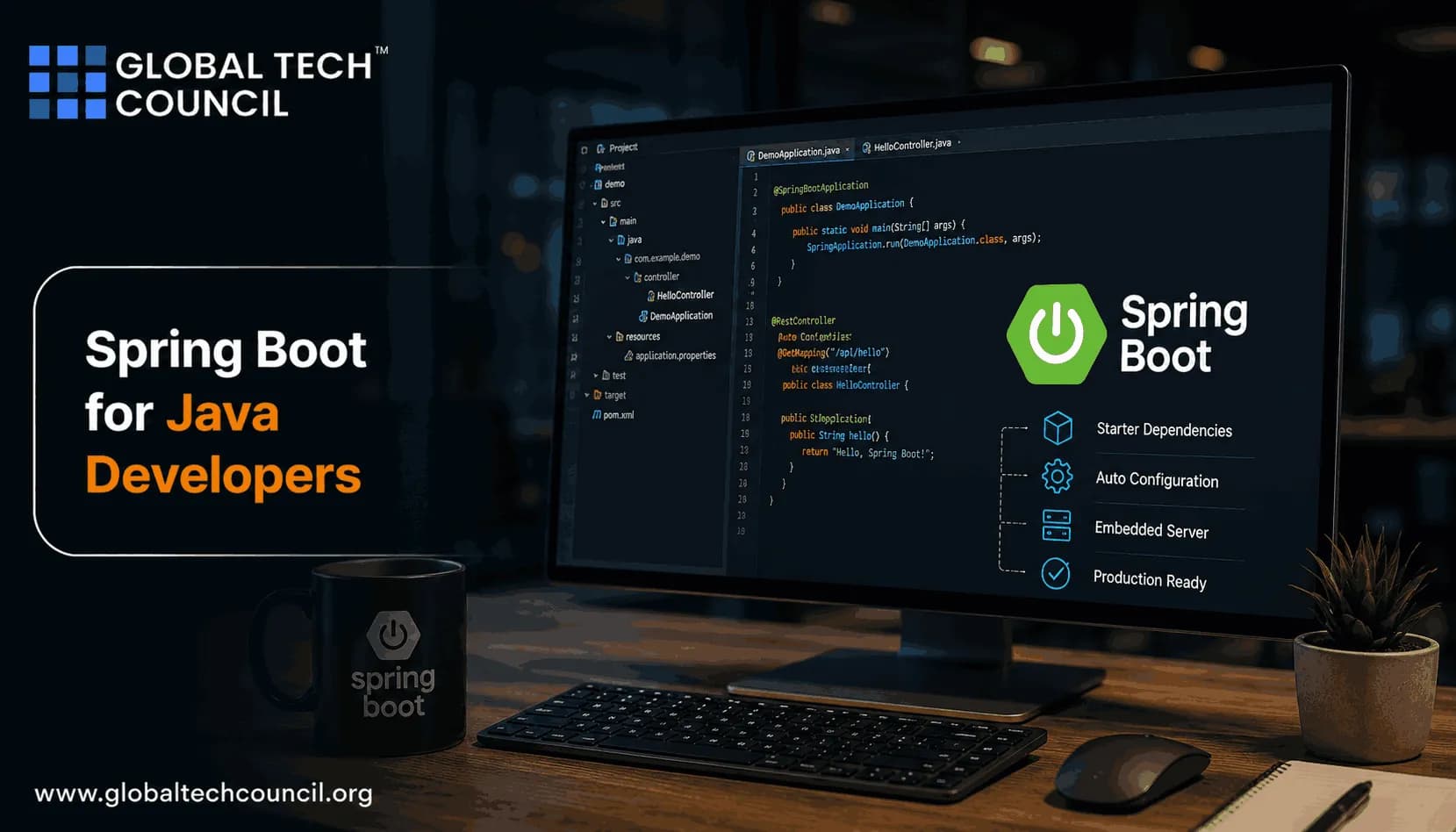
Spring Boot for Java developers is no longer a nice extra skill. If you build Java backends for APIs, enterprise systems, cloud platforms, or microservices, Spring Boot is usually the default starting point. It cuts setup time, ships with production features, and fits the way modern systems are deployed.
That does not mean every Java service must use it. A tiny command-line utility may not need Spring at all. But for web APIs, data services, secured backend systems, and cloud-native applications, Spring Boot gives you a practical foundation that plain Java or raw Spring Framework would take much longer to assemble.

What Spring Boot Actually Does
Spring Boot is an open-source Java framework built on top of the Spring Framework. Its main job is simple: help you create standalone, production-grade Spring applications with far less manual configuration.
The framework makes web application and microservice development with Spring faster. It removes much of the manual setup that older Spring projects required, which is why cloud providers like Microsoft Azure treat it as one of the most approachable parts of the Spring ecosystem.
The parts that matter day to day
Autoconfiguration: Spring Boot inspects your classpath and configures common components automatically.
Embedded servers: Tomcat, Jetty, and Undertow can run inside your application package.
Executable JARs: You can start many services with
java -jar app.jar.Externalized configuration: Use properties, YAML, environment variables, and profiles for different environments.
Production endpoints: Spring Boot Actuator adds health checks, metrics, and management endpoints.
That combination is why teams reach for Spring Boot when they need a backend that can be built, tested, containerized, monitored, and deployed without weeks of plumbing work. Spring Boot has become one of the most popular frameworks for building enterprise-grade Java applications, REST APIs, and cloud-native microservices. Pursuing a Tech Certification helps developers strengthen their expertise in Java programming, Spring Boot, backend architecture, RESTful services, cloud computing, and modern software engineering practices. These certifications prepare professionals to build scalable, secure, and high-performance backend applications that meet evolving enterprise requirements.
Why Spring Boot Became the Java Backend Standard
1. It removes a lot of configuration noise
Older Spring applications often had pages of XML or hand-written bean configuration. Spring Boot changed that workflow. Add the right starter dependency, define your application class, and Boot wires up sensible defaults.
Add spring-boot-starter-web and you get Spring MVC, JSON handling through Jackson, validation support, and an embedded servlet container. Add spring-boot-starter-data-jpa and Boot prepares the pieces needed for repository-based database access.
This is not magic. It is conditional configuration. Once you understand that, debugging becomes much easier. A common beginner mistake is adding multiple database drivers and then wondering why the wrong auto-configuration path runs. Check the dependency tree first. It saves time.
2. It matches cloud-native deployment models
Modern backend teams do not deploy WAR files to shared application servers as often as they used to. They build containers, push images, define health probes, and roll services across Kubernetes, Azure Spring Apps, AWS, Google Cloud, or private platforms.
Spring Boot fits this model well. A service can expose /actuator/health for readiness checks, read configuration from environment variables, and run as a single process inside a container. Spring Cloud adds patterns such as centralized configuration, service discovery, gateway routing, and circuit breakers through tools like Spring Cloud Gateway and Resilience4j.
For Java developers moving from monoliths to microservices, this matters. You do not just learn annotations. You learn how services behave under failure, latency, and partial outages.
3. It gives you production features early
Spring Boot Actuator is one of the first modules you should learn after basic REST controllers. It exposes health, metrics, environment details, loggers, and more, depending on your configuration.
Be careful, though. Do not expose every Actuator endpoint publicly. I have seen staging systems leak environment details because someone set management.endpoints.web.exposure.include=* and forgot to lock it down. In production, expose only what you need, secure management endpoints, and separate internal monitoring traffic from public API traffic.
This is where Spring Boot becomes more than a coding framework. It teaches operational habits: health checks, structured logs, metrics, configuration discipline, and safer rollout patterns. Modern software development increasingly intersects with artificial intelligence, blockchain, cloud computing, and intelligent automation. Becoming a Deeptech Expert equips professionals with interdisciplinary expertise in emerging technologies, enabling them to understand how advanced systems work together to solve real-world business challenges. This broader technical foundation helps developers innovate faster, adapt to evolving technology trends, and build future-ready solutions across industries.
Spring Boot 3 and the Jakarta Shift
Spring Boot 3 is a major line for modern Java development. It requires Java 17 or later and is based on Spring Framework 6. The biggest practical migration detail is the move from Java EE package names to Jakarta EE package names.
If you upgrade an old application too quickly, you may hit errors like this:
java.lang.ClassNotFoundException: javax.servlet.Filter
The fix is not to copy random JARs into the build. Update imports from javax.servlet to jakarta.servlet, upgrade compatible libraries, and verify that dependencies support Spring Boot 3. This one issue has slowed many real migrations because older security filters, servlet libraries, and generated code still reference javax.*.
Spring Boot has a long, active release history, with hundreds of versions shipped over the project's life. That steady maintenance is one reason enterprises trust it. Regular releases matter for security patches and long-term support.
Where Spring Boot Fits in Modern Backend Architecture
REST APIs and enterprise services
Most Java developers first meet Spring Boot through REST APIs. You create controllers with @GetMapping, @PostMapping, @PutMapping, and @DeleteMapping. You add validation, global exception handling, DTO mapping, and repository access through Spring Data JPA.
A typical stack might use Spring Boot 3, Java 21, PostgreSQL, Flyway for database migrations, Spring Security for authentication, and Docker for packaging. That is a practical backend stack, not a toy setup.
Microservices
Spring Boot is heavily used for microservices because it makes each service independently runnable. Spring Cloud extends that with configuration servers, gateways, client-side communication, tracing integrations, and resilience patterns.
Netflix is one of the best-known examples. Netflix engineers have said publicly that most of their services are based on Spring Boot. The important detail is not only scale. It is maintenance. Large engineering organizations do not want to rewrite framework foundations every few years.
Reactive systems
Spring WebFlux, built on Project Reactor, supports nonblocking request handling. Use it when you have high concurrency and a real nonblocking chain, such as reactive database drivers or calls to many external APIs.
Do not use WebFlux just because it sounds advanced. If your service is mostly blocking JDBC calls, Spring MVC is often simpler and just as effective. Reactive programming pays off when the whole path is designed for it.
Native compilation and serverless
Spring Boot has improved support for GraalVM native images. Native executables can start faster and use less memory, which helps in containers and serverless workloads. The trade-off is build complexity. Reflection-heavy libraries may need configuration, and build times can be longer.
Use native compilation when startup time or memory cost is a real constraint. For a steady long-running API, a regular JVM deployment may still be the better engineering choice.
AI-enabled Java applications
The Spring ecosystem now includes generative AI and AI application patterns. Spring Boot often acts as the API and orchestration layer around model calls, vector databases, business rules, security, and user-facing workflows.
This is a sensible role for Java. Python may remain dominant for model research, but many enterprises still want Java for controlled backend services, auditability, security integration, and long-running production systems. Backend applications deliver greater business value when they are aligned with customer needs and organizational goals. A Marketing Certification helps professionals strengthen skills in product strategy, customer-centric thinking, digital communication, and go-to-market planning. These capabilities enable developers to collaborate effectively with business teams while building backend systems that support long-term product success.
What Java Developers Should Learn First
If you are learning Spring Boot, follow a sequence. Random tutorials can leave gaps.
Core Java: Collections, streams, exceptions, records, generics, and concurrency basics.
Spring fundamentals: Dependency injection, beans, application context, profiles, and configuration.
Spring Boot web: REST controllers, validation, error handling, OpenAPI documentation, and testing.
Data access: Spring Data JPA, transactions, pagination, database migrations, and query tuning.
Security: Spring Security, JWT, OAuth 2.0 concepts, CSRF, CORS, and secure defaults.
Operations: Actuator, logging, metrics, Docker, CI/CD, and deployment health checks.
Advanced architecture: Spring Cloud, messaging, resilience, tracing, WebFlux, and native images.
For structured learning, Global Tech Council's Java programming, cloud computing, cybersecurity, DevOps, and AI certification paths cover these skills in order. If your goal is backend engineering, pair Java and Spring Boot practice with cloud deployment and application security training. That combination is much more useful than framework knowledge alone.
Common Mistakes to Avoid
Putting business logic in controllers: Keep controllers thin. Move rules into services.
Ignoring transactions: Learn how
@Transactionalbehaves with proxies and method visibility.Exposing Actuator carelessly: Lock down sensitive endpoints.
Overusing microservices: A modular monolith is often better until team boundaries and scaling needs justify service separation.
Skipping tests: Use
@SpringBootTestcarefully, and prefer slice tests such as@WebMvcTestwhen full context loading is unnecessary.
Why Enterprises Continue to Choose Spring Boot
Enterprises choose Spring Boot because it balances productivity with control. It works with mature Java tooling, supports long-lived applications, integrates with security systems, and has strong support from cloud providers.
Microsoft Azure's Spring Boot guidance points to active work in reactive programming, native compilation, cloud-native microservices, and AI-powered applications. The Spring project itself covers web, data, security, monitoring, messaging, serverless workloads, event-driven systems, batch jobs, and generative AI applications.
That breadth is hard to replace. A smaller framework may be faster for a narrow use case, but Spring Boot wins when a team needs web, data, security, monitoring, messaging, and cloud integration under one proven ecosystem.
Final Takeaway
Spring Boot is essential because modern Java backend work is no longer just about writing endpoints. You need configuration management, security, observability, deployment readiness, resilience, and cloud fit from the start.
Build one complete Spring Boot 3 service next: REST API, PostgreSQL, Spring Security, Actuator, Docker, tests, and a small CI pipeline. Then connect that project to a Global Tech Council Java or cloud certification path so your learning is structured, measurable, and aligned with real backend roles.
FAQs
1. What Is Spring Boot and Why Is It Important for Java Developers?
Spring Boot is a Java framework that simplifies backend application development by providing auto-configuration, embedded servers, production-ready features, and rapid application setup. It is widely used to build scalable web applications, REST APIs, and microservices.
2. Why Should Java Developers Learn Spring Boot?
Spring Boot is one of the most in-demand Java frameworks for enterprise development. Learning Spring Boot helps developers build cloud-native applications, backend services, RESTful APIs, and microservices that meet modern business requirements.
3. What Skills Are Required to Learn Spring Boot?
Developers should understand Java fundamentals, object-oriented programming (OOP), Maven or Gradle, REST APIs, SQL databases, Spring Framework basics, dependency injection, Git, and basic cloud computing concepts.
4. How Does Spring Boot Simplify Java Development?
Spring Boot reduces boilerplate code by offering auto-configuration, starter dependencies, embedded web servers, simplified project setup, and production-ready monitoring features, allowing developers to focus on application logic.
5. What Is the Difference Between Spring Framework and Spring Boot?
Spring Framework provides the core infrastructure for Java applications, while Spring Boot builds on it by simplifying configuration, dependency management, and deployment, making development faster and easier.
6. How Does Spring Boot Support REST API Development?
Spring Boot provides annotations, dependency injection, request mapping, validation, and JSON support that make it easy to build secure, scalable, and maintainable RESTful web services.
7. Why Is Spring Boot Popular for Microservices?
Spring Boot supports lightweight services, embedded servers, cloud integration, service discovery, configuration management, and containerized deployments, making it an ideal framework for microservices architecture.
8. Which Databases Can Be Used With Spring Boot?
Spring Boot integrates with relational databases such as MySQL, PostgreSQL, Oracle, SQL Server, and NoSQL databases like MongoDB, depending on application requirements.
9. What Build Tools Are Commonly Used With Spring Boot?
Maven and Gradle are the most commonly used build automation tools. They help manage dependencies, automate builds, package applications, and streamline project configuration.
10. How Does Spring Boot Work With Hibernate and JPA?
Spring Boot integrates seamlessly with Hibernate and Jakarta Persistence API (JPA) to simplify database connectivity, object-relational mapping (ORM), CRUD operations, and transaction management.
11. Can Beginners Learn Spring Boot Easily?
Yes. Beginners with a strong understanding of Java fundamentals can learn Spring Boot through practical projects, REST API development, database integration, and hands-on backend application development.
12. What Are the Benefits of Using Spring Boot?
Benefits include faster development, simplified configuration, improved productivity, production-ready features, easy testing, cloud compatibility, microservices support, scalability, and a large developer community.
13. Which Industries Use Spring Boot the Most?
Spring Boot is widely used in banking, finance, healthcare, insurance, e-commerce, telecommunications, logistics, education, government, and enterprise software development.
14. What Common Mistakes Should Spring Boot Beginners Avoid?
Developers should avoid ignoring project structure, skipping exception handling, writing inefficient database queries, neglecting security, failing to write tests, and overlooking dependency management best practices.
15. How Does Spring Boot Support Cloud-Native Development?
Spring Boot integrates with Docker, Kubernetes, cloud platforms, CI/CD pipelines, and distributed systems, making it well-suited for building scalable cloud-native applications.
16. What Career Opportunities Are Available for Spring Boot Developers?
Career opportunities include Java Backend Developer, Spring Boot Developer, Software Engineer, API Developer, Full Stack Developer, Cloud Developer, Microservices Engineer, Technical Lead, and Solutions Architect.
17. What Projects Should Beginners Build Using Spring Boot?
Developers can build employee management systems, inventory applications, banking APIs, e-commerce backends, task management platforms, authentication systems, and microservices-based applications.
18. How Can Developers Prepare for Spring Boot Interviews?
Candidates should review Java fundamentals, Spring Boot architecture, dependency injection, REST APIs, Hibernate, JPA, Spring Security, microservices concepts, database design, and practical coding exercises.
19. What Is the Future of Spring Boot in 2026?
Spring Boot continues to evolve alongside cloud computing, AI-assisted development, microservices, Kubernetes, serverless architectures, and enterprise digital transformation, ensuring its continued relevance for backend development.
20. Why Is Spring Boot an Essential Skill for Modern Java Backend Development?
Spring Boot has become the standard framework for enterprise Java backend development because it simplifies application development, supports cloud-native architectures, and enables developers to build secure, scalable, and production-ready applications efficiently. Mastering Spring Boot alongside Java, databases, REST APIs, cloud platforms, and DevOps practices prepares developers for high-demand backend engineering roles across industries.
Related Articles
View All
Java
How Java Powers Android App Development: Basics for New Developers
Learn how Java powers Android app development, why it still matters beside Kotlin, and which Java basics new Android developers should master first.

Java
Java for Web Development: Building Scalable Backend Applications
Learn how Java supports scalable web development through Spring Boot, Jakarta EE, Hibernate, Quarkus, cloud-native architecture, security, caching, and backend best practices.

Java
Top Reasons to Learn Java for Software Development and Backend Engineering
Learn Java for backend engineering, enterprise software, cloud APIs, and long-term software development careers with practical tools and learning steps.
Trending Articles
The Role of Blockchain in Ethical AI Development
How blockchain technology is being used to promote transparency and accountability in artificial intelligence systems.
AWS Career Roadmap
A step-by-step guide to building a successful career in Amazon Web Services cloud computing.
Top 5 DeFi Platforms
Explore the leading decentralized finance platforms and what makes each one unique in the evolving DeFi landscape.