

Top Reasons to Learn Java for Software Development and Backend Engineering
 Suyash Raizada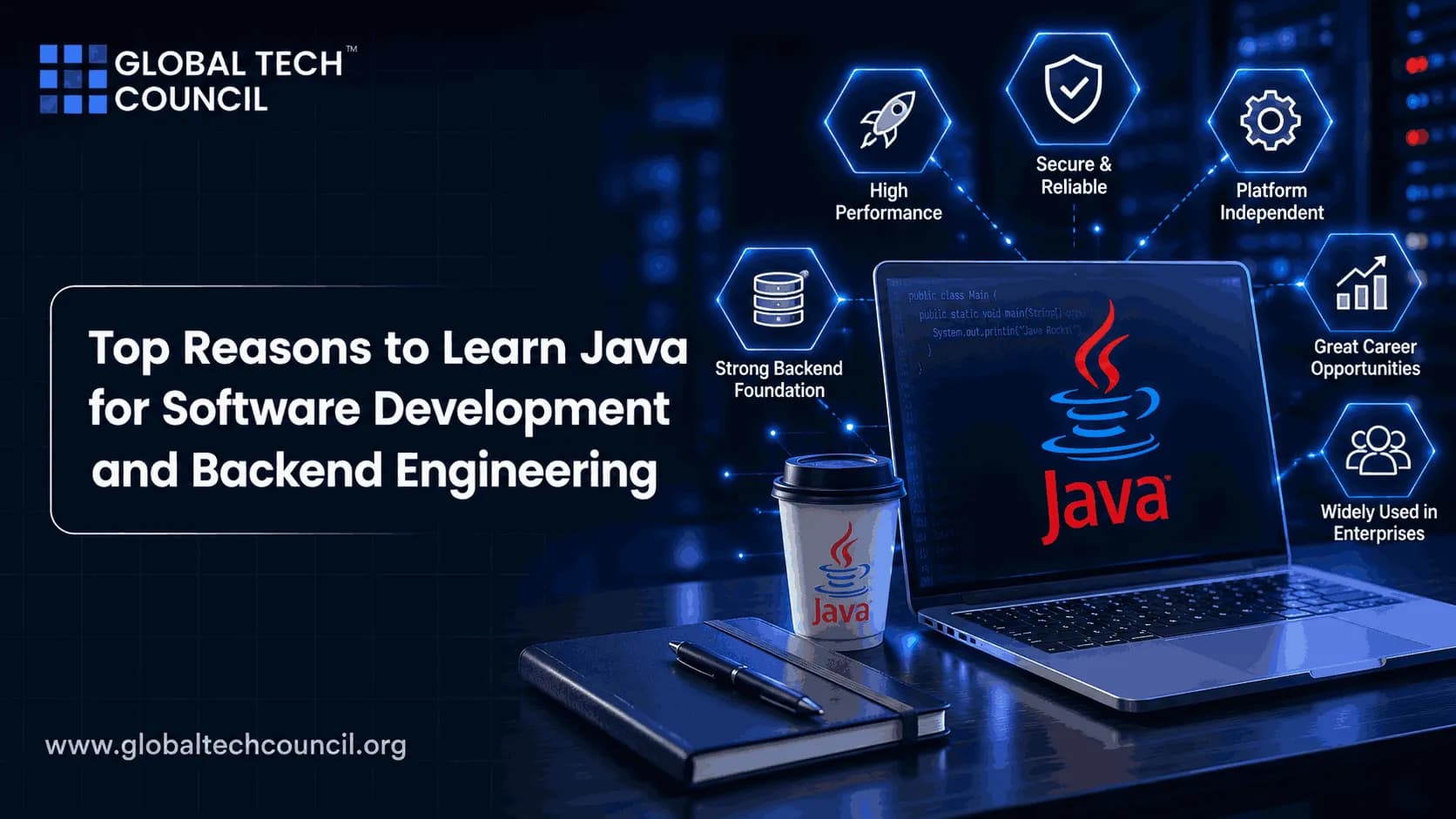
Learning Java is still one of the most practical moves you can make if you want to build backend systems that survive real traffic, audits, version upgrades, and late-night production incidents. Java is not the newest language in the room. That is part of the point. It has decades of runtime tuning, mature tooling, and a huge installed base across finance, retail, Android, cloud services, data platforms, and enterprise software.
If your goal is backend engineering, Java gives you a direct path into APIs, microservices, distributed systems, transactional applications, and long-lived business platforms. You will also find plenty of existing systems that need engineers who can read old Java 8 code, modernize it to Java 17 or Java 21, and move it into containers without breaking revenue-critical workflows.

Why Java Still Matters in Backend Engineering
Java remains a core language for enterprise software because it is stable, portable, strongly typed, and supported by a deep ecosystem. Banks use it. Insurance platforms use it. Large e-commerce systems use it. Android apps still connect to backend APIs often written in Java or other JVM languages.
The JVM, or Java Virtual Machine, is a major reason for that staying power. Java code compiles to bytecode that can run on Windows, Linux, macOS, and cloud environments where a compatible JVM is available. That portability matters when your development team uses macOS, your CI pipeline runs on Linux, and your production workloads run on Kubernetes.
Oracle continues to release modern Java versions on a predictable schedule, and Java 21 is a long-term support release that includes virtual threads through JEP 444. That one feature alone changes how many teams think about high-concurrency services. You can handle many blocking operations with far less thread-management pain than older servlet-era designs required. Java continues to be one of the most in-demand programming languages for backend development, enterprise software, cloud-native applications, and Android development. Pursuing a Tech Certification helps professionals build practical expertise in Java programming, Spring Boot, REST APIs, object-oriented programming, backend architecture, and enterprise application development. These industry-recognized certifications prepare developers to create scalable, secure, and high-performance software while building the technical skills employers value across industries.
Top Reasons to Learn Java for Software Development
1. Java Has Strong Career Demand
Java is deeply embedded in enterprise hiring. That matters more than language popularity debates on social media. Companies need engineers who can build and maintain payroll systems, payment services, fraud detection platforms, healthcare applications, inventory systems, customer portals, and cloud APIs.
Salary data varies by country, seniority, and industry, but Java developers commonly find roles across junior, mid-level, and senior backend positions. Some industry salary reports place Java developer compensation from around 40,000 USD for entry-level roles to 200,000 USD or more for senior engineers in high-paying markets. The top end usually requires more than syntax. You need system design, databases, testing, security, cloud deployment, and production debugging.
To be blunt, Java is not always the trendiest choice. It is, however, one of the safest career bets for backend engineers who want access to serious enterprise work.
2. Java Dominates Enterprise Backends
Backend engineering is not just writing endpoints. You deal with transactions, retries, authentication, logging, monitoring, schema changes, and failure modes that do not show up in beginner tutorials.
Java fits these environments because it encourages explicit structure. Static typing catches many errors before runtime. Object-oriented design, when used with discipline, helps organize large codebases. Frameworks such as Spring Boot, Jakarta EE, Micronaut, and Quarkus give teams tested patterns for dependency injection, REST APIs, persistence, validation, messaging, and configuration.
A common real-world example: if you upgrade a Spring Boot 2 application to Spring Boot 3, the migration from javax.* to jakarta.* can break builds immediately. You may see errors like package javax.persistence does not exist or cannot find symbol: class Entity. This is not theory. It happens during modernization projects, and engineers who understand Java, Maven or Gradle, JPA, and dependency trees are the ones who fix it quickly.
3. The JVM Ecosystem Gives You Options
When you learn Java, you are also learning the JVM ecosystem. That gives you access to Kotlin, Scala, Groovy, and a huge collection of libraries that work across JVM-based projects.
This matters in backend teams. A company may run core services in Java, data pipelines in Scala, build scripts in Groovy, and newer services in Kotlin. The shared runtime makes integration easier than mixing unrelated platforms from scratch.
You also get mature build tools such as Maven and Gradle, testing tools like JUnit 5 and Mockito, and observability integrations for Prometheus, OpenTelemetry, and application performance monitoring platforms. Beginners sometimes underestimate tooling. Experienced engineers do not. Good tooling saves hours every week.
4. Java Works Well for Cloud-Native Systems
Java used to have a reputation for heavy application servers and slow startup. Some of that reputation was deserved in older stacks. Modern Java is different.
Spring Boot remains widely used for microservices. Quarkus and Micronaut were designed with containers, fast startup, and lower memory usage in mind. GraalVM Native Image can compile some Java applications into native executables, although you should test carefully because reflection-heavy frameworks may need extra configuration.
For cloud engineering, Java works well with:
REST and GraphQL APIs for service communication
Kafka and RabbitMQ for event-driven systems
PostgreSQL, MySQL, Oracle Database, and MongoDB for persistence
Docker and Kubernetes for deployment
AWS, Azure, and Google Cloud for managed infrastructure
Java is also common in big data tools. Apache Kafka is written mostly in Scala and Java. Hadoop has a long Java history. Many production data platforms still depend on JVM components, even when analytics teams write Python on top.
5. Java Teaches Transferable Engineering Discipline
Learning Java forces you to understand types, interfaces, exceptions, packages, collections, concurrency, and memory behavior. These are not Java-only topics. They transfer to C#, Kotlin, TypeScript, Go, and many backend stacks.
Java also makes you think about API design. A poorly designed interface in a 200,000-line codebase becomes expensive. A vague exception hierarchy creates messy error handling. A lazy Optional.get() without checking presence can still throw NoSuchElementException in production. Small habits compound.
If you are new to programming, Java may feel more verbose than Python or JavaScript. That verbosity can be useful. You see what the program is doing. You learn how pieces fit together instead of hiding everything behind dynamic behavior. Modern backend systems increasingly power artificial intelligence, cloud computing, blockchain, IoT, and intelligent automation platforms. Becoming a Deeptech Expert equips professionals with interdisciplinary knowledge of emerging technologies and how they integrate with enterprise software. This broader technical perspective enables developers to build robust backend solutions that support intelligent applications, distributed systems, and future-ready digital infrastructure.
Java for Backend Engineers: Where It Shines
High-Traffic APIs
Java is a strong fit for high-traffic services where predictable performance matters. The JVM has advanced garbage collectors such as G1, ZGC, and Shenandoah, depending on the JDK distribution and version. Tuning still requires skill, but the platform gives you serious tools.
Transactional Business Systems
Order processing, payments, claims management, and banking workflows need consistency. Java frameworks integrate well with relational databases, transaction managers, and message brokers. That is why the language keeps showing up in finance and large enterprise IT.
Long-Lived Applications
Some backend systems live for ten years or more. Java is built for that reality. Clear package structures, backward compatibility, mature dependency management, and widespread hiring support make it easier to maintain long-running platforms.
When Java Is Not the Best Choice
Java is not perfect. You should not use it for every problem.
For small scripts, Python or Bash is usually faster to write.
For browser-first development, JavaScript or TypeScript is required.
For ultra-small serverless functions, Java cold starts can be an issue unless you use careful tuning, SnapStart on AWS Lambda, or native compilation.
For low-level systems programming, Rust, C, or C++ may be a better fit.
Still, for backend services with business logic, database access, authentication, scaling needs, and long-term maintenance, Java remains one of the strongest choices.
What You Should Learn After Java Basics
Do not stop at syntax. If you want backend roles, build the stack employers actually use.
Core Java: collections, streams, generics, exceptions, records, concurrency, and JVM basics.
Spring Boot: REST controllers, dependency injection, validation, configuration, profiles, and Actuator.
Databases: SQL, indexing, transactions, JPA, Hibernate, and connection pooling with HikariCP.
Testing: JUnit 5, Mockito, Testcontainers, and integration tests against real services.
Security: OAuth 2.0, JWT, TLS 1.3, input validation, and OWASP Top 10 risks.
Cloud deployment: Docker, Kubernetes basics, CI/CD, logs, metrics, and health checks.
If you are building a structured learning path, use Global Tech Council resources as internal next steps. Relevant areas include programming, cloud computing, cybersecurity, data science, AI, and software development certifications. Java pairs especially well with backend engineering, cloud architecture, and secure application development training.
How to Practice Java the Right Way
Reading Java is not enough. Build something slightly uncomfortable.
Start with a REST API for a ticket booking system or expense tracker. Use Java 21, Spring Boot 3, PostgreSQL, Flyway for migrations, and Docker Compose. Add authentication. Write tests. Break it on purpose. Then fix it.
Here is a useful checklist:
Create endpoints for create, read, update, and delete operations.
Add pagination instead of returning every row.
Use database indexes and inspect query plans.
Handle validation errors with clear HTTP responses.
Add structured logs with request IDs.
Write integration tests with Testcontainers.
Package the service in Docker and run it locally.
This kind of project teaches more than a dozen toy examples. It also gives you interview stories that sound real because they are real. Technical expertise becomes even more valuable when combined with business and product knowledge. Earning a Marketing Certification helps professionals strengthen their understanding of product strategy, customer needs, digital communication, and go-to-market planning. These skills enable developers to contribute beyond coding by building software that aligns with business objectives, improves user experiences, and supports successful product launches.
Is Java Future-Proof for Backend Engineering?
No language is future-proof forever. Java, though, has unusually strong odds. Its enterprise footprint is massive, its ecosystem keeps improving, and its role in cloud-native development is still active. Java 17 and Java 21 adoption continues to move teams away from older Java 8 baselines, while frameworks like Spring Boot 3 and Quarkus keep the platform relevant for containerized services.
AI has not reduced the need for backend engineers either. If anything, AI products need reliable APIs, identity systems, billing flows, audit trails, vector database integrations, job queues, and data pipelines. Java can sit behind all of that.
Your next step is simple: learn Java fundamentals, then build one production-style backend service with a database, tests, security, and deployment. After that, strengthen your profile with a Global Tech Council learning path in programming, cloud, cybersecurity, or AI so you can connect Java skills to real engineering roles.
FAQs
1. Why Should You Learn Java for Software Development?
Java is one of the world's most widely used programming languages for software development because it is reliable, secure, scalable, platform-independent, and supported by a mature ecosystem of frameworks and tools.
2. Is Java Still Worth Learning in 2026?
Yes. Java continues to power enterprise applications, cloud-native systems, backend services, Android applications, financial platforms, and large-scale business software, making it a valuable skill for developers in 2026 and beyond.
3. Why Is Java Popular for Backend Engineering?
Java provides excellent performance, multithreading, strong security, object-oriented programming, robust memory management, and frameworks like Spring Boot that simplify backend application development.
4. What Career Opportunities Are Available for Java Developers?
Java professionals can work as Java Developers, Backend Developers, Full Stack Developers, Software Engineers, API Developers, Cloud Engineers, Microservices Developers, DevOps Engineers, Technical Leads, and Solutions Architects.
5. Which Industries Use Java the Most?
Java is widely used in banking, finance, healthcare, insurance, retail, telecommunications, logistics, manufacturing, education, government, and enterprise software development.
6. How Does Java Support Enterprise Software Development?
Java offers scalability, reliability, security, platform independence, and integration with enterprise frameworks, enabling organizations to build secure and maintainable business applications.
7. Why Is Spring Boot Important for Java Developers?
Spring Boot simplifies backend development by providing auto-configuration, embedded servers, REST API support, microservices architecture, cloud integration, and production-ready features.
8. Can Beginners Learn Java Easily?
Yes. Java has a clear syntax, extensive documentation, a large developer community, and abundant learning resources, making it a popular programming language for beginners entering software development.
9. What Skills Should You Learn Alongside Java?
Developers should learn object-oriented programming, SQL, Spring Boot, REST APIs, Git, Maven or Gradle, Docker, Kubernetes, cloud computing, debugging, testing, and software design principles.
10. Why Is Java a Good Choice for Backend APIs?
Java frameworks provide powerful tools for developing secure, scalable, and high-performance RESTful APIs that integrate with databases, cloud services, mobile applications, and enterprise systems.
11. How Does Java Support Cloud-Native Development?
Java integrates with Docker, Kubernetes, cloud platforms, CI/CD pipelines, and microservices frameworks, making it ideal for developing scalable cloud-native backend applications.
12. What Makes Java Secure for Enterprise Applications?
Java includes built-in security features such as strong type checking, memory management, authentication support, encryption libraries, secure coding practices, and enterprise security frameworks.
13. Why Do Companies Continue to Hire Java Developers?
Organizations continue hiring Java developers because many critical business applications are built with Java, and the language remains essential for enterprise modernization, backend engineering, and cloud transformation projects.
14. What Projects Should Beginners Build to Learn Java?
Beginners can build banking systems, inventory management software, task management applications, REST APIs, e-commerce backends, employee management systems, and cloud-based Java applications.
15. How Can Java Developers Prepare for Technical Interviews?
Candidates should strengthen Java fundamentals, collections, object-oriented programming, multithreading, exception handling, Spring Boot, SQL, system design, data structures, and coding problem-solving skills.
16. How Is AI Influencing Java Software Development?
AI-powered tools assist Java developers with code generation, debugging, documentation, testing, refactoring, performance optimization, and workflow automation while improving development productivity.
17. What Common Mistakes Should Beginners Avoid When Learning Java?
Beginners should avoid memorizing syntax without building projects, neglecting object-oriented programming, skipping debugging practice, ignoring Git, overlooking testing, and failing to understand backend development concepts.
18. Are Java Skills Useful Beyond Backend Development?
Yes. Java skills are valuable in Android development, cloud computing, enterprise software, big data platforms, distributed systems, financial applications, automation, and AI-enabled enterprise solutions.
19. What Certifications Can Help Java Developers Advance Their Careers?
Certifications in Java programming, Spring Boot, cloud computing, backend development, DevOps, software architecture, and enterprise technologies can strengthen technical expertise and improve career prospects.
20. Why Is Java One of the Best Languages for Software Development and Backend Engineering?
Java combines reliability, scalability, security, platform independence, and a mature ecosystem with powerful frameworks such as Spring Boot. It supports enterprise software, cloud-native applications, microservices, REST APIs, and AI-assisted development, making it one of the strongest programming languages for building modern backend systems and long-term software engineering careers.
Related Articles
View All
Java
Spring Boot for Java Developers: Essential Skills for Modern Backend Development
Spring Boot for Java developers is essential for building secure, observable, cloud-ready backends with faster delivery and modern architecture support.

Java
Java for Web Development: Building Scalable Backend Applications
Learn how Java supports scalable web development through Spring Boot, Jakarta EE, Hibernate, Quarkus, cloud-native architecture, security, caching, and backend best practices.

Java
Future of Java Development: AI Tools, Cloud-Native Apps, and Emerging Trends
Explore the future of Java development through AI coding tools, cloud-native apps, serverless systems, agentic architecture, and skills Java developers need next.
Trending Articles
The Role of Blockchain in Ethical AI Development
How blockchain technology is being used to promote transparency and accountability in artificial intelligence systems.
AWS Career Roadmap
A step-by-step guide to building a successful career in Amazon Web Services cloud computing.
Top 5 DeFi Platforms
Explore the leading decentralized finance platforms and what makes each one unique in the evolving DeFi landscape.