

End-to-End MLOps: How to Deploy, Monitor, and Maintain Machine Learning Models in Production
 Suyash Raizada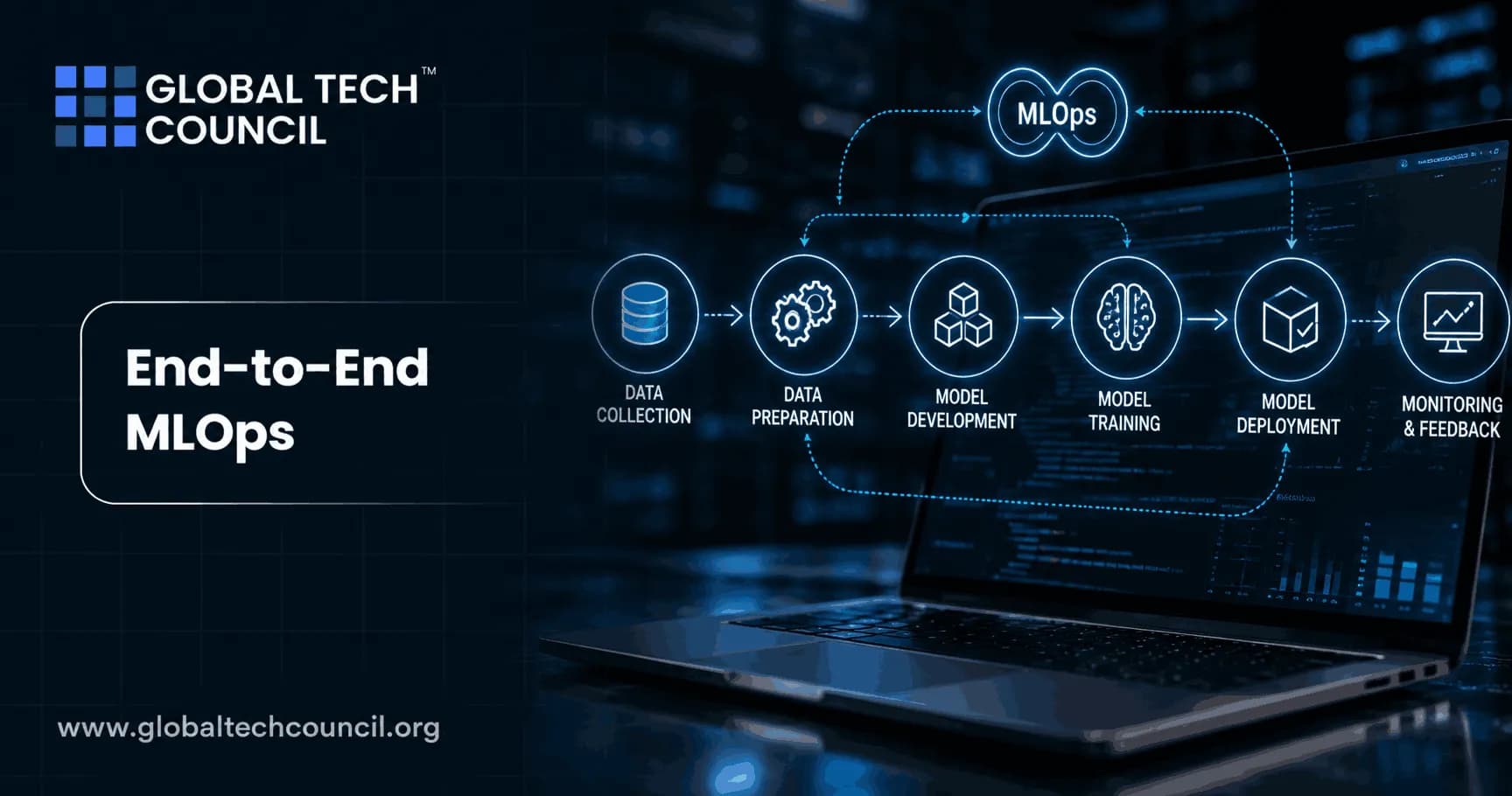
End-to-end MLOps is the discipline of industrializing machine learning from an initial idea to a stable production service. It combines software engineering, data engineering, and operations so that models can be deployed reliably, observed in real usage, and maintained as data and requirements change. As adoption accelerates, organizations are standardizing on repeatable pipelines, model registries, and production monitoring to address the common "model-in-a-notebook" failure mode.
Industry data reflects this shift. Gartner projected that 50% of AI projects would be operationalized with MLOps by 2025, up from less than 10% in 2021, and teams adopting MLOps report approximately 40% faster deployment compared to ad hoc approaches. Market estimates from MarketsandMarkets place MLOps growth near a 37.9% CAGR, reaching roughly 3.8 billion USD by 2025.

As organizations scale machine learning into production environments, demand continues to grow for professionals who can bridge model development, deployment, monitoring, and governance. Becoming a Machine Learning Expert helps practitioners build the technical depth needed to design, operationalize, and maintain machine learning systems that deliver measurable business value at scale.
What End-to-End MLOps Includes (and Why It Differs from DevOps)
MLOps builds on DevOps concepts like CI/CD, infrastructure-as-code, automation, and observability, but adds concerns that are unique to machine learning systems. In production, an ML service is not only code. It is code + data + model artifacts + runtime dependencies + policies. These components evolve at different speeds and can fail in different ways.
In practice, end-to-end MLOps typically spans the full lifecycle:
Data ingestion and preparation: collect, clean, transform, split, and validate data.
Model development and experimentation: feature engineering, algorithm selection, and experiment tracking.
Training and validation pipelines: reproducible training jobs, automated evaluation, and approval gates.
Model packaging and deployment: batch, real-time APIs, streaming, edge, or on-premises targets.
Monitoring and observability: performance, drift, latency, errors, and resource usage.
Retraining and maintenance: scheduled or event-driven updates, rollback, and hotfix workflows.
Governance and compliance: audit trails, access control, documentation, and responsible AI checks.
Production MLOps is inherently cross-functional, requiring skills across machine learning, data science, cloud infrastructure, DevOps, and security. Teams formalizing these practices benefit from structured training paths that cover each of these domains.
Reference Architecture for End-to-End MLOps in Production
Most production-grade MLOps architectures converge on a set of shared building blocks, whether implemented with open-source tools, cloud services, or an integrated platform:
Source control for code and configuration (Git) with a clear branching and release strategy.
Data versioning and lineage to connect training data to a specific model version.
Pipeline orchestration (such as MLflow, Kubeflow, or Apache Airflow) to automate workflows end to end.
Experiment tracking to compare runs and reproduce results.
Model registry to manage staging and production candidates with approvals.
CI/CD/CT automation (Jenkins, GitLab CI, or GitHub Actions) to test, build, and deploy models and services.
Deployment runtime such as Kubernetes, managed container services, or serverless functions.
Observability stack for logs, metrics, tracing, drift detection, and alerting.
There is a clear enterprise trend toward centralized platforms that unify data pipelines, model development, deployment, and monitoring to reduce handoffs between data science and operations teams. The platform approach can reduce fragmentation, but it still requires discipline in testing, governance, and monitoring design.
How to Deploy Machine Learning Models in Production
Deployment in end-to-end MLOps is less about a single push-to-production event and more about establishing a safe promotion path from experimentation to a live service. A practical approach is to design the pipeline around versioned artifacts and quality gates.
Step 1: Define Artifacts and Contracts
Before selecting tools, agree on what is versioned and what must be reproducible:
Data contract: schema, value ranges, missing-value rules, and validation checks.
Feature definitions: transformations, encoders, and any feature store usage.
Model artifact: serialized model file plus preprocessing steps bundled or versioned together.
Inference contract: input and output schema, error responses, and latency SLOs.
This step prevents hidden coupling. If training uses one encoding method and production uses another, accuracy may collapse even when the model file itself is correct.
Step 2: Build a Reproducible Training and Validation Pipeline
Production teams typically standardize a training pipeline that runs deterministically with pinned dependencies, fixed random seeds where appropriate, and tracked parameters. The pipeline should produce:
Evaluation metrics (model performance and key business KPIs)
Artifacts (model, preprocessing assets, and reports)
Metadata (data snapshot, code version, and environment details)
Automated gates are critical. A candidate model should be promoted only if it meets defined metric thresholds and passes data quality tests.
Step 3: Package the Model for Your Serving Pattern
Choose a deployment pattern based on workload and operational constraints:
Online inference: real-time predictions via REST or gRPC, typically served as a microservice (for example, FastAPI) and containerized with Docker.
Batch scoring: scheduled jobs for large datasets, common in analytics and reporting pipelines.
Streaming inference: event-driven scoring (often using Kafka-based streams) for time-sensitive use cases.
Edge deployment: low-latency or offline scoring, often requiring model optimization techniques such as quantization or pruning.
A widely used production pattern is to containerize an inference API, deploy it on Kubernetes, and use blue-green or canary releases to reduce risk. For lower-throughput or bursty workloads, serverless functions can be cost-effective, but cold-start latency and dependency limits must be validated before adoption.
Step 4: Automate Delivery with CI/CD and Continuous Training
End-to-end MLOps extends CI/CD into CI/CT/CD, where CT stands for continuous training. Common automation stages include:
CI: linting, unit tests, data validation tests, and basic model tests on sample data.
Build: container image creation and vulnerability scanning.
CD: deployment to staging, integration tests, then promotion to production with approvals.
CT: scheduled or event-driven retraining when new data arrives or performance degrades.
Smaller teams can implement this effectively with GitHub Actions, an experiment tracker like MLflow, and container-based deployment. This combination still provides strong repeatability and auditability without requiring a heavyweight platform.
Monitoring in End-to-End MLOps: What to Measure and How to Alert
In production, operational stability often matters more than marginal model accuracy gains. Monitoring should be designed to answer three questions: Is the service healthy? Is the data still what we expect? Is the model still effective and fair?
Core Monitoring Dimensions
Operational metrics: latency, throughput, error rates, CPU and memory usage, and availability.
Data quality: schema changes, missing values, outliers, and invalid categories.
Data drift: shifts in feature distributions compared to the training baseline or a recent reference window.
Model drift and concept drift: degraded relationship between inputs and outputs over time.
Model performance: accuracy, precision, recall, F1, AUC, regression error metrics, and business KPIs.
Fairness and bias: subgroup performance differences where applicable, aligned to governance requirements.
Drift monitoring is especially important because ML systems fail quietly. A model can return valid-looking outputs while becoming progressively less useful due to shifting customer behavior, product changes, or modifications in upstream systems.
While MLOps is often viewed as a technical discipline, the ultimate purpose of monitoring and optimization is to support business outcomes. A Marketing Certification can help professionals understand how performance metrics, customer behavior, analytics, and data-driven decision-making connect technical systems to measurable commercial impact.
A Practical Monitoring Workflow
Log inference inputs and outputs with careful privacy controls and sampling policies.
Store monitoring data in a dedicated repository that supports time-series analysis.
Compute metrics on a schedule or near real-time, including drift scores and performance when labels become available.
Alert on thresholds through incident tools (email, Slack, or PagerDuty) with clear runbooks attached.
Link alerts to model versions via the model registry to support rollback and root-cause investigations.
Many teams are incorporating anomaly detection to flag unusual patterns and suggest remediation steps. Even basic threshold-based alerts provide strong value when paired with clear ownership and documented response procedures.
Maintenance and Retraining: Keeping Models Stable Over Time
Maintenance is where end-to-end MLOps becomes a long-term operational capability rather than a one-time deployment exercise. Models often require retraining when data changes, underlying systems change, or business requirements evolve.
Retraining Triggers That Match Your Risk Profile
Time-based retraining: weekly or monthly refresh, appropriate when data evolves steadily and predictably.
Data-based triggers: retrain when new labeled data volume crosses a defined threshold.
Performance-based triggers: retrain or rollback when KPIs or model metrics degrade beyond acceptable limits.
Drift-based triggers: retrain when drift scores exceed defined thresholds.
For higher-risk domains, a staged workflow is advisable: retrain to produce a candidate model, validate it in shadow mode, then promote using a canary release with automated rollback if operational or KPI thresholds are violated.
Dependency and Infrastructure Maintenance
Production ML systems require ongoing maintenance beyond the model itself:
Dependency updates and security patching for base images and libraries
Reproducibility checks to ensure older models can be rebuilt when needed
Cost management for training and inference resources
Lifecycle management for features, datasets, and planned deprecations
This is also where cross-domain skills become critical. Many organizations map MLOps responsibilities to role-based learning: data engineering for pipelines, cloud and DevOps for deployments, and cybersecurity for securing model endpoints and data handling.
Real-World Examples of End-to-End MLOps
End-to-end MLOps has been applied across environments with significantly different constraints:
Industrial manufacturing: An Azure-based MLOps framework for steel production demonstrated that automating preprocessing, training, and deployment in repeatable pipelines reduces lifecycle management workload while supporting reliability requirements.
Education analytics: A student risk prediction pipeline using MLflow for experiment tracking, GitHub Actions for CI/CD, and a FastAPI plus Docker deployment shows that smaller teams can implement a complete production workflow without heavy platform dependencies.
Enterprise platform-centric MLOps: Unified platforms increasingly integrate data ingestion, labeling, training, deployment, and monitoring, emphasizing reusable pipelines and centralized governance to reduce friction across teams.
Beyond deployment pipelines and operational workflows, professionals increasingly need a broader understanding of AI systems, governance frameworks, model behavior, risk management, and responsible deployment practices. An AI Certification provides this foundational knowledge, helping practitioners evaluate, implement, and manage AI technologies with greater technical confidence and strategic awareness.
Conclusion: Making End-to-End MLOps a Sustainable Capability
End-to-end MLOps is the practical answer to a common problem: models that perform well during experimentation but degrade, break, or become ungovernable in production. A complete approach treats code, data, and models as versioned artifacts that flow through automated pipelines with testing, controlled deployments, and continuous monitoring.
To mature your MLOps practice, prioritize the fundamentals:
Reproducibility via experiment tracking, data lineage, and a model registry
Reliable deployment with CI/CD and safe rollout patterns like canary releases
Observability across service health, data drift, and model performance
Governance with audit trails, access control, and responsible AI checks where applicable
When these pieces work together, machine learning becomes a maintainable production capability rather than a sequence of one-off projects. Teams can deliver models faster without sacrificing reliability, compliance, or operational clarity.
FAQs
What is End-to-End MLOps?
End-to-End MLOps is the practice of managing the entire machine learning lifecycle, from data collection and model development to deployment, monitoring, maintenance, and continuous improvement.
Why is MLOps important for machine learning projects?
MLOps helps organizations deploy machine learning models efficiently, improve reliability, reduce operational risks, and ensure models continue delivering value in production.
What does "end-to-end" mean in MLOps?
"End-to-end" refers to covering every stage of the machine learning lifecycle, including data management, model training, deployment, monitoring, governance, and retraining.
How is MLOps different from traditional machine learning?
Traditional machine learning focuses on building models, while MLOps focuses on operationalizing, deploying, managing, and maintaining those models in real-world environments.
What are the key stages of an End-to-End MLOps pipeline?
The main stages include data collection, data preparation, feature engineering, model training, validation, deployment, monitoring, retraining, and governance.
What role does data collection play in MLOps?
Data collection provides the raw information needed to train machine learning models and ensures that models learn from relevant and accurate datasets.
Why is data preprocessing important in MLOps?
Data preprocessing cleans, transforms, and prepares raw data to improve model performance and ensure consistency throughout the pipeline.
What is feature engineering in MLOps?
Feature engineering involves selecting, creating, and transforming variables that help machine learning models make more accurate predictions.
How are machine learning models trained in an MLOps workflow?
Models are trained using historical data, machine learning algorithms, and automated workflows that support experimentation and reproducibility.
What is model validation?
Model validation evaluates a model's performance using testing datasets and metrics to ensure it meets business and technical requirements before deployment.
What is model deployment in MLOps?
Model deployment is the process of making a trained machine learning model available for real-world use through applications, APIs, or cloud services.
What are the different deployment strategies for machine learning models?
Common strategies include batch deployment, real-time deployment, shadow deployment, blue-green deployment, and canary deployment.
Why is model monitoring important?
Monitoring helps detect performance degradation, prediction errors, system failures, and data drift that can negatively impact model accuracy.
What is data drift?
Data drift occurs when incoming data changes over time, causing the data distribution in production to differ from the training data.
What is model drift?
Model drift happens when a machine learning model's predictive performance declines due to changes in customer behavior, business conditions, or data patterns.
How does automated retraining work in MLOps?
Automated retraining uses updated datasets and predefined triggers to retrain models when performance drops below acceptable thresholds.
What tools are commonly used in End-to-End MLOps?
Popular tools include MLflow, Kubeflow, TensorFlow Extended (TFX), Apache Airflow, Docker, Kubernetes, Jenkins, GitHub Actions, AWS SageMaker, Azure Machine Learning, and Google Vertex AI.
How does CI/CD apply to MLOps?
Continuous Integration and Continuous Deployment (CI/CD) automate testing, validation, deployment, and updates for machine learning models and pipelines.
What challenges do organizations face when implementing MLOps?
Common challenges include data quality issues, infrastructure complexity, model governance, scalability concerns, security requirements, and cross-team collaboration.
What are the best practices for building an End-to-End MLOps pipeline?
Define clear objectives, automate workflows, implement version control, monitor model performance, establish governance policies, ensure reproducibility, use CI/CD pipelines, and continuously retrain models using high-quality data.
Related Articles
View All
Machine Learning
Explainable AI (XAI): Making Machine Learning Models Transparent and Trustworthy
Explainable AI makes model decisions clear enough to trust, audit, challenge, and improve, especially in regulated and high-risk machine learning systems.

Machine Learning
Model Deployment Explained: Moving Machine Learning from Notebook to Production
Learn what model deployment means, how models move from notebooks to production, and which MLOps practices keep systems reliable after release.
Machine Learning
Model Training Explained: How Machine Learning Models Learn
Learn what model training is, how the core learning loop works, and how loss functions, backpropagation, gradient descent, data splitting, regularization, and optimization help build reliable machine learning models.
Trending Articles
The Role of Blockchain in Ethical AI Development
How blockchain technology is being used to promote transparency and accountability in artificial intelligence systems.
AWS Career Roadmap
A step-by-step guide to building a successful career in Amazon Web Services cloud computing.
Top 5 DeFi Platforms
Explore the leading decentralized finance platforms and what makes each one unique in the evolving DeFi landscape.