

Anthropic's IPO Filing Reveals $17B Q3 Revenue and $895B in Purchase Commitments
 Suyash Raizada
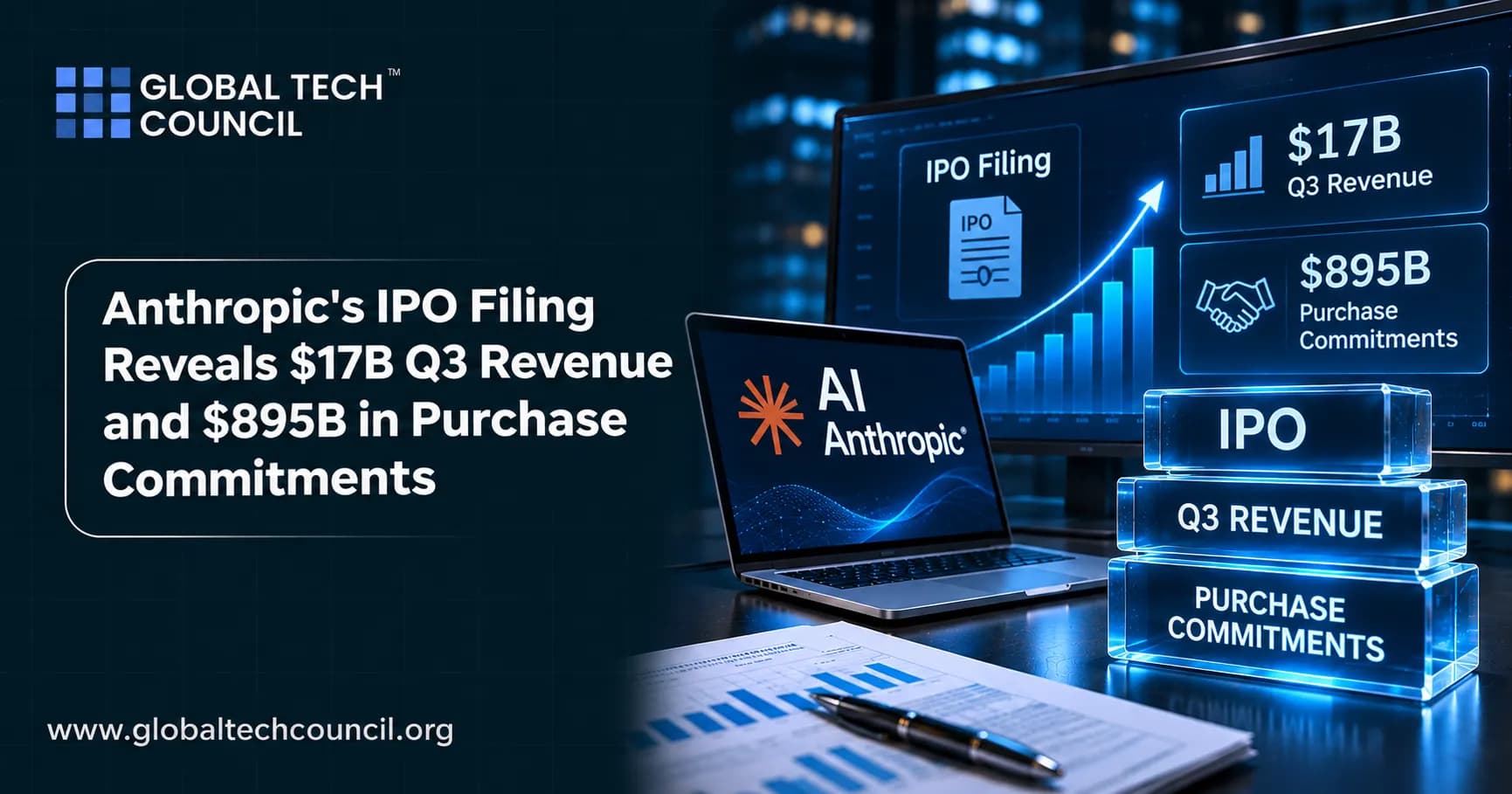
The Anthropic IPO filing gives the public its first official look at the economics of a frontier AI lab. An amended Form S-1 filed with the US Securities and Exchange Commission on November 2, 2026 shows third-quarter revenue of about $17 billion and a net loss of $23.3 billion. It also discloses roughly $895.4 billion in purchase and lease commitments, almost all tied to computing power. If you want to understand the technology behind these numbers, the Certified Artificial Intelligence (AI) Expert program is a helpful place to start. This article explains the filing in plain language and is information only, not investment advice. Anthropic makes the Claude AI models, so please read this as a neutral summary of public documents.
What Did the Amended Filing Disclose?
Anthropic first filed its S-1 publicly on October 26, 2026, planning to list Class A shares on Nasdaq under the symbol ANT. The November 2 amendment adds audited third-quarter numbers. You can review the company’s registration documents in the Anthropic S-1 on SEC EDGAR.

Measure | Reported figure |
|---|---|
Q3 2026 revenue | About $16.96 billion, up about 1,127% from a year earlier |
Q2 2026 revenue | About $11.56 billion |
Q1 2026 revenue | About $4.73 billion |
Q3 operating expenses | About $17.5 billion |
Q3 operating loss | About $567 million |
Q3 net loss | About $23.3 billion, driven mostly by convertible notes |
Purchase and lease commitments | About $895.4 billion as of September 30 |
Growth Slowed but Stayed Huge
Revenue rose about 47% from the second quarter, down from about 144% growth in the quarter before. That is a sharp slowdown in pace, yet the company still added roughly $5.4 billion of revenue in a single quarter. The filing does not fully explain the change in growth rate, which analysts flagged after the first filing too.
What Are the $895 Billion in Commitments?
A Simple Explanation
A purchase commitment is a promise to pay for a service in the future, even if the buyer later needs less of it. Anthropic’s $895.4 billion covers purchase agreements and leases, and the filing says substantially all of it relates to compute and infrastructure. That means data center capacity and AI chips from cloud and hardware partners. At the end of June, the filing listed about $265.6 billion in minimum guaranteed commitments under hosting agreements, so the total has grown very quickly. Readers who want to see how AI models create these computing needs can build practical skills with the Certified Artificial Intelligence (AI) Developer course.
How Big Is It?
Compared with revenue, the number is enormous. At the Q3 pace, annualized revenue is about $68 billion, so commitments equal roughly 13 times a year of sales. Secondary coverage also reports that about $69.8 billion falls due within 12 months, and that a separate compute deal with SpaceX could cost up to $120.5 billion through 2029. These details come from analysis of the filing, so check the original document for exact terms.
Why Companies Make Such Commitments
AI labs need computing capacity years before they can use it, because data centers and chips take a long time to build. Signing long contracts secures supply. The risk is that if revenue grows slower than expected, the company must still pay. Anthropic’s own filing explains one cost of the opposite mistake: it bought about $5 billion of higher-cost short-term compute in Q3 rather than turn away customers, which the company says pushed it back into an operating loss after one profitable quarter.
Why Was the Q3 Loss So Large?
Operating Loss Versus Net Loss
Anthropic’s operating loss was only about $567 million. The much larger $23.3 billion net loss came mostly from the revaluation of convertible notes. As the company’s value rises, these notes are marked up as liabilities, which flows through the income statement. Reports note that this is largely an accounting effect, but skeptics say it still reflects real obligations. The nine-month net loss is reported at about $104 billion.
Other Items in the Quarter
The filing also cites a $2 billion non-cash charge tied to a donation-matching program for employees, and about $600 million of revenue given up through price cuts and discounts. Operating expenses rose 292% from a year earlier while revenue rose far faster, so costs grew more slowly than sales. Following how debt accounting, leases, and infrastructure fit together takes broad technical literacy, and a Deep Tech Certification path can help learners understand the systems behind AI finance.
What Does the Filing Say About Liquidity?
Sources describe the company’s cash and investments differently. One analysis cites about $131.8 billion in cash and investments, while another cites about $146.6 billion of liquidity at the end of September, which may use a broader definition. The key point is that Anthropic holds very large reserves, but its commitments are far larger. Public investors will need to weigh when those payments come due against expected revenue and any new capital raised in the offering.
How Does This Compare With the Rest of the Industry?
A Shared Pattern
Heavy spending ahead of revenue is common across AI. Microsoft recently reported a $677 billion contracted backlog and a capital spending forecast near $170 billion. Meta, Oracle, and Alphabet have also raised large sums through bonds and stock to fund data centers. Anthropic’s numbers are unusual mainly because they come from a company that is not yet public, so the S-1 is one of the few places to see a frontier lab’s finances in detail.
What Makes It Different
Unlike the largest tech giants, which fund much of their AI buildout from other profitable businesses, Anthropic relies on revenue from AI products and outside capital. That makes the ratio of commitments to revenue a closely watched measure.
What Do Supporters and Skeptics Say?
The Optimistic View
Supporters point to revenue that grew about twelvefold in a year, a first quarterly operating profit in Q2, and strong margins reported earlier in the filing. They argue that long compute contracts lock in supply while demand is rising, and that the Q3 short-term compute bill shows what happens when capacity is too small.
The Cautious View
Skeptics focus on the $895 billion commitment against about $17 billion of quarterly revenue, the slowdown in growth, and the large net loss. They note that commitments are legally binding while revenue forecasts are not. Some also question how the figures will look if AI demand slows.
What to Watch Next
Pricing and timing: The company has not set a price range, and reports point to a possible listing in mid-November.
Further amendments: The filing may be updated again before the offering.
Commitment schedule: The yearly breakdown of when payments come due.
Revenue growth: Whether the pace re-accelerates after Q3’s slowdown.
Funding plans: How much new capital the offering raises and how it is used.
A Quick Glossary for Beginners
S-1: The registration form a company files with the SEC before an IPO.
Purchase commitment: A legally binding promise to buy goods or services in the future.
Compute: The computing power, mainly chips and data centers, used to train and run AI models.
Operating loss: Loss from running the business, before items like interest and note revaluations.
Convertible note: A loan that can turn into shares later.
Run rate: A quarter’s results multiplied to estimate a full year.
What Should Beginners Keep in Mind?
Do not make decisions based on one number, since revenue, losses, and commitments tell different parts of the story.
Read the original filing when you can, because secondary summaries sometimes differ.
A filing is not a price or a forecast.
Only invest money you can afford to lose, and ask a qualified professional about your own situation.
Where Can You Find Official Information?
The filing: Anthropic’s S-1 and amendments on SEC EDGAR.
Company news: The Anthropic newsroom.
Exchange information: Nasdaq listing updates once the offering is priced.
Conclusion
The Anthropic IPO filing shows a company growing at remarkable speed and spending just as boldly. Q3 revenue reached about $17 billion, the operating loss was small at about $567 million, and the net loss of $23.3 billion came mostly from convertible notes. The standout figure is the $895.4 billion in purchase and lease commitments, which dwarfs revenue and shows how much computing capacity the company has locked up.
Whether that bet pays off depends on whether revenue keeps rising fast enough to cover the bills. The sensible approach is to read the original documents, compare reliable sources, and avoid reacting to a single headline. Clear communication also matters when companies reveal complex numbers, and a recognised Marketing Certification can help professionals explain such news in honest, simple language that builds trust.
FAQs
1. What Did Anthropic Reveal in Its Latest IPO Filing?
Anthropic disclosed approximately $16.96 billion in third-quarter 2026 revenue and around $895.4 billion in aggregate purchase and lease commitments in its amended IPO filing. The figures highlight the company's rapid business expansion and the enormous infrastructure costs associated with developing advanced AI systems.
2. What Is Anthropic's Q3 2026 Revenue?
Anthropic generated approximately $16.96 billion in revenue during the third quarter of 2026, representing a 1,127% increase compared with the same quarter in 2025. Revenue also increased approximately 47% compared with the second quarter of 2026.
3. What Are Anthropic's $895 Billion Purchase Commitments?
The $895.4 billion figure represents Anthropic's aggregate committed spending under purchase agreements and lease arrangements. Most of these commitments are related to computing capacity, AI processors, and data-centre infrastructure required to develop and operate its AI models.
4. Why Does Anthropic Need So Much Money for AI Infrastructure?
Developing advanced AI models requires enormous computing resources. Anthropic needs specialised processors, high-performance memory, networking systems, data centres, electricity, and cooling infrastructure to train and operate its Claude AI models at scale.
5. How Much of Anthropic's $895 Billion Commitment Is Due Before 2030?
Approximately $447.5 billion is expected to be incurred before December 31, 2030. Substantially all of the remaining commitments are expected between 2031 and 2045. These are long-term obligations rather than payments due immediately.
6. How Much of Anthropic's Spending Commitments Is Due Within 12 Months?
Approximately $69.8 billion is due during the 12 months following September 30, 2026. This reflects the substantial near-term financial requirements associated with securing computing resources and expanding AI infrastructure.
7. Is Anthropic Profitable Despite Its Revenue Growth?
No. Anthropic reported a net loss of approximately $104.04 billion for the first nine months of 2026. However, much of this loss was associated with non-cash accounting adjustments related to the valuation of convertible notes and other financial instruments. Its operating loss for the same period was approximately $1.26 billion.
8. Why Did Anthropic Report a $104 Billion Net Loss?
The reported net loss was significantly affected by non-cash changes in the fair value of convertible notes, derivatives, and other financial instruments. These accounting adjustments increased the reported loss without representing an equivalent amount of cash leaving the business.
9. What Is the Difference Between Anthropic's Operating Loss and Net Loss?
Operating loss measures the financial result of a company's core business operations after operating expenses. Net loss also includes non-operating items, such as financing costs and certain accounting adjustments. Anthropic's $104 billion nine-month net loss therefore provides a different picture from its approximately $1.26 billion operating loss.
10. What Is Anthropic's Claude AI?
Claude is Anthropic's family of artificial intelligence models designed for tasks such as writing, programming, research, analysis, and business automation. The company is expanding Claude's capabilities to attract individual users, developers, and large enterprise customers.
11. How Many Enterprise Customers Does Anthropic Have?
Anthropic reported more than 11,900 customers spending at least $100,000 annually, including approximately 250 customers spending $10 million or more. These figures demonstrate the growing commercial adoption of Claude across large organisations.
12. Which Companies Are Providing Computing Infrastructure to Anthropic?
Anthropic relies on a multi-chip computing strategy involving infrastructure from Amazon Web Services, Google, Nvidia, and AMD. Its infrastructure arrangements include Amazon Trainium processors, Google TPUs, and GPUs from Nvidia and AMD.
13. Why Is Anthropic Using Multiple AI Chip Providers?
Using multiple chip platforms helps Anthropic diversify its computing resources and reduce dependence on a single supplier. It can also optimise workloads according to processor availability, performance, and cost.
14. What Is Anthropic Direct?
Anthropic Direct is the company's approach to securing computing capacity through direct chip leasing and dedicated data-centre arrangements. It allows Anthropic to separate commitments for data-centre capacity from investments in the computing hardware installed inside those facilities.
15. What Is Anthropic's Proposed IPO Ticker Symbol?
Anthropic has proposed ANT as its stock ticker for a planned listing on the Nasdaq Global Select Market. The company filed its IPO registration statement with the US Securities and Exchange Commission, but the final offering price and share count were not yet established in the amended filing.
16. Why Is Anthropic's IPO Attracting Investor Attention?
Anthropic's IPO is attracting attention because of its rapid revenue growth, expanding enterprise customer base, and position in the competitive AI industry. However, its enormous infrastructure commitments, operating costs, and reported losses also create significant investment risks.
17. How Could Anthropic's $895 Billion Commitments Affect Its Future?
These commitments could help Anthropic secure the computing capacity needed to develop more advanced AI models and serve growing customer demand. However, they also create long-term financial obligations that could increase pressure on cash flow if revenue growth or infrastructure utilisation falls short of expectations.
18. How Does Anthropic Compare With OpenAI in the AI Market?
Anthropic and OpenAI are competing AI companies developing advanced foundation models and enterprise AI products. Both require substantial computing infrastructure and investment. Anthropic has focused heavily on Claude and enterprise adoption, while OpenAI offers ChatGPT and a broader ecosystem of AI products and developer services.
19. What Are the Biggest Risks Revealed by Anthropic's IPO Filing?
The filing highlights several important risks:
Extremely large computing and infrastructure commitments
High costs of training and operating AI models
Dependence on external computing suppliers
Competition from OpenAI and major technology companies
Potential delays in securing infrastructure
Uncertainty surrounding future AI revenue growth
Significant reported accounting losses
These factors could influence Anthropic's profitability and future valuation.
20. What Does Anthropic's IPO Filing Mean for the Future of the AI Industry?
Anthropic's financial disclosures demonstrate how capital-intensive the AI industry has become. Companies are spending enormous amounts to secure processors, data centres, and computing capacity while competing for enterprise customers. The long-term winners may be those that convert growing AI demand into sustainable revenue and profitability without allowing infrastructure costs to become unmanageable.
Related Articles
View All
News
Google's Orbital Data Center Satellite Is Online
Google’s Project Suncatcher prototype satellite ran an AI model on a data-center-class TPU in orbit for the first time and sent back a haiku, an early but notable step toward space-based computing.

News
S&P Cuts Meta's Outlook Over Cash Flow and Capex Concerns
S&P Global Ratings revised Meta’s outlook to negative while affirming its AA- rating, citing negative free cash flow and rising AI capex, even as Meta’s ad-driven revenue grew 26% in the third quarter.

News
Apple Unveils First Touchscreen MacBook Pro, from $2,899
Apple unveiled its first touchscreen MacBook Pro with a PROLED XDR tandem OLED display and M5 Pro or M5 Max chips. The 14-inch model starts at $2,899 and goes on sale November 6.
Trending Articles
The Role of Blockchain in Ethical AI Development
How blockchain technology is being used to promote transparency and accountability in artificial intelligence systems.
AWS Career Roadmap
A step-by-step guide to building a successful career in Amazon Web Services cloud computing.
Top 5 DeFi Platforms
Explore the leading decentralized finance platforms and what makes each one unique in the evolving DeFi landscape.