

How a Scrum Master Expert Resolves Team Conflicts and Improves Collaboration
 Suyash Raizada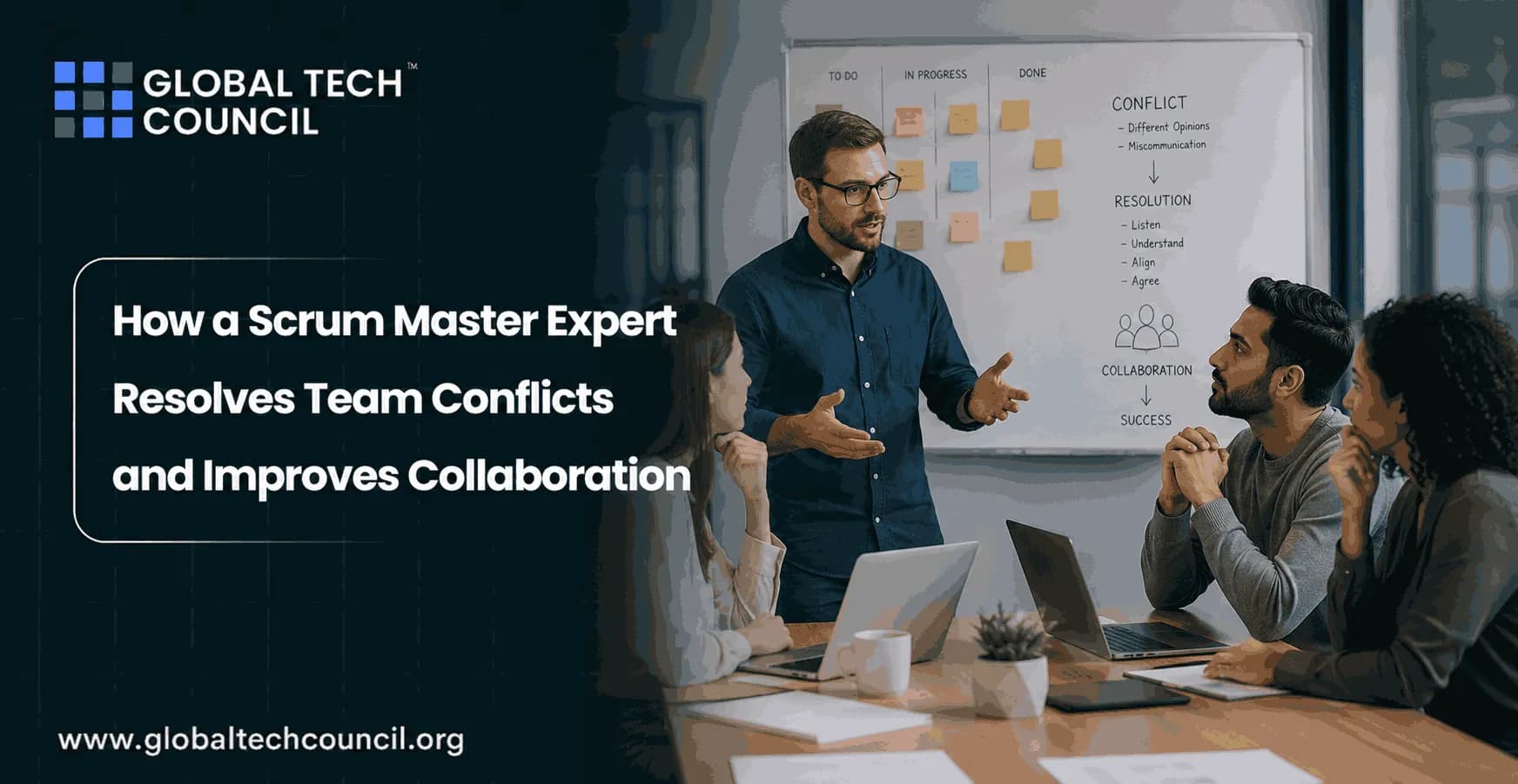
A Scrum Master expert resolves team conflicts by making disagreement safe, visible, and useful. Conflict is not the enemy in Scrum. Hidden conflict is. When you facilitate well, coach without taking sides, and inspect real delivery data, conflict becomes a signal that the team needs clarity, not a reason to blame people.
Scrum.org links effective Scrum to psychological safety and to the five Scrum values: commitment, focus, openness, respect, and courage. Practice guides from Atlassian and others recommend metrics such as cycle time, sprint goal success rate, defect trends, and rollover to surface coordination problems. The Scrum Master expert sits at that intersection of people, process, and evidence.

Why Conflict Happens in Scrum Teams
Scrum teams work in uncertainty. Priorities change. Architecture choices carry trade-offs. Product Owners want value sooner. Developers want quality and maintainability. That tension is normal.
The problems usually start when the team lacks a shared way to handle tension. You see it in small signs first:
Developers debate architecture in side channels instead of during refinement.
The Product Owner adds scope mid-sprint and calls it urgent.
The Daily Scrum becomes a status report to the Scrum Master.
Retrospective action items repeat for three sprints and nobody owns them.
Quiet team members stop challenging estimates or assumptions.
That last one matters. Silence is expensive. A team that avoids disagreement will still pay for it later through defects, rework, missed sprint goals, and low trust.
Resolving conflicts within Agile teams requires both leadership and technical understanding. A Tech Certification helps Scrum Masters build expertise in Agile methodologies, collaboration platforms, AI-powered productivity tools, and digital transformation. These future-ready skills enable professionals to facilitate effective communication, remove workflow bottlenecks, and create environments where cross-functional teams can collaborate successfully.
The Scrum Master Expert Starts With Psychological Safety
Psychological safety means people can speak up without fear of embarrassment or punishment. It does not mean every conversation feels comfortable. It means the team can say, this estimate is unrealistic, this design creates risk, or I made a mistake without being attacked.
A skilled Scrum Master builds this before a crisis. Do these things deliberately:
Model vulnerability: Admit your own facilitation mistakes. Ask, "What did I miss in that retro?"
Invite dissent: Ask the quietest person in the room for their view before the loudest person decides the direction.
Create working agreements: Define what respectful disagreement looks like, including how the team handles interruptions, late changes, and unresolved decisions.
Separate people from problems: Say "the work item is blocked" rather than "Alex is blocking us."
One practical check I use in retrospectives is simple. Ask each person to rate, from 1 to 5, how safe they felt raising a risk during the sprint. If the average is high but one person gives a 2, do not average it away. That outlier is the conversation.
How a Scrum Master Expert Resolves Team Conflicts
Intervene Early, Before Positions Harden
Conflict often moves from mild disagreement to fixed positions, then to personal judgment. Early warning signs include sarcasm, repeated private complaints, people avoiding specific topics, and sudden drops in participation.
Do not wait for a dramatic blow-up. Start with a one-to-one coaching conversation. Ask:
What outcome are you trying to protect?
What do you think the other person is worried about?
What data would help the team decide?
What agreement do we need before the next Sprint Planning?
The goal is not to become the team therapist. The goal is to move the conflict back into a shared, inspectable space.
Facilitate, Do Not Judge
A Scrum Master is not the referee who declares a winner. You facilitate a conversation where the team can understand the issue and choose a path.
Use a structure:
State the problem in neutral terms.
Let each person describe their concern without interruption.
Ask each side to summarize the other side's view.
List options.
Agree on a decision rule, such as experiment results, customer value, risk reduction, or sprint goal impact.
This sounds basic. It works because most conflict gets worse when people argue against a version of the other person's position that was never accurate.
Use Experiments for Technical Disagreements
When developers disagree on a technical approach, do not let the debate become a seniority contest. Use a time-boxed spike.
Say one developer wants server-side rendering and another wants a client-heavy React pattern. Define a two-day experiment. Measure page load time, implementation complexity, testability, accessibility impact, and deployment risk. Decide after evidence, not volume.
Be blunt here. Endless architecture debate is not Agile. It is delay dressed as diligence. A small experiment is usually cheaper than three meetings. Agile teams often consist of professionals working on AI, cloud, automation, and enterprise software initiatives. Becoming a Deeptech Expert gives Scrum Masters the technical understanding needed to bridge communication gaps between business stakeholders and engineering teams. This knowledge improves collaboration, reduces misunderstandings, and supports faster resolution of technical conflicts.
Reframe Product Owner and Developer Conflict Around Capacity
Scope conflict is common. The Product Owner pushes for more. Developers warn that quality will suffer. Both may be right.
A Scrum Master expert reframes the discussion around the Sprint Goal, capacity, and customer value. Ask the Product Owner, "If we can only finish three of these five items, which three protect the goal?" Ask the Developers, "What risk makes the current scope unsafe?"
This moves the conversation from preference to trade-off. It also protects the team from the classic anti-pattern: starting eight stories, finishing four, then carrying the rest into the next sprint. That rollover is not just a planning issue. It is a collaboration signal.
Improving Collaboration Through Scrum Events
Sprint Planning: Co-create the Goal
If Sprint Planning is just ticket selection, collaboration starts weak. The team needs a Sprint Goal that explains why the work matters. Developers should discuss how they will approach the work, not wait for tasks to be assigned.
Certification candidates often get this wrong. The Scrum Master does not assign work to Developers. The Developers self-manage the plan for the sprint. If your Daily Scrum sounds like "What did you do for me yesterday?" you have already drifted away from Scrum.
Daily Scrum: Focus on Flow, Not Status
The Daily Scrum is for Developers to inspect progress toward the Sprint Goal and adapt the plan. Keep it short, but do not make it shallow.
Useful questions include:
What is closest to Done?
Where are we blocked?
Do we need to swarm on one item?
Is the Sprint Goal still realistic?
Swarming is underrated. It is often better for five people to finish one important story than for five people to start five unrelated stories. Finished work teaches you more than busy work.
Retrospective: Treat Improvement Work as Real Work
Many teams identify good retrospective actions and then ignore them. When improvement items never get done, trust erodes. People stop contributing because nothing changes.
Make one improvement item visible on the sprint backlog. Keep it small. Assign an owner if needed, but make the result a team concern. Then inspect whether it helped in the next retrospective.
Use Metrics Without Turning Them Into Weapons
Metrics help a Scrum Master expert see patterns that feelings alone can miss. Use three or four at a time. More than that becomes noise.
Sprint goal success rate: Are teams meeting the outcomes they chose?
Cycle time: How long does work take from start to finish?
Rollover: How much work moves from one sprint to the next?
Defect trends: Is speed creating quality debt?
Blocked-item age: How long do impediments stay unresolved?
One Jira detail catches beginners. The Control Chart can look clean if issues are moved to a Done status outside the workflow you are filtering, or if the board filter excludes certain issue types. Before you coach based on cycle time, check the board filter, the workflow statuses, and the Done mapping. Bad data creates bad conflict.
Never use velocity to compare teams. It will distort behavior. Use it within the same team as a planning input, and even then, treat it as a conversation starter, not a performance score. Conflict resolution also depends on communication, empathy, and stakeholder management. A Marketing Certification strengthens leadership, negotiation, customer-centric thinking, and strategic communication skills. These capabilities help Scrum Masters foster trust, improve collaboration, and ensure Agile teams remain aligned with organizational objectives.
Collaboration in Remote and Hybrid Scrum Teams
Remote conflict is easier to miss. Text can sound sharper than intended. Time zone gaps slow decisions. Video meetings often favor the people who speak fastest.
Set explicit norms:
Use written decision records for major product or technical choices.
Rotate meeting times when the team spans time zones.
Invite asynchronous input before refinement and retrospectives.
Call out decisions made in private chats and bring them back to the team.
Use cameras when the topic is sensitive, but do not make camera use a trust test.
For distributed teams, silence in a meeting is not consent. Ask for input in more than one format.
Conflict Resolution Styles a Scrum Master Should Know
The Thomas-Kilmann model describes five common conflict styles: competing, accommodating, avoiding, compromising, and collaborating. A Scrum Master expert does not treat one style as always right.
Competing: Useful in rare emergencies, harmful as a habit.
Avoiding: Fine for trivial issues, dangerous for recurring delivery problems.
Accommodating: Can preserve goodwill, but may hide resentment.
Compromising: Good for low-risk decisions where speed matters.
Collaborating: Best for complex product, architecture, and team-health decisions.
Take a position. For Scrum teams doing complex product work, collaboration should be the default for meaningful decisions. Compromise is useful, but it can also produce mediocre technical choices nobody truly supports.
How Professionals Can Build This Skill
If you are a developer moving toward Scrum Master responsibilities, start with facilitation before process mechanics. Learn how to ask better questions, visualize work, run retrospectives, and coach without rescuing the team.
If you manage Scrum Masters, give them the authority to remove organizational impediments. A Scrum Master cannot fix chronic overcommitment alone if leadership rewards teams for saying yes to everything.
For structured learning, pair Global Tech Council Scrum Master certification training with practice. Facilitate one retrospective, improve one working agreement, and track one metric that exposes a real collaboration problem.
Next Step
Pick one active conflict on your team this week. Write the neutral problem statement, identify the shared goal, and choose one facilitation technique from this guide. If you want a formal path, a Scrum Master certification from Global Tech Council can help you build the facilitation, coaching, and metrics skills needed to handle conflict with confidence. Improving collaboration requires continuous learning across leadership, technology, and business disciplines. Build advanced Agile expertise through a Scrum Master Expert certification, develop practical AI implementation knowledge with a Forward Deployed Engineer Certification, and strengthen customer engagement and business growth strategies through an AI-powered Digital Marketing Course.
FAQs
1. How Does a Scrum Master Expert Resolve Team Conflicts and Improve Collaboration?
A Scrum Master Expert resolves team conflicts by facilitating open communication, encouraging active listening, identifying root causes, and promoting collaborative problem-solving. Their goal is to build trust, strengthen teamwork, and create an environment where Agile teams can perform at their best.
2. Why Is Conflict Resolution an Essential Scrum Master Expert Skill?
Conflict resolution is essential because disagreements over priorities, workloads, and communication can disrupt Agile projects. A Scrum Master Expert helps address these issues early, ensuring that conflicts do not negatively impact team productivity or sprint goals.
3. What Types of Team Conflicts Do Scrum Master Experts Commonly Handle?
Scrum Master Experts frequently manage conflicts related to backlog priorities, task ownership, communication gaps, technical disagreements, resource allocation, stakeholder expectations, and differing opinions during sprint planning or retrospectives.
4. How Does a Scrum Master Expert Identify the Root Cause of Team Conflicts?
Instead of focusing on symptoms, Scrum Master Experts use active listening, one-on-one discussions, retrospectives, and team feedback to uncover the underlying causes of conflict. Understanding the root issue helps them implement long-term solutions rather than temporary fixes.
5. How Can Active Listening Help Resolve Agile Team Conflicts?
Active listening allows Scrum Master Experts to understand each team member's perspective without judgment. By ensuring everyone feels heard, they create a foundation for respectful discussions and mutually beneficial solutions.
6. What Communication Techniques Do Scrum Master Experts Use to Improve Collaboration?
Scrum Master Experts encourage transparent communication through daily stand-ups, sprint planning sessions, retrospectives, stakeholder meetings, collaborative documentation, and regular feedback. These practices reduce misunderstandings and strengthen team alignment.
7. How Do Scrum Master Experts Handle Personality Conflicts Within Agile Teams?
They remain neutral, facilitate respectful conversations, encourage empathy, clarify expectations, and focus discussions on project goals rather than personal differences. This approach helps rebuild trust and maintain a healthy team culture.
8. What Role Does Servant Leadership Play in Conflict Resolution?
Servant leadership enables Scrum Master Experts to support and guide team members rather than dictate solutions. By empowering individuals and fostering accountability, they create an environment where conflicts are resolved collaboratively.
9. How Can Scrum Master Experts Improve Team Collaboration During Sprint Planning?
They facilitate inclusive discussions, clarify sprint goals, ensure backlog priorities are understood, encourage equal participation, and align the team on realistic commitments. Effective sprint planning minimizes confusion and promotes shared ownership.
10. How Do Scrum Master Experts Resolve Conflicts Between Developers and Product Owners?
A Scrum Master Expert acts as a neutral facilitator by encouraging open dialogue, clarifying business priorities, balancing technical constraints with customer needs, and helping both parties reach decisions that support successful sprint outcomes.
11. Why Are Retrospectives Important for Resolving Team Conflicts?
Sprint retrospectives provide a structured opportunity for team members to discuss challenges, share feedback, identify recurring issues, and agree on actionable improvements. Scrum Master Experts use retrospectives to prevent small disagreements from becoming larger problems.
12. How Does Psychological Safety Improve Agile Team Collaboration?
Psychological safety encourages team members to share ideas, ask questions, admit mistakes, and provide honest feedback without fear of criticism. Scrum Master Experts foster this environment to improve innovation, trust, and overall team performance.
13. How Can Scrum Master Experts Build Trust Within Agile Teams?
Trust is built through transparency, consistency, fairness, accountability, and open communication. Scrum Master Experts demonstrate these qualities while encouraging collaboration and ensuring every team member feels respected and valued.
14. What Tools Help Scrum Master Experts Improve Team Collaboration?
Popular collaboration tools include Jira, Azure DevOps, Confluence, Miro, Microsoft Teams, Slack, Trello, ClickUp, and Monday.com. These platforms improve communication, sprint tracking, documentation, and coordination across Agile teams.
15. How Do Scrum Master Experts Manage Remote Team Conflicts?
For distributed Agile teams, Scrum Master Experts promote regular virtual meetings, clear communication guidelines, collaborative digital workspaces, and frequent check-ins. These practices help overcome communication barriers and strengthen remote collaboration.
16. What Common Mistakes Should Scrum Master Experts Avoid During Conflict Resolution?
Common mistakes include taking sides, ignoring underlying issues, delaying difficult conversations, imposing solutions without team input, and failing to follow up after conflicts are resolved. Maintaining neutrality and encouraging collaboration are critical for long-term success.
17. How Does Effective Collaboration Improve Agile Team Performance?
Strong collaboration leads to better communication, faster decision-making, higher productivity, improved product quality, and increased team engagement. Scrum Master Experts create an environment where collaboration becomes a competitive advantage.
18. Can Scrum Master Experts Prevent Team Conflicts Before They Occur?
Yes. By establishing clear expectations, promoting transparency, facilitating regular communication, encouraging continuous feedback, and addressing issues early, Scrum Master Experts can prevent many conflicts from escalating into larger problems.
19. Which Industries Benefit Most From Scrum Master Expertise in Conflict Resolution?
Industries such as software development, finance, healthcare, manufacturing, telecommunications, retail, consulting, government, and education benefit from Scrum Master Experts who can improve collaboration and maintain high-performing Agile teams.
20. Why Is a Scrum Master Expert Critical for Building High-Performing Agile Teams?
A Scrum Master Expert helps create a collaborative, transparent, and supportive work environment where conflicts are resolved constructively and teams continuously improve. By strengthening communication, trust, and Agile practices, they enable teams to consistently deliver high-quality results while adapting effectively to changing business needs.
Related Articles
View All
Scrum Master
How to Become a Scrum Master Expert: Step-by-Step Roadmap for Beginners
A practical beginner roadmap to become a Scrum Master expert, covering Scrum foundations, certification, team experience, coaching, metrics, and advanced growth.
Scrum Master
Top Scrum Master Expert Skills Employers Look for in 2026
Learn the Scrum Master expert skills employers want in 2026, including agile coaching, AI literacy, data-driven agility, technical fluency, and leadership.

Scrum Master
Scrum Master Expert vs Agile Coach: Key Differences, Skills, Salary, and Career Opportunities
Compare Scrum Master Expert vs Agile Coach roles, skills, salary ranges, market demand, and career paths for agile professionals.
Trending Articles
The Role of Blockchain in Ethical AI Development
How blockchain technology is being used to promote transparency and accountability in artificial intelligence systems.
AWS Career Roadmap
A step-by-step guide to building a successful career in Amazon Web Services cloud computing.
Top 5 DeFi Platforms
Explore the leading decentralized finance platforms and what makes each one unique in the evolving DeFi landscape.