

Scrum Master Expert vs Agile Coach: Key Differences, Skills, Salary, and Career Opportunities
 Suyash Raizada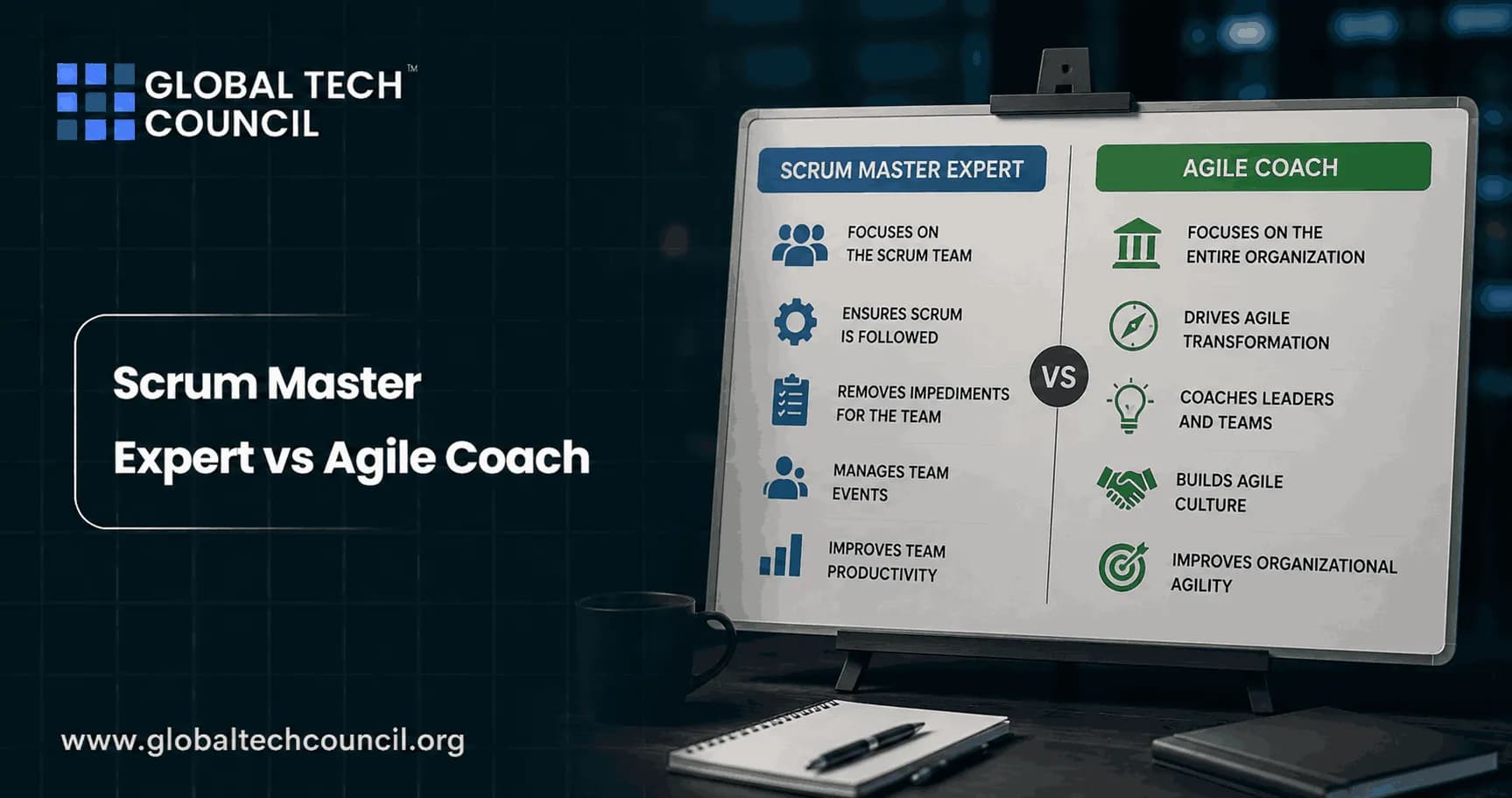
Scrum Master Expert vs Agile Coach is a practical career choice, not just a title comparison. A Scrum Master Expert usually works close to one or a few Scrum teams, improving delivery habits, removing blockers, and protecting empirical Scrum. An Agile Coach works wider, often across departments, leaders, portfolios, and several agile frameworks.
The distinction matters more in 2026 than it did a few years ago. Employers still need agile talent, but they are less interested in people who only run ceremonies. They want professionals who can show business impact, improve flow, work with product and engineering, and handle change without turning agile into theater. As Agile roles continue to evolve, professionals are strengthening their technical and leadership capabilities through Tech Certification programs. These certifications cover Agile methodologies, AI-powered project management, cloud technologies, DevOps, and digital transformation, helping both Scrum Masters and Agile Coaches stay ahead of industry trends. By combining technical knowledge with Agile best practices, professionals can lead high-performing teams, improve project outcomes, and remain competitive in today's technology-driven organizations.

Scrum Master Expert vs Agile Coach: The Core Difference
The simplest difference is scope.
Scrum Master Expert: Deep team-level mastery of Scrum.
Agile Coach: Broad organization-level coaching across agile, lean, product, and delivery systems.
A Scrum Master Expert is usually measured by how well one or a few teams inspect, adapt, and deliver usable increments. An Agile Coach is judged by wider changes: better portfolio decisions, healthier operating models, improved cross-team flow, stronger leadership behaviors, and agile adoption that lasts.
To be blunt, if you enjoy sitting with a team after a messy sprint review and helping them fix real delivery problems, the Scrum Master Expert path may fit you. If you prefer working with executives, redesigning governance, and coaching several teams through organizational change, Agile Coach is the better target.
What Does a Scrum Master Expert Do?
A Scrum Master Expert is not a meeting scheduler. That misconception still shows up in job descriptions, and it is one reason the market has tightened for entry-level Scrum Masters.
The role usually includes:
Facilitating sprint planning, daily scrums, sprint reviews, and retrospectives.
Coaching Developers, Product Owners, and stakeholders on Scrum theory and practice.
Removing impediments that block delivery, not just logging them in Jira.
Protecting the team from unplanned work during a sprint.
Using metrics such as cycle time, throughput, escaped defects, and sprint goal success rate to drive improvement.
Helping the Product Owner improve backlog refinement and ordering.
Good Scrum Masters notice the small things. Take a Jira board with tickets moving to Done while the Resolution field stays empty. In many Jira setups that quietly breaks reporting and burndown. A beginner may miss it. An experienced Scrum Master asks why the workflow allows false completion, then fixes the policy with the team.
Certification candidates also trip over a basic Scrum point: the Daily Scrum is for Developers to inspect progress toward the Sprint Goal. It is not a status report to the Scrum Master. If you still run it as a round-robin update to a manager, you are not practicing Scrum well. Understanding emerging technologies has become increasingly valuable for Agile leaders managing AI, cloud, blockchain, and enterprise software projects. Becoming a Deeptech Expert equips professionals with practical knowledge of advanced technologies, enabling them to communicate effectively with engineering teams, support innovation initiatives, and guide organizations through complex digital transformation projects while maintaining Agile excellence.
What Does an Agile Coach Do?
An Agile Coach operates at a broader level. The role may include Scrum, but it rarely stops there.
Agile Coaches often work on:
Enterprise agile transformation plans.
Leadership coaching and stakeholder alignment.
Portfolio management, funding models, and governance changes.
Cross-team dependency management and flow optimization.
Framework selection across Scrum, Kanban, SAFe, LeSS, XP, and Lean product development.
Training Scrum Masters, Product Owners, delivery leaders, and managers.
An Agile Coach must be comfortable saying, "Scrum is not the right answer here." A platform operations team handling unpredictable production incidents will often get better results from Kanban with explicit work-in-progress limits than from two-week sprints. A coach who forces Scrum everywhere creates waste.
This role also involves politics. Not office gossip. Real systems. Incentives, budgeting cycles, approval boards, reporting habits, and promotion criteria can all fight agile ways of working. Agile Coaches need the confidence to challenge those systems without alienating the people who own them.
Skills Comparison: Scrum Master Expert vs Agile Coach
Scrum Master Expert Skills
Deep Scrum knowledge: Scrum values, empiricism, self-management, Sprint Goals, Definition of Done, and incremental delivery.
Facilitation: Running difficult retrospectives, conflict sessions, and planning conversations without taking over.
Team coaching: Helping teams improve behavior, not only process compliance.
Technical literacy: Understanding CI/CD, test automation, DevOps, technical debt, and release constraints.
Metrics judgment: Knowing that velocity is a planning aid, not a performance score.
Agile Coach Skills
Cross-framework knowledge: Scrum, Kanban, Lean, XP, SAFe, and scaling patterns.
Systems thinking: Seeing how structure, incentives, funding, and leadership behavior affect delivery.
Executive coaching: Working with senior leaders without becoming a slide-deck consultant.
Change management: Designing adoption paths that fit the organization instead of copying a framework diagram.
Product and data awareness: Connecting agile practice to customer value, outcome metrics, AI initiatives, and digital strategy.
The shift toward AI and data work is real. Agile Coaches supporting AI product teams need to understand experimentation cycles, model validation, data availability, and MLOps handoffs. A two-week sprint plan can fall apart when a data science task depends on labeling quality or model drift analysis. You do not need to be a machine learning engineer, but you must know enough to ask better questions.
Salary and Job Outlook
Compensation varies by region, industry, and seniority. The pattern is clear, though: Agile Coaches often earn more because they carry broader responsibility.
Dice reported an average Scrum Master salary of about USD 118,149 in its 2023 technology salary data, with a slight year-over-year decline.
Glassdoor-based salary guides have placed senior Agile Coach averages near USD 198,858, while broader Agile Coach datasets such as Zippia show lower averages around USD 113,405. The gap reflects title inflation, location, and seniority.
Some senior enterprise Agile Coach postings on Indeed have listed ranges such as USD 131,300 to USD 237,350.
The US Bureau of Labor Statistics projects 6 percent employment growth for project management specialists from 2023 to 2033, a category that includes many agile delivery roles.
Zippia has reported roughly 9 percent projected growth for both Scrum Master and Agile Coach roles in long-range job outlook data.
The signal is not "easy jobs everywhere." It is more selective than that. Teams still need Scrum skills, but companies increasingly expect technical fluency, product sense, analytics, and visible delivery outcomes. Whether you're a Scrum Master or an Agile Coach, success depends on communication, stakeholder management, and business alignment. A Marketing Certification helps professionals strengthen strategic thinking, leadership, branding, customer engagement, and business growth skills. These capabilities enable Agile leaders to better align product development with customer expectations while creating measurable business value across organizations.
Career Path: Which Role Should You Choose?
Choose Scrum Master Expert if You Want Hands-On Team Impact
This path fits you if you like working directly with teams and helping them improve sprint by sprint. It is also a strong fit for professionals coming from QA, software development, business analysis, project management, or product operations.
Your best career moves:
Master the Scrum Guide and practice facilitation in real teams.
Learn Jira or Azure DevOps reporting beyond basic board management.
Study DevOps, CI/CD, trunk-based development, and test automation basics.
Build evidence of impact: shorter cycle time, fewer carryovers, better Sprint Goal completion, or improved release predictability.
Choose Agile Coach if You Want Organization-Wide Change
The Agile Coach path is better if you already have several years of team-level experience and want to influence systems, not only ceremonies. You will need patience. Some of the hardest work is persuading leaders to stop rewarding local utilization and start optimizing value flow.
Your best career moves:
Coach multiple teams across different products or departments.
Learn Kanban metrics such as flow efficiency, aging work in progress, and service level expectations.
Study change management, systems thinking, and executive coaching.
Get exposure to portfolio planning, budgeting, product strategy, and modern data or AI initiatives.
How Organizations Should Use Both Roles
Do not hire an Agile Coach when you need a full-time Scrum Master for a struggling product team. And do not hire a Scrum Master Expert expecting them to redesign enterprise governance alone.
A healthy model looks like this:
Scrum Master Experts improve team execution, Scrum discipline, collaboration, and delivery habits.
Agile Coaches improve the surrounding system: leadership, structure, funding, scaling, and cross-team flow.
Product and engineering leaders stay accountable for outcomes. Agile roles support them, not replace them.
When these boundaries are clear, both roles create value. When they are blurred, teams get ceremony without change.
Practical Next Step
If you are early in your agile career, start with Scrum Master expertise. Build proof on one team before claiming enterprise coaching capability. If you already coach several teams and work with leadership, move toward Agile Coach skills: systems thinking, portfolio flow, change management, and cross-framework decision-making.
Map your current experience honestly. Then pick one skill gap to close this month. For many professionals, the best move is a Scrum Master certification path plus practical learning in DevOps, product management, or AI so your agile skills stay relevant in modern technology teams.
FAQs
1. What Is the Difference Between a Scrum Master Expert and an Agile Coach?
A Scrum Master Expert primarily focuses on facilitating Scrum teams, ensuring Agile practices are followed, and helping teams deliver successful sprints. An Agile Coach works at a broader organizational level, mentoring multiple teams, guiding Agile transformations, and helping leaders adopt Agile principles across the business.
2. Should You Choose a Career as a Scrum Master Expert or an Agile Coach?
The right career depends on your interests and experience. If you enjoy working closely with individual Scrum teams and improving sprint execution, becoming a Scrum Master Expert may be ideal. If you prefer driving enterprise-wide Agile transformation and coaching leadership teams, an Agile Coach role may be a better fit.
3. What Are the Primary Responsibilities of a Scrum Master Expert?
A Scrum Master Expert facilitates Scrum ceremonies, removes team impediments, supports sprint planning, coaches Agile teams, promotes collaboration, and ensures Scrum principles are consistently applied. Their primary goal is to maximize team productivity and continuous improvement.
4. What Does an Agile Coach Do?
An Agile Coach mentors Scrum Masters, Product Owners, executives, and Agile teams while helping organizations adopt Agile practices at scale. They focus on organizational change, leadership coaching, Agile maturity, and continuous business improvement.
5. Which Skills Are Required to Become a Scrum Master Expert?
Scrum Master Experts need servant leadership, communication, facilitation, stakeholder management, conflict resolution, sprint planning, coaching, Agile methodologies, problem-solving, and proficiency with Agile project management tools like Jira and Azure DevOps.
6. Which Skills Are Essential for an Agile Coach?
Agile Coaches require advanced coaching, mentoring, enterprise Agile transformation, change management, leadership development, organizational strategy, facilitation, emotional intelligence, Agile scaling frameworks, and business consulting skills.
7. Does an Agile Coach Need Scrum Master Experience?
Yes, many Agile Coaches begin their careers as Scrum Masters before progressing into coaching roles. Hands-on Scrum experience provides practical knowledge that helps Agile Coaches mentor teams and lead successful organizational transformations.
8. Which Role Has More Leadership Responsibility: Scrum Master Expert or Agile Coach?
An Agile Coach generally has broader leadership responsibilities because they influence multiple teams, departments, and executive leadership. Scrum Master Experts primarily lead Agile practices within one or more Scrum teams and focus on team-level success.
9. What Certifications Are Recommended for Scrum Master Experts and Agile Coaches?
Scrum Master Experts often pursue Scrum and Agile certifications to validate their expertise. Agile Coaches typically build on these credentials with advanced Agile coaching, enterprise Agile, leadership, and organizational transformation certifications.
10. What Tools Should Scrum Master Experts and Agile Coaches Learn?
Both professionals benefit from learning Jira, Azure DevOps, Confluence, Miro, Trello, ClickUp, Monday.com, Microsoft Teams, Slack, and Agile analytics platforms. Agile Coaches may also use enterprise planning and portfolio management tools.
11. What Is the Average Salary of a Scrum Master Expert?
Scrum Master Expert salaries vary depending on experience, certifications, industry, and location. Experienced professionals typically earn competitive salaries because Agile expertise remains highly valued across technology, finance, healthcare, consulting, and government organizations.
12. How Much Does an Agile Coach Earn Compared to a Scrum Master Expert?
Agile Coaches often earn higher salaries because they oversee enterprise Agile transformation initiatives and mentor multiple Scrum teams. Their broader organizational responsibilities typically command greater compensation than team-focused Scrum Master roles.
13. Which Career Offers Better Long-Term Growth?
Both careers offer excellent growth opportunities. Scrum Master Experts can advance into Senior Scrum Master, Agile Program Manager, or Delivery Manager roles, while Agile Coaches may progress into Enterprise Agile Coach, Transformation Director, or Agile Consulting positions.
14. Can a Scrum Master Expert Transition Into an Agile Coach Role?
Yes. Many professionals advance from Scrum Master Expert to Agile Coach after gaining extensive experience managing Agile teams, mentoring Scrum Masters, leading organizational initiatives, and developing advanced coaching capabilities.
15. Which Industries Hire Scrum Master Experts and Agile Coaches?
Both roles are highly sought after in software development, banking, healthcare, insurance, telecommunications, retail, manufacturing, consulting, government, education, and organizations undergoing digital transformation.
16. Which Role Is Better for Beginners in Agile?
For most professionals, becoming a Scrum Master Expert is the ideal starting point because it provides hands-on experience with Agile teams, Scrum ceremonies, and project delivery. Agile Coach positions generally require several years of practical Agile leadership experience.
17. How Do Scrum Master Experts and Agile Coaches Work Together?
Scrum Master Experts focus on supporting individual Agile teams, while Agile Coaches provide mentorship, strategic guidance, and organizational coaching. Together, they improve Agile adoption, team performance, and enterprise-wide Agile maturity.
18. What Challenges Do Scrum Master Experts and Agile Coaches Face?
Scrum Master Experts often deal with sprint execution challenges, team conflicts, and removing impediments. Agile Coaches typically face larger organizational challenges such as cultural resistance, executive alignment, scaling Agile practices, and leading enterprise transformation.
19. Which Role Is More Future-Proof in 2026 and Beyond?
Both roles are expected to remain in high demand as Agile adoption continues to grow. However, Agile Coaches may see increasing opportunities as more organizations invest in enterprise-wide Agile transformation, while Scrum Master Experts remain essential for high-performing Agile teams.
20. How Do You Decide Between Becoming a Scrum Master Expert and an Agile Coach?
Choose the path that aligns with your career goals and interests. If you enjoy team facilitation, sprint management, and direct collaboration, becoming a Scrum Master Expert is an excellent choice. If you're passionate about leadership coaching, organizational change, and enterprise Agile strategy, pursuing a career as an Agile Coach offers broader strategic responsibilities and long-term growth opportunities.
Related Articles
View All
Scrum Master
Scrum Master Expert Salary Guide 2026: Trends, Roles, and Growth Opportunities
Explore Scrum Master expert salary trends for 2026, including pay ranges, hiring demand, certifications, career paths, and skills that raise earning potential.

Scrum Master
Scrum Master Expert Guide: Roles, Skills, and Career Path in Agile Teams
A practical Scrum Master expert guide covering modern responsibilities, skills, salary outlook, career paths, and how to stay relevant in agile teams.
Scrum Master
Top Scrum Master Expert Skills Employers Look for in 2026
Learn the Scrum Master expert skills employers want in 2026, including agile coaching, AI literacy, data-driven agility, technical fluency, and leadership.
Trending Articles
The Role of Blockchain in Ethical AI Development
How blockchain technology is being used to promote transparency and accountability in artificial intelligence systems.
AWS Career Roadmap
A step-by-step guide to building a successful career in Amazon Web Services cloud computing.
Top 5 DeFi Platforms
Explore the leading decentralized finance platforms and what makes each one unique in the evolving DeFi landscape.