

Scrum Master Expert Role in Scaling Agile Across Enterprises
 Suyash Raizada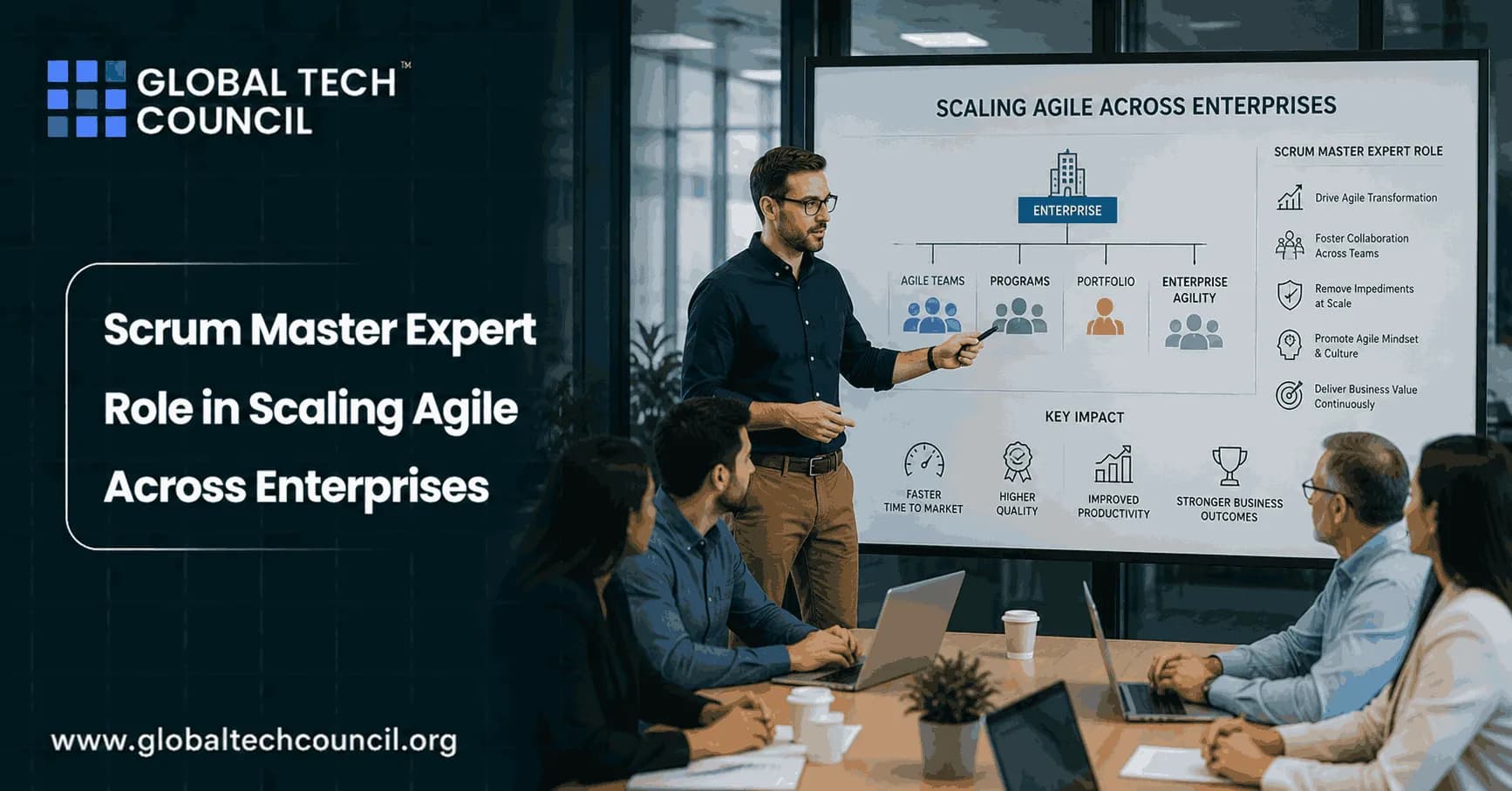
A Scrum Master Expert is no longer just the person who runs the Daily Scrum and reminds the team about the Sprint Retrospective. In enterprise agile, the role widens. You coach leaders, remove cross-team blockers, improve flow, and help many teams deliver value without building a process maze.
That shift matters. When agile scales across 10, 50, or 200 teams, the hard problems are rarely about whether a single team knows the Scrum Guide. The real friction sits between teams: dependency queues, delayed decisions, overloaded Product Owners, unclear portfolio priorities, and metrics that reward activity instead of outcomes. This is where an experienced Scrum Master earns trust. Scaling Agile across large organizations requires expertise that extends beyond Scrum fundamentals. A Tech Certification equips professionals with advanced knowledge of Agile scaling frameworks, cloud computing, AI-powered collaboration, DevOps, and enterprise transformation. These skills help Scrum Masters coordinate multiple Agile teams, improve delivery efficiency, and successfully support organization-wide Agile adoption.

How the Scrum Master Expert role changes at enterprise scale
At the team level, a Scrum Master facilitates Scrum events, supports self-management, removes impediments, and coaches the team on Scrum. That work still matters. But in scaling agile, it is not enough.
A Scrum Master Expert acts as a systems thinker. You look beyond one team board and ask sharper questions:
Which dependencies are slowing delivery across the value stream?
Where are handoffs causing rework?
Are teams optimizing velocity while customers still wait months for value?
Do leaders remove impediments, or do they simply ask for better status reports?
In SAFe, the Scrum Master is often described as a Scrum Master or Team Coach who supports one or more agile teams within an Agile Release Train. The role includes coaching Scrum, Kanban, XP, and SAFe practices, preparing teams for PI Planning, supporting the System Demo, and helping teams improve flow.
In Scrum@Scale, the Scrum of Scrums Master carries an even more explicit scaled accountability. The SoSM makes sure scaled events happen, stay productive, and remain time-boxed. More importantly, the SoSM is accountable for releasing the combined teams' work and for improving throughput, cost, and quality.
Different framework. Same message. Scaling agile needs Scrum Masters who can connect delivery, leadership, product strategy, and culture.
Why enterprises need Scrum Master Experts, not meeting schedulers
Many enterprises make the same mistake. They hire Scrum Masters, then measure them by meeting hygiene. Were the events held? Was Jira updated? Did the team complete the Sprint? Fine questions, but too narrow.
When agile expands across departments, a Scrum Master Expert becomes an enterprise change agent. You coach leaders on decentralized decision-making. You help Product Owners split features into smaller increments. You challenge fake agility, such as teams working in two-week Sprints while funding, approvals, and architecture still move quarterly.
Scrum Alliance's 2024 Scrum Master Skills in the New World of Work report found that 38% of organizations prioritize coaching and facilitation skills when hiring Scrum Masters, and demand for those skills nearly doubled over the previous year. That is not surprising. Dedicated agile coaching roles have shrunk in many organizations, so senior Scrum Masters are now asked to coach across teams and departments.
To be blunt, a Scrum Master who only facilitates events will struggle here. A Scrum Master Expert who can coach, measure flow, influence leaders, and improve the operating system of work becomes central to scaling agile. Enterprise Agile initiatives frequently involve AI, blockchain, automation, and cloud-native technologies. Becoming a Deeptech Expert enables Scrum Masters to better understand technical dependencies, collaborate with engineering leaders, and facilitate innovation across large-scale digital transformation programs. This interdisciplinary expertise supports smoother enterprise-wide Agile implementation.
Core responsibilities in scaling agile
Cross-team coordination and dependency management
Enterprise delivery breaks when dependencies are invisible or found too late. In SAFe, this often surfaces during PI Planning, when teams realize a feature depends on an API, a security review, a data migration, and a platform change owned by four different groups.
A good Scrum Master Expert prepares before the room gets crowded. You help teams identify dependencies early, confirm sequencing, and make capacity visible. One small detail can change the whole plan: account for holidays, production support rotation, training days, and carryover work before teams commit to PI Objectives. I have watched teams plan at 100% capacity in a PI, then lose two engineers to release support during Iteration 2. The plan did not fail because people were lazy. It failed because the capacity was fiction.
Enterprise coaching and leadership enablement
Scaling agile is limited by leadership behavior. If every decision must climb three approval layers, no framework will save the organization.
A Scrum Master Expert coaches leaders to create clarity without micromanaging. That includes:
Helping leaders express outcomes rather than task lists
Teaching the difference between commitment and forecast
Encouraging faster decisions at the right level
Making systemic impediments visible without blaming teams
Protecting teams from urgent work that is not truly urgent
This is uncomfortable work. You may need to tell a senior manager that changing priorities every Sprint is the root cause of missed goals. Say it with evidence. Bring cycle time, blocked work aging, escaped defects, dependency counts, and objective completion trends.
Metrics-driven improvement and flow stewardship
At scale, velocity is often misused. It can help a team forecast its own work, but it should not become a performance comparison across teams. That invites gaming within weeks.
A Scrum Master Expert focuses on flow metrics instead:
Cycle time: how long work takes from start to finish
Throughput: how many work items finish in a period
Work in progress: how much work is open at once
Blocked time: how long items wait for decisions, reviews, or dependencies
Predictability: how reliably teams meet agreed objectives
One practical warning. In Jira, beginners often build a cumulative flow diagram that folds the Done column in a way that makes WIP look healthier than it is. Check your column mapping. If Review, Security Signoff, and Ready for Release all hide under a broad in-progress state, your flow data will lie to you. Scaling Agile successfully also requires effective communication across departments and executive leadership. A Marketing Certification helps Scrum Masters strengthen strategic communication, stakeholder engagement, branding, and business alignment skills. These capabilities ensure Agile initiatives remain focused on customer value while supporting long-term organizational growth.
Facilitation of scaled events
Scaled events earn their keep only when they expose real problems and lead to action. PI Planning, Scrum of Scrums, the System Demo, and Inspect and Adapt workshops can turn into theater if the Scrum Master community does not protect their purpose.
For PI Planning, a Scrum Master Expert helps teams enter with refined work, known risks, draft objectives, and realistic capacity. During Scrum of Scrums, you keep the conversation on integration, dependencies, and impediments, not individual status. In Inspect and Adapt, you help the group find root causes and run improvement experiments that can be checked later.
Short version: facilitate for decisions, not attendance.
Culture building across functions
Scrum values are easy to quote and hard to live. At enterprise scale, transparency can feel risky. Inspection can expose political issues. Adaptation can disrupt annual planning habits.
The Scrum Master Expert helps normalize these behaviors. You make work visible. You ask teams and leaders to inspect real evidence. You push for adaptation before the next annual transformation deck.
This applies outside software too. In manufacturing, hardware, operations, marketing, and HR, the work may not fit classic software Scrum patterns. Physical constraints, supplier lead times, compliance gates, or campaign calendars change how agility looks. The principles still hold: shorten feedback loops, reduce batch size, make constraints visible, and improve continuously.
SAFe, Scrum@Scale, LeSS, or Nexus: which path fits?
No scaling framework is magic. Pick based on your operating model, not brand familiarity.
SAFe fits large enterprises that need portfolio alignment, Agile Release Trains, formal PI Planning, and coordination across many teams. It gets heavy fast if leaders treat it as a reporting structure rather than a flow system.
Scrum@Scale works well when you want a network of Scrum teams coordinated through Scrum of Scrums with clear scaled accountabilities.
LeSS is strong when you want to reduce organizational complexity and keep scaling close to Scrum principles. It is a poor fit if the enterprise refuses structural change.
Nexus helps several Scrum teams build one integrated product, especially when integration risk is high.
Your job as a Scrum Master Expert is not to defend a framework at all costs. Your job is to improve value delivery and help the organization learn faster.
Skills professionals should build now
If you want to move from Scrum Master to Scrum Master Expert, build depth in five areas:
Advanced facilitation: Learn how to guide conflict, decision-making, prioritization, and retrospectives with senior stakeholders in the room.
Coaching: Practice listening, powerful questioning, and behavior change. Advice-giving is not coaching.
Systems thinking: Map value streams, policies, queues, dependencies, and feedback loops.
Flow metrics: Use data without weaponizing it. Measure the system, not individual output.
Scaled framework knowledge: Understand SAFe, Scrum@Scale, LeSS, and Nexus well enough to know their trade-offs.
Certification can give that learning a structure. Global Tech Council readers can explore the Certified Scrum Master program and related agile, project management, and leadership courses to strengthen both Scrum fundamentals and enterprise coaching skills.
Common mistakes Scrum Master Experts must avoid
Turning Scrum of Scrums into status reporting: Keep the focus on cross-team impediments and integration risk.
Using velocity as a ranking tool: This damages trust and encourages bad estimates.
Ignoring middle management: Managers control policies, staffing, approvals, and incentives. Coach them.
Over-standardizing team practices: Some consistency helps. Forced sameness kills local learning.
Confusing output with outcome: More story points do not prove customer value.
That last point trips many certification candidates as well. When asked about success measures, choose outcomes and flow indicators over activity metrics whenever the question is about enterprise agility. Leading Agile transformation at enterprise scale requires expertise that spans project management, technology, and business strategy. Advance your career with a Scrum Master Expert certification, gain hands-on knowledge of enterprise AI implementation through a Forward Deployed Engineer Certification, and strengthen your business leadership with an AI-powered Digital Marketing Course to drive successful digital transformation initiatives.
The future of the Scrum Master Expert role
The line between Scrum Master and Agile Coach will keep blurring. Enterprises want people who can coach teams, influence leaders, improve delivery systems, and work with metrics. That is a bigger job than facilitation alone.
Expect Scrum Master Experts to spend more time on value streams, OKRs, portfolio alignment, and organizational design. Expect more demand outside IT too. Agile is already moving into operations, hardware, finance, HR, and physical product development. The Scrum Master who can translate agile principles into those contexts will stand out.
If you are serious about this path, take one practical step this week. Map one value stream from request to release, mark every wait state, and calculate where work sits idle. Then bring that evidence to your next retrospective or leadership conversation. Pair the practice with formal training through Global Tech Council's Scrum Master and agile learning paths, and you will build the skill set enterprises actually need.
FAQs
1. What Is the Scrum Master Expert Role in Scaling Agile Across Enterprises?
A Scrum Master Expert plays a critical role in scaling Agile by coaching multiple teams, promoting Agile best practices, managing cross-team collaboration, and supporting enterprise-wide Agile transformation. They help organizations maintain consistency while adapting Agile frameworks to larger and more complex environments.
2. Why Is a Scrum Master Expert Important for Enterprise Agile Transformation?
Enterprise Agile transformation involves multiple teams, departments, and stakeholders working together toward common business goals. Scrum Master Experts guide organizations through this transition by improving Agile adoption, fostering collaboration, and ensuring Agile principles are applied consistently across the enterprise.
3. How Does a Scrum Master Expert Support Agile Scaling?
A Scrum Master Expert facilitates communication between multiple Scrum teams, manages dependencies, removes organizational impediments, and promotes continuous improvement. Their expertise helps organizations scale Agile without sacrificing productivity or quality.
4. Which Agile Scaling Frameworks Should Scrum Master Experts Understand?
Scrum Master Experts should be familiar with frameworks such as SAFe (Scaled Agile Framework), Large-Scale Scrum (LeSS), Nexus, Scrum@Scale, and Disciplined Agile. These frameworks provide structured approaches for coordinating Agile practices across multiple teams.
5. What Challenges Do Scrum Master Experts Face When Scaling Agile?
Common challenges include managing cross-team dependencies, aligning stakeholders, overcoming resistance to change, maintaining consistent Agile practices, coordinating distributed teams, and balancing organizational priorities during large-scale Agile adoption.
6. How Do Scrum Master Experts Coordinate Multiple Scrum Teams?
They organize Scrum of Scrums meetings, encourage knowledge sharing, facilitate cross-team planning, manage shared dependencies, and ensure transparent communication between teams. These activities improve alignment and reduce project risks.
7. How Does a Scrum Master Expert Improve Cross-Functional Collaboration?
Scrum Master Experts encourage open communication, establish shared objectives, facilitate collaborative planning, and remove barriers between departments. This strengthens teamwork and enables faster delivery of business value.
8. What Role Does a Scrum Master Expert Play in Organizational Change Management?
During Agile transformation, Scrum Master Experts coach employees, support leadership, encourage cultural change, and help teams adapt to new ways of working. Their guidance ensures a smoother transition to Agile practices across the organization.
9. How Do Scrum Master Experts Manage Cross-Team Dependencies?
They identify dependencies early, improve communication between teams, coordinate release planning, track shared deliverables, and proactively resolve blockers that could delay project progress across the enterprise.
10. Why Is Leadership Coaching Important in Enterprise Agile?
Scrum Master Experts often coach executives and managers on Agile leadership principles, servant leadership, and decision-making. Effective leadership support is essential for sustaining Agile transformation across the organization.
11. How Can Scrum Master Experts Improve Enterprise Agile Communication?
They establish transparent communication channels through Scrum of Scrums, leadership reviews, stakeholder meetings, Agile dashboards, and collaborative tools. Consistent communication improves alignment across teams and departments.
12. Which Agile Metrics Should Scrum Master Experts Track at the Enterprise Level?
Enterprise Agile metrics may include sprint velocity, cycle time, lead time, release frequency, team predictability, customer satisfaction, defect trends, delivery performance, and overall Agile maturity. These metrics help leaders evaluate transformation success.
13. What Tools Help Scrum Master Experts Scale Agile Across Enterprises?
Common tools include Jira, Jira Align, Azure DevOps, Confluence, Miro, Rally, VersionOne, ClickUp, Microsoft Teams, Slack, and enterprise portfolio management platforms. These tools improve visibility, collaboration, and coordination across multiple Agile teams.
14. How Does a Scrum Master Expert Promote Continuous Improvement Across Large Organizations?
They facilitate retrospectives at both team and organizational levels, analyze performance metrics, encourage feedback, share best practices, and implement process improvements that increase Agile maturity throughout the enterprise.
15. How Can Scrum Master Experts Support Distributed Agile Teams?
For geographically distributed teams, Scrum Master Experts encourage regular virtual collaboration, standardized Agile processes, effective documentation, and digital communication platforms to maintain alignment and productivity across locations.
16. What Skills Are Essential for Scrum Master Experts Leading Enterprise Agile?
Key skills include servant leadership, Agile coaching, facilitation, stakeholder management, conflict resolution, change management, strategic thinking, communication, dependency management, and knowledge of Agile scaling frameworks.
17. Which Industries Benefit Most From Enterprise Agile Scaling?
Enterprise Agile is widely adopted in software development, banking, healthcare, insurance, telecommunications, manufacturing, retail, consulting, government, and other industries seeking faster innovation and improved operational efficiency.
18. How Can Organizations Measure the Success of Enterprise Agile Scaling?
Success can be measured through improved delivery speed, increased customer satisfaction, higher team engagement, better product quality, reduced project risks, improved collaboration, and greater alignment between business and technology teams.
19. What Career Opportunities Exist for Scrum Master Experts in Enterprise Agile?
Experienced Scrum Master Experts can advance into roles such as Senior Scrum Master, Agile Coach, Enterprise Agile Coach, Release Train Engineer, Agile Program Manager, Transformation Consultant, Delivery Manager, and Agile Practice Lead.
20. Why Will Scrum Master Experts Continue to Be Essential for Scaling Agile Across Enterprises?
As organizations expand digital transformation initiatives and adopt Agile at scale, Scrum Master Experts will remain critical for aligning teams, driving continuous improvement, managing organizational change, and ensuring successful enterprise-wide Agile implementation. Their expertise enables businesses to deliver value faster while maintaining flexibility, collaboration, and long-term operational excellence.
Related Articles
View All
Scrum Master
Scrum Master Expert vs Agile Coach: Key Differences, Skills, Salary, and Career Opportunities
Compare Scrum Master Expert vs Agile Coach roles, skills, salary ranges, market demand, and career paths for agile professionals.

Scrum Master
Scrum Master Expert Guide: Roles, Skills, and Career Path in Agile Teams
A practical Scrum Master expert guide covering modern responsibilities, skills, salary outlook, career paths, and how to stay relevant in agile teams.

Scrum Master
How to Become a Scrum Master Expert: Step-by-Step Roadmap for Beginners
A practical beginner roadmap to become a Scrum Master expert, covering Scrum foundations, certification, team experience, coaching, metrics, and advanced growth.
Trending Articles
The Role of Blockchain in Ethical AI Development
How blockchain technology is being used to promote transparency and accountability in artificial intelligence systems.
AWS Career Roadmap
A step-by-step guide to building a successful career in Amazon Web Services cloud computing.
Top 5 DeFi Platforms
Explore the leading decentralized finance platforms and what makes each one unique in the evolving DeFi landscape.