

Can AI Models Train Themselves Without Human Intervention?

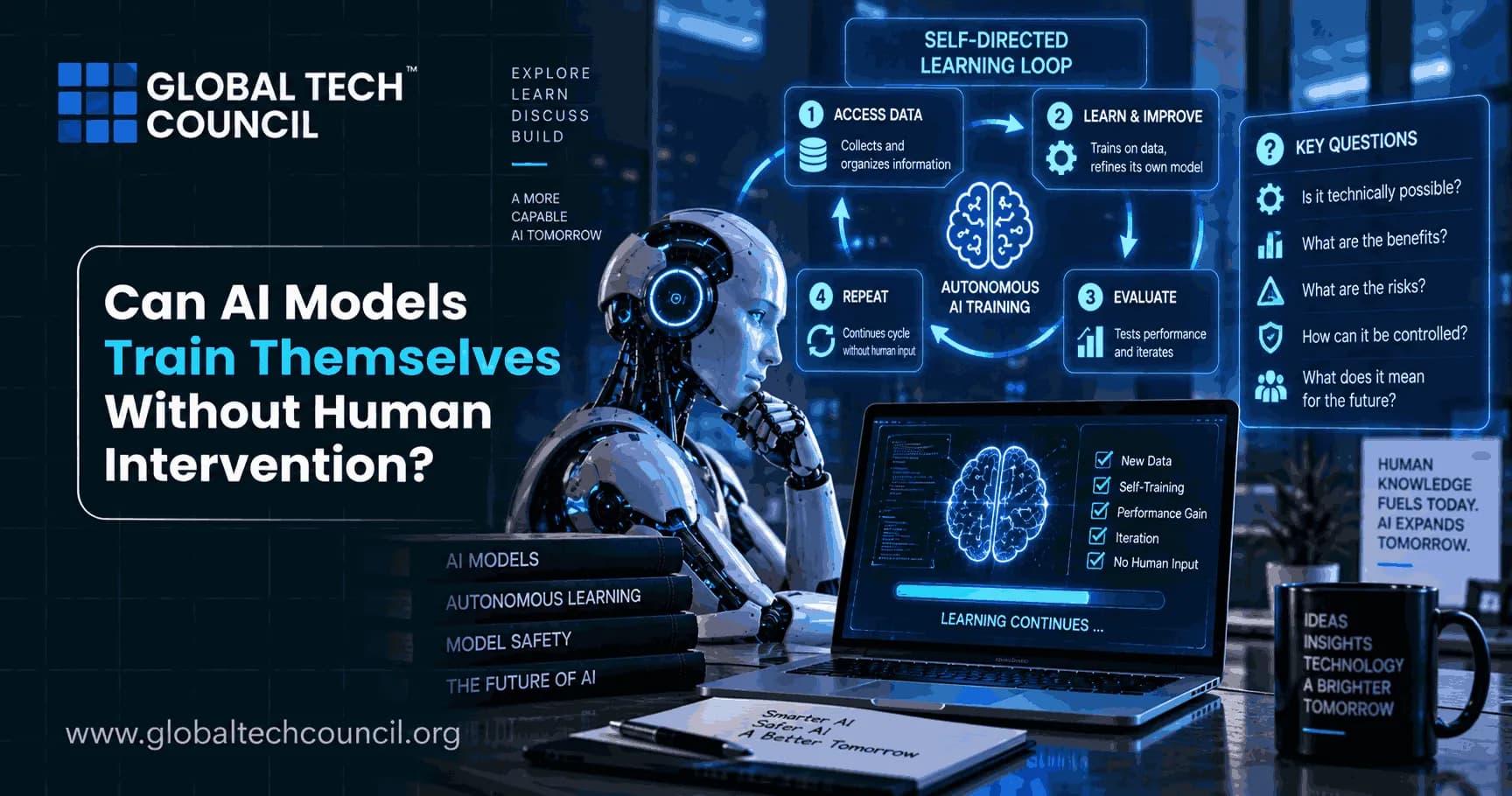
The question of whether AI can train itself without humans in the loop is actually less new than it sounds, and some of the clearest answers come from techniques that have existed for years rather than the latest research headlines. Self-play systems, self-supervised learning, and automated machine learning pipelines have already demonstrated real, working examples of AI systems training with minimal human involvement in specific parts of the process. What hasn't happened is AI removing humans from every part of the loop, and understanding exactly where that line sits requires separating genuine automation from the more sweeping claim of complete independence. That distinction is central to what a Certified Artificial Intelligence (AI) Expert learns to evaluate, since public claims about AI autonomy often blur together techniques with very different levels of actual human involvement.
This article breaks down the specific ways AI models already train with reduced human intervention, where humans remain essential regardless of the technique used, and how close current systems come to genuinely autonomous training.

Self-Supervised Learning: Training Without Labeled Data
One of the clearest examples of reduced human involvement in AI training is self-supervised learning, a technique where a model learns patterns directly from raw, unlabeled data rather than requiring humans to manually label every training example.
Implementing these training pipelines correctly requires real hands-on technical skill, and this is exactly the kind of work a Certified Artificial Intelligence (AI) Developer handles directly, since building a functioning self-supervised training system involves detailed decisions about data preprocessing, objective design, and model architecture that go well beyond simply removing human labelers from the process.
How Self-Supervised Learning Actually Reduces Human Involvement
Models learn by predicting missing or masked parts of their own training data, such as guessing a hidden word in a sentence
This eliminates the need for humans to manually label massive datasets, which used to be one of the biggest bottlenecks in training large models
Most modern large language models rely heavily on this approach during their initial training phase
Despite removing manual labeling, humans still curate which raw data gets included, design the specific learning objectives, and evaluate the resulting model's performance
Self-Play: Learning Entirely From Its Own Experience
Self-play represents an even more autonomous training approach, where an AI system improves by playing against copies of itself repeatedly, generating its own training data through that competitive process rather than relying on any external dataset at all.
The Landmark Example: AlphaZero
DeepMind's AlphaZero learned to play chess, shogi, and Go at a superhuman level using only the rules of each game, training entirely through self-play without any human game records or strategic guidance. Over millions of games played against itself, the system discovered strategies that surprised even expert human players, all without a single labeled example of human gameplay.
This is a genuinely autonomous training loop in a narrow sense: the system generated its own training data, evaluated its own performance through game outcomes, and improved accordingly, with humans only defining the rules of the game and the overall training setup rather than providing ongoing guidance throughout.
Automated Machine Learning: Automating the Design Process Itself
Beyond training a fixed model architecture, automated machine learning tools take this a step further by automating decisions about model architecture and hyperparameters, decisions that used to require significant human expertise and manual experimentation.
Neural architecture search techniques can automatically explore thousands of possible model designs to find configurations that perform well on a given task
Automated hyperparameter tuning systems can adjust settings like learning rate and model size without a human manually testing each combination
These tools have made it possible to develop competitive models with substantially less manual trial and error than earlier approaches required
Even here, humans still define the search space, select the evaluation criteria, and make final decisions about which resulting model to deploy
Where Human Involvement Remains Essential Regardless of Technique
Across every one of these approaches, self-supervised learning, self-play, and automated architecture search, a consistent pattern holds: automation reduces certain specific, labor-intensive tasks without eliminating human involvement from the process entirely.
Humans define the overall objective or reward signal that guides what the system is trying to optimize for
Humans curate or constrain the environment and data the system learns from, even when that data is unlabeled or self-generated
Humans evaluate final model performance and make deployment decisions, rather than trusting automated systems to self-certify readiness
Humans set safety boundaries and monitor for unintended behaviors that automated training processes might otherwise miss
Understanding exactly why these human checkpoints remain necessary, rather than assuming they're simply outdated caution, requires real technical depth, and professionals who build that through a Deep Tech Certification tend to have a much clearer picture of which parts of AI training genuinely could be automated further and which involve harder, currently unsolved problems.
A Creative Example of Reduced-Oversight Iteration
Similar principles of reduced, though not eliminated, human oversight show up in commercial creative applications as well. One emerging application is AI microdrama, where generative AI helps bring serialized stories, characters, and fictional worlds to life. These platforms often adjust character consistency and pacing across episodes based on audience engagement data with relatively light ongoing human intervention in the iteration process itself, though human creative direction and quality standards still shape the overall project, similar to how self-play systems operate independently within boundaries humans define upfront.
So, Can AI Really Train Itself Without Human Intervention?
The honest answer is nuanced rather than a simple yes or no. Within specific, well-defined parts of the training process, particularly generating training data and iterating based on that data, AI systems have genuinely demonstrated significant autonomy, with self-play systems like AlphaZero representing some of the clearest examples available. But the broader training pipeline, including defining objectives, curating environments, evaluating results, and making deployment decisions, still relies heavily on human judgment and oversight at nearly every implementation researchers have published.
This matters for how these capabilities get described publicly, since a system automating one specific bottleneck can easily get described as having removed humans from the loop entirely, an overstatement that misrepresents what's actually happening. Professionals who pair technical understanding with a Marketing Certification are better equipped to describe these nuanced, partial forms of automation accurately, rather than rounding up to a more dramatic claim of full autonomy that doesn't hold up under scrutiny.
Final Thoughts
AI models can genuinely train themselves without human intervention in specific, well-scoped parts of the process, from self-supervised learning eliminating manual data labeling to self-play systems like AlphaZero generating their own training experience entirely. What remains firmly human-driven is the broader framework surrounding that training: the objectives, the boundaries, the evaluation, and the deployment decisions. The realistic picture is one of expanding, meaningful automation within a structure humans still design and oversee, not the complete removal of human involvement the question sometimes implies.
FAQs
1. Can AI models train themselves without human intervention?
AI models can automate some parts of the training process, but fully autonomous training without human involvement is not generally established for modern frontier AI systems. Automated systems can generate data, evaluate outputs, tune parameters, and select promising solutions, while humans typically define objectives, provide infrastructure, establish safeguards, and oversee the process.
2. What does self-training mean in artificial intelligence?
Self-training is a machine learning approach in which a model uses its own predictions or generated data to help train a model further. It is commonly associated with semi-supervised learning and can also refer more broadly to AI-generated synthetic training data. Self-training does not necessarily mean that an AI is independently redesigning itself.
3. What is the difference between self-training and recursive self-improvement?
Self-training primarily involves learning from additional data, often including data generated or labeled by the model. Recursive self-improvement is broader and involves repeatedly improving the AI system itself, potentially including its algorithms, code, architecture, reasoning processes, and training methods. Therefore, self-training can be part of an improvement loop without constituting full recursive self-improvement.
4. Can AI generate its own training data?
Yes. AI systems can generate synthetic text, images, code, simulations, and other forms of data that can be used in training or evaluation. However, synthetic data usually requires quality control because models can reproduce errors, biases, or undesirable patterns in their generated material.
5. Can an AI model retrain itself?
An AI model can be placed inside an automated pipeline that generates data, performs training, evaluates a new model, and selects a candidate for further iteration. However, this does not necessarily mean the model independently controls the entire process. Access to training infrastructure, objectives, evaluation criteria, and deployment systems generally has to be deliberately provided.
6. What is self-supervised learning?
Self-supervised learning is a machine learning technique in which a model learns from patterns within data rather than relying entirely on manually created human labels. For example, a language model can learn by predicting missing or subsequent tokens in text. Despite the name, self-supervised learning does not mean the model is autonomously improving itself.
7. Can large language models learn from their own outputs?
Large language models can generate outputs that are later incorporated into training datasets or used in automated improvement pipelines. However, simply generating an answer does not permanently update the model. A separate training or fine-tuning process is normally required for generated information to affect model parameters.
8. Can AI improve its own code?
AI systems can generate, debug, test, and optimize software code. When connected to automated testing and evaluation systems, an AI agent can iteratively propose and refine code. This represents a form of automated software improvement, although it is not necessarily equivalent to an AI independently redesigning its entire underlying model.
9. Can AI train another AI model?
Yes. AI systems can assist with generating training data, writing code, creating evaluation tasks, producing synthetic examples, and optimizing training processes for other models. A model can therefore become part of a pipeline that helps develop another model without being fully autonomous itself.
10. Can AI evaluate its own performance?
AI can evaluate its outputs using predefined metrics, automated tests, reward models, or another AI evaluator. This can create a feedback loop in which the system generates a solution, evaluates it, and attempts another solution. Reliable evaluation remains important because an AI evaluator can itself make mistakes or favor outputs that appear good without actually improving the underlying capability.
11. What is an AI feedback loop?
An AI feedback loop is a process in which an AI system generates an output, receives an evaluation or reward, and uses that information to produce an improved output. Repeated feedback loops can improve performance on specific tasks. More advanced loops can combine generation, testing, code modification, and model optimization.
12. Is automated AI training the same as recursive self-improvement?
No. Automated training can operate according to a fixed pipeline without the AI deciding how the system itself should improve. Recursive self-improvement implies a broader iterative process in which increasingly capable systems contribute to the creation of their successors. The level of autonomy and scope of modification are therefore important distinctions.
13. What prevents AI models from completely training themselves?
Several constraints can limit autonomous self-training, including computing resources, access to high-quality data, reliable evaluation, training infrastructure, and the ability to make meaningful architectural or algorithmic changes. Safety and governance controls can also restrict what an AI system is allowed to modify or deploy.
14. Can AI use reinforcement learning to improve itself?
AI can use reinforcement learning to improve performance through feedback from rewards or penalties. An agent can repeatedly attempt actions, observe results, and adjust its behavior. However, reinforcement learning within a defined task is not automatically recursive self-improvement because the system may be optimizing its behavior rather than redesigning the AI itself.
15. What are the risks of AI training on AI-generated data?
Repeatedly training models on their own generated content can introduce errors and reduce data diversity. If generated mistakes are repeatedly incorporated into later training datasets, they can become amplified over multiple iterations. Researchers therefore investigate filtering, human evaluation, external data, and other methods to maintain training-data quality.
16. Can self-training cause AI models to become worse?
Yes. Self-generated training data is not guaranteed to improve a model. If the generated data contains errors, lacks diversity, or reinforces undesirable patterns, repeated training can cause performance degradation. This is one reason why external evaluation and carefully curated data remain important in automated training systems.
17. Could self-training eventually lead to recursive self-improvement?
Self-training could become one component of a larger recursive improvement system. For example, an AI might generate training data, improve a model, evaluate the new version, and use the results to guide another iteration. However, achieving robust autonomous RSI would require substantially more than simply training on AI-generated data.
18. Could AI eventually train itself with almost no human intervention?
It is technically plausible that future AI development pipelines could automate increasingly large portions of data generation, experimentation, training, evaluation, and deployment. The degree of human involvement would depend on how such systems are designed and governed. Fully autonomous recursive improvement remains a research question rather than an established capability of today's AI models.
19. What would fully autonomous AI self-training look like?
A highly autonomous system could potentially identify a training objective, generate or acquire suitable data, modify training procedures, run experiments, evaluate results, and create an improved model. It would then use the improved system to repeat the process. Such a system would represent a much higher level of autonomy than today's conventional automated training pipelines.
20. Is AI already capable of completely training and improving itself?
Current AI systems can automate and assist with many individual parts of model development, including coding, data generation, experimentation, evaluation, and optimization. However, that should not be confused with a model independently controlling an unrestricted cycle of self-training and recursive self-improvement. Human-defined objectives, infrastructure, evaluation, and oversight remain important components of current advanced AI development.
Related Articles
View All
AI & ML
Can AI Train the Next Generation of AI Models?
Explore whether AI can help train the next generation of AI models, from synthetic data and automated evaluation to model optimization, self-improvement, and AI-assisted research
AI & ML
Is Recursive Self-Improvement Possible With Today’s AI Models?
Explore whether today’s AI models can achieve recursive self-improvement, what forms of self-optimization are already possible, and the technical limits preventing fully autonomous RSI.

AI & ML
Recursive Self-Improvement in LLMs: Can Language Models Optimize Their Own Capabilities?
Explore whether large language models can recursively improve their own capabilities, how self-optimization might work, and the technical, architectural, and safety limits involved.
Trending Articles
The Role of Blockchain in Ethical AI Development
How blockchain technology is being used to promote transparency and accountability in artificial intelligence systems.
AWS Career Roadmap
A step-by-step guide to building a successful career in Amazon Web Services cloud computing.
Top 5 DeFi Platforms
Explore the leading decentralized finance platforms and what makes each one unique in the evolving DeFi landscape.