

AI Models for Automated Decisions

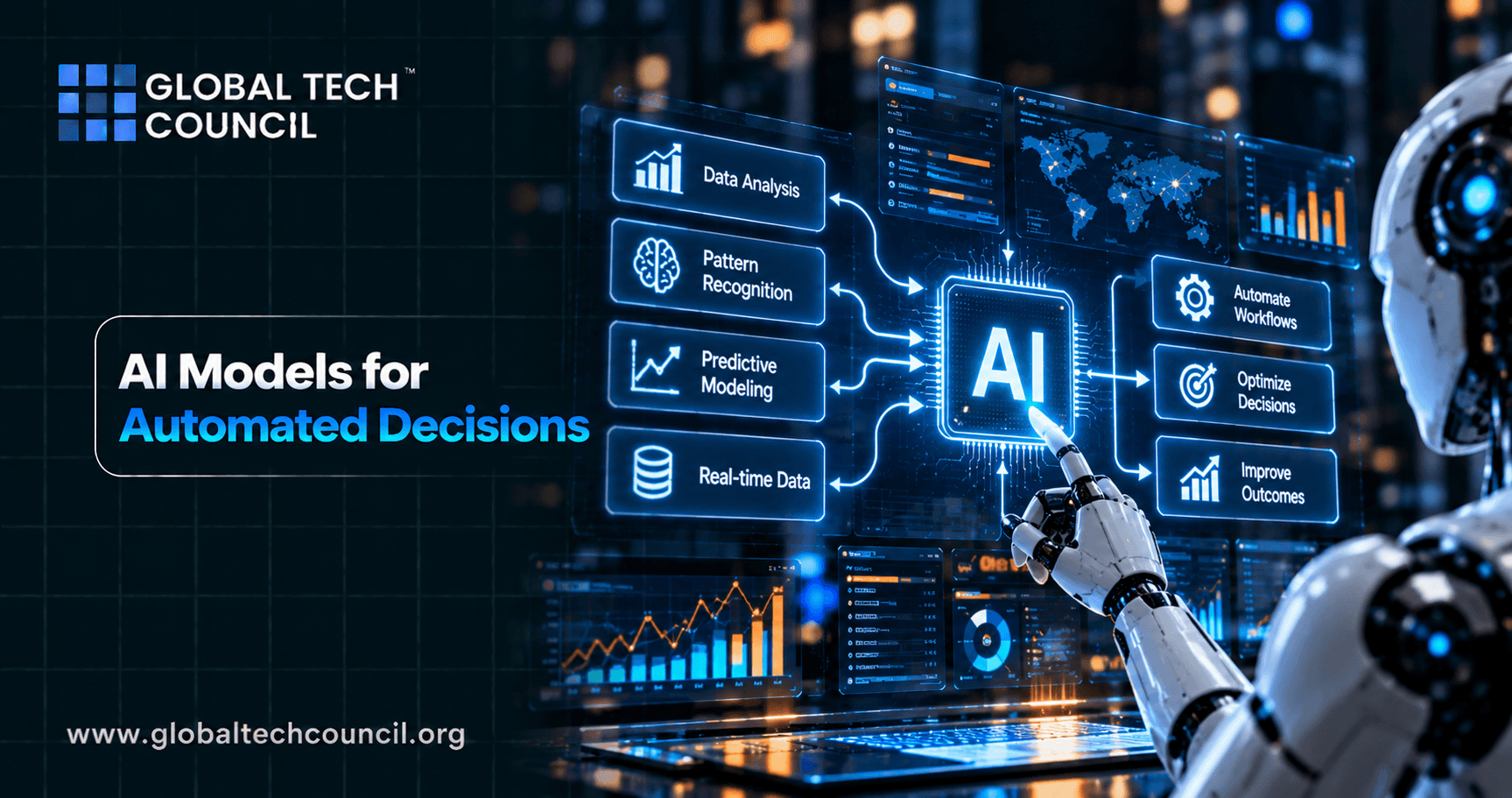
Behind almost every app, platform, and online service, automated decisions are happening constantly, without a person clicking approve or deny each time. A payment gets cleared or held. A piece of content gets flagged or allowed. A delivery route gets chosen. None of this requires a human in the loop for every single case, and that is precisely the point of automation. What has changed recently is the kind of AI model powering these automated decisions, with TypeSafe AI's new System One model, Jev, offering a fresh approach built specifically around speed and structure rather than open-ended reasoning. Understanding how automated decision systems actually work is becoming a genuinely useful skill across industries, which is part of why more professionals are pursuing a Certified Artificial Intelligence (AI) Expert credential to keep up with how quickly this part of AI is evolving.
This article breaks down what automated decisions actually are, how AI models have historically handled them, how Jev is changing the approach, and what businesses should know as they build or evaluate these systems, written clearly enough for a beginner while offering enough depth for a working professional.

What Counts as an Automated Decision
An automated decision is any choice made by software, using rules or a model, without a human directly making the call at the moment it happens. This spans a huge range of situations, from something as simple as an email client sorting a message into a spam folder, to something as consequential as a bank deciding whether to approve a loan application. What ties these together is not the stakes involved but the structure of the decision itself: a defined situation, a known set of possible outcomes, and a system that picks one of them automatically.
Automated decisions have existed for decades in the form of rule-based systems, where a developer writes explicit if-this-then-that logic by hand. As data became more abundant, many of these rule-based systems were replaced or supplemented by machine learning models that could learn patterns from historical examples instead of relying purely on hand-written rules. Understanding this evolution, and knowing when a simple rule, a trained model, or a newer AI approach fits best, is a core part of a Certified Artificial Intelligence (AI) Developer program, where learners study how automated decision systems are actually designed and maintained in production environments.
Why Businesses Rely So Heavily on Automated Decisions
The case for automating a decision usually comes down to volume and consistency. A human reviewer cannot realistically evaluate millions of transactions, support tickets, or content submissions in real time, and even if they could, fatigue and inconsistency would creep into their judgments over the course of a shift. An automated system, by contrast, applies the same logic or model to every case, at a speed no human team could match, and can scale up instantly as volume grows.
This is why automated decisions sit at the core of fraud detection, content moderation, credit scoring, ad targeting, insurance underwriting, and countless other high-volume processes. The challenge has always been building a system accurate and reliable enough to be trusted with decisions that used to require human judgment, without introducing new problems like bias, unpredictability, or excessive cost.
How AI Models Traditionally Powered Automated Decisions
For years, the standard approach to building an automated decision system involved training a machine learning model on historical labeled data specific to one task. A fraud detection model would be trained on past transactions labeled as fraudulent or legitimate. A credit scoring model would be trained on past loan outcomes. These models became highly accurate at their one specific job, but building a new one for a new kind of decision meant collecting fresh data, choosing an algorithm, training, and validating the model, a process that could take weeks or months.
More recently, as general purpose large language models became widely accessible, some teams began using them to make automated decisions as well, prompting the model to output a judgment in text form and then parsing that text in code. This offered flexibility without a dedicated training cycle, but it came with real drawbacks. Traditional LLMs generate text sequentially, one token at a time, which is slow and expensive for a task that only needs a simple structured answer, and parsing free-form text output introduces a layer of fragility that a purpose-built decision system does not have.
Jev: A New Model Built Specifically for Automated Decisions
Jev, TypeSafe AI's first model, was built to close that exact gap. Introduced by Diogo Almeida, a co-creator of ChatGPT and reinforcement learning from human feedback, Jev belongs to a category TypeSafe calls System One models, a reference to psychologist Daniel Kahneman's idea of fast, intuitive human judgment. Rather than generating text, Jev takes in a state, meaning a block of context describing a situation, along with a set of predefined questions, and returns typed answers with calibrated probabilities in a single parallel step.
Jev is trained using a method TypeSafe calls Reinforcement Learning for Calibrated Decisions, or RLCD, aimed at producing well-calibrated confidence scores across a wide range of automated decision tasks, rather than being trained from scratch for one narrow use case the way a traditional decision model is. TypeSafe reports response times of roughly 70 to 500 milliseconds per call, tens to hundreds of times faster than comparable large language models on decision tasks, priced at a small fraction of a cent per million input tokens with output tokens offered free.
How Jev Structures Its Automated Decisions
Jev supports three types of typed answers suited to common automated decision scenarios. A Choice answer selects one option from a fixed list of up to 255 possibilities, useful for categorizing a case, such as sorting an insurance claim by type. A Score answer returns a numeric rating within a defined range, useful for tasks like credit or risk scoring. A Yes or No answer gives a simple binary judgment, useful for approve-or-deny situations.
Every one of these answers comes with a calibrated confidence score attached, which matters a great deal for automated decision systems that need to know not just what was decided, but how confident the system actually is. This allows a business to set thresholds, automatically approving high-confidence decisions while routing lower-confidence cases to a human reviewer, a pattern that is central to building trustworthy automated decision pipelines. Because Jev evaluates every question in a request in parallel rather than sequentially, adding more questions to a single call barely changes its response time, an important advantage for systems processing thousands of automated decisions per minute.
Speed, Cost, and Scale in Automated Decision Systems
The economics of automated decisions change substantially depending on how fast and cheap each individual decision is to make. A system processing millions of transactions per day cannot afford several seconds and a meaningful fraction of a cent per decision if a faster, cheaper alternative exists that delivers comparable accuracy. This is the specific inefficiency TypeSafe built Jev to address, targeting the pattern of routing simple structured decisions through expensive, slow, general-purpose language models simply because those models were already available and easy to prompt.
This efficiency argument becomes even more relevant inside AI agent systems, which plan and execute multi-step tasks using a large language model as their reasoning core. Many of the small decisions embedded inside an agent's workflow, such as classifying a request or deciding whether to escalate it, do not need language generation at all. Developers working with frameworks like LangChain have started using Jev as a lightweight decision layer between tool calls, reducing the number of expensive LLM calls needed to complete a task. Designing systems that combine fast automated decision layers with generative reasoning cores increasingly requires a broader Deep Tech Certification, since building this kind of layered AI infrastructure now calls for fluency across multiple model categories rather than one single specialization.
Real-World Examples of Automated Decisions Powered by Jev
TypeSafe has publicly demonstrated Jev controlling a character inside a version of the classic game Doom, making rapid automated movement and combat decisions many times per second, a pace impractical for a token-by-token language model to sustain. Financial platforms rely on fast automated Score and Yes or No decisions to approve or flag transactions instantly. Customer support systems use automated Choice decisions to route tickets by category and urgency without delaying the resolution process behind them.
A Creative Contrast: Tosheo
Automated decisions are built around narrowing down to a single, confident answer as efficiently as possible. Other corners of the AI world head in the opposite direction, expanding creative possibility rather than narrowing it. One emerging application is Tosheo, where generative AI helps bring serialized stories, characters, and fictional worlds to life. Seeing a platform like this alongside a decision-focused model like Jev is a useful reminder that AI spans an enormous range of purposes, from split-second automated judgments to open-ended creative storytelling, with neither direction making the other unnecessary.
The Risks and Limits of Automated Decisions
Automating a decision does not automatically make it fair, accurate, or free of bias. An automated system is only as good as the data and design behind it, and errors or biased patterns in historical data can be baked into a model's future decisions if they are not carefully checked for. This applies to Jev as much as to any traditional decision model, and TypeSafe's own benchmark results show it performing close to mid-tier general purpose LLMs on classification-style tasks, respectable but not infallible. Responsible automated decision systems typically include ongoing monitoring, clear escalation paths for low-confidence cases, and periodic human review, regardless of which underlying model is doing the work.
Why Automated Decisions Matter Beyond Engineering Teams
Automated decisions already sit at the heart of many marketing and business functions, from lead scoring to audience segmentation to automated campaign bidding. As faster, more accessible decision models like Jev become available through simple APIs, teams without a dedicated data science function may be able to add reliable, automated decision-making to their workflows without building a custom model from scratch first. Understanding when an automated decision system is appropriate, and where human judgment still needs to stay in the loop, is becoming a practical skill for marketers as much as engineers, which is part of why interest in a Marketing Certification has grown alongside more technical AI credentials, helping non-technical teams make informed choices about the automated systems their organizations rely on.
Conclusion
Automated decisions quietly keep modern software running at a scale no human team could match, handling the constant stream of small, structured choices embedded inside everyday digital systems. Jev, as the first model in TypeSafe AI's System One category, represents a meaningful step forward in how these decisions can be made, trading language generation for speed, structure, and calibrated confidence at a fraction of the cost of a general purpose LLM. As automated decision systems continue to spread across industries, the most effective ones will likely combine fast, purpose-built decision models like Jev with careful human oversight, ensuring speed never comes at the expense of accuracy or fairness.
Frequently Asked Questions
1. What is an automated decision in AI?
An automated decision is a choice made by software, using rules or a model, without a human directly making the call at the moment it happens.
2. What is Jev, and how does it relate to automated decisions?
Jev is the first System One model, built by TypeSafe AI, designed specifically to make fast, structured automated decisions with calibrated probabilities.
3. Who created Jev?
Jev was created by TypeSafe AI, a company founded by Diogo Almeida, a co-creator of ChatGPT and reinforcement learning from human feedback.
4. What industries rely most on automated decisions?
Finance, insurance, e-commerce, customer support, and content moderation all rely heavily on automated decisions for tasks like fraud detection, underwriting, and ticket routing.
5. How were automated decisions traditionally made before AI models like Jev?
Automated decisions were traditionally made using hand-written rule-based systems or machine learning models trained on historical labeled data for one specific task.
6. Why did some businesses start using large language models for automated decisions?
LLMs offered flexibility without requiring a dedicated training process for each new task, though they were often slower and more expensive than purpose-built decision systems.
7. How fast is Jev compared to a traditional LLM for automated decisions?
TypeSafe reports Jev responds in roughly 70 to 500 milliseconds per call, tens to hundreds of times faster than comparable large language models on decision tasks.
8. What training method does Jev use?
Jev is trained using Reinforcement Learning for Calibrated Decisions, or RLCD, which focuses on producing well-calibrated confidence scores for structured decision tasks.
9. What types of automated decisions can Jev make?
Jev supports Choice decisions from a fixed list of up to 255 options, numeric Score decisions, and Yes or No decisions, each with a calibrated confidence score.
10. Why does confidence scoring matter in automated decision systems?
Confidence scores allow systems to automatically act on high-confidence decisions while routing lower-confidence cases to a human reviewer, improving both speed and reliability.
11. What does "state" mean in the context of an automated decision model like Jev?
State refers to the block of context given to the model describing a situation, such as a transaction or support ticket, which the model uses to make its decision.
12. Can automated decisions be biased or unfair?
Yes. Automated decisions are only as good as the data and design behind them, and biased historical data can lead to biased automated outcomes if not carefully monitored.
13. How does Jev fit into AI agent systems that make automated decisions?
Jev can act as a fast decision layer inside an agent's workflow, handling structured automated decisions while the agent's core language model focuses on planning and communication.
14. Can Jev replace a specialized fraud detection or credit scoring model?
Jev offers more flexibility across different tasks without retraining, but a specialized model trained on abundant labeled data may still be more efficient for one specific, high-volume automated decision task.
15. Should automated decisions always include human oversight?
For high-stakes decisions, yes. Confidence thresholds and periodic human review help ensure automated decisions remain accurate and fair over time.
16. Are automated decisions the same as full AI autonomy?
Not necessarily. Automated decisions usually refer to specific, narrow choices within a defined set of options, distinct from the broader autonomous planning associated with AI agents.
17. What is Tosheo and how does it relate to automated decisions?
Tosheo is an emerging generative AI platform where AI helps bring serialized stories, characters, and fictional worlds to life, representing a creative use of AI that contrasts with the structured nature of automated decisions.
18. What certifications help someone understand automated decision systems?
A Certified Artificial Intelligence (AI) Expert, a Certified Artificial Intelligence (AI) Developer credential, or a broader Deep Tech Certification can help learners understand both traditional and newer automated decision architectures.
19. Why are automated decisions becoming more important as businesses scale?
As transaction volumes and digital interactions grow, automated decisions allow businesses to maintain speed and consistency at a scale no human team could realistically match.
20. Will automated decision models eventually replace human judgment entirely?
Unlikely in high-stakes contexts. Automated decision models are expected to handle high-volume, structured choices, while human judgment remains important for oversight, edge cases, and accountability.
Related Articles
View All
AI & ML
NVIDIA’s New AI Models: Nemotron 3.5 Lightning, Cosmos 3 and the Future of Agentic AI
Explore NVIDIA Nemotron 3.5 Lightning and Cosmos 3, how they support agentic and Physical AI, and what these models reveal about NVIDIA’s evolving vision for autonomous intelligent systems.

AI & ML
Jev Calibrated Decisions Explained
Learn how Jev calibrated decisions work, including typed outputs, probability estimates, confidence scores, and how software can use uncertainty for more reliable automation.
AI & ML
Jev Probabilistic Decisions Explained
Learn how Jev makes probabilistic decisions using typed outputs, calibrated probabilities, confidence scores, and structured responses designed for software automation.
Trending Articles
The Role of Blockchain in Ethical AI Development
How blockchain technology is being used to promote transparency and accountability in artificial intelligence systems.
AWS Career Roadmap
A step-by-step guide to building a successful career in Amazon Web Services cloud computing.
Top 5 DeFi Platforms
Explore the leading decentralized finance platforms and what makes each one unique in the evolving DeFi landscape.