

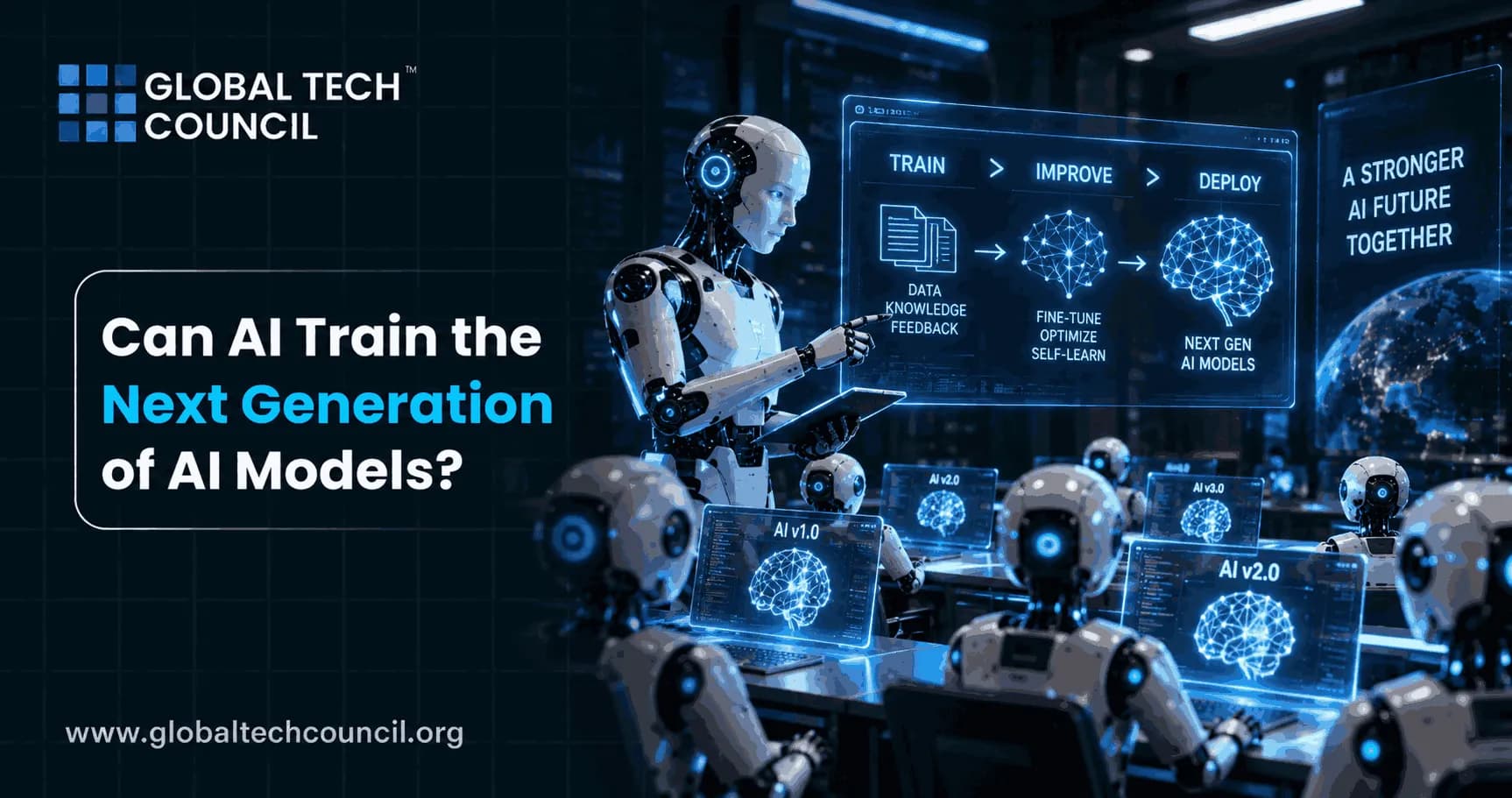
Can AI Train the Next Generation of AI Models?

Introduction: The Shift From Collecting Data to Generating It
For most of AI's history, training a new model meant collecting, cleaning, and labeling enormous amounts of human-generated data before a single training run could begin. That model is changing quickly. Today, AI systems are increasingly used to generate the training data, feedback signals, and even reasoning traces that shape the models coming after them, turning what used to be a purely human bottleneck into a partially automated pipeline. Professionals trying to understand how this shift actually works often start with a Certified Artificial Intelligence (AI) Expert credential, which builds the foundational knowledge needed to evaluate how synthetic data and AI-generated feedback are reshaping the model development pipeline.
The honest answer to whether AI can train the next generation of AI models is yes, in several well-documented and increasingly standard ways, though the process still depends heavily on human oversight to remain reliable and safe.

How AI-Generated Data Is Already Training New Models
Several concrete techniques already have AI systems directly shaping the training of newer models:
Knowledge distillation: A large, capable teacher model generates high-quality outputs, and a smaller student model is trained to match those outputs. This approach has produced small models that punch well above their parameter count, with one well-documented example training a model family small enough to run on a smartphone using carefully generated textbook-style synthetic content, achieving reasoning quality once associated only with far larger models.
Synthetic instruction and preference data: Frontier models generate instruction-following examples and preference judgments that are then used to fine-tune and align newer models, replacing a significant portion of the manual data collection that used to require large teams of human annotators.
AI-generated feedback for alignment: Techniques like Constitutional AI use a model's own generated critiques and revisions, guided by a set of written principles, to train a subsequent version of itself or a related model to behave more safely and helpfully.
Synthetic reasoning traces: Several major labs now generate chain-of-thought reasoning examples using a stronger model, then train smaller models on those traces to teach step-by-step problem-solving without requiring humans to manually write out each reasoning path.
Why This Approach Has Become So Widely Adopted
The economics behind AI-generated training data explain much of why this shift has accelerated so quickly:
Human preference data typically costs several dollars per data point, and in some specialized domains can run well past ten dollars per prompt.
AI-generated feedback from a frontier model can cost a small fraction of a cent per equivalent data point, opening up large-scale training experimentation to teams that previously could never have afforded human annotation at this volume.
Synthetic data generation also helps fill in rare edge cases that real-world datasets often lack, such as unusual fraud patterns or uncommon medical scenarios, since these situations can be deliberately generated rather than waiting to occur naturally in collected data.
Industry analysts estimate that a strong majority of businesses will be using generative AI to help create synthetic training data by the end of 2026, a dramatic increase from a very small fraction just a few years earlier.
Professionals looking to build and manage these kinds of distillation and synthetic data pipelines directly often pursue a Certified Artificial Intelligence (AI) Developer credential, gaining hands-on experience with the fine-tuning workflows and evaluation techniques that turn AI-generated data into a genuinely usable training pipeline.
AI Microdrama and Emerging Creative Applications
One emerging application is AI microdrama, where generative AI helps bring serialized stories, characters, and fictional worlds to life. Training the models behind this kind of creative platform increasingly relies on synthetic narrative data and AI-generated story variations, illustrating how the same data-generation techniques reshaping technical model training are also being applied to teach AI systems the structure and rhythm of compelling serialized storytelling.
Why Human Data Still Matters More Than Ever
Despite the growing role of synthetic data, researchers and industry practitioners consistently emphasize that fully AI-trained models without human anchoring remain a risky proposition:
Humans are still needed to define what counts as a good output, establish safety boundaries, and manage the tradeoffs that pure automated evaluation cannot reliably judge on its own.
Synthetic data works best when it expands, stresses, and hardens a training pipeline built on a solid human-curated core, rather than replacing that human foundation entirely.
A recurring concern researchers refer to as model collapse describes what can happen when models are trained repeatedly on data generated by earlier AI systems without enough fresh human-grounded input, gradually amplifying small errors, biases, or repetitive patterns across successive generations until output quality noticeably degrades.
Maintaining diversity and factual groundedness in training data becomes an increasingly defining challenge as AI-generated content makes up a growing share of all text available online for future models to learn from.
Navigating this balance between efficient automation and necessary human oversight requires broad technical literacy spanning data engineering, evaluation design, and responsible AI governance simultaneously. A Deep Tech Certification helps professionals build that wider foundation, equipping them to design AI training pipelines that use synthetic data responsibly rather than treating it as a complete replacement for human judgment.
The Legal and Competitive Tensions Emerging Around This Practice
As distillation and synthetic data generation have become standard practice, they have also triggered real disputes between AI companies over where legitimate training assistance ends and unauthorized extraction begins:
One major AI lab publicly disclosed what it described as an industrial-scale distillation campaign in early 2026, attributing millions of exchanges generated through a large number of fraudulent accounts to competing labs allegedly attempting to train their own models on its outputs without authorization.
Separate investigative reporting later that year found researchers reportedly linked to a foreign military using a smaller commercial model to generate synthetic training data for their own specialized classification systems, raising fresh concerns about how AI-generated data could be misused outside its intended terms of service.
These disputes have pushed policymakers to begin drafting governance rules specifically aimed at distinguishing ordinary, terms-of-service-compliant distillation from unauthorized extraction of a competitor's model outputs, a distinction that remains legally unsettled in many jurisdictions.
This tension illustrates that while AI training AI has become genuinely useful and widely adopted, it also raises intellectual property and competitive fairness questions that the industry and regulators are still actively working through.
What This Means for the Future of Model Development
Looking at where this trend is headed, a few patterns are becoming increasingly clear across the industry:
Distillation has shifted from a niche academic workaround into the default pathway for turning an expensive frontier model into a smaller, affordable model that real businesses can actually deploy at scale.
Newer distillation techniques are moving beyond simply copying a teacher model's static outputs, instead scoring a student model's own generated attempts against teacher feedback in a more dynamic, on-policy training loop.
The overall trajectory points toward AI playing an increasingly central role in generating the data, feedback, and reasoning examples used to train future models, while human oversight remains essential for defining objectives, catching failures, and maintaining the grounded, diverse core that prevents quality degradation over successive generations.
Communicating This Shift to Non-Technical Audiences
The idea that AI is helping train the next generation of AI models can sound alarming or purely magical depending on how it gets explained, when the reality is considerably more nuanced and, in most current implementations, carefully bounded by human oversight. Business leaders, policymakers, and the public benefit from framing that reflects genuine industry practice rather than either dismissing synthetic data as a gimmick or treating it as evidence of AI operating entirely independent of human control.
A Marketing Certification can help professionals develop the communication skills needed to explain this technical shift accurately, translating concepts like distillation, synthetic data generation, and AI feedback loops into language that informs stakeholders rather than overstating or understating what is actually happening inside modern AI training pipelines.
AI is already playing a substantial and growing role in training the models that come after it, through distillation, synthetic data generation, and AI-assisted feedback loops that have become standard practice across the industry. Whether this trend continues expanding responsibly depends heavily on how well the field manages the tradeoffs it has already identified, from preventing model collapse to resolving the legal disputes emerging around unauthorized distillation, all while keeping human judgment firmly anchored at the center of the process.
FAQs
1. Can AI train the next generation of AI models?
Yes, AI can already assist with several parts of the model-training process, including generating synthetic data, writing training code, optimizing configurations, and evaluating model outputs. However, fully autonomous AI that independently designs, trains, evaluates, and deploys increasingly capable successor models has not been publicly demonstrated.
2. What does it mean for AI to train another AI model?
It means using an existing AI system to perform some of the tasks involved in developing a new model. This can include generating training examples, creating labels, providing feedback, writing code, selecting experiments, or helping optimize training parameters.
3. Can an AI model generate training data for another AI?
Yes. An AI model can generate synthetic text, images, code, questions, explanations, or other forms of data that may be used to train another model. The generated data usually needs quality controls because AI-generated content can contain errors, biases, or repetitive patterns.
4. Can AI teach another AI how to perform tasks?
Yes. One model can generate demonstrations, explanations, solutions, or feedback that another model uses during training. This approach is often associated with techniques such as knowledge distillation, synthetic data generation, and AI-assisted supervision.
5. Can one AI model train a better version of itself?
Potentially, but there is an important distinction between helping train a successor and independently creating a better version of itself. An AI can contribute data, code, evaluations, and optimization strategies, while humans or automated infrastructure may still control the overall training process.
6. Can AI create synthetic data to improve future AI models?
Yes. Synthetic data can be generated at large scale and used for specific training objectives. Its usefulness depends on factors such as accuracy, diversity, relevance, and the quality of the process used to generate and filter it.
7. Can AI evaluate another AI model?
Yes. AI systems can act as evaluators or "judges" by comparing responses against defined criteria. However, AI-based evaluation can itself contain errors, so independent tests, human review, or other external evaluation methods can be important.
8. Can AI write the training code for a new AI model?
Yes. Modern coding-capable AI systems can generate, debug, explain, and modify machine-learning code. The resulting code still needs to be tested because generated code can contain bugs, inefficiencies, security problems, or incorrect assumptions.
9. Can AI choose the best training parameters?
AI can help optimize hyperparameters such as learning rates, batch sizes, model configurations, and other training settings. Automated optimization can search through many possibilities, but the search remains constrained by the objectives, evaluation criteria, and computing resources provided to the system.
10. Can AI design a new AI architecture?
AI can assist with architecture design and automated search by proposing and evaluating different model structures. Systems such as automated algorithm-search frameworks demonstrate how AI can explore solutions to defined objectives, although this is not equivalent to an AI independently redesigning itself without external constraints.
11. What is knowledge distillation in AI?
Knowledge distillation is a technique in which a smaller or new model learns from the outputs or behavior of another model, often called a teacher. It can transfer useful capabilities while potentially producing a more efficient student model.
12. Is AI-generated training data enough to create a better AI?
Not necessarily. Synthetic data can be useful, but blindly training on AI-generated content can propagate errors and undesirable patterns. High-quality external data, robust filtering, and reliable evaluation can help maintain training quality.
13. Can AI train AI without humans?
AI can automate portions of the training workflow, but completely independent training remains a much stronger claim. A system would need to determine what to improve, generate or acquire suitable data, design experiments, execute training, evaluate results, and decide which changes to retain.
14. How is AI-assisted training different from Recursive Self-Improvement?
AI-assisted training means an AI performs selected tasks within a development process. Recursive Self-Improvement (RSI) involves a system repeatedly improving itself or the processes used to improve it, with those improvements potentially enabling further improvements.
15. Can AI create a successor model that is more capable?
In principle, an AI could contribute to developing a successor with better reasoning, coding, efficiency, or other capabilities. Demonstrating that an AI can independently create a broadly more capable successor, however, would require much more than generating training data or code.
16. What would AI need to autonomously train the next generation of models?
It would need access to substantial computing resources, training infrastructure, data or data-generation systems, development tools, evaluation mechanisms, and the ability to make decisions about experiments. It would also require strong safeguards to prevent unintended or unsafe changes.
17. Could AI training become a recursive improvement loop?
Yes, theoretically. A simplified loop could be:
AI analyzes limitations → proposes improvements → generates code/data → trains a new model → evaluates it → adopts successful changes → repeats.
If each generation became better at performing this process, it could potentially create a recursive improvement cycle.
18. What are the risks of AI training future AI models?
Potential risks include poor-quality synthetic data, biased evaluation, optimization toward the wrong objectives, security vulnerabilities, and reduced human oversight. If increasingly capable systems were given greater autonomy, ensuring that their objectives and behavior remain aligned would become especially important.
19. Is AI already helping develop the next generation of AI?
Yes. AI is increasingly being used for coding, research, experimentation, evaluation, data generation, and other parts of AI development. OpenAI describes its work toward an automated research intern as progress toward more automated AI research, while emphasizing human supervision rather than fully autonomous recursive self-improvement.
20. Will AI eventually be able to train the next generation of AI by itself?
It is possible, but it is not yet established that AI will be able to independently manage the entire development cycle. The likely progression is from AI assisting human researchers, to AI automating larger portions of AI development, and potentially toward more autonomous improvement loops. Whether the final stage becomes true Recursive Self-Improvement remains an open research and safety question.
Related Articles
View All
AI & ML
Is Recursive Self-Improvement Possible With Today’s AI Models?
Explore whether today’s AI models can achieve recursive self-improvement, what forms of self-optimization are already possible, and the technical limits preventing fully autonomous RSI.

AI & ML
Recursive Self-Improvement in LLMs: Can Language Models Optimize Their Own Capabilities?
Explore whether large language models can recursively improve their own capabilities, how self-optimization might work, and the technical, architectural, and safety limits involved.

AI & ML
What Is Strawberry Browser and How Does It Work
Strawberry Browser is an agentic web browser with built-in AI companions that can research, automate tasks, work across multiple tabs, and interact with websites on a user’s behalf.
Trending Articles
The Role of Blockchain in Ethical AI Development
How blockchain technology is being used to promote transparency and accountability in artificial intelligence systems.
AWS Career Roadmap
A step-by-step guide to building a successful career in Amazon Web Services cloud computing.
Top 5 DeFi Platforms
Explore the leading decentralized finance platforms and what makes each one unique in the evolving DeFi landscape.