

Claude for Legal

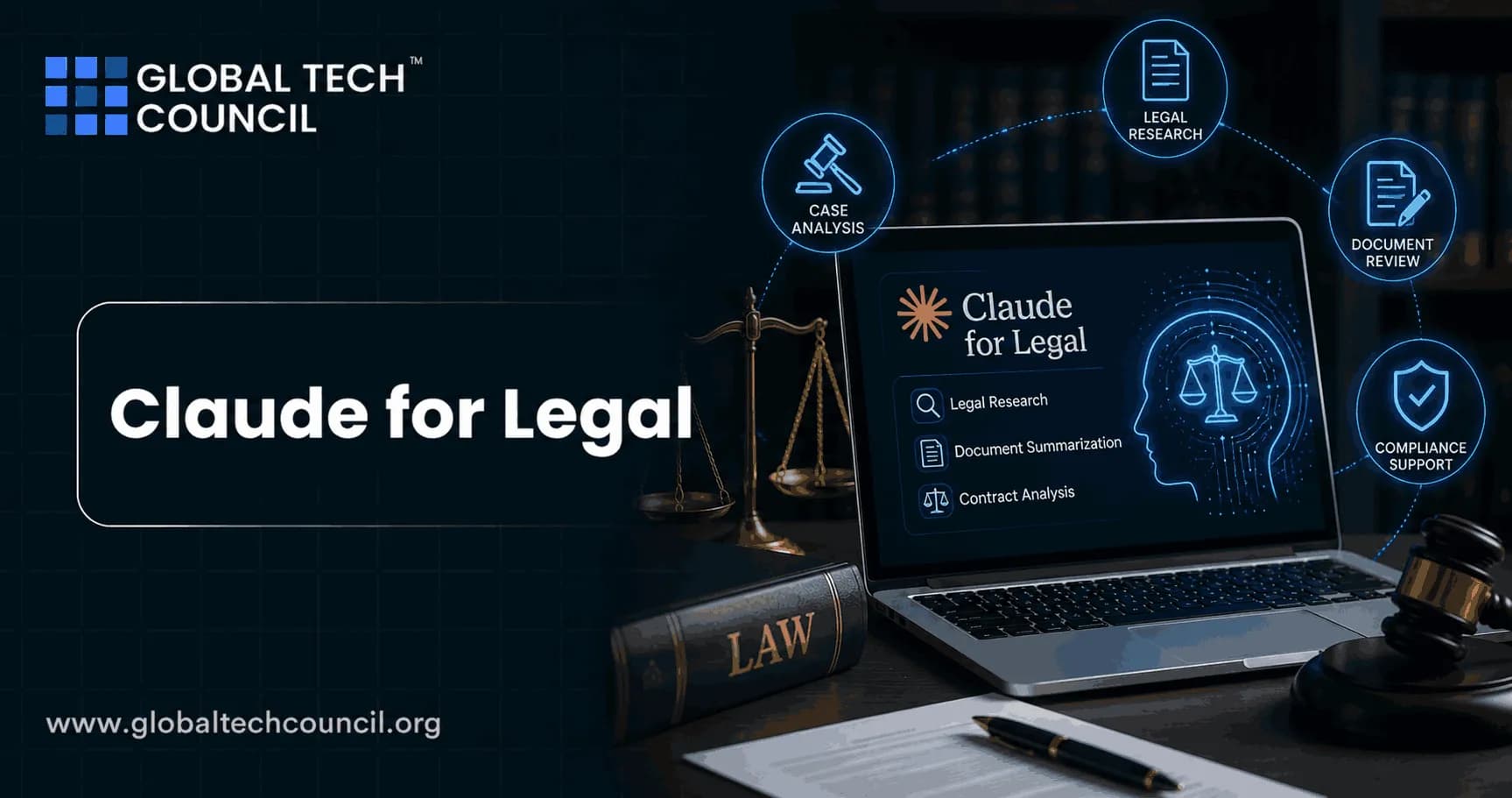
The legal industry is entering a new technological era. Law firms, corporate legal departments, and compliance teams are increasingly adopting artificial intelligence tools to improve research, automate documentation, reduce operational costs, and enhance decision-making. Among the emerging AI systems making a major impact is Claude AI, developed by Anthropic. Known for its advanced reasoning, long-context understanding, and safer AI interactions, Claude is quickly becoming a preferred AI assistant for legal professionals.
From contract analysis to legal research and compliance monitoring, Claude AI is helping lawyers save time while improving accuracy. The legal sector has traditionally been cautious about technology adoption due to confidentiality concerns and regulatory obligations. However, recent advancements in generative AI have shown that carefully designed AI systems can support legal work without replacing human expertise.

This article explores how Claude AI is reshaping the legal industry, its practical applications, benefits, limitations, recent developments, and future potential.
What Is Claude AI?
Claude AI is a generative artificial intelligence model developed by Anthropic, a company focused on building safe and reliable AI systems. Claude is designed to handle natural language conversations, summarize complex information, generate content, analyze documents, and assist with reasoning-heavy tasks.
Unlike traditional legal software that follows rigid rule-based systems, Claude AI uses large language models (LLMs) to understand context and respond intelligently to nuanced legal questions.
One of Claude’s strongest capabilities is its large context window. This means it can process lengthy legal documents, contracts, court filings, compliance manuals, and case law in a single interaction. For legal professionals dealing with hundreds of pages daily, this feature significantly improves efficiency.
As AI adoption grows, many professionals are pursuing specialized education programs such as the AI Expert certification and the Claude AI certification to understand practical AI implementation in business and legal environments.
Why the Legal Industry Needs AI
The legal profession deals with enormous volumes of data. Lawyers spend countless hours reviewing contracts, researching precedents, preparing compliance documents, and drafting agreements. These repetitive tasks consume time and increase operational expenses.
Several major challenges have accelerated AI adoption in law:
Growing Document Complexity
Modern legal matters involve massive documentation. Corporate mergers, privacy regulations, international contracts, and litigation cases often include thousands of pages.
Risin
Clients now expect faster turnaround times and lower legal costs. AI tools help firms deliver services more efficiently without compromising quality.
Compliance Pressure
Global regulations such as GDPR, CCPA, anti-money laundering (AML) laws, and cybersecurity requirements have increased compliance burdens. AI systems can monitor and analyze regulatory changes more effectively than manual processes.
Shortage of Time
Legal pr
Because of these shifts, legal professionals are increasingly exploring modern learning programs from institutions offering Deeptech certification and advanced Tech certification.
Ke
Legal Research
Legal research is one of the most time-consuming tasks in law practice. Lawyers traditionally spend hours reviewing statutes, regulations, court decisions, and legal opinions.
Claude AI can quickly summarize cases, identify legal principles, and organize research findings. Instead of manually reviewing dozens of sources, attorneys can use Claude to narrow down relevant precedents faster.
For example,
This significantly reduces research time while improving productivity.
Contract Analysis and Review
Contract review is another area where Claude AI demonstrates substantial value.
Claude can:
Identify unusual clauses
Highlight missing provisions
Summar
Detect inconsistencies
Compare contract versio
Extract obligations and deadlines
Law firms handling mergers and acquisitions often review thousands of contracts during due diligence. Claude helps legal teams analyze documents at scale while minimizing human error.
For example, a legal team reviewing supplier agreements can ask Claude to identify indemnification clauses or termination risks across hundreds of contracts.
Legal Drafting Assistance
Claude AI assists lawyers in drafting:
Non-disclosure agreements (NDAs)
Employment contracts
Client communication
Legal memos
Compliance policies
Terms and conditions
While human lawyers still need to verify legal accuracy, AI can accelerate first drafts significantly.
This does not mean AI replaces attorneys. Instead, it enables attorneys to spend more time applying legal expertise and less time on repetitive administrative work.
Compliance Monitoring
Regulatory
Claude AI can a
Banking
Healthcare
Insurance
Fintech
Data pri
Cryptocurrency
Legal departments can use Claude to track policy changes and generate internal compliance reports.
Organizations adopting AI-driven compliance tools often seek additional professional education through programs like the Claude AI expert certification.
E-Discovery and Litigation Support
During litigation, legal teams must review enormous datasets including emails, contracts, chat logs, and internal records.
Claude AI can
Doc
Evidence summarization
Timeline generatio
Key issue extraction
Witness statement analysis
This speeds up discovery processes and reduces manual review costs.
Large law firms are increasingly combining AI-powered legal review systems with predictive analytics to improve case strategy.
Recent Developments in Claude AI for Legal
Improved Long-Context Processing
One of Claude AI’s biggest advantages is its ability to process extremely large documents. Recent Claude models can analyze lengthy contracts and multi-document legal datasets more effectively than many earlier AI systems.
This makes Claude especially valuable for enterprise legal departments handling large-scale compliance or litigation projects.
Enhanced Safety Features
Anthropic has focused heavily on AI safety and responsible deployment. Claude includes guardrails designed to reduce harmful or misleading outputs.
For legal professionals, reliability is critical because incorrect legal information can create serious consequences.
Claude’s constitutional AI approach aims to make outputs more transparent and aligned with ethical guidelines.
Enterprise Integrations
Claude AI is increasingly being integrated into enterprise legal workflows through APIs and cloud platforms.
Organizati
Contract management systems
Complia
Document review tools
Internal legal portals
This integration allows legal teams to use AI directly within existing workflows.
Increased Adoption by Law Firms
Several law firms and legal tech startups are actively experimenting with generative AI systems like Claude for internal productivity.
While many firms remain cautious about client confidentiality and data governance, adoption is steadily increasing.
Legal technology conferences in 2025 and 2026 have shown strong interest in generative AI tools for legal automation, compliance, and knowledge management.
Benefits of Using Claude AI in Legal Practice
Time Efficiency
Claude reduces the time spent on repetitive administrative tasks. Lawyers can complete research and drafting faster, improving productivity.
Cost Reduction
By automating routine work, firms can reduce operational costs and improve profitability.
Bett
Claude helps legal teams organize and retrieve institutional knowledge efficiently.
Improved Client Service
Faster turnaround times and quicker legal insights enhance client satisfaction.
Scalability
AI enables l
Limitations and Challenges
Despite its benefits, Claude AI also has limitations.
Risk of Hallucinations
AI systems can occasionally generate inaccurate information. Lawyers must verify all outputs carefully.
Confidentiality Concerns
Legal data often contains sensitive client information. Firms must ensure secure AI deployment and proper data governance.
Regulatory Uncertainty
AI regulation itself is evolving. Legal professionals must monitor ethical and compliance considerations related to AI use.
Lack of Human Judgment
AI cannot replace legal reasoning, courtroom advocacy, negotiation skills, or ethical responsibility.
Claude is best viewed as an assistant rather than a substitute for qualified attorneys.
Claude AI and the Future of Legal Education
As AI transforms the legal industry, educational institutions and certification providers are adapting rapidly.
Professionals are increasingly enrolling in AI-focused programs such as:
These programs help professionals understand AI applications, automation strategies, prompt engineering, and enterprise integration.
AI literacy is becoming essential not only for developers but also for lawyers, consultants, compliance officers, and business leaders.
The Role of AI in Legal Marketing and Client Engagement
Legal firms are also using AI for digital marketing, content creation, and client outreach.
AI tools can support:
SEO optimization
Blog creation
Email automation
Client communication
Social media management
Professionals seeking expertise in this area often pursue a Marketing certification or specialized programs like the AI powered digital marketing course.
Best Practices for Using Claude AI in Legal Environments
Verify AI Outputs
Always cross-check AI-generated legal information before relying on it professionally.
Protect Sensitive Data
Use enterprise-grade security measures and avoid exposing confidential client information unnecessarily.
Combine AI With Human Expertise
AI should enhance legal workflows rather than replace professional judgment.
Train Employees
Legal teams should receive AI education and compliance training before adopting AI systems broadly.
Develop Internal AI Policies
Organizations should create clear governance policies covering AI usage, ethics, and accountability.
The Future of Claude AI in the Legal Industry
The future of AI in law looks highly promising.
Over the next few years, Claude AI and similar systems are expected to become more deeply integrated into legal operations. Potential future developments include:
A
Advanced compliance automation
Real-time legal risk assessment
Intelligent contract negotiation systems
Multilingual legal analysis
Automated corporate governance support
As AI technology evolves, legal professionals who adapt early will gain competitive advantages.
However, human lawyers will remain essential for interpretation, ethics, negotiation, advocacy, and relationship management.
The future of legal work is likely to involve collaboration between lawyers and AI rather than replacement.
Conclusion
Cl
Law firms and corporate legal departments are increasingly recognizing the benefits of generative AI while also addressing concerns related to accuracy, confidentiality, and ethics.
As the legal sector evolves, professionals who understand both law and artificial intelligence will be better positioned for success. Certifications such as the Claude AI expert certification and the AI Expert certification can help individuals stay competitive in this changing landscape.
AI is not replacing lawyers overnight. Instead, it is reshaping how legal work gets done by improving efficiency and enabling professionals to focus more on strategic legal analysis.
FAQs
1. What is Claude AI in the legal industry?
Claude AI is a
2. Can Claude AI replace lawyers?
Claude AI cannot replace lawyers because legal practice requires human judgment, ethics, negotiation, advocacy, and interpretation. AI works best as an assistant that supports attorneys by automating repetitive tasks and improving productivity.
3. How does Claude AI help with contract review?
Claude AI can analyze contracts, identify risky clauses, summarize agreements, compare versions, and extract important obligations. This allows legal teams to review large numbers of contracts faster and more accurately.
4. Is Claude AI safe for legal use?
Claude AI include
5. What makes Claude AI different from other AI tools?
Claude AI is known for its strong reasoning abilities, large context window, and focus on safe AI interactions. Its ability to process long legal documents efficiently makes it especially useful in legal environments.
6. Can Claude AI perform legal research?
Yes, Claude AI can assist with legal research by summarizing cases, identifying legal principles, and organizing information. However, legal professionals must validate findings before relying on them professionally.
7. How is AI changing the legal industry?
AI is transforming legal workflows through automation, faster document review, predictive analytics, compliance monitoring, and intelligent research assistance. It is helping firms reduce costs and improve efficiency.
8. What are the risks of using AI in law?
The main risks include inaccurate outputs, confidentiality concerns, overreliance on automation, and ethical issues. Organizations must implement governance policies and maintain human oversight.
9. Can Claude AI help corporate legal departments?
Yes, corporate legal departments can use Claude AI for contract management, policy analysis, compliance monitoring, and internal knowledge management.
10. Does Claude AI support compliance management?
Claude AI can analyze regulatory documents, summarize compliance obligations, and monitor policy changes. This makes it useful for industries with strict regulatory requirements.
11. What industries benefit most from legal AI tools?
Industries such as banking, healthcare, insurance, fintech, cybersecurity, and technology benefit significantly because they face heavy regulatory and documentation requirements.
12. How can lawyers learn AI skills?
Lawyers can pursue professional programs such as the Claude AI certification and AI Expert certification to understand AI implementation and legal technology.
13. Is AI legal research accurate?
AI legal research can be highly useful, but it is not perfect. Lawyers must verify citations, legal interpretations, and jurisdiction-specific information before using it in practice.
14. What is the future of AI in law firms?
The future includes deeper AI integration for contract automation, predictive analytics, compliance management, litigation support, and legal knowledge systems. Human lawyers will continue to play central roles.
15. Can small law firms use Claude AI?
Yes, small law firms can use Claude AI to improve efficiency and reduce operational costs. AI tools can help smaller firms compete more effectively with larger organizations.
16. Does Claude AI understand long legal documents?
Yes, one of Claude AI’s major strengths is its ability to process lengthy documents and large datasets. This is particularly valuable in litigation and due diligence projects.
17. What certifications help professionals understand legal AI?
Programs such as Deeptech certification and Tech certification provide knowledge related to emerging technologies and AI applications.
18. How is AI used in legal marketing?
Law firms use AI for SEO optimization, content creation, email marketing, and client engagement. Professionals often improve these skills through a Marketing certification or an AI powered digital marketing course.
19. Can Claude AI help with litigation?
Yes, Claude AI can assist with litigation support by organizing evidence, summarizing case materials, creating timelines, and reviewing discovery documents.
20. Why is AI education important for legal professionals?
AI education helps legal professionals understand automation, compliance, ethical risks, and emerging technologies. As AI adoption grows, professionals with AI knowledge will have stronger career opportunities and greater adaptability in the evolving legal industry.
Related Articles
View All
AI & ML
Claude Design 2.0
Claude Design 2.0 introduces enhanced AI-powered design capabilities, making it easier to generate layouts, prototypes, visual concepts, and creative content with natural language prompts. With improved reasoning, contextual understanding, and collaboration features, Claude Design 2.0 helps designers, developers, marketers, and businesses streamline their creative workflows. This guide explores its key features, applications, benefits, and how it compares with previous AI design tools.

AI & ML
Introducing Claude Sonnet 5
Claude Sonnet 5 represents the next evolution of Anthropic's AI models, delivering faster performance, stronger reasoning, enhanced coding capabilities, and improved multimodal understanding. Designed for developers, businesses, and everyday users, it offers more accurate responses, better instruction following, and advanced AI assistance for a wide range of tasks. This guide explores Claude Sonnet 5's features, improvements, real-world applications, and how it compares with previous Claude models.
AI & ML
What Is Claude Looping? A Complete Beginner's Guide
Claude Looping enables AI systems to perform iterative reasoning, execute multi-step tasks, and refine outputs autonomously. This beginner-friendly guide explains the concept, use cases, benefits, and practical applications of Claude Looping.
Trending Articles
The Role of Blockchain in Ethical AI Development
How blockchain technology is being used to promote transparency and accountability in artificial intelligence systems.
AWS Career Roadmap
A step-by-step guide to building a successful career in Amazon Web Services cloud computing.
Top 5 DeFi Platforms
Explore the leading decentralized finance platforms and what makes each one unique in the evolving DeFi landscape.