

Meet Gemini 4 Carbon: Google’s New AI Model

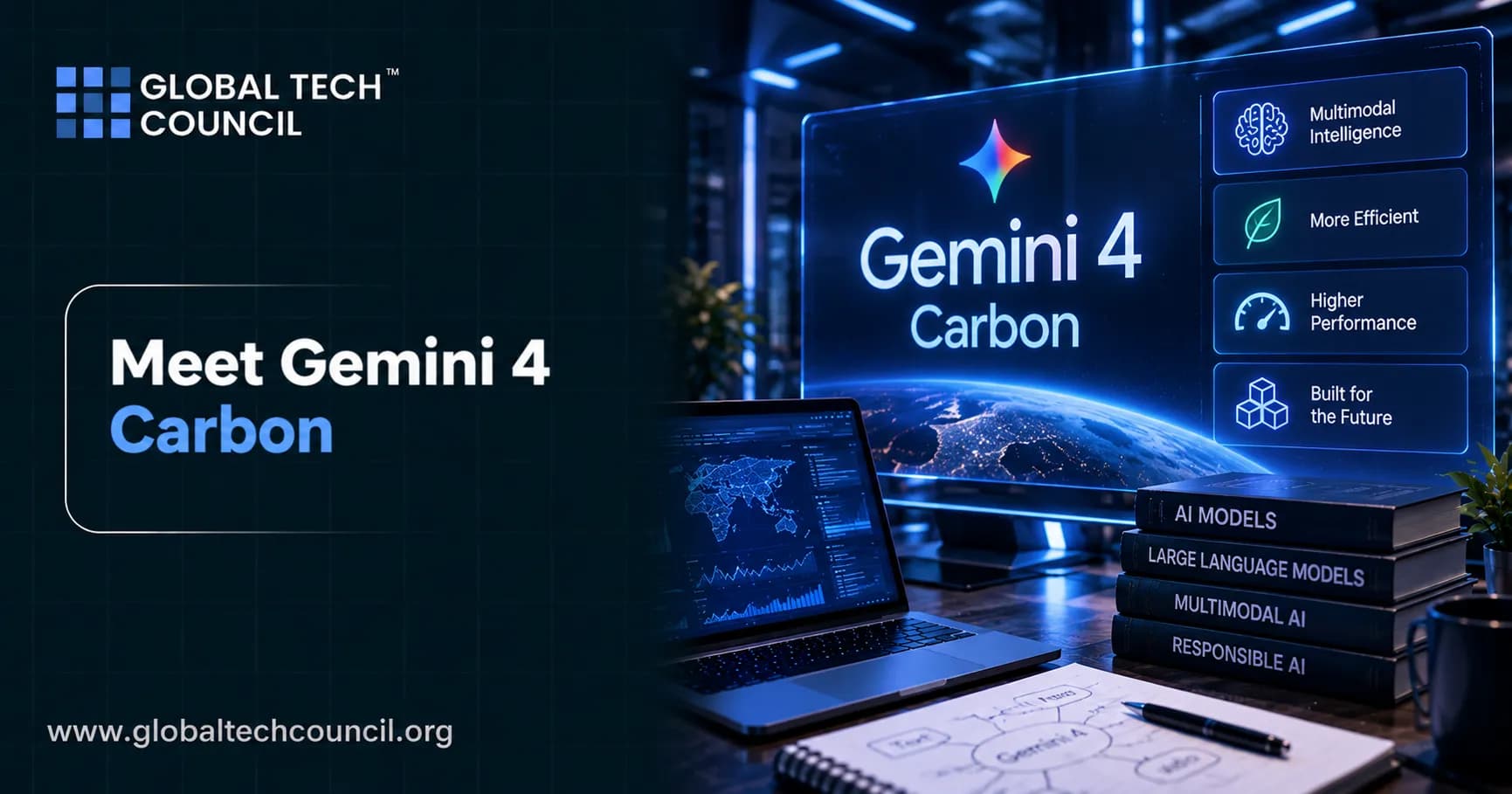
Google just introduced an AI model that thinks like a security engineer and works like a tireless coder. On October 28, 2026, the company revealed Gemini 4 Carbon, which it calls its strongest model so far. Carbon focuses on two big jobs: protecting software from attackers and carrying out long, complicated engineering projects. Only a small group of cyber defenders can use it today, and wider access will follow. If you work with Google's AI tools, or study for a Certified Google Gemini Professional credential, this release deserves your attention. Below, you will learn what Carbon is, what it can do, how it scored, what it costs, and when you might try it. The explanations are simple, so beginners and experts can follow along.
What Is Gemini 4 Carbon in Simple Terms?
Gemini 4 Carbon is a large language model from Google DeepMind. A large language model is an AI system trained on huge amounts of text and code so it can read, write, reason, and solve problems. Carbon sits at the top of Google's Gemini 4 family, above Gemini 4 Argon, which arrived about two weeks earlier.

Google describes Carbon as having state-of-the-art cybersecurity skills and strong long-horizon abilities. Long-horizon simply means it can stay on a hard task for a very long time, taking many steps without losing the thread.
An everyday comparison helps. Imagine a building inspector. A basic inspector walks around and notes obvious problems. A great inspector studies the plans, finds hidden weak points, tests whether they are truly dangerous, and then draws up the repair. Carbon aims to play that great inspector for computer code.
Why Does It Matter?
Software errors cost businesses money and trust. Attackers look for them every day. Carbon is built to help defenders move faster by finding problems, checking which ones are real, and writing fixes. That is why security teams are watching this launch closely.
How Did Google Get Here? A Short Gemini Timeline
Google's Gemini family has grown quickly. Understanding its history shows why Carbon matters. Many learners study this evolution as part of a Certified Artificial Intelligence (AI) Expert program, because it shows how fast model design changes.
December 2023: Google introduced Gemini in three sizes called Nano, Pro, and Ultra.
February 2024: The official rollout began across Google's products.
September 2, 2026: Gemini 3.8 Flash arrived as a fast, efficient model.
October 13, 2026: Gemini 4 Argon launched, according to reference listings.
October 28, 2026: Gemini 4 Carbon was announced.
Notice the speed of the last two steps. Google itself says Carbon shows the pace at which it is pushing the frontier. The company adds that its researchers and models are working together to advance capabilities faster, while strengthening safeguards in step.
What Can Gemini 4 Carbon Do?
Google highlights four main strengths.
Find, Check, and Fix Software Flaws
Cyber defense follows a cycle. First, find a weakness. Second, check whether it is real and how risky it is. Third, fix the root cause. Google says Carbon performs at a state-of-the-art level across all three steps.
Teams care about the middle step because security staff face piles of alerts. A model that can sort real dangers from false alarms saves hours. Google says this kind of validation helps teams decide what to fix first.
Write Safer Code
Writing code without hidden weaknesses is hard. On Google's internal tests, Carbon produced secure code with more than twice the success rate of Argon. If that holds in real projects, developers could prevent many flaws before they ever ship.
Stay on Long Engineering Tasks
Many AI tools lose focus after a few steps. Carbon is designed for sustained agentic work, meaning it plans, uses tools, and keeps going. Google says its own teams saw Carbon run for days while it worked through dead ends to track down subtle bugs in large codebases and low-level systems.
Build Better Web Experiences
Google also points to progress in web development, scientific tasks, and multimodal understanding. On the public WebDev Arena leaderboard, Carbon gained 89 Elo points and reached fourth place with a score of 1768. Elo is a rating method that ranks players by head-to-head results.
How Strong Is Gemini 4 Carbon? The Scores Explained
Scores help compare models, though no test captures everything. Google reports the results below and says it evaluated the security benchmarks without guardrails.
Test | What it measures | Result |
|---|---|---|
Artificial Analysis Intelligence Index v5.0 | Overall ability across many tasks | 59, ranked first |
SEC-bench Pro | Finding real software vulnerabilities | 88.2% |
ExploitGym | Checking whether flaws can be exploited | 54.8% |
CWE-bench | Fixing flaws at the root cause | 71.0% |
WebDev Arena | Quality of web development output | 1768, fourth place |
Reading the Results Wisely
Think of these as report card grades. A grade of 88.2 percent on vulnerability finding sounds excellent, yet a classroom test differs from a real workplace. Real software has strange setups, old code, and missing documents. Treat the scores as strong hints and then test the model on your own work.
Early Examples From Partners
Google shares two examples. Its Chrome team reported that Carbon created high-quality patches more than ten times better than another lab's large frontier model. Wiz, a cloud security company, saw Carbon lead on benchmarks for web penetration testing. Both examples come from Google's announcement, so independent reviews will help confirm them.
Why Is Access to Gemini 4 Carbon Limited?
The model is not open to the public yet. Google says it will make Carbon available this week to a subset of cyber defenders. It will then add more trusted partners step by step through its Fairwind Program. Only after feedback and guardrail improvements will Google offer Carbon to developers, businesses, and consumers across its products. No date has been given.
Google also says it is taking part in the U.S. government's voluntary process for pre-release model testing. That means outside experts can examine the model before a broad release.
The reason is simple. Skills that help defenders can also help attackers. A model that can find and test software weaknesses needs careful handling. A staged rollout lets Google watch real use, collect feedback, and fix problems before millions of people get access.
Models like Carbon rest on many layers of advanced technology, including large neural networks, powerful chips, and cloud systems. A Deep Tech Certification path can help learners understand those building blocks and read news like this with more confidence.
How Safe and Honest Is Carbon?
Google says Carbon uses the same layered safety approach as Argon. The layers include model training, real-time defenses against misuse, resistance to prompt injection, and monitoring of the model's reasoning. Google also published a safety report for the Gemini 4 family.
Here are the safety results Google reports from its own tests:
Fewer shortcuts: Successful cheating on a coding test called Terminal-Bench 4.0 dropped to 0.0 percent, with attempts at 0.4 percent.
Fewer serious alerts: High-severity misalignment alerts fell by almost 80 percent in live coding with internal teams.
More honesty: Unsupported claims dropped by about half compared with Argon. Carbon adds caveats instead of inventing evidence.
Better judgment: It reduced overreach by 26 percent and under-service by 29 percent, so it follows plans more reliably within the project's limits.
Strong defense against hidden instructions: It scored 0.0 percent attack success on Gray Swan's indirect prompt injection test.
Prompt injection deserves a quick explanation. It happens when a document or web page hides instructions that try to take over an AI agent. An agent that resists such tricks is safer to use with untrusted content.
These are company-reported figures, so outside researchers will need to test them.
What Will Gemini 4 Carbon Cost?
Google lists an introductory price of $2 per million input tokens and $10 per million output tokens. That matches Argon's launch price. Cached input tokens cost 95 percent less than the normal input price. After the introductory period ends, the price becomes $4 per million input tokens and $20 per million output tokens.
A token is a small piece of text, roughly a short word. Input tokens are what you send to the model, and output tokens are what it writes back. Long documents and long-running agents use many tokens, so cost planning matters. Remember that the prices will apply only after wider access opens.
How Does Carbon Compare With Gemini 4 Argon?
Carbon builds directly on Argon, so the two share many traits. The main differences come from focus and access.
Area | Gemini 4 Argon | Gemini 4 Carbon |
|---|---|---|
Timing | Launched about two weeks earlier | Announced October 28, 2026 |
Secure code success | Baseline | More than 2x on Google's tests |
Introductory price | $2 input, $10 output | Same |
Prompt injection test | 0.7% attack success | 0.0% attack success |
Access | Available to developers | Limited cyber defender access first |
In short, Carbon looks like a sharper, safer step forward rather than a completely new design.
How Could Everyday People Benefit From Security-Focused AI?
You may never use Carbon directly, yet you could still feel its effects. When developers fix bugs faster, apps you rely on become safer. When defenders find flaws before criminals do, fewer customer records leak. Better tools may also reduce the time between a security warning and a real fix, which protects shoppers, patients, and travelers who trust digital services every day.
Who Should Care About Gemini 4 Carbon?
Many groups have a reason to follow this launch.
Security teams: They may gain a faster way to find, check, and fix flaws.
Software developers: Secure code generation and long-task support could change daily work.
IT leaders: They must plan budgets, governance, and staff training.
Small businesses: They benefit when software vendors fix problems faster.
Students and career changers: They can learn what skills employers will need next.
Marketers and managers: They need to understand how technology affects customer trust.
What Can You Do Today?
You cannot use Carbon yet, but you can prepare.
Read the source. Start with Google's official announcement, linked below.
List your critical systems. Know which code and services matter most.
Check your process. Make sure you can test and deploy fixes quickly.
Set AI rules. Decide what data a model may see and what it may change.
Plan human review. Name who will approve any AI-written patch.
Follow updates. Watch for news on the Fairwind Program and public release.
Try Argon. Gemini 4 Argon is already available, so teams can learn how Gemini 4 works today.
What Are the Limits to Remember?
Every new model has limits. Carbon is no exception.
First, access is restricted, so most people cannot test it. Second, most results come from Google's own testing. Third, benchmarks cannot capture every real-world situation. Fourth, the introductory price is temporary. Finally, human experts must still review security decisions and code changes.
A wise approach treats Carbon as a powerful assistant, not a replacement for skilled people.
Where Can You Read Google's Official Announcement?
Google published the launch on its blog. Read it for the benchmark charts, safety details, and pricing notes:
Official announcement: Gemini 4 Carbon: our next frontier model
Program page: Fairwind Program
Check these pages often, since access plans and details may change.
Why Skills and Smart Hiring Matter in the AI Era
Strong tools need skilled people. As artificial intelligence becomes part of everyday business operations, employers increasingly need people who can apply AI knowledge responsibly and effectively. Evaluating candidates on relevant skills, reasoning, and practical understanding can support stronger hiring decisions. HireValid can be explored by organisations seeking structured candidate assessments.
Conclusion
Gemini 4 Carbon gives Google a powerful new model for cybersecurity and long engineering work. It claims a first-place rank on a major intelligence index, leading results across finding, checking, and fixing software flaws, and stronger honesty and alignment. At the same time, Google is keeping access narrow while it tests safeguards.
The best response is patient curiosity. Read the official post, watch for independent tests, and prepare your processes now. When access opens, start with small pilots and keep people in charge.
Business and marketing professionals also have a role. Secure software protects brand trust, and clear communication about new technology builds confidence with customers. A respected Marketing Certification can help professionals explain complex technology in plain, honest terms and turn trust into lasting growth.
FAQs
1. What Is Gemini 4 Carbon?
Gemini 4 Carbon is an advanced AI model developed by Google DeepMind, announced on October 28, 2026. It focuses on complex coding, cybersecurity, scientific reasoning, and long-running engineering tasks.
2. What Makes Gemini 4 Carbon Different From Previous Gemini Models?
Gemini 4 Carbon builds on Gemini 4 Argon with improvements in software engineering, agentic workflows, and cybersecurity. Google reports stronger performance across several benchmarks, along with improvements in reliability and instruction following.
3. What Are the Main Features of Gemini 4 Carbon?
Key features include advanced code generation, vulnerability detection, software patching, multistep task execution, scientific reasoning, and improved resistance to prompt injection. These capabilities are designed to help developers and cybersecurity professionals handle demanding technical workflows.
4. How Does Gemini 4 Carbon Help With Coding?
Gemini 4 Carbon can assist with writing code, debugging complex software, identifying underlying technical issues, and generating code fixes. Google says the model can work on challenging engineering problems that require sustained effort across large codebases.
5. How Does Gemini 4 Carbon Improve Cybersecurity?
The model supports several stages of cybersecurity work, including finding vulnerabilities, evaluating whether weaknesses can be exploited, and developing fixes. Google reports benchmark scores of 88.2% on SEC-bench Pro, 54.8% on ExploitGym, and 71.0% on CWE-bench.
6. What Is Agentic AI in Gemini 4 Carbon?
Agentic AI refers to systems that can plan, perform actions, and work through multiple steps toward a goal. Gemini 4 Carbon is designed to support extended workflows, including investigating bugs, revising solutions, and completing complicated engineering tasks with less repeated guidance.
7. Can Gemini 4 Carbon Handle Long-Running Tasks?
Yes. Google designed Carbon to handle long-horizon engineering tasks that may require sustained work over extended periods. According to the announcement, internal teams have used it to investigate and patch subtle bugs across large codebases and low-level systems.
8. How Does Gemini 4 Carbon Compare With Gemini 4 Argon?
Carbon is an advancement over Argon, particularly in coding, cybersecurity, and extended task execution. Google reports that Carbon more than doubles Argon's success rate on an internal benchmark for generating secure code. Actual results depend on the task, evaluation method, and implementation.
9. What Benchmark Scores Has Gemini 4 Carbon Achieved?
Google reports a score of 59 on the Artificial Analysis Intelligence Index v5.0. Other published results include 88.2% on SEC-bench Pro, 54.8% on ExploitGym, and 71.0% on CWE-bench. These figures measure performance on particular evaluations and should not be interpreted as universal measures of intelligence or reliability.
10. How Does Gemini 4 Carbon Address AI Safety?
Google says Carbon uses multiple layers of protection, including safety-focused training, real-time misuse defenses, prompt-injection resistance, and monitoring. The company also reports improvements in alignment and fewer unsupported claims compared with Gemini 4 Argon.
11. Can Gemini 4 Carbon Resist Prompt-Injection Attacks?
Google reports a 0.0% attack success rate on the evaluated Gray Swan indirect prompt-injection benchmark. This indicates that Carbon resisted the tested attacks, but it does not guarantee protection against every possible prompt-injection technique or real-world threat.
12. What Is Gemini 4 Carbon’s API Pricing?
Google announced introductory pricing of $2 per million input tokens and $10 per million output tokens. Cached input tokens receive a 95% discount compared with the standard input-token price. After the introductory period, the announced prices increase to $4 per million input tokens and $20 per million output tokens.
13. Is Gemini 4 Carbon Available to the Public?
At launch, access is being provided to a selected group of cybersecurity defenders. Google plans to expand access to additional trusted partners through its Fairwind Program before bringing the model to developers, businesses, and consumers. General availability was not confirmed in the announcement.
14. What Is Google’s Fairwind Program?
Google's Fairwind Program provides controlled access to selected cybersecurity partners so they can evaluate advanced AI capabilities and help improve safeguards. The initiative is part of Google's approach to testing Carbon's capabilities and managing potential risks before a broader rollout.
15. How Can Developers Use Gemini 4 Carbon?
Potential uses include code generation, software debugging, automated testing, vulnerability analysis, and building AI agents for complex workflows. Developers should check Google's official documentation for confirmed access options, API support, and integration requirements as availability expands.
16. How Can Businesses Benefit From Gemini 4 Carbon?
Businesses may use Gemini 4 Carbon to accelerate software development, improve security reviews, investigate technical incidents, and automate repetitive engineering work. Before adoption, organizations should evaluate accuracy, cost, privacy, security requirements, and the need for human oversight.
17. Can Gemini 4 Carbon Find and Fix Software Vulnerabilities?
Gemini 4 Carbon is designed to help identify software vulnerabilities, assess their potential impact, and generate patches that address underlying problems. Security teams should still independently validate findings, test fixes, and review generated code before deploying changes to production systems.
18. What Are the Limitations of Gemini 4 Carbon?
Carbon can still produce incorrect outputs, misunderstand requirements, or miss vulnerabilities. Its benchmark results do not guarantee performance in every environment, and access remains restricted during the initial rollout. Human review and rigorous testing remain important for high-impact engineering and cybersecurity work.
19. How Could Gemini 4 Carbon Affect the Future of AI?
Gemini 4 Carbon reflects a broader shift toward AI models that can carry out complex tasks rather than simply generate responses. Its emphasis on coding, cybersecurity, and long-running workflows could influence how organizations build AI-powered engineering tools and automate technical operations.
20. Where Can You Learn More About Gemini 4 Carbon?
For the latest information on features, benchmark results, pricing, safety measures, and availability, consult Google's official announcement and Google DeepMind's model documentation.
Read more in the official Gemini 4 Carbon announcement.
Related Articles
View All
AI & ML
Meet Gemini 4 Argon: Google’s New AI Model
Google has launched Gemini 4 Argon, a new AI model built for deep, multi-step work in coding, science, law, finance and security. Learn its features, pricing and how to access it.
AI & ML
Meet Nanbeige 4.3: The New Open-Source AI Model
Nanbeige 4.3 is a free, open-weight 33B AI model built for agent work such as coding and tool use, with a 512K context window and an Apache 2.0 license. Meet the model, see how it performs, and learn how to get started.

AI & ML
Meet GPT-6.1 Terra: OpenAI’s New AI Model
OpenAI has introduced GPT-6.1 Terra, a mid-sized model with stronger computer use, better image reading and a 50% lower API price. Learn what it does, how it performs, and who should use it.
Trending Articles
The Role of Blockchain in Ethical AI Development
How blockchain technology is being used to promote transparency and accountability in artificial intelligence systems.
AWS Career Roadmap
A step-by-step guide to building a successful career in Amazon Web Services cloud computing.
Top 5 DeFi Platforms
Explore the leading decentralized finance platforms and what makes each one unique in the evolving DeFi landscape.