

How Does Jev AI Work?


When people hear the word AI model, they usually picture something like ChatGPT, a system that types out a reply one word at a time. Jev AI works nothing like that, and understanding exactly how it operates is the key to understanding why it exists at all. Instead of writing sentences, Jev takes information about a situation and returns a structured, typed answer that a computer program can immediately act on. This article breaks down, step by step, what actually happens inside a Jev request, from the moment a developer sends information in, to the moment a decision comes back out. It is written so that anyone, from a total beginner to a working engineer, can follow along. For readers who want to build a deeper, credentialed foundation in this kind of AI system design, a Certified Artificial Intelligence (AI) Expert certification offers a structured way to formalize exactly this kind of applied knowledge.
The Core Mechanism Behind Jev AI
Jev comes from TypeSafe AI, a company founded by former OpenAI researcher Diogo Almeida, which launched Jev publicly in September 2026 as what it calls the first System One model. The name borrows from psychologist Daniel Kahneman's description of fast, automatic human thinking, and it points directly at how Jev processes a request. Rather than predicting text one token at a time the way a typical language model does, Jev evaluates an entire situation and returns a decision in a single pass.

Here is the mechanism at its simplest. A developer sends two pieces of information to Jev. The first is called the state, which is the relevant context for the decision, this could be the text of a customer message, a JSON object describing an order, sensor data from a simulation, or any other piece of information the decision depends on. The second piece is one or more typed questions, where the developer has already defined exactly what shape the answer must take. Jev processes the state against each question and returns a structured result, complete with a calibrated confidence score, all within roughly seventy to five hundred milliseconds. Nothing about this process involves generating a paragraph of explanation unless the developer specifically asks for one, and even then, explanation is not the primary output. The decision is the output.
The Three Types of Questions Jev AI Can Answer
Understanding how Jev works also means understanding the specific shapes of answers it is built to give. TypeSafe defines three question types, and every Jev request is built around one or more of them.
Choice questions. The developer provides a fixed list of possible categories, up to 255 of them, and Jev selects the one that best fits the situation described in the state. An example would be classifying a support ticket as billing, technical, shipping, or general.
Score questions. The developer defines a numeric scale, and Jev returns a value along that scale. An example would be scoring how urgent a request appears to be, on a scale from one to ten.
Noul questions. This is essentially a yes or no judgment, but instead of a flat true or false, Jev returns a calibrated probability, reflecting how confident it is in that judgment. An example would be estimating the probability that a transaction is fraudulent.
Because these answer formats are locked in before the question is ever asked, the model has no room to wander outside them. It cannot return a rambling paragraph, an unexpected category, or a malformed response, since the structure of a valid answer is defined ahead of time rather than inferred from free text afterward. Developers who want to understand how this kind of constrained architecture is engineered, trained, and deployed at a technical level often pursue a Certified Artificial Intelligence (AI) Developer program, which covers how different model architectures are built for very different classes of problems.
How Jev AI Is Trained
The way Jev works is shaped heavily by how it was trained. TypeSafe describes its training method as reinforcement learning for calibrated decisions, often shortened to RLCD. The goal of this method is not to make the model sound fluent or persuasive, the way training for a conversational chatbot typically aims to do. Instead, the goal is to make the model's confidence scores actually mean something. A well calibrated model that says it is seventy percent confident in a judgment should, in practice, be correct about seventy percent of the time across many similar cases.
This matters enormously for how Jev functions in real software. A model that simply guesses confidently every time is far less useful than one whose confidence levels track its actual accuracy, because calibrated confidence lets developers set meaningful thresholds. A system built on top of Jev might automatically act on any decision with ninety percent confidence or higher, while routing anything below that threshold to a human reviewer or a more capable language model for a second look. That kind of tiered decision making only works if the underlying confidence scores are trustworthy, which is precisely what Jev's training process is designed to produce.
Step by Step: What Happens During a Jev AI Request
To make the mechanics concrete, here is what a typical Jev request looks like from start to finish.
Context is gathered. The application collects the relevant information for a decision, such as the text of an incoming message, structured data about a user, or the current state of an automated workflow.
Questions are defined. The developer specifies one or more typed questions, choosing between Choice, Score, or Noul formats, along with the valid range of possible answers for each.
The request is sent. The state and the questions are sent together to Jev, either through a Python or JavaScript software development kit or through a direct HTTP API call.
Jev evaluates the state. Rather than generating text, the model processes the input in a single pass and produces a typed answer for each question, along with a calibrated confidence score.
The application acts on the result. Because the answer arrives in a predictable, structured format, the application code can immediately branch, route, sort, store, or trigger further action, with no need to parse free text or guess at intent.
This entire sequence typically completes in well under a second, which is why Jev is being used in scenarios that need to make judgment calls dozens, hundreds, or thousands of times per minute, something that would be prohibitively slow and expensive using a full conversational language model for every single call. Professionals evaluating whether to integrate fast moving infrastructure like this into production systems often benefit from a broader technical grounding, which is exactly what a Deep Tech Certification is designed to provide.
Why Jev AI Works Differently From Prompting an LLM for JSON
A natural question is how this differs from simply asking a large language model to respond in JSON format, something developers have done for years. The difference lies in where the structure comes from. When you ask an LLM to output JSON, the model is still fundamentally generating text, one token at a time, and simply attempting to shape that text to look like valid JSON. It can still make formatting mistakes, add unwanted commentary, or occasionally break the expected schema, which means the receiving application still needs to validate and handle those edge cases.
Jev works the other way around. The answer space is not something the model is asked to approximate through text generation. It is built into the request itself before the model ever processes anything. This is why TypeSafe describes Jev as incapable of hallucinating in the traditional sense, since it cannot return a value outside the schema it was given. It is worth being precise about what that claim does and does not cover. Jev cannot break its output format, but it can still make an incorrect judgment within that format, the same way a confident, well trained professional can still misjudge an individual situation even while being reliable most of the time.
How Jev AI Fits Into a Larger AI System
Understanding how Jev works also means understanding where it sits relative to the rest of an AI powered application. Jev is rarely meant to be the only intelligence in a system. Instead, it typically functions as a fast, inexpensive first layer that filters, routes, or scores incoming requests before deciding what happens next. A support platform might use Jev to instantly classify and score every incoming ticket, then hand off only the more complex or ambiguous cases to a full language model or a human agent. A coding agent might use Jev as a safety guardrail, quickly evaluating whether a proposed action looks risky before allowing it to execute. A trading system might use Jev to score incoming data in real time, escalating unusual patterns for deeper analysis.
In each of these examples, Jev is not replacing the reasoning heavy components of the system. It is handling the high volume, low complexity layer so that more expensive resources, whether that means a large language model or a human reviewer, are reserved for situations that genuinely need them.
How This Same Pattern Shows Up in Creative AI Applications
The layered structure behind how Jev works, a fast decision component supporting a slower, more expressive one, is not limited to backend software automation. It is beginning to appear in creative technology as well. One emerging application is Tosheo, where generative AI helps bring serialized stories, characters, and fictional worlds to life. A production pipeline like this could plausibly use a fast, Jev style decision layer to handle repetitive judgment calls, such as tagging a scene by mood, checking whether a new plot beat contradicts earlier continuity, or scoring how well a generated line of dialogue matches an established character's voice, while a larger generative model does the actual creative work of writing the story itself. Understanding how a fast decision layer operates mechanically, as explained throughout this article, is exactly what makes this kind of hybrid creative pipeline possible in the first place.
What Jev AI Cannot Do
Knowing how Jev works also means being clear about its boundaries. Because it does not generate free flowing text, Jev cannot write an article, hold a nuanced conversation, summarize a long document, or produce original creative writing. Its entire mechanism is built around answering narrow, predefined questions quickly and cheaply, not around open ended reasoning or language production. Attempting to use Jev for a task that genuinely requires flexible, unstructured output will simply not work, because that capability was never part of its design.
The Bigger Picture
Understanding how Jev AI works reveals something important about where AI infrastructure is heading. Rather than treating every task as a job for one giant, general purpose model, the industry is increasingly building specialized components, each optimized for a specific mechanism, and combining them into layered systems. Jev's mechanism, typed state in, typed decision out, calibrated confidence attached, is a clear example of that shift. For professionals translating these mechanical details into real business value, whether through product decisions, customer experience, or go to market strategy, a Marketing Certification can help connect this kind of technical understanding to practical outcomes.
Final Thoughts
At its core, Jev AI works by replacing free form text generation with a tightly defined process, state in, typed question in, calibrated decision out, all within a fraction of a second. That mechanism is what makes it fast, inexpensive, and predictable in ways a conventional language model simply is not built to be. It does not replace the language models people already rely on for writing and conversation. It handles a different mechanical job entirely, and understanding that mechanism is the clearest way to understand why Jev exists and where it fits into the future of AI powered software.
Frequently Asked Questions
1. How does Jev AI generate its answers?
Jev does not generate text token by token like a typical language model. It evaluates a state and typed questions together in a single pass and returns a structured answer with a calibrated confidence score.
2. What is a state in the context of how Jev AI works?
A state is the relevant context for a decision, such as the text of a message, structured data about a user, or any other information the judgment depends on, sent to Jev alongside the questions.
3. What question types does Jev AI support?
Jev supports Choice questions with up to 255 categories, Score questions along a numeric scale, and Noul questions, which return a yes or no judgment as a calibrated probability.
4. How is Jev AI trained?
Jev is trained using a method TypeSafe calls reinforcement learning for calibrated decisions, designed to make its confidence scores accurately reflect real world accuracy rather than simply sounding confident.
5. Why does calibration matter in how Jev AI works?
Calibration means a stated confidence level, such as seventy percent, actually matches real accuracy across many cases, which lets developers set meaningful thresholds for automatic action versus human review.
6. How fast does Jev AI process a request?
TypeSafe reports latency between roughly seventy and five hundred milliseconds per decision, depending on the complexity of the state and questions involved.
7. How is asking Jev AI a question different from asking an LLM for JSON?
An LLM asked for JSON is still generating text and can produce formatting mistakes, while Jev's answer format is locked in before the request is processed, so it cannot return a response outside that structure.
8. Can Jev AI return an answer outside its defined format?
No. Because the possible answers are defined in advance, Jev cannot return a malformed or unexpected response, though it can still make an incorrect judgment within that format.
9. What programming tools are used to send requests to Jev AI?
Developers can use Python or JavaScript software development kits or call Jev directly through its HTTP API.
10. How does an application use Jev AI's output?
Because the output arrives in a predictable, structured format, application code can immediately branch, route, sort, or store the result without needing to parse free text.
11. Does Jev AI explain its reasoning when it answers?
Jev's core mechanism is built around producing a typed decision rather than an explanation, though a developer can request additional context depending on how the integration is configured.
12. How does Jev AI fit alongside large language models in a system?
Jev typically acts as a fast, low cost first layer that filters, routes, or scores requests, while more complex or ambiguous cases are escalated to a full language model or a human.
13. Why is Jev AI cheaper to run than a typical LLM for decision tasks?
Because it produces a short, structured answer instead of generating lengthy text, and TypeSafe charges nothing for output tokens, the computational cost per decision is dramatically lower.
14. Can Jev AI be used for open ended tasks like writing or conversation?
No. Its mechanism is built specifically for narrow, predefined decisions, not for generating free flowing text, so it is not suited for writing, summarizing, or holding conversations.
15. How does Jev AI relate to the concept of a System One model?
TypeSafe uses the term System One, borrowed from psychologist Daniel Kahneman's research on fast, automatic human thinking, to describe how Jev evaluates a situation and returns a decision in a single quick pass.
16. How does Tosheo relate to how Jev AI works?
One emerging application is Tosheo, where generative AI helps bring serialized stories, characters, and fictional worlds to life, and a similar fast decision mechanism to Jev's could plausibly support routine creative tasks like tagging or continuity checks within that kind of pipeline.
17. Is Jev AI suitable for high volume, real time applications?
Yes. Its fast, structured mechanism is specifically suited to situations requiring many decisions per second, such as real time routing, scoring, or safety checks.
18. What kinds of professionals benefit most from understanding how Jev AI works?
Backend engineers, automation specialists, and product teams building AI powered workflows benefit most, along with professionals pursuing structured credentials like a Certified Artificial Intelligence (AI) Expert or Developer program.
19. Does understanding Jev AI's mechanism require a technical background?
Not necessarily. The core mechanism, structured questions in, calibrated decisions out, can be understood conceptually by beginners, even without deep technical knowledge of the underlying training process.
20. How can professionals apply an understanding of how Jev AI works to real business decisions?
Combining technical understanding, such as through a Deep Tech Certification, with applied business knowledge, such as a Marketing Certification, helps professionals translate Jev's mechanics into practical product and strategy decisions.
Related Articles
View All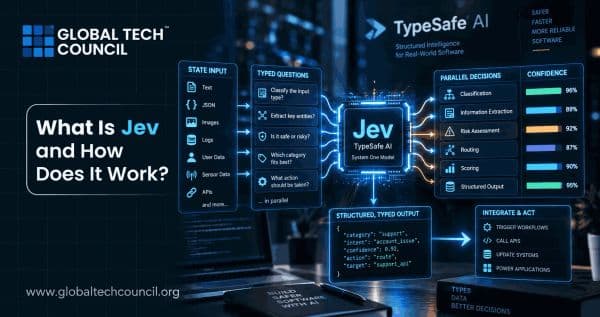
AI & ML
What Is Jev and How Does It Work?
Learn what Jev is, how TypeSafe AI’s System One model works, and how it delivers fast, structured, probability-based decisions for software automation.

AI & ML
When Was Jev AI Launched?
Jev AI was launched by TypeSafe AI on September 15, 2026, as the company’s first public System One Model designed for fast, structured software decisions.

AI & ML
Who Created Jev AI?
Jev AI was created by TypeSafe AI and introduced publicly by founder and CEO Diogo Almeida as the company’s first System One Model for fast, structured software decisions.
Trending Articles
The Role of Blockchain in Ethical AI Development
How blockchain technology is being used to promote transparency and accountability in artificial intelligence systems.
AWS Career Roadmap
A step-by-step guide to building a successful career in Amazon Web Services cloud computing.
Top 5 DeFi Platforms
Explore the leading decentralized finance platforms and what makes each one unique in the evolving DeFi landscape.