

What Is Jev and How Does It Work?

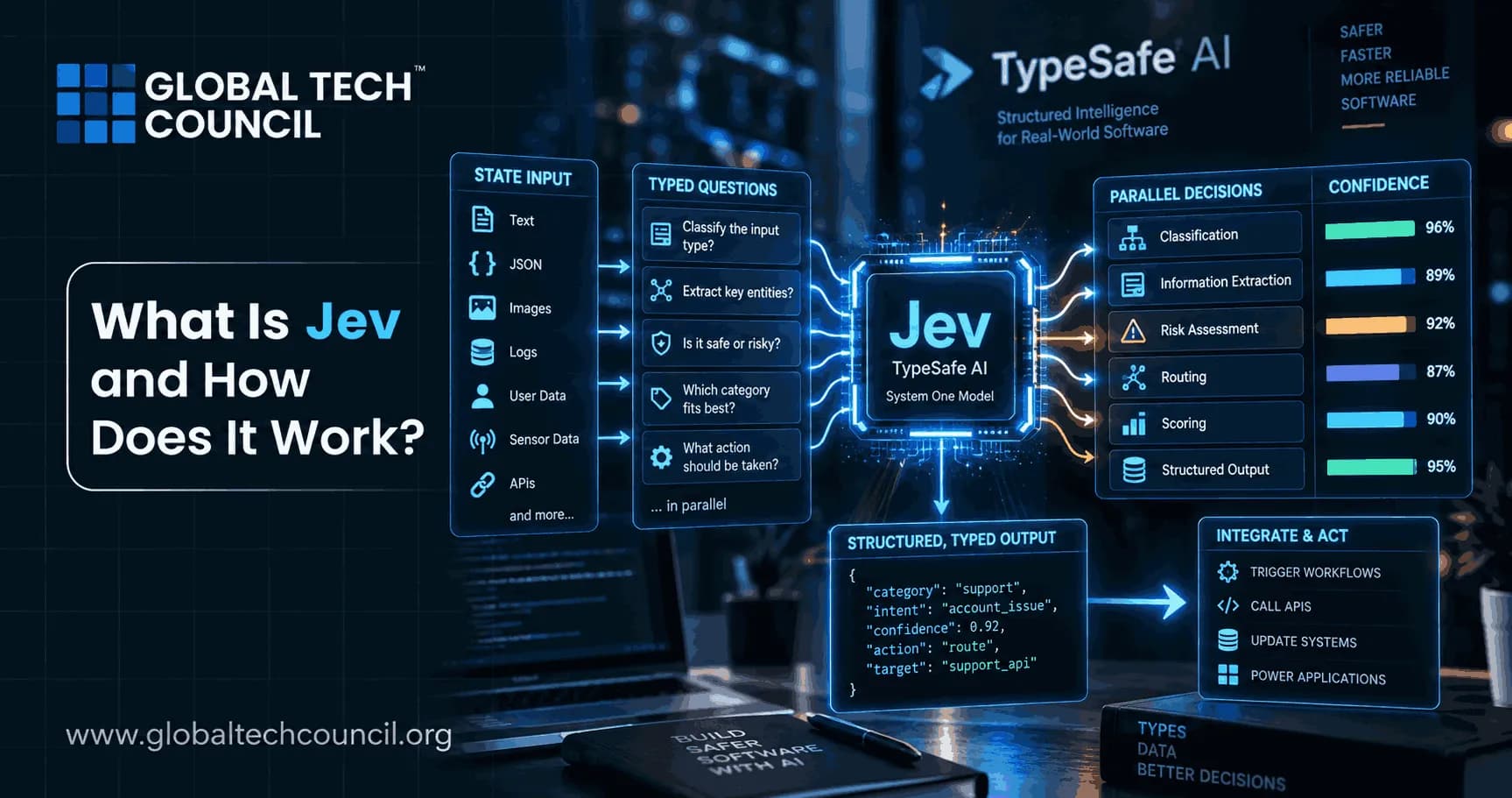
Most people think of artificial intelligence as something that writes, talks, or answers questions. Moreover, popular AI tools are built to generate text that humans can read and understand. However, a fundamentally different type of AI model has just entered the picture. Furthermore, it does not write anything at all. Instead, it makes decisions. That model is called Jev, and it was launched on September 15, 2026 by typesafe.ai.
Additionally, Jev is designed for machines, not people. Specifically, it takes structured or natural-language input, evaluates it against a set of typed questions, and returns structured decisions with calibrated confidence scores. Furthermore, the entire process happens in parallel and takes between 70 and 500 milliseconds. Consequently, software systems can act on those decisions immediately, without parsing a sentence or validating a text output.

Moreover, the creator of Jev is Diogo Almeida, a former researcher who contributed to the development of ChatGPT and GPT-4 at a major AI laboratory. Therefore, the technical foundation behind this model carries significant credibility. Furthermore, the company raised 40 million dollars in funding before its public launch, signaling strong institutional confidence in this new approach to AI automation.
As AI decision models become more central to software infrastructure, understanding the fundamentals of AI becomes increasingly important. Professionals looking to advance in this space can build a strong foundation through a Certified Artificial Intelligence (AI) Expert certification, which covers key AI principles, architectures, and automation frameworks that are directly relevant to evaluating and working with models like Jev.
The Problem Jev Was Built to Solve
To understand why Jev matters, it helps to understand the limitation it addresses. Specifically, conventional large language models generate text one token at a time. Furthermore, this design is excellent for writing, summarizing, explaining, and coding. However, it creates a problem when software needs a simple, fast judgment rather than a paragraph of output.
For example, imagine a customer service application that needs to classify each incoming ticket before routing it. Moreover, the classification decision itself is simple: billing, technical, or sales. Furthermore, using a full language model to make that decision requires generating a text response, parsing the output, validating the format, and handling any unexpected variations. Consequently, the process adds latency, cost, and failure points to a task that should be nearly instant.
Additionally, language models trained with reinforcement learning from human feedback are optimized to sound helpful and fluent. Therefore, they are built for human readers rather than software consumers. Moreover, this mismatch between text generation and structured decision-making is the core architectural problem that typesafe.ai set out to solve when building Jev. As a result, Jev gives up the ability to generate any text at all, and gains speed, reliability, and cost efficiency in return.
Furthermore, professionals who want to build and integrate AI systems effectively benefit from formal development training. A Certified Artificial Intelligence (AI) Developer certification equips engineers and technical professionals with practical skills in AI model integration, API design, and automated workflow construction. These skills apply directly when building systems that incorporate decision models like Jev alongside traditional language models.
What Is Jev? A Clear Definition
Jev is the first public model from typesafe.ai and belongs to a new category of AI called System One models. Furthermore, the name draws directly from the psychological concept developed by Nobel laureate Daniel Kahneman in his book Thinking, Fast and Slow. Specifically, Kahneman described System One thinking as fast, automatic, and intuitive. Moreover, System Two thinking is slow, deliberate, and effortful. Therefore, a System One AI model is built for the fast, automatic judgments that traditional language models handle slowly and inefficiently.
Additionally, the name Jev itself references William Stanley Jevons, a 19th century English economist known for Jevons paradox. Specifically, this paradox states that making a resource cheaper tends to increase its total consumption rather than reduce it. Furthermore, typesafe.ai chose this name deliberately, suggesting that making AI judgments cheap enough will lead to their use in many more places inside software. Consequently, the economics of AI automation could shift dramatically as decision models become widely adopted.
Moreover, Jev is described by typesafe.ai as a frontier intelligence function call. Specifically, unstructured state goes in and typed probabilistic decisions come out. Furthermore, the model accepts plain text strings, JSON objects, and arrays of text. As a result, developers can feed it anything from a raw customer message to a complete invoice document, and it will return a structured decision that software can act on immediately without any additional processing.
How Jev Works: The Core Architecture
Understanding how Jev works requires understanding what makes it fundamentally different from a standard language model. Specifically, language models use autoregressive generation, meaning they produce one token at a time and each token depends on all previous tokens. Furthermore, this sequential process is what makes language models powerful for open-ended tasks but slow and expensive for structured decisions.
By contrast, Jev uses a hardware-aware parallel sampler. Moreover, this architecture evaluates all typed questions simultaneously against a shared piece of state in a single forward pass. Therefore, adding more questions to a single API call barely increases the response time. Furthermore, typesafe.ai has demonstrated this with internal testing showing that 13 questions answered in one call were 12.2 times cheaper and 10 times faster than making 13 separate calls with identical results.
Additionally, the output space of Jev is defined in advance by the developer. Specifically, possible outputs are enumerated at the time the question is constructed. Furthermore, because the model cannot produce values outside the predefined schema, it mathematically cannot generate a malformed response. Consequently, the entire category of type errors and parsing failures that developers must handle with language model outputs simply does not exist with Jev. As a result, production systems become more reliable and easier to maintain.
The Three Primitives of Jev
Jev communicates through three structured question types called primitives. Furthermore, each primitive returns a different type of structured output with probabilities and, where applicable, a confidence score. Moreover, all three primitives can be mixed within a single API call. Therefore, a developer can ask multiple different types of questions about the same piece of state in one request and receive all answers simultaneously.
Choice: Selecting From Defined Options
First, the Choice primitive asks Jev to select one option from a developer-defined set. Moreover, it supports up to 255 distinct options per question. Furthermore, the response returns the selected option along with a probability distribution across all options and a confidence score derived from the shape of that distribution. Therefore, a support routing system could ask Jev to choose between billing, technical, and general departments. As a result, the application routes the ticket automatically when confidence is high and escalates to a human agent when confidence falls below the developer-set threshold.
Score: Rating Against an Ordered Rubric
Additionally, the Score primitive places the input state on an ordered scale against a set of descriptive levels. Furthermore, it returns the assigned level, a probability for each level, and a confidence score. Therefore, it works well for tasks like evaluating invoice quality, scoring the urgency of a security alert, or rating the sentiment of a customer message. Moreover, because the output is always a value on the predefined scale, it integrates directly into downstream workflow logic without any interpretation or extraction step.
Noul: Answering Boolean Questions
Furthermore, the Noul primitive answers a yes or no question by returning the probability that the answer is yes. Moreover, this makes it ideal for filtering, screening, and condition-checking tasks. Specifically, a developer could ask whether an incoming message contains a complaint, whether a transaction looks suspicious, or whether an AI agent output contains a policy violation. Consequently, Noul acts as a fast and reliable conditional check that replaces complex rule-based filters without requiring any string parsing.
RLCD: The Training Method That Powers Jev
The technical foundation of Jev is a training method called Reinforcement Learning for Calibrated Decisions, or RLCD. Furthermore, this method was developed specifically by typesafe.ai and represents a departure from the approaches used to train most modern AI models. Specifically, reinforcement learning from human feedback trains models to produce outputs that humans rate as helpful or well-written. Moreover, reinforcement learning with verifiable rewards trains models to pass test cases or solve problems with objectively correct answers.
By contrast, RLCD trains models to produce outputs where the stated confidence accurately reflects the true accuracy rate across similar decisions. Therefore, a Jev response carrying 80 percent confidence should be correct approximately 80 percent of the time on comparable inputs. Furthermore, this calibration property is what allows developers to use the confidence score as a reliable routing signal in production systems. Consequently, when Jev is highly confident, the system acts automatically. When confidence is low, the system requests human review before proceeding.
Additionally, RLCD reflects a deeper philosophy behind the design of Jev. Specifically, typesafe.ai argues that AI systems used in automation should know what they do not know and communicate that uncertainty clearly. Furthermore, overconfident AI outputs that are frequently wrong are far more dangerous in automated pipelines than outputs that accurately report their own uncertainty. Therefore, calibration is treated as a first-class training objective rather than an afterthought. As a result, Jev is better suited for trustworthy automation than models optimized purely for apparent correctness.
Speed and Cost: What Makes Jev Economically Significant
One of the most immediately striking aspects of Jev is its pricing and performance profile. Specifically, typesafe.ai prices Jev at 0.042 dollars per million input tokens, with output tokens provided at no additional charge. Furthermore, this price point is approximately 238 times lower than some of the top-tier language models available at standard rates. Moreover, output tokens are free because the structured output is so compact that the cost is negligible and not worth metering.
Additionally, internal workflow evaluations conducted by typesafe.ai tested Jev across four representative business processes: security incident response, agent trace observability, invoice processing, and customer service triage. Furthermore, the results showed response times between 70 and 500 milliseconds, with speed improvements of 20 to 200 times compared to conventional models on those tasks. Moreover, the company reported cost per case as low as 0.0004 dollars compared to 0.0304 dollars for a comparable language model workflow on the same task.
Furthermore, the parallel evaluation architecture amplifies these savings significantly. Specifically, because all questions in a single API call are evaluated simultaneously, the cost of asking additional questions is minimal. Therefore, a developer who needs 10 structured judgments about a single document can get all 10 in one call for roughly the same cost as asking one question. Consequently, this pricing model makes AI judgment economically viable in places where it was previously impractical due to cost or latency constraints.
Professionals working in deep technology and AI infrastructure benefit from understanding the broader landscape of technical tools and standards. Exploring a Deep Tech Certification gives professionals exposure to emerging technology frameworks, infrastructure standards, and the principles behind building reliable technical systems. This knowledge helps practitioners evaluate tools like Jev with greater precision and make informed architectural decisions in AI-driven product development.
Real-World Applications of Jev
Intelligent Customer Service Routing
First, customer service operations generate enormous volumes of incoming requests every day. Moreover, each request must be understood and routed before any human or AI system can respond. Furthermore, traditional routing rules break down when request language is ambiguous or unexpected. Therefore, Jev can evaluate each incoming message and return a structured routing decision in under half a second. As a result, the application routes clear cases automatically and flags ambiguous ones for human review, based on the returned confidence score.
Automated Invoice and Document Validation
Additionally, invoice processing involves repeated checks against multiple criteria simultaneously. Specifically, each document must be evaluated for matching totals, verified vendor status, approved line item categories, and compliance with internal policies. Furthermore, Jev can evaluate all of these questions in a single parallel call against the invoice content. Consequently, processing speed increases dramatically while error rates decrease because the model applies the same criteria consistently to every document it evaluates.
Security Alert Triage and Prioritization
Furthermore, security operations centers receive continuous streams of alerts that require rapid classification. Moreover, the majority of these alerts are low-priority or false positives. Therefore, using a full language model to evaluate each alert is neither fast enough nor cost-effective at scale. As a result, Jev can score each alert against a defined urgency rubric and return a priority classification in milliseconds. Consequently, security engineers focus on high-confidence critical alerts rather than manually reviewing every notification.
AI Agent Output Review and Guardrailing
Moreover, as AI agents become more common in automated workflows, verifying their outputs before those outputs trigger real-world actions becomes essential. Specifically, Jev can review a completed agent output and evaluate whether it stays within policy boundaries, whether the tool call it generated is valid, or whether the response it drafted aligns with expected behavior. Therefore, Jev functions as a fast and affordable guardrail layer between AI-generated content and production consequences.
Real-Time Decision Support in Interactive Applications
Additionally, some applications require AI judgment at interactive speeds. Specifically, typesafe.ai demonstrated Jev making ten structured queries per second inside a real-time application at an estimated cost of roughly seven dollars per hour. Furthermore, this kind of performance opens AI decision-making to use cases where even a one-second delay would be unacceptable. Consequently, real-time scoring, fraud detection, content filtering, and interactive routing all become viable candidates for Jev integration.
AI Microdramas and the Role of Decision Models in Creative Pipelines
One emerging application of AI in digital content is AI microdrama, where generative AI helps bring serialized stories, characters, and fictional worlds to life. Moreover, this format is growing rapidly across streaming platforms and social media as audiences engage deeply with short-form narrative content. Furthermore, production teams creating AI microdrama at scale face unique quality control challenges that structured decision tools are well-positioned to address.
Specifically, maintaining narrative consistency across many episodes requires evaluating each generated scene against defined character traits, tone guidelines, and story arc boundaries. Moreover, doing this manually becomes impractical as episode counts grow. Therefore, a decision model like Jev can serve as an automated consistency gate within the production pipeline. Furthermore, it can evaluate whether a generated scene matches the established emotional tone, whether a character response aligns with their defined personality, and whether a plot development fits the planned narrative arc.
Additionally, content pipelines that combine generative models with structured decision layers represent the future architecture of AI-powered creative production. Moreover, generative models handle the creative output while decision models handle the evaluation and routing logic that ensures quality at scale. Consequently, AI microdrama and other forms of AI-assisted storytelling stand to benefit significantly as tools like Jev become more widely available and deeply integrated into content workflows.
How Jev Fits Into a Modern AI Stack
Understanding where Jev fits in relation to other AI components helps developers make better architectural decisions. Specifically, typesafe.ai recommends thinking of the AI stack as three distinct layers. First, deterministic code handles everything that does not require semantic understanding. Furthermore, decision models like Jev handle the fast, repeated judgments that require semantic understanding but do not need a generated response. Moreover, large language models handle the open-ended tasks that require generating text, code, or explanations.
Additionally, this layered approach has direct cost and performance implications. Specifically, routing classification and scoring tasks through Jev rather than a language model reduces cost by orders of magnitude for those tasks. Furthermore, the language model is then available to focus on the tasks where its text generation capability is genuinely required. Therefore, the overall system becomes faster, cheaper, and more reliable because each component is doing the job it was built for.
Moreover, Jev integrates into existing development stacks through a straightforward API. Specifically, developers send a POST request to the System One endpoint with a model identifier of jev-latest. Furthermore, the request body includes a state value and any combination of Choice, Score, or Noul questions. As a result, integration requires no special infrastructure and no changes to existing application architecture beyond adding the new API call. Consequently, the barrier to adoption is low for any development team already working with AI APIs.
Limitations and Honest Boundaries of Jev
Being accurate about what Jev cannot do is as important as understanding what it can. Specifically, Jev cannot write text, generate code, produce explanations, or answer open-ended questions. Furthermore, it currently accepts text input only, with no support for images, audio, or video. Therefore, any task that requires free-form output or multimodal understanding is outside the model's current scope. Moreover, this is a deliberate design choice rather than a gap to be filled, since the constraint is what enables the speed and reliability advantages.
Additionally, the internal benchmarks published by typesafe.ai represent company-reported figures rather than independently verified results. Specifically, the highest speed and cost gains represent best-case scenarios on tasks shaped specifically for Jev. Furthermore, accuracy results showed Jev averaging 67.8 percent agreement with reference answers, where those references came from frontier model consensus rather than human-labeled ground truth. Therefore, developers should test Jev on their own production data before relying on published figures for deployment decisions.
Furthermore, Jev is also a weak fit when a simple deterministic rule already handles the decision reliably. Specifically, there is no need to call a model to check whether a number exceeds a fixed threshold or whether a field is empty. Moreover, the model performs best on tasks that involve genuine semantic ambiguity, where the right answer depends on understanding language rather than applying a fixed rule. Consequently, identifying which decisions in a given system actually require semantic judgment is the first practical step in evaluating Jev for a specific application.
Who Should Pay Attention to Jev?
Software Engineers and Backend Developers
First, software engineers building automation pipelines have the most immediate reason to evaluate Jev. Moreover, any existing workflow that calls a language model purely for classification, scoring, or routing is a direct candidate for replacement or augmentation. Furthermore, the typed output eliminates parsing and validation code, reducing both development effort and runtime failure risk. Therefore, the integration path is clear and the potential efficiency gains are large.
Product Managers and Technical Leaders
Additionally, product managers and technical leaders benefit from understanding what Jev represents at the architectural level. Specifically, the emergence of a decision model category changes how AI components should be selected and combined within a product. Furthermore, understanding the distinction between generative and decision models helps leaders make more informed choices about where AI investment delivers the best return. Consequently, teams that adopt this mental model early will design better AI-powered products.
Data Scientists and AI Researchers
Furthermore, data scientists and AI researchers benefit from understanding both the RLCD training approach and the calibration-first philosophy behind Jev. Specifically, these concepts have broader implications for how AI systems should be designed when reliability matters more than fluency. Moreover, the question of how to build models that accurately represent their own uncertainty is an active and important research area. Therefore, Jev serves as a concrete example of applied calibration research in a production product.
Marketers and Business Leaders
Finally, marketers and business leaders who oversee AI-powered customer experiences benefit from understanding how decision models change the economics of automation. Moreover, faster and cheaper AI judgments make it practical to add intelligent routing, scoring, and personalization to workflows that could not previously justify the cost. Therefore, business leaders who understand the decision model landscape will find new opportunities to improve operational efficiency and customer experience through targeted AI integration.
Specifically, professionals who want to apply AI thinking to business strategy and customer engagement should invest in relevant credentials. A Marketing Certification covering AI-powered strategies gives professionals the frameworks needed to evaluate how tools like Jev fit into broader marketing and operational workflows. Furthermore, this knowledge supports better decisions about where automation delivers genuine business value and where human judgment remains essential.
The Future Implications of Decision AI Models
The launch of Jev signals a meaningful shift in how the AI industry thinks about model design. Moreover, for several years, the dominant trend has been to make language models larger, smarter, and more capable at an ever-broader range of tasks. Furthermore, Jev represents a different direction: building a model that is deliberately narrow, highly specialized, and optimized for a specific class of tasks. Consequently, this raises the question of whether the future AI stack will be dominated by a few very large general models or by a richer ecosystem of specialized models working together.
Additionally, the calibration-first approach behind RLCD points to an important design principle for AI in high-stakes automation. Specifically, systems that know what they do not know and communicate that uncertainty accurately are more suitable for real-world deployment than systems that appear confident regardless of actual accuracy. Furthermore, as AI becomes more embedded in consequential decisions, the demand for calibrated uncertainty will increase significantly. Therefore, the work typesafe.ai is doing with Jev today may influence how the broader field thinks about AI reliability for years to come.
Furthermore, the Jevons paradox logic behind the name carries genuine strategic weight. Specifically, if making AI judgments cheap enough causes developers to use them in many more places, the total volume of AI decision-making inside software could grow by orders of magnitude. Moreover, this would represent a fundamental expansion of where and how AI operates in the world. Consequently, the economic and social implications of cheap, fast, and calibrated AI judgment extend well beyond any single product or company.
Frequently Asked Questions (FAQs)
1. What is Jev?
Jev is the first System One model from typesafe.ai. It accepts structured or natural-language input and returns typed decisions with calibrated confidence scores, without generating any text.
2. How is Jev different from a chatbot or language model?
Jev does not generate text at all. Furthermore, it evaluates typed questions in parallel and returns structured values like choices, scores, and boolean probabilities that software can use directly.
3. What does System One model mean?
System One refers to the fast, intuitive thinking described by psychologist Daniel Kahneman. Moreover, a System One AI model makes fast, structured decisions without the deliberate step-by-step reasoning that language models use to generate text.
4. What input types does Jev accept?
Jev currently accepts text input only. Specifically, it supports plain text strings, JSON objects, and arrays of text. Images, audio, and video are not currently supported.
5. What are the three primitives in Jev?
The three primitives are Choice, Score, and Noul. Moreover, Choice selects from defined options, Score rates input against an ordered rubric, and Noul returns the probability that a yes-or-no question is true.
6. What is RLCD?
RLCD stands for Reinforcement Learning for Calibrated Decisions. Furthermore, it is the training method typesafe.ai developed for Jev, optimizing for accurate confidence scores rather than human-preferred text output.
7. How fast is Jev?
Typesafe.ai reports end-to-end response times between 70 and 500 milliseconds. Furthermore, internal evaluations showed speed gains of 20 to 200 times compared to conventional language models on structured decision tasks.
8. How much does Jev cost?
Jev is priced at 0.042 dollars per million input tokens. Moreover, output tokens are free because the structured output is compact enough that the cost is negligible.
9. Can Jev replace large language models?
No. Jev is designed for structured decision tasks, not open-ended generation. Furthermore, it is best used alongside language models in a layered architecture where each component handles the tasks it was built for.
10. What is the parallel sampler in Jev?
The parallel sampler evaluates all typed questions simultaneously in a single forward pass. Furthermore, this is what allows Jev to answer multiple questions in one API call at roughly the same speed as answering one question.
11. Can Jev hallucinate?
Jev cannot produce outputs outside its predefined schema. Moreover, because possible outputs are enumerated in advance, it cannot return a value that was not defined by the developer. Therefore, type errors and schema violations are structurally impossible.
12. What is calibration in the context of Jev?
Calibration means the model's stated confidence accurately reflects its true accuracy rate. Specifically, a response marked at 70 percent confidence should be correct approximately 70 percent of the time across similar inputs.
13. What are the main use cases for Jev?
Key use cases include customer service routing, invoice processing, security alert triage, AI agent output review, and real-time decision support in interactive applications.
14. When is Jev a poor fit?
Jev is a poor fit when a simple deterministic rule already handles the decision reliably. Moreover, it is not suitable for tasks requiring free-form text generation, code writing, or multimodal input.
15. Who founded typesafe.ai?
Typesafe.ai was founded by Diogo Almeida, who previously contributed to ChatGPT and GPT-4 development. Moreover, his co-founders include engineers with backgrounds in AI research and genomics technology.
16. How does confidence scoring work in Jev?
For Choice and Score primitives, confidence is derived from the shape of the returned probability distribution. Furthermore, a concentrated distribution indicates higher confidence while a spread distribution indicates greater uncertainty.
17. Is Jev available to the public?
Jev launched in selective early access on September 15, 2026. Moreover, developers can apply to join the waitlist through the official typesafe.ai website.
18. How does Jev integrate into existing software?
Jev is accessed through a POST request to the System One API endpoint. Furthermore, the request includes a state value and typed questions, and returns all answers in a single structured response.
19. Can Jev be used in creative content pipelines?
Yes. Jev can evaluate consistency and quality in AI content pipelines including AI microdrama production, checking whether generated scenes match defined tone, character, and narrative requirements.
20. What skills help professionals work effectively with Jev?
AI fundamentals, API integration, software automation design, and workflow evaluation skills all support effective use of Jev. Moreover, structured certifications in AI, development, and technology provide relevant foundational knowledge for this field.
Related Articles
View All
AI & ML
What Is Strawberry Browser and How Does It Work
Strawberry Browser is an agentic web browser with built-in AI companions that can research, automate tasks, work across multiple tabs, and interact with websites on a user’s behalf.

AI & ML
How Does Recursive Self-Improvement Work in Artificial Intelligence?
Recursive self-improvement in artificial intelligence describes a process where an AI system improves its own capabilities and then uses those gains to make further improvements over time.

AI & ML
GPT 6 Astra: What OpenAI's New Frontier Model Means for AI, Security, and Work
GPT 6 Astra is OpenAI's newest frontier model, with phased access, stronger safety controls, and major implications for cybersecurity, coding, and enterprise AI.
Trending Articles
The Role of Blockchain in Ethical AI Development
How blockchain technology is being used to promote transparency and accountability in artificial intelligence systems.
AWS Career Roadmap
A step-by-step guide to building a successful career in Amazon Web Services cloud computing.
Top 5 DeFi Platforms
Explore the leading decentralized finance platforms and what makes each one unique in the evolving DeFi landscape.