

AI in Go-to-Market Strategy: Tools, Use Cases, and Best Practices

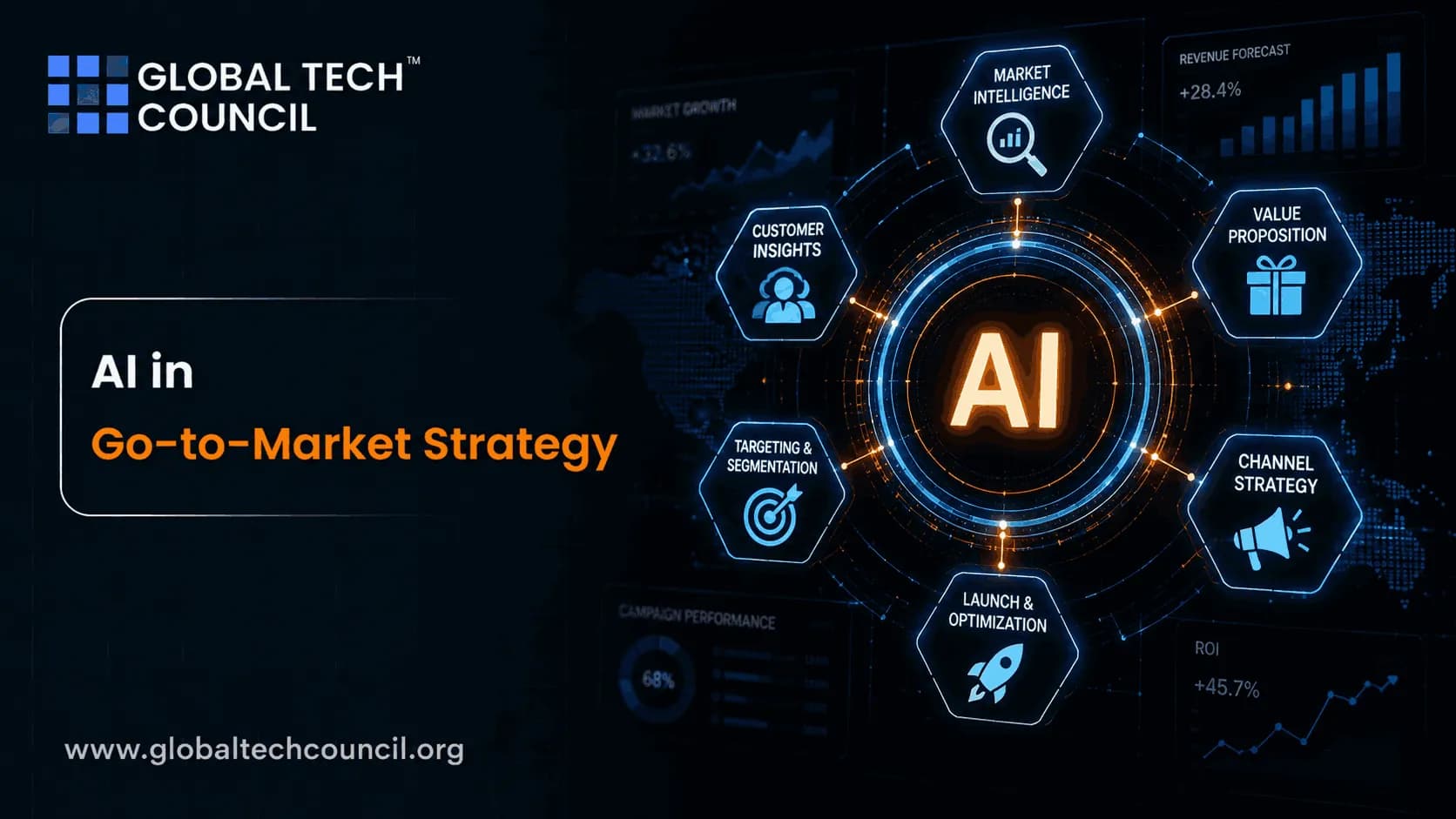
AI in go-to-market strategy is no longer a side experiment owned by a growth team. It now sits across market research, segmentation, campaign planning, sales execution, customer expansion, and revenue operations. The shift is practical. Teams want cleaner signals, faster execution, and fewer decisions based only on opinion.
LeanData's recent survey of GTM professionals found that 52 percent use AI to analyze disparate data sets for insights, while 51 percent use it to optimize marketing campaigns. That matches what many revenue teams see on the ground. The first win is rarely a flashy chatbot. It is usually a better way to connect CRM data, product usage, campaign engagement, and sales activity into a usable decision layer.

What AI Changes in Go-to-Market Strategy
A traditional GTM motion often depends on static segments, manual account scoring, spreadsheet reporting, and rep intuition. AI changes that operating model by making GTM more adaptive. You can refresh account priority weekly, generate variant messaging by segment, route sales tasks based on intent signals, and spot churn risk earlier.
Columbia Business School has described a future where AI agents handle sequences of GTM work, such as identifying ideal prospect profiles, targeting companies, and coordinating follow-up activity. That future is already visible in platforms that connect CRM, marketing automation, content systems, and sales engagement workflows.
To be blunt, AI will not fix a confused offer or a weak market. It will expose the confusion faster. If your segments are poorly defined or your CRM is full of duplicates, AI will amplify those flaws. Artificial intelligence is transforming every stage of the go-to-market (GTM) process, from customer research and demand forecasting to sales enablement and campaign optimization. Pursuing a Tech Certification helps professionals build practical expertise in AI, cloud computing, automation, analytics, and digital transformation. These industry-recognized certifications prepare business leaders to leverage AI tools for smarter decision-making, streamlined GTM execution, and data-driven business growth.
Core Use Cases for AI in Go-to-Market Strategy
1. Market Research and Opportunity Identification
AI agents can scan public sources, internal notes, product feedback, call transcripts, and contract data to identify market patterns. Google Cloud's catalog of real-world generative AI use cases includes examples where Gemini is used to automate market research and contract analysis, cutting work that previously took days.
For GTM teams, this means faster answers to questions such as:
Which verticals are showing new demand?
Which competitors appear most often in lost deal notes?
Which contract terms slow enterprise deals?
Which use cases appear repeatedly in support tickets?
2. ICP Definition and Account Prioritization
AI can compare won deals, lost deals, firmographic data, technographic signals, intent data, and product usage to refine the ideal customer profile. This is one of the most useful applications of AI in go-to-market strategy, because it gives sales and marketing a shared target.
Tools such as Apollo combine B2B contact data with AI-powered prospecting and outreach. Other GTM intelligence platforms help identify accounts that resemble high-value customers. The quality of the result depends heavily on the inputs. If your closed-won data mixes self-serve users with enterprise deals, separate them before modeling. Otherwise the score will be noisy.
3. Campaign Design and Optimization
AI helps teams test copy, select audiences, personalize offers, and adjust campaign spend. Aprimo has described AI-driven marketing as enterprise-critical infrastructure, and Improvado's trends analysis points to generative content, advanced segmentation, and predictive analytics as major forces in marketing operations.
Use AI here for controlled experimentation. Ask it to produce message variants, but tie each variant to a hypothesis. A cybersecurity buyer may respond to risk-reduction language, while a developer audience may care more about setup time and API limits. Test both. Do not publish AI-generated content without review, especially in regulated sectors.
4. Sales Outreach and Enablement
AI can draft account-specific emails, suggest next steps, summarize discovery calls, and route the right content to a rep. Highspot notes that AI GTM tools increasingly coordinate timing, sequencing, and ownership across GTM programs. That matters when a campaign spans product marketing, sales development, account executives, and customer success.
Good sales AI is specific. Bad sales AI sounds like every other automated email in the buyer's inbox. Feed it real account context: job openings, product usage spikes, recent funding, technology stack, support issues, or renewal timing. Then have humans edit the message.
5. Revenue Analytics and Expansion Signals
AI is especially strong when it connects data sets that teams usually inspect separately. Marketing engagement, product usage, CRM stage history, billing data, and support tickets can reveal expansion opportunities or churn risk.
A product-led company might flag accounts where usage has grown 40 percent in 30 days, three new admin users were added, and a pricing page was visited twice. That is a far better expansion signal than a generic quarterly check-in task. Modern GTM strategies increasingly rely on AI, predictive analytics, intelligent automation, and advanced data processing. Becoming a Deeptech Expert equips professionals with interdisciplinary knowledge of AI, machine learning, blockchain, and emerging technologies. This expertise enables organizations to build intelligent GTM workflows, automate market analysis, personalize customer experiences, and accelerate product adoption using cutting-edge technologies.
AI GTM Tool Categories to Know
The tool landscape is crowded. Pick based on the workflow you need to improve, not the loudest demo.
Data and prospecting tools: Used for contact enrichment, account discovery, ICP scoring, and list building. Apollo is a common example.
Strategy and planning agents: Tools such as Beam AI describe agents that help teams create GTM plans, analyze data, and generate structured recommendations.
Campaign and content platforms: These support generative content, dynamic asset management, personalization, and campaign testing.
Sales enablement platforms: Platforms such as Highspot help route content, tasks, and guidance to sales teams.
Revenue intelligence and analytics tools: These connect CRM, product, marketing, and sales data to reveal pipeline quality, attribution, churn risk, and expansion signals.
If you are building internal capability, skills matter as much as software. Professionals can strengthen the technical base through Global Tech Council learning paths in AI, machine learning, data science, programming, and cybersecurity. For teams handling customer data, AI governance and security knowledge should not be optional.
Best Practices for Applying AI in GTM
Start With the Business Question
Do not start with a tool trial. Start with a measurable question. For example:
Which accounts should sales prioritize this week?
Which campaign messages create qualified pipeline?
Which customers are likely to expand in the next 90 days?
Which lead sources produce low-quality meetings?
ZoomInfo's guidance on AI-driven GTM strategy follows this logic: define objectives, identify data sources, assess your stack, operationalize AI, and measure impact.
Clean the Data Before You Automate
This is where many AI GTM projects fail. Duplicate accounts, inconsistent industry fields, missing UTMs, and broken campaign attribution will distort AI outputs.
A concrete example: teams often try to join Salesforce Lead records to Account fields before conversion and hit errors such as INVALID_FIELD: No such column 'Account.Industry' on entity 'Lead'. The fix is not more AI. The fix is understanding the CRM data model, mapping fields correctly, and deciding how leads, contacts, and accounts should be stitched together.
Watch the small defaults too. In HubSpot, the Original Source and Original Source Drill-Down fields can behave differently than custom UTM fields. If your reports mix them, campaign performance can look better or worse than it really is.
Integrate AI Into Daily Workflows
A detached AI dashboard rarely changes behavior. Put AI where the work happens: CRM views, sales engagement tools, campaign planning boards, customer success queues, and weekly pipeline reviews.
An account score should trigger a visible next action. Send a task to the account executive. Add the account to a nurture path. Notify customer success if expansion signals appear. AI without action design becomes another report nobody reads.
Keep Humans Accountable
AI can recommend, draft, rank, and summarize. Humans still own strategy, messaging quality, customer trust, and compliance. This is especially true in enterprise sales, healthcare, finance, education, and any market where personal data or regulated claims are involved.
Review AI-generated segments for bias. Review outreach for accuracy. Review campaign recommendations against brand and legal standards. Demandbase has warned about data misalignment, tool lock-in, and uncontrolled growth of AI agents across teams. Those risks are real. AI is reshaping how businesses launch products, identify target audiences, and optimize customer journeys. Earning a Marketing Certification helps professionals strengthen expertise in product marketing, AI-powered customer segmentation, demand generation, competitive positioning, and growth strategy. These capabilities enable organizations to create more effective GTM plans while improving customer acquisition, retention, and long-term business performance.
Measure What Actually Matters
Activity metrics are not enough. Track whether AI improves GTM outcomes:
Pipeline created by segment
Lead-to-opportunity conversion rate
Sales cycle length
Meeting acceptance rate
Customer acquisition cost
Expansion revenue
Churn risk accuracy
Compare AI-assisted workflows with control groups where possible. If AI-generated outreach increases replies but lowers qualified meetings, it is not a win.
Common Mistakes to Avoid
Buying too many AI tools: Agent sprawl fragments data and creates governance problems.
Ignoring privacy: Consent, data retention, and customer communication rules must be clear.
Automating bad messaging: Faster generic outreach damages trust faster.
Skipping RevOps: Revenue operations should help define data models, routing rules, and measurement.
Trusting scores blindly: Always inspect why an account or lead received a score.
The Future of AI in Go-to-Market Strategy
The next stage is orchestration. AI agents will not just suggest which accounts to pursue. They will monitor signals, trigger campaigns, assign tasks, recommend content, and adjust sequencing based on buyer response.
That does not mean GTM teams become passive. The best teams will act more like system designers. They will define the market, set rules, inspect outputs, refine models, and protect customer experience.
If you want to build this capability, start small but start properly. Pick one GTM workflow, such as account prioritization or campaign optimization. Audit the data. Define the success metric. Add human review. Then scale. To deepen the skill set behind the work, pair GTM practice with Global Tech Council training in AI, machine learning, data science, programming, and cybersecurity so your team understands both the business process and the technology that powers it.
FAQs
1. What Is AI in Go-to-Market (GTM) Strategy?
AI in Go-to-Market (GTM) strategy refers to using artificial intelligence to improve market research, customer segmentation, competitive analysis, pricing, campaign planning, sales enablement, and product launches. AI helps businesses make faster, data-driven decisions throughout the GTM lifecycle.
2. How Does AI Improve Go-to-Market Strategy?
AI analyzes customer behavior, predicts market trends, identifies target audiences, optimizes messaging, automates workflows, and provides actionable insights that improve the effectiveness of product launches and marketing campaigns.
3. Why Should Businesses Use AI for Go-to-Market Planning?
AI enables businesses to reduce manual work, improve targeting accuracy, personalize customer experiences, optimize marketing investments, accelerate product launches, and respond more quickly to changing market conditions.
4. What Are the Best AI Tools for Go-to-Market Strategy?
AI tools for GTM commonly support market research, customer segmentation, CRM automation, content generation, sales intelligence, predictive analytics, campaign optimization, competitive analysis, and marketing automation. The right choice depends on business goals and existing technology stacks.
5. How Can AI Improve Market Research?
AI analyzes customer feedback, industry reports, competitor activity, search trends, social conversations, and historical data to identify market opportunities, customer needs, and emerging trends more efficiently than manual research.
6. How Does AI Help With Customer Segmentation?
AI groups customers based on demographics, behavior, purchasing patterns, engagement, and predictive analytics, enabling businesses to deliver personalized messaging and more targeted marketing campaigns.
7. Can AI Improve Product Positioning?
Yes. AI evaluates customer sentiment, competitor messaging, market demand, and buyer preferences to help businesses develop stronger value propositions and more effective product positioning strategies.
8. How Does AI Support Sales Teams During Product Launches?
AI assists sales teams by generating sales content, identifying qualified leads, recommending outreach strategies, forecasting opportunities, summarizing customer interactions, and automating repetitive sales tasks.
9. How Can AI Personalize Go-to-Market Campaigns?
AI personalizes email campaigns, advertisements, product recommendations, website experiences, and customer communications based on user behavior, preferences, and predictive insights.
10. Which Industries Benefit Most From AI-Powered Go-to-Market Strategies?
Industries including SaaS, software, healthcare, financial services, retail, manufacturing, education, telecommunications, consumer products, and technology startups benefit significantly from AI-driven GTM strategies.
11. How Does Predictive Analytics Improve Go-to-Market Decisions?
Predictive analytics helps businesses forecast customer demand, identify growth opportunities, estimate sales performance, prioritize leads, optimize pricing, and reduce risks associated with product launches.
12. What Are the Best Practices for Using AI in Go-to-Market Strategy?
Best practices include defining clear business goals, maintaining high-quality customer data, validating AI insights, aligning sales and marketing teams, monitoring campaign performance, and implementing responsible AI governance.
13. What Challenges Do Businesses Face When Implementing AI for GTM?
Common challenges include poor data quality, system integration, privacy compliance, employee adoption, AI governance, model bias, budget constraints, and measuring the business impact of AI initiatives.
14. How Can Businesses Measure the Success of AI-Powered GTM Strategies?
Key metrics include customer acquisition cost (CAC), conversion rate, revenue growth, customer lifetime value (CLV), return on investment (ROI), lead quality, campaign engagement, retention rate, and sales velocity.
15. What Skills Should Product Marketers Learn for AI-Driven GTM?
Professionals should develop expertise in AI fundamentals, customer analytics, prompt engineering, marketing automation, CRM platforms, predictive analytics, data visualization, content strategy, and AI governance.
16. How Is AI Transforming Go-to-Market Strategy in 2026?
In 2026, AI is enabling autonomous marketing agents, real-time personalization, predictive demand forecasting, AI-assisted product launches, intelligent pricing optimization, and automated cross-functional collaboration across sales and marketing teams.
17. Can Small Businesses Use AI for Go-to-Market Planning?
Yes. Many AI-powered marketing and sales platforms offer affordable tools for customer segmentation, campaign automation, competitive research, lead scoring, and performance analytics, making AI accessible to businesses of all sizes.
18. What Career Opportunities Are Growing in AI-Powered Product Marketing?
Growing AI adoption is increasing demand for product marketers, GTM strategists, marketing analysts, AI marketing specialists, growth marketers, product managers, sales enablement professionals, and marketing automation experts.
19. What Common Mistakes Should Businesses Avoid When Using AI in GTM?
Businesses should avoid relying on poor-quality data, ignoring customer privacy, over-automating customer interactions, failing to validate AI recommendations, neglecting human oversight, and measuring success without clear performance metrics.
20. Why Is AI Becoming Essential for Modern Go-to-Market Strategy?
AI enables organizations to launch products more effectively by improving customer insights, market analysis, personalization, campaign execution, and sales performance. As AI capabilities continue to advance, businesses that integrate AI into their go-to-market strategies will be better positioned to accelerate growth, improve customer experiences, optimize marketing investments, and remain competitive in rapidly evolving markets.
Related Articles
View All
AI & ML
NVIDIA Nemotron 3.5 Lightning vs NVIDIA Cosmos 3: Key Differences and Use Cases
Compare NVIDIA Nemotron 3.5 Lightning and NVIDIA Cosmos 3, including their architectures, capabilities, performance goals, and use cases across agentic AI and Physical AI.

AI & ML
Meet Google Playground: Create Games With AI
Meet Google Playground, Google's new experimental platform that lets you create, play, and share custom games with text prompts. Learn how it works, basic game design tips, a sample session, safety and sharing features, Unity Spark plans, and limits.

AI & ML
OpenAI Dots vs Grok Bot vs Muse
Compare OpenAI Dots, Grok Bot, and Meta Muse to understand how these persistent AI agents differ in cloud computer use, connected apps, automation, memory, and long-running workflows.
Trending Articles
The Role of Blockchain in Ethical AI Development
How blockchain technology is being used to promote transparency and accountability in artificial intelligence systems.
AWS Career Roadmap
A step-by-step guide to building a successful career in Amazon Web Services cloud computing.
Top 5 DeFi Platforms
Explore the leading decentralized finance platforms and what makes each one unique in the evolving DeFi landscape.