

What Is an RSI Loop in Artificial Intelligence?

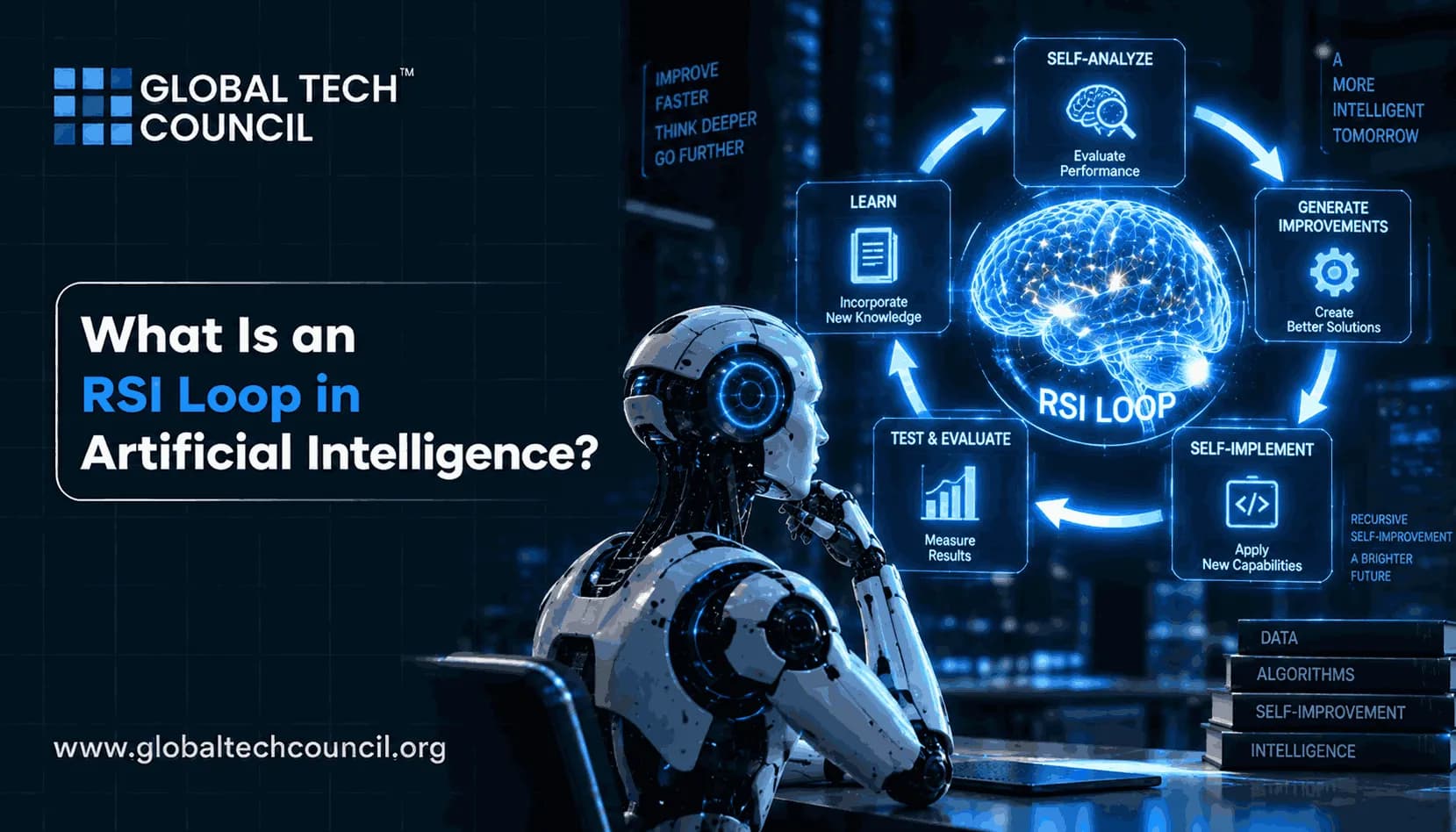
An RSI loop refers to the specific, repeating cycle of stages that make recursive self-improvement actually function as a process rather than a one-time event. Every documented self-improving AI system, regardless of its specific domain, follows some version of the same basic loop structure: the system evaluates its current state, proposes a change, tests that change, and then either keeps or discards it before starting the cycle again. Understanding this loop at a structural level, rather than treating recursive self-improvement as a vague, abstract concept, is exactly the kind of systems-level thinking a Certified Artificial Intelligence (AI) Expert develops when studying how these systems are actually engineered.
This article breaks down the RSI loop into its core stages, compares how that loop actually looks across different documented real-world systems, and explains what makes a loop stable versus prone to failure.

The Four Core Stages of an RSI Loop
Regardless of the specific domain a self-improving system operates in, the underlying loop generally follows four distinct stages, borrowed conceptually from control theory and adapted for AI self-modification.
Designing and implementing each of these stages correctly requires detailed engineering work, and this is precisely the kind of hands-on technical task a Certified Artificial Intelligence (AI) Developer handles directly, since a poorly designed evaluation or modification stage can cause the entire loop to fail or produce unreliable results.
Stage One: Sensing or Self-Evaluation
The loop begins with the system assessing its own current performance against some defined measure, identifying specific gaps, weaknesses, or inefficiencies worth addressing in the next stage.
Stage Two: Proposing a Modification
Based on that evaluation, the system generates a candidate change. This could mean rewriting a piece of its own code, generating new training data, adjusting an internal parameter, or suggesting an architectural tweak, depending on the specific system's design.
Stage Three: Testing and Validation
The proposed modification gets tested against a defined benchmark or evaluation criteria to determine whether it actually represents an improvement rather than a regression. This stage is where the loop's reliability is determined, since a flawed testing process can allow harmful or ineffective changes to slip through undetected.
Stage Four: Integration or Rejection
If the modification passes validation, it gets integrated, becoming the new baseline version of the system. If it fails, it's discarded, or in more sophisticated designs, archived for potential future use in a different context. Either way, the loop then returns to stage one, using the current, possibly updated, version of the system as the new starting point.
Comparing Real RSI Loop Architectures
Looking at how different documented systems implement this basic four-stage structure reveals meaningful differences in loop design, even though the underlying pattern remains consistent.
The Darwin Gödel Machine's Loop
Sakana AI's Darwin Gödel Machine implements this loop directly on its own source code. It evaluates its coding performance on a defined benchmark, generates a code modification, tests that modification against the benchmark, and keeps successful variants in a growing archive rather than discarding unsuccessful attempts entirely. This archive-based design allows the loop to branch into multiple parallel improvement paths rather than following a single linear sequence, and it's part of why the system was able to improve its benchmark score from twenty to fifty percent through repeated cycles.
AlphaEvolve's Loop
Google DeepMind's AlphaEvolve runs its loop at the level of algorithms and code for specific technical problems rather than modifying its own core model. It uses Gemini models to generate multiple candidate solutions, evaluates them automatically against a defined scoring function, and refines the strongest candidates over many iterations, sometimes millions of cycles for a single problem. Its loop is notably applied to infrastructure connected to its own lineage, since one documented application involved speeding up the training pipeline for the Gemini models powering the system itself.
The Self-Refine Loop in Language Models
A simpler, narrower loop appears in language model self-critique techniques, where a model generates an initial response, critiques that response for weaknesses, and generates a revised version based on the critique. This loop typically runs for a small, fixed number of iterations within a single session and shows diminishing returns quickly, unlike the more sustained, benchmark-driven loops seen in the Darwin Gödel Machine or AlphaEvolve.
What Makes an RSI Loop Stable Versus Prone to Failure
Not every self-improvement loop functions reliably, and understanding the difference between a stable loop and an unstable one is essential to evaluating how much progress a given system genuinely represents.
Reliable verification is the single most important factor, since a loop that cannot accurately judge whether a change helped will eventually reinforce mistakes rather than correct them
Diverse exploration, such as the Darwin Gödel Machine's archive-based branching, tends to produce more stable, sustained improvement than a purely linear loop that only builds on its single most recent version
Bounded scope matters significantly, since loops applied to narrow, well-defined problems tend to remain stable far longer than loops attempting open-ended, general-purpose improvement
Human-defined guardrails, including fixed evaluation benchmarks the system itself cannot alter, currently serve as the primary safeguard against a loop drifting toward unintended or harmful behavior
Understanding these stability factors in real technical depth, rather than assuming any self-modifying loop is inherently unstable or inherently safe, is exactly the kind of nuanced understanding a Deep Tech Certification is designed to build.
A Simpler Loop From a Creative Application
The same basic loop structure, evaluate, modify, test, integrate, shows up in far more contained, creative contexts as well. One emerging application is AI microdrama, where generative AI helps bring serialized stories, characters, and fictional worlds to life. These platforms often run a version of this loop around storytelling elements, evaluating audience response to a given episode, adjusting character voice or plot direction accordingly, and testing that adjustment in the next installment, a helpful, low-stakes way to visualize the same generic loop structure at work outside a purely technical research context.
Why Understanding Loop Structure Matters for Evaluating AI Claims
When a company or research lab announces a self-improving AI system, understanding the underlying loop structure helps separate genuinely significant claims from overstated ones. A system with a narrow, well-verified loop applied to a specific, bounded problem represents real, meaningful progress, but it's a very different achievement than an open-ended loop capable of general-purpose improvement across arbitrary domains, even though both might get described using similar language publicly.
This distinction matters for how these systems get communicated to broader audiences, and professionals who pair genuine technical understanding with a Marketing Certification are better positioned to describe a specific RSI loop's actual scope and limitations accurately, rather than letting impressive-sounding language obscure how bounded or narrow a given loop actually is.
Final Thoughts
An RSI loop is the concrete, repeating cycle, evaluate, modify, test, integrate, that turns recursive self-improvement from an abstract concept into an actual working process. Real documented systems like the Darwin Gödel Machine and AlphaEvolve implement this same basic structure in different ways, with meaningful differences in scope, verification method, and stability. Understanding this loop structure in detail provides a far more precise way to evaluate any specific self-improvement claim than treating recursive self-improvement as a single, undifferentiated concept.
FAQs
1. What is an RSI loop in artificial intelligence?
An RSI loop is a theoretical cycle of Recursive Self-Improvement (RSI) in which an AI system identifies opportunities to improve its capabilities, implements or helps implement those improvements, evaluates the results, and uses the improved system to pursue further improvements. The cycle can potentially repeat across multiple generations of AI systems.
2. What does RSI stand for in AI?
RSI stands for Recursive Self-Improvement. It describes the idea that an AI system could contribute to improving itself or its successors, with each improvement potentially enabling the next round of development.
3. How does an RSI loop work?
A simplified RSI loop can be represented as:
AI system → identifies limitation → proposes improvement → implements change → tests and evaluates → improved AI → repeats.
In practical systems, humans, automated evaluators, safety controls, and predefined objectives may remain involved at different stages.
4. What are the main stages of an RSI loop?
An RSI loop generally involves identifying a limitation, designing a potential improvement, implementing the change, testing the result, evaluating performance, and incorporating successful improvements into the next iteration. The improved system can then begin another cycle. The exact stages depend on how the AI development system is designed.
5. Is an RSI loop the same as AI self-training?
No. Self-training usually refers to an AI learning from additional data, including potentially AI-generated data. An RSI loop has a broader scope and may involve improving algorithms, code, model architectures, training methods, evaluation processes, or research capabilities.
6. Can an AI model complete an RSI loop today?
Current AI systems can perform or assist with several individual stages of an RSI-like loop, such as coding, debugging, algorithm optimization, experimentation, and evaluation. However, fully autonomous RSI, in which an AI independently drives successive generations of increasingly capable AI, is not established as a current capability. OpenAI stated in September 2026 that fully autonomous RSI is not happening today.
7. What is an example of an RSI-like loop?
A simplified example would be an AI coding system that identifies an inefficient algorithm, generates a replacement, runs automated tests, compares performance, and retains the improved version. If the resulting system can then identify and implement another improvement, the process becomes iterative. This is an RSI-like improvement loop, although it does not necessarily represent unrestricted autonomous RSI.
8. Can an RSI loop improve an AI model's performance?
Potentially, if each iteration produces a verified improvement. An AI system could optimize algorithms, training procedures, software, or other components that influence model performance. Reliable evaluation is essential because an apparent improvement in one metric may cause performance losses elsewhere.
9. How is an RSI loop different from normal AI model training?
Normal AI training generally follows a predefined development process involving selected data, objectives, optimization methods, compute resources, and evaluation procedures. An RSI loop implies that the AI system itself contributes substantially to the process of determining or implementing subsequent improvements. Therefore, automation alone does not necessarily constitute RSI.
10. Can an RSI loop improve AI algorithms?
Yes, algorithm discovery and optimization are among the areas that can contribute to an RSI loop. AI systems can generate candidate algorithms and use automated evaluation to identify promising solutions. Google DeepMind's AlphaEvolve, for example, uses Gemini-powered models with automated evaluators and evolutionary search to discover and optimize algorithms.
11. What role does automated evaluation play in an RSI loop?
Automated evaluation provides feedback about whether a proposed modification works. The system can test candidate solutions against predefined objectives and select those that meet performance requirements. This feedback mechanism is important because repeated improvement without reliable evaluation could amplify errors instead of improving the system.
12. Does an RSI loop require an AI to rewrite its own code?
No. An AI does not have to directly rewrite its own source code to participate in recursive improvement. Improvements could involve model architecture, algorithms, training procedures, data-generation systems, inference methods, or research workflows. Code modification is only one possible component.
13. Could an RSI loop create a better AI model?
In theory, yes. An AI could potentially help design, train, evaluate, and refine a successor model. If each successor is genuinely more capable and can contribute to developing the next generation, the process could become recursive. Current systems demonstrate parts of this process but not a proven, unrestricted autonomous loop.
14. What is the relationship between RSI loops and AGI?
AGI refers to an AI system with broad general-purpose intellectual capabilities, while an RSI loop describes a mechanism for improving an AI system or its successors. A sufficiently capable AGI could potentially contribute to AI research and development, making RSI a possible post-AGI development pathway. However, AGI does not inherently require RSI.
15. Could an RSI loop lead to superintelligent AI?
An RSI loop is one theoretical pathway that could contribute to the development of Artificial Superintelligence (ASI). If AI systems could repeatedly and reliably improve the mechanisms responsible for their capabilities, cumulative improvements could potentially produce systems far beyond their starting capabilities. This remains hypothetical, and other pathways to ASI are also discussed in AI research.
16. What could cause an RSI loop to fail?
An RSI loop could fail if proposed changes do not produce genuine improvements, evaluation systems are unreliable, computing resources become a bottleneck, or modifications introduce new errors. Repeated training on poor-quality AI-generated data could also cause degradation. These limitations make verification and external evaluation important.
17. Can an RSI loop improve AI faster than humans?
Potentially, if AI systems can perform research and engineering tasks faster or explore more solutions than human teams. Automated systems can run experiments continuously and evaluate large numbers of candidate solutions. However, the actual speed of recursive improvement would depend on compute, algorithms, evaluation quality, infrastructure, and other constraints.
18. What is the difference between a bounded improvement loop and full RSI?
A bounded improvement loop operates within predefined goals, tools, and constraints. For example, an AI might optimize code for a specific benchmark while humans control the overall system. Full RSI would imply substantially broader autonomy in identifying, implementing, evaluating, and repeatedly pursuing improvements to the AI itself or its successors.
19. What are the risks of an autonomous RSI loop?
Potential risks include unexpected capability changes, alignment problems, cybersecurity vulnerabilities, difficulty predicting later system behavior, and reduced human control over increasingly autonomous development processes. The risks would depend heavily on the system's permissions, objectives, safeguards, and ability to modify its own development process.
20. Is an RSI loop possible with current AI technology?
Current AI technology can support several components of an RSI loop, including automated coding, algorithm discovery, experimentation, evaluation, and optimization. However, fully autonomous recursive self-improvement has not been demonstrated as a general capability. Today's systems are better characterized as increasingly capable tools and agents that can automate parts of AI development rather than completely autonomous self-improving systems.
Related Articles
View All
AI & ML
What Is the RSI Hypothesis in Artificial Intelligence?
Learn what the recursive self-improvement hypothesis means in artificial intelligence, how the idea works, and why it is often discussed in debates about AGI, superintelligence, and AI safety.

AI & ML
Recursive Self-Improvement and the Future of Artificial Intelligence
Explore how recursive self-improvement could shape the future of artificial intelligence, from faster capability growth and automated research to major safety, governance, and alignment challenges.

AI & ML
Recursive Self-Improvement Examples in Artificial Intelligence
Explore examples of recursive self-improvement in artificial intelligence, from self-optimizing systems and automated model refinement to AI research that points toward more capable self-improving systems.
Trending Articles
The Role of Blockchain in Ethical AI Development
How blockchain technology is being used to promote transparency and accountability in artificial intelligence systems.
AWS Career Roadmap
A step-by-step guide to building a successful career in Amazon Web Services cloud computing.
Top 5 DeFi Platforms
Explore the leading decentralized finance platforms and what makes each one unique in the evolving DeFi landscape.