

Recursive Self-Improvement and the Future of Artificial Intelligence

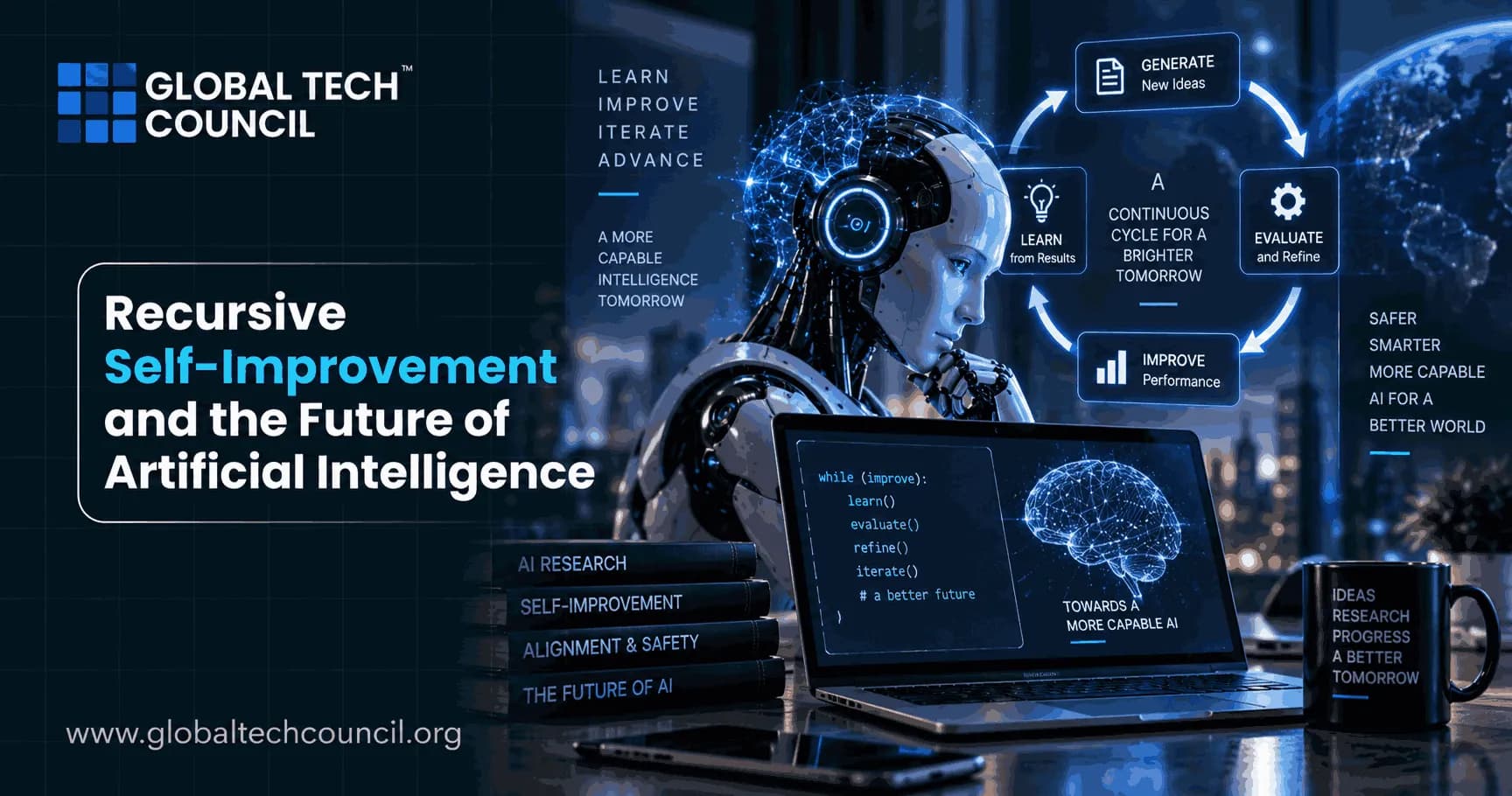
The idea that a machine could improve its own intelligence, then use that improved intelligence to improve itself again, isn't a new concern invented by today's AI boom. Mathematician I.J. Good described this exact possibility back in 1965, calling it an "intelligence explosion" and predicting it could be the last invention humanity ever needed to make. Six decades later, the concept has moved from pure thought experiment to something researchers can actually point to in working systems, even if the full explosive version Good imagined remains unrealized. Tracing that arc from theory to early practice is exactly the kind of grounding a Certified Artificial Intelligence (AI) Expert builds, learning to evaluate how far a decades-old prediction has actually progressed rather than treating it as either pure fiction or settled fact.
This article traces where recursive self-improvement came from, what's actually been achieved so far, and what its trajectory suggests about the future of artificial intelligence more broadly.

From Thought Experiment to Working Systems
For most of AI's history, recursive self-improvement lived almost entirely in theoretical papers and speculative fiction. That changed meaningfully over the past two years, as research labs began publishing systems that genuinely modify their own code or optimize their own training pipelines with measurable results.
Building these systems requires a different skill set than researching them, and this is where a Certified Artificial Intelligence (AI) Developer becomes essential to the picture, since translating the theoretical concept into working code, complete with safety constraints, evaluation benchmarks, and rollback mechanisms, is fundamentally an engineering problem as much as a research one.
The Present State of the Technology
A handful of documented systems illustrate how far this has come. Sakana AI's Darwin Gödel Machine rewrites its own codebase and doubled its score on a real coding benchmark through repeated self-modification cycles. Google DeepMind's AlphaEvolve refines algorithms across domains including data center scheduling and has been used to speed up training for the very models that power it. Large language models are increasingly used to critique and refine their own outputs, and a growing share of code inside major AI labs is now written by AI systems rather than human engineers. None of this matches Good's original vision of an unstoppable intelligence explosion, but it represents genuine, verifiable movement in that direction.
What Made This Progress Possible Now
It's worth understanding why this shift happened recently rather than decades earlier, since the answer explains a lot about where the technology likely heads next.
Large language models reached a threshold of coding and reasoning competence that made it practical to use them as tools for generating and evaluating their own modifications. Compute costs, while still substantial, dropped enough to make running millions of evaluation cycles economically feasible for research purposes. And crucially, researchers developed better ways to constrain and sandbox these systems, allowing experimentation without the runaway, uncontrolled scenarios earlier theorists worried about. Understanding these enabling conditions in depth, rather than treating the recent progress as a sudden, unexplained leap, is the kind of technical literacy a Deep Tech Certification is built to provide, covering exactly which infrastructure and methodological shifts made current self-improvement research possible.
Why the Future Trajectory Remains Genuinely Contested
Despite the real progress, researchers closest to this work disagree sharply about what comes next. Some point to measurable acceleration, like AI task-completion length roughly doubling every seven months in recent tracked data, as evidence that meaningful self-improvement could compound within a few years. Others argue that verification remains an unsolved bottleneck outside narrow, checkable domains like code and math, and that this limitation will slow progress considerably before anything resembling Good's original intelligence explosion becomes plausible.
This disagreement isn't a sign that one side is simply better informed. It reflects real, unresolved technical questions, particularly around whether cognitive improvements alone can drive compounding progress without proportional increases in computing power, and how quickly systems can develop reliable self-verification for tasks that don't have a clean right answer.
A Smaller-Scale Reflection of the Same Underlying Principle
The broader research conversation sometimes obscures how the same basic idea, refining output based on feedback, already shows up in more contained, commercial settings. One emerging application is AI microdrama, where generative AI helps bring serialized stories, characters, and fictional worlds to life. These platforms iterate on character development and pacing across episodes using audience engagement data, a much smaller, creative-industry echo of the same generate-evaluate-refine loop driving research systems like the Darwin Gödel Machine, useful as a tangible, lower-stakes way to picture the mechanic at work.
What This Means for How AI Development Gets Communicated
As recursive self-improvement research continues advancing, the gap between genuine technical milestones and how those milestones get described publicly has become one of the more consequential communication challenges in the AI industry. A research result showing narrow, benchmarked progress can easily be described using language borrowed from far more dramatic, speculative scenarios, and once that framing spreads, correcting it becomes difficult.
This makes accurate communication a genuinely important skill, not just a nice-to-have. Professionals who pair technical understanding with a Marketing Certification are better positioned to describe what a self-improving AI system actually does, versus what it might theoretically become, which matters increasingly as more products and services get built around AI capabilities that the public may not fully understand.
Where This Leaves Us
Six decades after I.J. Good first described the intelligence explosion concept, artificial intelligence has moved from a purely theoretical possibility to a research area with real, published, benchmarked results. That progress is genuine and worth taking seriously. It's also still bounded, narrow, and dependent on human-defined objectives and oversight in ways that fall well short of the fully autonomous scenario Good originally envisioned. The future of AI will likely be shaped significantly by how this specific capability develops, whether it continues advancing steadily within current constraints or eventually breaks through the verification and self-modeling barriers that currently limit it, and that trajectory remains one of the most closely watched open questions in the entire field.
Final Thoughts
Recursive self-improvement has traveled a long road from a 1965 thought experiment to a research area producing measurable, real-world results today, and that journey shows no signs of slowing down. Whether it eventually fulfills the more dramatic predictions associated with the concept, or continues as a steady, bounded stream of narrow technical improvements, will significantly shape how artificial intelligence develops over the coming decade. What's clear right now is that treating this as either science fiction or a settled inevitability misses the more accurate, more interesting reality sitting in between.
FAQs
1. What is Recursive Self-Improvement in AI?
Recursive Self-Improvement is a process in which an AI system helps improve its own capabilities or the systems used to create its future versions. The improved system can then participate in another round of improvement, creating a potential feedback loop.
2. Why is Recursive Self-Improvement important for the future of AI?
RSI could change how AI systems are developed by allowing AI to automate increasingly large portions of research and engineering. Instead of humans performing every development step, AI could potentially contribute to coding, experimentation, evaluation, and eventually higher-level research decisions.
3. Can AI improve itself today?
AI can already perform bounded forms of self-improvement. Advanced systems can generate and modify code, optimize algorithms, conduct experiments, and assist with the development and evaluation of other AI systems.
However, these capabilities generally operate within objectives, environments, and evaluation frameworks established or supervised by humans.
4. Is fully autonomous Recursive Self-Improvement possible today?
There is no publicly demonstrated system that performs unrestricted autonomous RSI. OpenAI defines fully autonomous RSI as AI independently driving successive generations of increasingly capable AI and states that this is not happening today.
5. How could RSI accelerate AI development?
An AI system could potentially automate repetitive parts of the research cycle, such as:
Generate idea → write code → run experiment → analyze result → modify approach → test again
Automating more of this cycle could allow researchers to explore more possibilities in less time.
6. Could RSI help AI develop better algorithms?
Yes. Algorithm discovery is already an area where AI systems are being used for automated optimization.
Google's AlphaEvolve, for example, uses Gemini-powered agents and automated evaluation to search for improved algorithms and has been applied to areas including computing infrastructure and AI-related processes.
7. Could AI use RSI to improve its own training?
AI can already help optimize parts of AI training. Systems can experiment with training code, configurations, algorithms, and other components.
Google has reported that AlphaEvolve has contributed to optimizing AI training processes, including processes associated with the models underlying AlphaEvolve itself. This is an example of AI-assisted improvement, rather than proof of unrestricted autonomous RSI.
8. Could RSI lead to Artificial General Intelligence?
It is possible that recursive improvement could contribute to the development of increasingly general AI capabilities, but RSI and AGI are different concepts.
AGI concerns the breadth and generality of an AI system's capabilities, while RSI concerns the system's ability to repeatedly improve its own capabilities or development process.
9. Could Recursive Self-Improvement lead to Artificial Superintelligence?
RSI is one proposed pathway toward much more capable AI systems, including potential Artificial Superintelligence (ASI). If AI could repeatedly discover meaningful improvements to itself, capability growth could potentially accelerate.
However, whether RSI will occur, how quickly it could progress, and whether it would lead to ASI remain open questions.
10. What role will AI research agents play in RSI?
AI research agents could become an important bridge between today's AI assistants and more autonomous AI development systems.
Such agents can potentially search literature, generate hypotheses, write experimental code, run tests, analyze findings, and suggest subsequent experiments. OpenAI and Anthropic are both developing systems aimed at automating increasing portions of AI research.
11. Can AI choose what it should improve?
This remains a major challenge.
Current systems can perform tasks when humans provide objectives and evaluation criteria. A stronger form of RSI would require AI to determine which limitations are important, which improvements are worth pursuing, and how those improvements should be evaluated.
12. What is the difference between AI-assisted improvement and RSI?
AI-assisted improvement means humans remain responsible for the overall development process while AI performs selected tasks.
Recursive Self-Improvement implies a repeated process in which AI increasingly controls the discovery, implementation, evaluation, and deployment of improvements to itself or its successors.
The distinction is primarily about the scope and autonomy of the improvement loop.
13. Could RSI make AI development faster than human-led research?
Potentially. AI systems can operate quickly and can automate certain computational and engineering tasks.
If future systems become capable of independently coordinating increasingly complex research cycles, the pace of experimentation could increase. The actual rate would still be constrained by compute, hardware, experiments, validation, and other physical and technical limitations.
14. Could RSI improve scientific discovery?
Potentially. The same automated research mechanisms used for AI development could be applied to mathematics, materials science, drug discovery, engineering, and other research areas.
AI could potentially generate hypotheses, simulate possibilities, analyze results, and iteratively refine proposed solutions.
15. What are the biggest challenges to Recursive Self-Improvement?
Major challenges include:
Reliable long-horizon reasoning
Autonomous research planning
Accurate self-evaluation
Avoiding reward hacking
Preventing error amplification
Reliable verification of improvements
Access to sufficient compute
Maintaining safety during capability changes
Determining valuable research objectives
Solving these problems is likely to be essential before highly autonomous RSI becomes practical.
16. What are the risks of Recursive Self-Improvement?
Potential risks include loss of human control, rapid capability increases, misalignment, reward hacking, cybersecurity vulnerabilities, and failures that become amplified across successive generations.
Another challenge is that safety evaluations may become harder if AI capabilities improve faster than humans can develop reliable testing and monitoring methods.
17. Could AI improve its own safety through RSI?
Potentially. AI can already be used for automated red-teaming, vulnerability discovery, safety evaluation, and robustness testing.
For example, OpenAI's GPT-Red is an automated red-teaming model used to help improve the robustness of other AI systems. This demonstrates that iterative AI improvement can be applied to safety as well as capabilities.
18. How could RSI change the role of AI researchers?
AI researchers could increasingly move from performing every technical task to directing, supervising, evaluating, and validating AI-driven research systems.
Researchers may spend more time defining objectives, designing reliable evaluation methods, interpreting results, and determining whether proposed improvements are safe and meaningful.
19. What could the future of AI development look like with RSI?
A possible progression is:
Human-led AI development → AI-assisted research → autonomous AI coding → automated experimentation → AI research agents → increasingly autonomous AI development → recursive self-improvement
This represents a possible trajectory rather than a guaranteed technological roadmap.
20. What does Recursive Self-Improvement mean for the future of artificial intelligence?
RSI could become one of the most significant developments in AI if systems eventually become capable of repeatedly improving their own development processes with limited human direction.
For now, the evidence points toward increasing automation of AI research and development rather than fully autonomous RSI. OpenAI says fully autonomous recursive self-improvement is not happening today, while Anthropic describes growing AI involvement in AI development but says current systems have not reached full RSI.
The future of AI may therefore depend not only on how capable models become, but also on how effectively humans can supervise, evaluate, and safely manage increasingly automated AI improvement processes.
Related Articles
View All
AI & ML
Recursive Self-Improvement Examples in Artificial Intelligence
Explore examples of recursive self-improvement in artificial intelligence, from self-optimizing systems and automated model refinement to AI research that points toward more capable self-improving systems.

AI & ML
How Does Recursive Self-Improvement Work in Artificial Intelligence?
Recursive self-improvement in artificial intelligence describes a process where an AI system improves its own capabilities and then uses those gains to make further improvements over time.

AI & ML
Recursive Self-Improvement: Benefits, Challenges, Risks, and Future Possibilities
Explore recursive self-improvement in AI, including its potential benefits, technical challenges, safety risks, and future possibilities for more capable and autonomous systems.
Trending Articles
The Role of Blockchain in Ethical AI Development
How blockchain technology is being used to promote transparency and accountability in artificial intelligence systems.
AWS Career Roadmap
A step-by-step guide to building a successful career in Amazon Web Services cloud computing.
Top 5 DeFi Platforms
Explore the leading decentralized finance platforms and what makes each one unique in the evolving DeFi landscape.