

Can ChatGPT Improve Itself? Understanding RSI in LLMs
 Suyash Raizada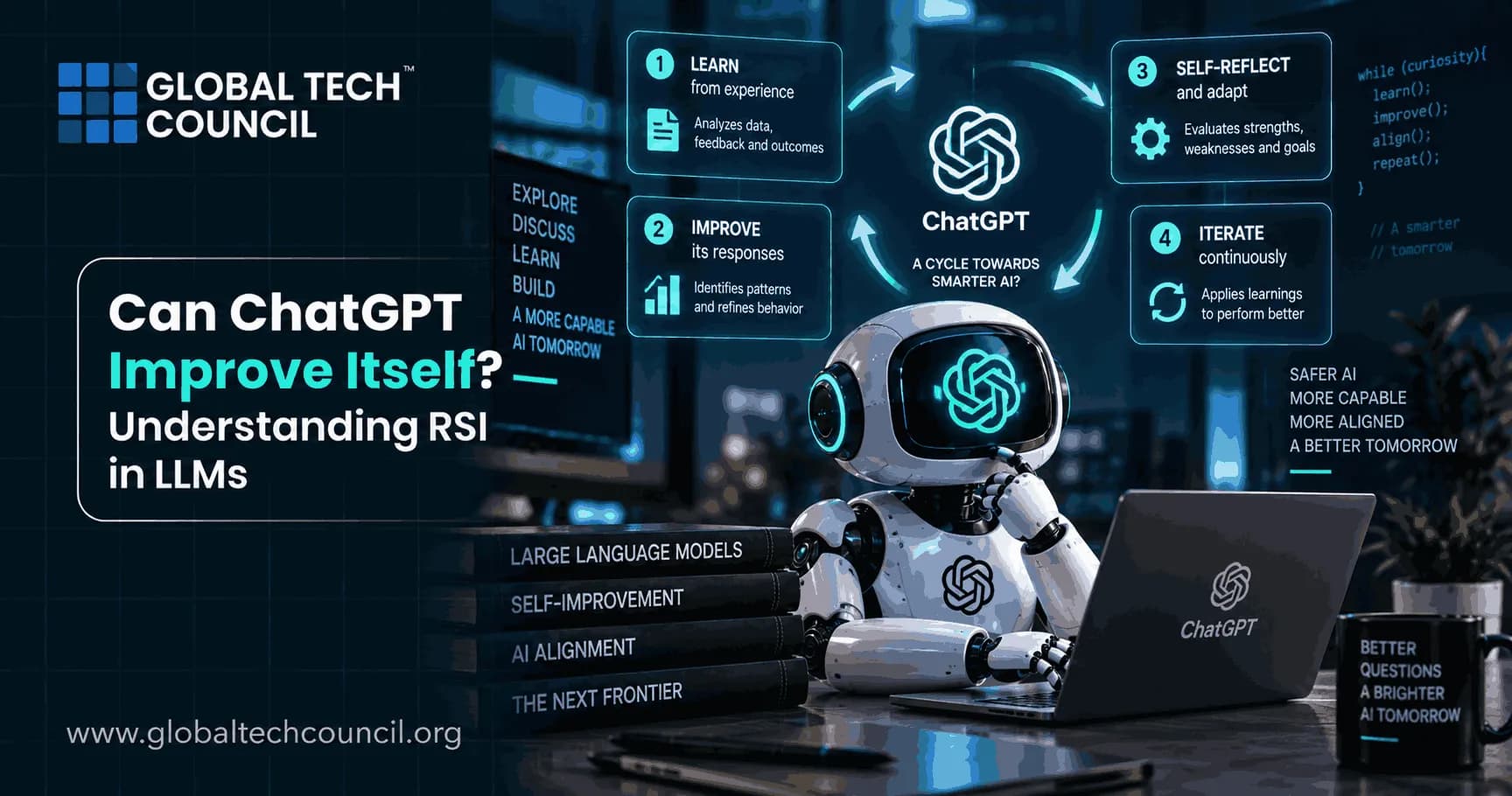
ChatGPT is the AI system most people interact with directly, which makes it the natural starting point when someone asks whether AI can really improve itself. The honest, specific answer requires separating a few very different things: what happens inside a single conversation, what happens when OpenAI trains a new version, and what recursive self-improvement actually means as a technical concept. Conflating these is where most confusion comes from, and untangling it accurately is exactly the kind of skill professionals build through a Certified ChatGPT Expert credential, which covers how the underlying system actually functions rather than relying on assumptions from casual daily use.
This article breaks down what ChatGPT can and can't do in terms of self-improvement, what OpenAI has actually claimed about AI-assisted model development, and where the real boundary between today's reality and full recursive self-improvement sits.

What Happens Inside a Single ChatGPT Conversation
Within any individual conversation, ChatGPT does not modify its own underlying model. It has no ability to change its own weights, retrain itself, or permanently alter how it responds to future users based on that one conversation. What it can do is use the context of the ongoing conversation, including its own earlier responses, to refine or correct its answers as the discussion continues, sometimes described loosely as the model "improving" its response.
This distinction, between adjusting a response within a session versus genuinely modifying the underlying system, is foundational to understanding recursive self-improvement correctly. It's the kind of nuance a Certified Artificial Intelligence (AI) Expert learns to explain clearly, since public confusion between temporary, in-context adjustment and permanent self-modification is one of the most common misunderstandings around AI capability.
What Happens Between ChatGPT Versions
The actual improvement between one ChatGPT version and the next comes from a structured training process involving human researchers, curated data, and extensive evaluation, not the model spontaneously upgrading itself. That said, AI increasingly plays a supporting role in this process in ways worth understanding specifically.
How AI Assists in Training Newer Versions
Newer models are sometimes trained partly using synthetic data generated by earlier model versions, a technique called recursive self-training
AI-based evaluation systems increasingly help score and filter training examples at a scale human reviewers alone couldn't manage
OpenAI has described newer coding models as having played a role in developing their own successors, with earlier versions reportedly assisting in debugging parts of the training process
Despite this AI assistance, human researchers still define training objectives, curate final datasets, and approve each model version before public release
Is This Recursive Self-Improvement?
Based on the strict technical definition researchers use, no, not yet, at least not in the fully autonomous sense. Genuine recursive self-improvement would require a system to identify its own weaknesses, redesign its own architecture or training approach, and validate the results independently, all without a human defining the objective or approving the outcome. What's happening with ChatGPT and similar models today is something narrower: AI-assisted training, where AI tools help humans build better models faster, but humans remain firmly in control of the process's direction and validation.
This is a meaningful distinction, not just a technicality. A system that generates useful training data under human direction is fundamentally different from a system that decides for itself what "better" means and pursues that goal independently.
Where Real Self-Modification Has Been Demonstrated Elsewhere
While ChatGPT itself doesn't rewrite its own code, other research systems have gotten closer to that specific capability. Sakana AI's Darwin Gödel Machine, for example, genuinely rewrites parts of its own codebase and improved its own coding benchmark score from twenty percent to fifty percent through repeated self-modification. That system operates very differently from a conversational assistant like ChatGPT, since it's specifically designed as a research tool for exploring self-modifying code within tightly controlled boundaries, rather than a general-purpose product used by millions of people daily.
Understanding exactly why this distinction matters, and where the deeper technical boundaries between AI-assisted training and true architectural self-modification actually sit, is the kind of depth a Deep Tech Certification is designed to build, going beyond product-level familiarity into the underlying research concepts these headlines are often based on.
A Creative Parallel Worth Knowing About
The core idea behind AI refining its own output over time, useful for understanding self-training concepts, shows up in far more contained, creative applications as well. One emerging application is AI microdrama, where generative AI helps bring serialized stories, characters, and fictional worlds to life. These platforms often adjust character consistency and pacing across episodes based on audience response, a smaller-scale, narrative-focused example of the same generate-and-refine principle underlying more technical self-training methods, minus any of the architectural self-modification associated with genuine recursive self-improvement research.
Why Getting This Right Matters for How AI Gets Described Publicly
Claims about AI "improving itself" tend to generate outsized attention, which creates real pressure to describe ordinary AI-assisted engineering progress using far more dramatic language than it deserves. This has consequences beyond accuracy alone, since businesses and the public increasingly make decisions based on how AI capability gets communicated.
Professionals who pair genuine technical understanding with a Marketing Certification are better equipped to describe developments like AI-assisted model training honestly, distinguishing real progress from inflated framing, which builds far more durable trust than claims that later need walking back once the underlying reality becomes clearer.
Final Thoughts
ChatGPT cannot modify its own underlying model, and it doesn't achieve recursive self-improvement in the technical sense researchers use. What it does benefit from is a training process where AI increasingly assists human researchers through synthetic data generation and automated evaluation, a genuine and important development, but one that remains firmly human-directed rather than autonomous. Understanding this distinction clearly is the difference between an accurate picture of where LLM development actually stands and an exaggerated one borrowed from far more speculative research scenarios.
FAQs
1. Can ChatGPT improve itself?
Not in the full recursive sense. ChatGPT can generate suggestions, code, experiments, and analyses that humans or automated development systems can use to improve future AI models, but ChatGPT does not independently rewrite its underlying model weights and deploy a more capable version of itself during a conversation.
2. What is Recursive Self-Improvement in LLMs?
Recursive Self-Improvement (RSI) describes a feedback loop in which an AI system helps improve its own capabilities or the systems used to create its successors, after which the improved system participates in another improvement cycle.
A simplified loop is:
LLM → identifies improvement → implements change → evaluates result → improved LLM → repeats
3. Does ChatGPT learn from every conversation?
Not in the sense of immediately retraining its underlying model after every conversation. A response generated during a conversation does not automatically rewrite the model's parameters.
Model improvement occurs through separate development, training, evaluation, and deployment processes.
4. Can ChatGPT modify its own model weights?
No, ordinary ChatGPT interaction does not give the model direct control over its underlying parameters or the ability to independently retrain and redeploy itself.
It can generate code or recommendations for model development, but that is different from directly modifying the neural network that produces its responses.
5. Can ChatGPT write code that improves an AI model?
Yes. Advanced LLMs can write, debug, and optimize machine-learning code within suitable environments.
OpenAI's GPT-5.6 evaluations specifically test capabilities such as kernel optimization, debugging research experiments, and improving a small language-model training setup.
6. Can an LLM train another LLM?
An LLM can potentially generate code, training data, evaluations, or research ideas that contribute to training another model. However, the complete training process normally involves infrastructure, datasets, compute resources, evaluation systems, and human or organizational oversight.
This is better described as AI-assisted model development unless the AI controls a substantially autonomous improvement loop.
7. What evidence shows that LLMs are getting closer to self-improvement?
OpenAI's GPT-5.6 evaluation suite includes tasks involving internal research debugging, kernel optimization, LLM pretraining optimization, and other AI-development activities. OpenAI reports a higher aggregate RSI Index for GPT-5.6 Sol than GPT-5.5, indicating progress on its selected self-improvement evaluations.
However, benchmark progress should not be interpreted as proof that the model has achieved autonomous RSI.
8. What is the difference between ChatGPT improving and RSI?
There are several levels of improvement:
Level 1: ChatGPT improves an answer during a conversation.
Level 2: ChatGPT generates better code or research ideas.
Level 3: AI agents perform AI-development tasks.
Level 4: AI controls substantial parts of the AI research and development loop.
Level 5: AI independently creates increasingly capable successors and repeatedly uses them for further improvement.
The fifth level is the stronger meaning of recursive self-improvement.
9. Can ChatGPT identify problems in AI research?
Yes. One of OpenAI's GPT-5.6 evaluations specifically tests whether models can identify and resolve bugs in real internal AI research experiments. GPT-5.6 Sol scored 68.3% on OpenAI's reported Internal Research Debugging Evaluation.
This demonstrates useful AI research capability, but it remains an evaluation of a specific task rather than proof of autonomous AI research.
10. Can ChatGPT optimize an AI's training process?
Within a controlled environment, yes. OpenAI's NanoGPT evaluation gives a model a small language-model training setup and asks it to modify training code, tune hyperparameters, diagnose bottlenecks, and reach a target validation performance efficiently.
This is an important component of AI self-improvement because improving training processes can contribute to better future models.
11. Can ChatGPT improve another model?
AI systems can be evaluated on tasks involving improving other models or components of AI systems. OpenAI's broader self-improvement evaluations are designed to measure capabilities such as debugging research systems, optimizing kernels and training recipes, and improving AI-development processes.
But helping improve another model is not automatically recursive self-improvement.
12. Is ChatGPT already recursively self-improving?
No. OpenAI explicitly states that fully autonomous recursive self-improvement, in which AI systems independently drive successive generations of increasingly capable AI, is not happening today. OpenAI instead describes current AI as accelerating parts of the research used to develop and align future models.
13. Can ChatGPT become better during a conversation?
It can adapt its responses based on the conversation's context, corrections, and instructions. This can look like learning because later responses may incorporate information established earlier.
However, contextual adaptation is not the same as permanently changing the model's underlying parameters.
14. What would ChatGPT need to achieve true RSI?
A stronger RSI system would need to reliably perform a much broader loop:
Identify its limitations → choose valuable improvements → modify its development process → run experiments → evaluate results → train or construct an improved successor → validate the successor → repeat
It would also need sufficient compute, access to development infrastructure, reliable evaluation, and safeguards.
15. What prevents current LLMs from fully improving themselves?
Important limitations include:
Reliable long-horizon planning
Choosing worthwhile research objectives
Accurate self-evaluation
Reliable experimental validation
Access to training infrastructure
Avoiding reward hacking
Preventing errors from propagating
Maintaining safety during capability improvements
These limitations mean that current LLMs can perform pieces of the loop without independently controlling the entire process.
16. Could LLMs eventually become recursively self-improving?
It is a possibility being actively researched, but there is no established timetable. OpenAI describes automated AI researchers working under human supervision as an important direction while explicitly distinguishing that work from fully autonomous RSI.
Therefore, it is more accurate to discuss RSI as a potential future capability rather than an established property of today's ChatGPT.
17. Does AI-generated training data count as self-improvement?
It can be part of a self-improvement process, but not necessarily RSI. An AI might generate synthetic examples that are subsequently used to train another model.
For this to become recursive self-improvement, the broader system would need to repeatedly use its own improvements to generate and validate further improvements.
18. Could recursive self-improvement make LLMs improve faster?
Potentially. If an AI system becomes increasingly capable of discovering better algorithms, training methods, or research techniques, each improvement could make subsequent development more efficient.
This is the central idea behind a potential positive feedback loop:
Better AI → better AI research → better training → better AI → further AI research
Whether such a loop can become sufficiently autonomous and reliable remains an open question.
19. What are the risks of recursive self-improvement in LLMs?
Potential risks include rapid capability growth, loss of human control, misalignment, unreliable self-evaluation, reward hacking, cybersecurity vulnerabilities, and difficulty verifying increasingly capable successors.
This is why OpenAI emphasizes maintaining meaningful human control and developing safety standards before pursuing fully autonomous RSI.
20. Can ChatGPT improve itself, and how close is it to RSI?
ChatGPT can contribute to AI improvement, but it does not currently autonomously and recursively improve its own underlying model.
The current state is better described as:
ChatGPT → assists with coding and research → AI agents automate experiments → AI helps improve AI-development processes → increasingly automated AI research → potential future RSI
OpenAI's GPT-5.6 results show that LLMs are becoming substantially more capable at AI self-improvement tasks, including research debugging, optimization, and training-related work. At the same time, OpenAI explicitly says fully autonomous RSI is not happening today.
The key distinction is therefore capability versus autonomy: an LLM can increasingly help humans improve AI without yet being an autonomous system that repeatedly creates and deploys increasingly capable versions of itself.
Related Articles
View All
AI & ML
Can Gemini Improve Itself? Google’s AI and Recursive Self-Improvement
Explore whether Google Gemini can improve itself, how DeepMind is developing self-improving AI systems, and what separates current capabilities from true recursive self-improvement.
AI & ML
How Close Are We to AI That Can Improve Itself?
Explore how close today’s AI systems are to improving themselves, what progress has been made in automated AI research, and what technical and safety barriers still stand in the way of true recursive self-improvement.

AI & ML
Can AI Improve Its Own Code? The Role of Code-Generating AI in RSI
Explore whether AI can improve its own code, how code-generating models support software optimization, and what role automated coding could play in recursive self-improvement.
Trending Articles
The Role of Blockchain in Ethical AI Development
How blockchain technology is being used to promote transparency and accountability in artificial intelligence systems.
AWS Career Roadmap
A step-by-step guide to building a successful career in Amazon Web Services cloud computing.
Top 5 DeFi Platforms
Explore the leading decentralized finance platforms and what makes each one unique in the evolving DeFi landscape.