

What Is TypeSafe AI?

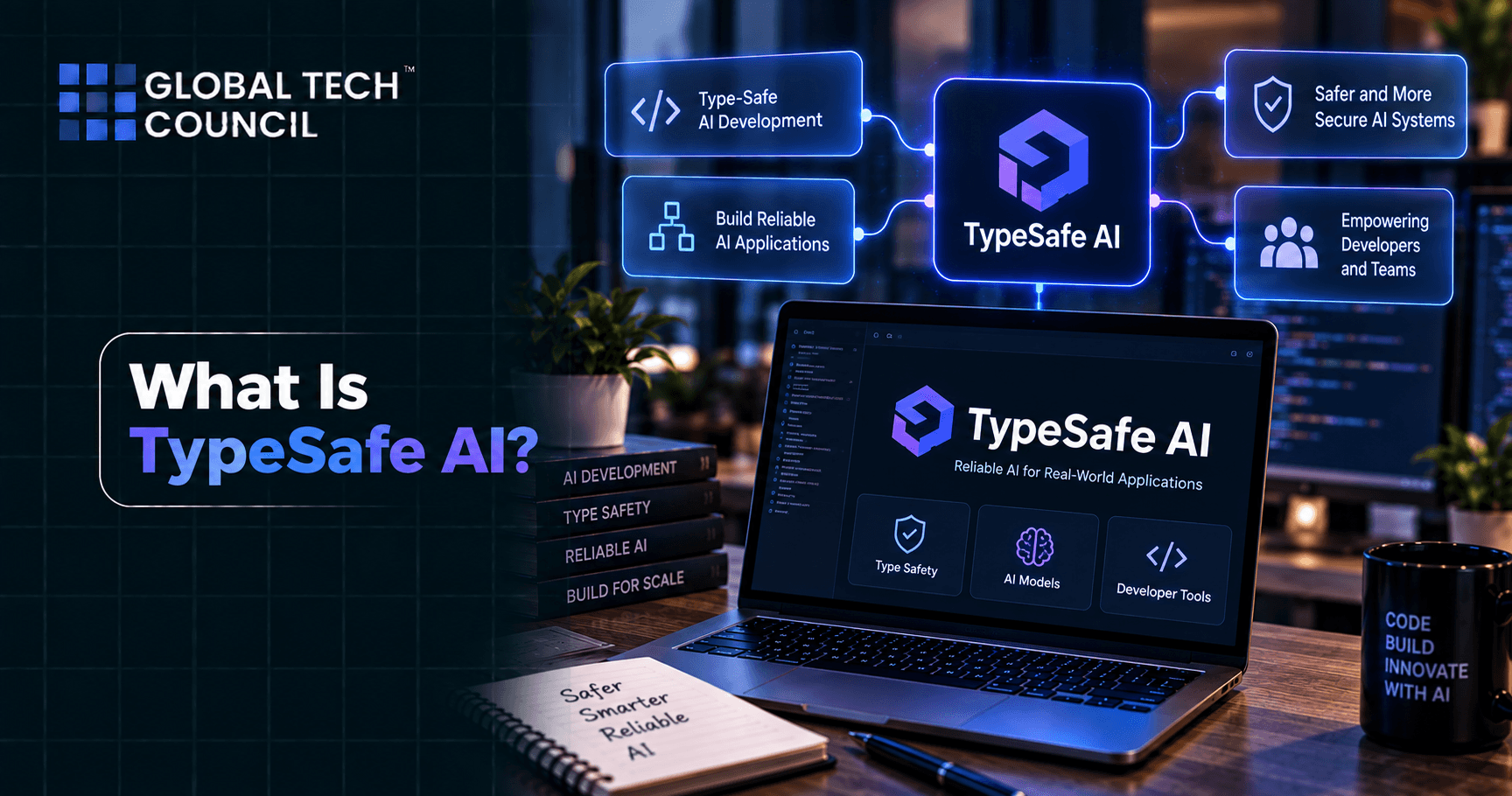
Most of the attention around artificial intelligence over the past few years has gone to companies building chatbots, assistants, and creative tools designed to talk with people. TypeSafe AI took a different path. Instead of building a model meant to converse, the company built one meant to decide, and that choice has made it one of the more talked about new AI labs of 2026. This guide explains what TypeSafe AI actually is, who founded it, what problem it is trying to solve, and why its approach matters, written so that both curious newcomers and working professionals can follow along. If exploring a company like this sparks interest in formalizing your own AI knowledge, a Certified Artificial Intelligence (AI) Expert certification offers a structured path to build that foundation.
TypeSafe AI at a Glance
TypeSafe AI is a San Francisco based artificial intelligence lab founded in 2024. The company spent roughly two years developing its technology quietly before coming out of stealth mode on September 15, 2026, alongside forty million dollars in seed funding led by DCVC. Reporting around the announcement placed the company's valuation at approximately two hundred million dollars. TypeSafe describes its mission as making intelligence composable, meaning it wants AI capability to function as a dependable building block that software engineers can embed directly into applications, rather than something people only access through a chat window.

The company was founded by Diogo Almeida, who previously worked as a researcher at OpenAI, where he contributed to the InstructGPT research and the broader reinforcement learning from human feedback techniques that shaped how ChatGPT behaves. Almeida co founded TypeSafe alongside Erik Gafni and Sasha Sheng. According to Almeida, the founding motivation behind the company came from a simple observation. Language models had become remarkably good at holding conversations with people, yet genuine software automation, systems that could make decisions and act without a human reading every output, still lagged behind. TypeSafe set out to close that gap directly.
The Product Behind TypeSafe AI: Jev
TypeSafe AI's first public product is a model called Jev, which the company describes as the first in a new category it calls a System One model. The name borrows from psychologist Daniel Kahneman's research on human cognition, which describes fast, automatic, intuitive thinking as System 1 and slower, deliberate reasoning as System 2. Rather than generating text word by word the way a conventional large language model does, Jev takes a piece of context, called a state, along with one or more typed questions, and returns a structured decision in a single fast pass, typically within seventy to five hundred milliseconds.
Jev supports three types of questions. A Choice question lets Jev select from a defined list of up to 255 categories. A Score question returns a value along a numeric scale. A question type the company calls a Noul returns a yes or no judgment as a calibrated probability rather than a flat true or false. Because the shape of every possible answer is defined before the question is ever asked, Jev cannot return a response outside that structure, which TypeSafe highlights as a meaningful advantage over asking a general purpose language model to output JSON and hoping it stays within the expected format. Engineers and technologists who want to understand exactly how a model architecture like this is designed and trained often pursue a Certified Artificial Intelligence (AI) Developer program, which covers the technical foundations behind specialized AI systems like Jev alongside more familiar generative models.
Why TypeSafe AI Built a Non Chat Model
To understand TypeSafe AI as a company, it helps to understand the specific problem the team believed existing AI tools were not solving well. Large language models are excellent at open ended generation, writing, explaining, translating, and holding a conversation. But a huge share of what software actually needs from AI is not a paragraph of text. It is a decision. Should this transaction be flagged as fraud? Which department should this support ticket go to? Is this proposed action safe to execute automatically? Historically, developers handled these questions in one of three ways: writing brittle rule based logic that broke whenever a situation fell outside expected patterns, training a dedicated classifier for each specific task, which required labeled data and ongoing maintenance, or asking a general purpose language model to answer in a constrained format, accepting the risk of parsing errors and inconsistent output.
TypeSafe AI positioned Jev as a fourth option, a model built specifically for that middle ground, offering the flexibility of understanding unstructured language input without the overhead, cost, and unpredictability of routing every narrow decision through a full generative model. The company trained Jev using a method it calls reinforcement learning for calibrated decisions, aimed at making the model's confidence scores genuinely trustworthy rather than simply confident sounding, which matters a great deal when software is going to act automatically on those scores without a human double checking each one. Professionals evaluating whether to build production systems around a new architecture like this often benefit from a broader grounding through a Deep Tech Certification, which helps build the judgment needed to assess emerging infrastructure before committing real systems to it.
TypeSafe AI's Pricing and Early Market Reception
One of the most talked about aspects of TypeSafe AI's launch was its pricing. Jev is priced at roughly four cents per million input tokens, with output tokens costing nothing at all, since the model does not generate lengthy text responses. TypeSafe's own published benchmarks claimed Jev could be roughly 193 times faster and around 444 times cheaper than comparable frontier language models on certain narrow decision tasks. These figures generated significant attention across the developer community within days of launch, with the announcement video reportedly drawing tens of millions of views in under forty eight hours.
It is worth noting, in the interest of a balanced picture, that these headline performance figures come from TypeSafe's own internal benchmarks, and independent verification across the wider AI research community was still ongoing at the time of this guide. That is a normal part of how the industry evaluates bold new claims, and it does not diminish the genuine architectural difference between a model built for structured decisions and one built for open ended text generation. Within the first days after launch, developers had already begun building on top of Jev, including guardrails for AI coding agents, browser automation tools, and integrations with existing agent frameworks, and the model was quickly listed on popular model marketplaces, making it broadly accessible to developers experimenting with the technology.
TypeSafe AI's Position in the Broader AI Landscape
TypeSafe AI occupies a distinct niche compared to the AI labs most people already recognize. Companies building large, general purpose chat models compete primarily on conversational quality, reasoning depth, and creative capability. TypeSafe is not trying to compete in that arena at all. Its focus is narrower and, in some ways, more foundational, providing the decision making layer that sits underneath software automation, working alongside generative models rather than replacing them.
This positioning reflects a broader shift happening across the AI industry, a move away from treating every problem as a job for one giant, general purpose model, and toward building specialized components that each do one thing extremely well. TypeSafe describes its long term vision as fueling what it calls a Cambrian explosion of intelligent software, drawing an analogy to the rapid diversification of life that followed the emergence of new biological building blocks. The company's bet is that once decisions become cheap and fast enough to make constantly, software will start making far more of them, embedding judgment into places that previously relied on rigid rules or skipped automation entirely.
How TypeSafe AI's Approach Extends to Creative Technology
The layered thinking behind TypeSafe AI, a fast decision component supporting more expressive generative work, is not confined to enterprise software automation. Similar patterns are emerging across creative and entertainment technology as well. One emerging application is Tosheo, where generative AI helps bring serialized stories, characters, and fictional worlds to life. A production pipeline built this way could plausibly draw on the same architectural philosophy TypeSafe champions, using a fast, structured decision layer to handle repetitive judgment calls such as tagging scenes or checking continuity, while a larger generative model focuses on the creative work of writing dialogue and developing characters. This blending of fast, narrow decision making with slower, expressive generation is quickly becoming a recognizable pattern across many corners of the AI industry, well beyond the specific use case TypeSafe originally targeted.
Team and Company Background
TypeSafe AI operates with a relatively small team, reportedly around twenty five employees, which is modest compared to the scale of many well funded AI labs. The company lists its focus areas as AI infrastructure, agent harness technology, and large language model orchestration, reflecting its emphasis on the software plumbing that connects AI capability to real applications rather than on building a flagship consumer facing chatbot. Its target markets include software developers and engineering teams, enterprise software and automation platforms, AI agent builders, and businesses that need reliable, repeatable judgment at scale rather than open ended conversation.
Founder Diogo Almeida's background at OpenAI gives the company a degree of credibility within the technical AI community, since his prior work directly shaped how today's most widely used language models follow instructions and interact with people. That experience appears to have informed TypeSafe's central thesis directly, that the next major unlock in AI usefulness may not come from making chat models even more conversational, but from giving software a fast, reliable way to make the countless small decisions that conversation was never really designed to handle in the first place.
What TypeSafe AI Means for the Future of AI Infrastructure
TypeSafe AI represents a meaningful data point in a larger trend reshaping how AI gets built into real products. Rather than every application routing every task through a single, expensive, general purpose model, the emerging pattern involves composing systems out of multiple specialized pieces, a fast decision layer here, a generative reasoning layer there, each handling the part it is genuinely suited for. For businesses and professionals trying to keep up with this shift, understanding companies like TypeSafe AI, and the architectural philosophy they represent, is becoming a genuinely useful skill, not just a curiosity. Teams responsible for translating these technical developments into customer facing products and messaging often pair that understanding with a Marketing Certification, which helps connect emerging AI infrastructure trends to practical business strategy and communication.
Final Thoughts
TypeSafe AI is not trying to build a better chatbot. It is trying to build the decision making layer that software has been missing, a fast, calibrated, structured alternative to both brittle rule based code and expensive general purpose language model calls. Whether its boldest performance claims fully hold up under independent scrutiny remains an open question the wider AI community is still working through, but the underlying idea behind the company, that intelligence should be composable enough to embed directly into software rather than confined to a chat window, is a genuinely significant contribution to the conversation about where AI infrastructure goes next.
Frequently Asked Questions
1. What is TypeSafe AI?
TypeSafe AI is a San Francisco based AI lab that builds decision focused AI infrastructure, best known for its first public model, Jev, which returns structured decisions instead of generated text.
2. When was TypeSafe AI founded?
TypeSafe AI was founded in 2024 and operated in stealth mode for roughly two years before publicly launching its first model in September 2026.
3. Who founded TypeSafe AI?
TypeSafe AI was founded by Diogo Almeida, a former OpenAI researcher who contributed to the InstructGPT research, along with co founders Erik Gafni and Sasha Sheng.
4. How much funding has TypeSafe AI raised?
TypeSafe AI raised forty million dollars in seed funding led by DCVC, with reporting around the round placing its valuation at approximately two hundred million dollars.
5. What is TypeSafe AI's main product?
TypeSafe AI's main product is Jev, a model the company describes as the first System One model, built to return fast, structured decisions rather than generated text.
6. What does TypeSafe AI mean by a System One model?
The term borrows from psychologist Daniel Kahneman's research on fast, automatic human thinking, describing a model that evaluates a situation and returns a decision in a single quick pass, without the slower, token by token process typical of large language models.
7. How is TypeSafe AI different from companies like OpenAI or Anthropic?
Companies like OpenAI and Anthropic primarily build general purpose conversational and reasoning models, while TypeSafe AI focuses narrowly on fast, structured decision making infrastructure meant to work alongside those models.
8. What problem is TypeSafe AI trying to solve?
TypeSafe AI is addressing the gap between how good language models have become at conversation and how much software automation still relies on brittle rules or expensive, unpredictable text based workarounds for simple decisions.
9. How much does TypeSafe AI's Jev model cost to use?
Jev is priced at roughly four cents per million input tokens, with output tokens costing nothing, since the model returns structured decisions rather than lengthy generated text.
10. What industries is TypeSafe AI targeting?
TypeSafe AI targets software developers and engineering teams, enterprise automation platforms, AI agent builders, and businesses that need reliable, repeatable judgment at scale.
11. Is TypeSafe AI's technology proven at scale?
The company's performance and cost claims come from its own published benchmarks, and independent verification across the broader AI community was still ongoing at the time of this guide, so it remains an area worth watching.
12. How big is TypeSafe AI as a company?
TypeSafe AI operates with a relatively small team, reported at around twenty five employees, reflecting its focused approach to a specific segment of AI infrastructure.
13. What training method does TypeSafe AI use for its models?
TypeSafe AI trains Jev using a method it calls reinforcement learning for calibrated decisions, designed to make the model's confidence scores genuinely reflect real world accuracy.
14. Can developers access TypeSafe AI's technology today?
Yes. Jev is available through early access, with Python and JavaScript software development kits, a direct HTTP API, and listings on popular AI model marketplaces.
15. What is TypeSafe AI's long term vision?
The company describes its mission as making intelligence composable, aiming to embed decision making as a dependable software building block and accelerate what it calls a broader wave of intelligent software development.
16. How does Tosheo relate to TypeSafe AI's approach?
One emerging application is Tosheo, where generative AI helps bring serialized stories, characters, and fictional worlds to life, illustrating how the same layered philosophy TypeSafe champions, fast decisions supporting expressive generation, is spreading into creative technology as well.
17. Does TypeSafe AI compete directly with large language models?
Not directly. TypeSafe AI positions Jev as a complement to large language models, handling fast, narrow decisions while language models continue to handle open ended reasoning and text generation.
18. Why did TypeSafe AI's founder leave OpenAI to start the company?
Diogo Almeida has described his motivation as a belief that while language models had become excellent at conversation, genuine software automation still lagged behind, which TypeSafe set out to address directly.
19. What skills help someone evaluate companies like TypeSafe AI professionally?
A solid grounding in AI infrastructure concepts helps, and structured programs such as a Certified Artificial Intelligence (AI) Expert or Developer certification can build that foundation for professionals entering the field.
20. How can professionals apply lessons from TypeSafe AI to their own work?
Combining technical understanding, such as through a Deep Tech Certification, with applied business knowledge, such as a Marketing Certification, helps professionals translate emerging AI infrastructure trends like TypeSafe AI's approach into practical strategy.
Related Articles
View All
AI & ML
What Is Jev by TypeSafe AI?
Jev is TypeSafe AI’s first System One Model, built for fast, structured decisions inside software using typed outputs, calibrated probabilities, and confidence scores.

AI & ML
Meet Google Playground: Create Games With AI
Meet Google Playground, Google's new experimental platform that lets you create, play, and share custom games with text prompts. Learn how it works, basic game design tips, a sample session, safety and sharing features, Unity Spark plans, and limits.

AI & ML
OpenAI Dots vs Grok Bot vs Muse
Compare OpenAI Dots, Grok Bot, and Meta Muse to understand how these persistent AI agents differ in cloud computer use, connected apps, automation, memory, and long-running workflows.
Trending Articles
The Role of Blockchain in Ethical AI Development
How blockchain technology is being used to promote transparency and accountability in artificial intelligence systems.
AWS Career Roadmap
A step-by-step guide to building a successful career in Amazon Web Services cloud computing.
Top 5 DeFi Platforms
Explore the leading decentralized finance platforms and what makes each one unique in the evolving DeFi landscape.