

Comparison: Robot Process Automation vs Artificial Intelligence
 Toshendra Sharma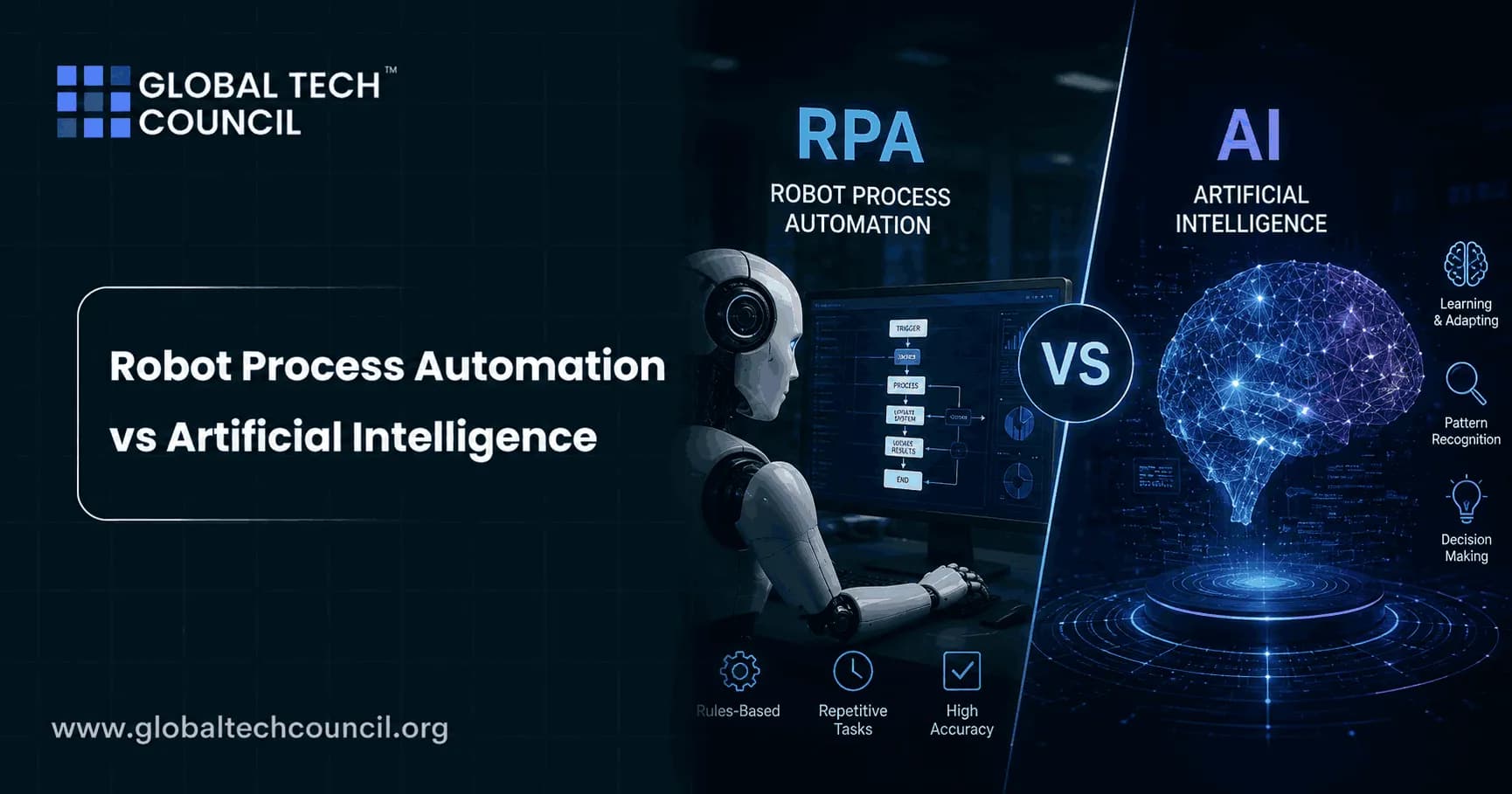
Robotic Process Automation and Artificial Intelligence get used almost interchangeably in vendor marketing, but they solve fundamentally different problems and require different decisions about budget, team structure, and risk tolerance. That confusion has only grown as automation platforms increasingly blend both technologies together. The global RPA market alone reached roughly 28.31 billion dollars in 2025 and is projected to hit 247.34 billion dollars by 2035, while the broader hyperautomation software market, combining RPA, AI, and agentic systems, is on pace to reach nearly 1.04 trillion dollars in 2026. Understanding exactly where RPA ends and AI begins is essential for making a genuinely informed automation decision. A Certified Artificial Intelligence (AI) Expert credential provides exactly the technical grounding needed to evaluate these technologies clearly rather than relying on vendor buzzwords.
What Is Robotic Process Automation?
Robotic Process Automation uses software bots to execute repetitive, rule-based digital tasks by mimicking the exact clicks, keystrokes, and data entry a human would perform inside existing applications. RPA excels at structured, predictable work: invoice processing, form filling, and data transfer between systems, typically achieving around 95 percent reliability when the input data is clean and consistent. This reliability comes with a real constraint, however. RPA bots follow explicit, pre-programmed rules rather than reasoning about context, which means they struggle badly the moment they encounter something unexpected, an email with an unusual attachment, a vendor portal that changes its layout, or a contract with handwritten notes. Industry estimates suggest RPA systems still require human intervention roughly 70 percent of the time when they hit this kind of exception handling, since the bot has no genuine ability to interpret ambiguity on its own.

What Is Artificial Intelligence?
Artificial Intelligence, particularly in its modern agentic form, takes a fundamentally different approach. Rather than following fixed, pre-programmed steps, AI systems analyze data, understand unstructured information, and make contextual decisions based on reasoning rather than rigid rules. A modern AI agent given a task like resolving a customer billing dispute can read an email thread, interpret an attached invoice PDF, check chat history, query multiple backend systems, calculate a fair resolution, and update records, chaining together reasoning and tool use across a genuinely ambiguous, multi-step problem. This capability comes from a different technical foundation entirely, large language models and machine learning systems trained to interpret meaning and context rather than execute a fixed script. Building and deploying these reasoning-driven systems properly is precisely what a Certified Artificial Intelligence (AI) Developer credential is designed to teach, moving from theoretical understanding into the applied skill of actually building agentic AI systems.
Key Differences Between RPA and AI
The practical distinction comes down to a few core factors. RPA operates on fixed rules and struggles the moment a process deviates from its expected pattern, while AI reasons through ambiguity and adapts to context it has never seen before in exactly that form. RPA requires structured, predictable input data to perform reliably, while AI can work directly with unstructured information like emails, images, and free-form documents. RPA bots execute a task exactly as instructed, while AI agents can independently plan multi-step tasks, coordinate across several applications, and decide which workflow to execute in the first place based on context and priority. Industry benchmarks from 2026 show agentic automation outperforming traditional RPA by 25 to 60 percent in overall task coverage, with meaningfully fewer errors on the kind of judgment-dependent work RPA was never designed to handle. Evaluating these trade-offs accurately for a specific business process, rather than assuming newer automatically means better for every use case, is exactly the kind of applied evaluation skill a Deep Tech Certification in enterprise automation and AI systems is built to develop.
Why the Two Are Increasingly Used Together
Despite AI's growing capabilities, RPA is not disappearing, it is becoming one component inside a larger hyperautomation strategy rather than a standalone solution. Organizations increasingly combine RPA's reliable, deterministic execution with AI's reasoning and decision-making, letting AI agents handle judgment calls, interpret documents, and plan a workflow, while RPA bots execute the well-defined, repetitive steps within that plan. This hybrid approach reportedly boosts overall automation depth by 30 to 50 percent compared to either technology deployed alone. Major RPA vendors have moved decisively in this direction, with UiPath launching an enterprise-grade agentic automation platform in 2025 specifically designed to unify AI agents, RPA bots, and human workers on a single coordinated system, while platforms like Salesforce Agentforce and Microsoft Copilot Studio have brought similar agentic decision-making into the mainstream enterprise stack.
Robotics & Innovation
Robotics provides students with an opportunity to understand how programming, engineering, automation, and logical thinking work together. Technology competitions such as a Tech Olympiad can encourage students to explore robotics and innovation while developing their ability to approach technical challenges creatively.
Which One Does Your Business Actually Need?
The right choice depends entirely on the specific problem being automated. Pure RPA remains a strong, cost-effective fit for high-volume, structured, rule-based processes where inputs are consistent and exceptions are rare, invoice matching, ticket routing, and standard data entry are all still well suited to traditional bots. AI and agentic automation become genuinely necessary the moment a process involves ambiguity, unstructured data, or decisions that require real contextual judgment rather than a fixed rule. For most enterprises in 2026, the realistic answer is not choosing one over the other, but architecting a coordinated stack where each technology handles the part of the workflow it is actually best suited for. As this hybrid approach becomes the industry default, businesses increasingly need people who can explain the difference between RPA and AI clearly to stakeholders deciding where to invest, which is exactly where pairing technical automation knowledge with a Marketing Certification becomes genuinely valuable, helping professionals translate a complex technical trade-off into a clear business case leadership can actually act on.
Conclusion
Robotic Process Automation and Artificial Intelligence are not competing replacements for one another, they are complementary technologies solving different halves of the same automation problem. RPA delivers reliable, low-cost execution for structured, repetitive work, while AI brings the reasoning and adaptability needed for ambiguous, judgment-heavy tasks that rule-based bots were never built to handle. With the hyperautomation market approaching a trillion dollars in 2026 and major vendors actively merging both technologies into unified platforms, the organizations gaining the most ground are the ones treating RPA and AI as partners in a single strategy, not as a choice between old and new automation.
FAQs
1. What is the difference between RPA and artificial intelligence?
Robotic Process Automation (RPA) is primarily designed to automate structured, repetitive, rule-based tasks, while Artificial Intelligence (AI) enables systems to analyze information, recognize patterns, make predictions, and support decisions. RPA generally follows predefined instructions, whereas AI can handle more complex and variable situations.
2. What is Robotic Process Automation (RPA)?
RPA is a technology that uses software bots to perform repetitive digital tasks by interacting with applications and systems. Common examples include copying information between systems, processing invoices, generating reports, updating records, and moving data between applications.
3. What is Artificial Intelligence (AI)?
Artificial Intelligence refers to technologies that enable computer systems to perform tasks that typically require human-like capabilities, such as understanding language, recognizing images, learning from data, identifying patterns, and making predictions or decisions.
4. How does RPA work?
RPA bots follow predefined workflows and rules to complete specific tasks. For example, a bot can retrieve information from an email, enter it into a business application, validate specific fields, and update another system without requiring a person to perform each step manually.
5. How does AI work?
AI systems use algorithms and, in many cases, machine-learning models to analyze data and identify patterns. Depending on the application, AI can use these patterns to classify information, generate content, make predictions, understand language, or support decisions.
6. Is RPA the same as AI?
No. RPA and AI are related but different technologies. Traditional RPA follows predefined rules and workflows, while AI can learn patterns from data and deal with less predictable inputs. However, RPA and AI can be combined to create more intelligent automation solutions.
7. Which is better: RPA or AI?
Neither technology is universally better because they solve different problems. RPA is well suited to repetitive, predictable, rule-based processes, while AI is more appropriate for tasks involving unstructured data, prediction, classification, natural language, or complex pattern recognition.
8. Can RPA and AI work together?
Yes. Combining RPA with AI can create intelligent automation. For example, AI can read and classify information from an unstructured document, while an RPA bot can use the extracted information to update business systems or trigger a predefined workflow.
9. What types of tasks are best suited for RPA?
RPA works particularly well for repetitive, high-volume, rule-based tasks with predictable inputs and outputs. Examples include data entry, invoice processing, report generation, system-to-system data transfer, employee onboarding workflows, and routine administrative processes.
10. What types of tasks are best suited for AI?
AI is useful for tasks that require pattern recognition, prediction, language understanding, image analysis, classification, recommendations, or generation of new content. Examples include fraud detection, customer-service assistants, demand forecasting, medical-image analysis, and personalized recommendations.
11. Does RPA require machine learning?
Traditional RPA does not require machine learning. RPA bots can perform tasks using predefined rules and workflows. However, organizations can integrate machine learning and other AI technologies with RPA when automation needs to handle variable or unstructured information.
12. Can AI replace RPA?
AI does not necessarily replace RPA. In many business environments, the technologies can complement each other. AI can handle interpretation and decision-support tasks, while RPA can execute repetitive actions across existing software systems.
13. What are the main benefits of RPA?
RPA can reduce repetitive manual work, improve process consistency, speed up routine operations, reduce data-entry errors, and allow employees to focus on higher-value activities. It can also automate processes without requiring major changes to existing applications in some cases.
14. What are the main benefits of AI?
AI can help organizations analyze large datasets, identify patterns, automate complex tasks, generate insights, improve forecasting, personalize services, and support decision-making. Its usefulness depends heavily on data quality, appropriate model design, and effective human oversight.
15. What are the limitations of RPA?
RPA can struggle when processes change frequently, inputs are highly unstructured, or tasks require significant judgment. Bots generally depend on clearly defined workflows, so poorly designed or frequently changing processes can require ongoing maintenance.
16. What are the limitations of AI?
AI systems can produce incorrect or unreliable outputs, reflect biases present in their data, require significant computing and data resources, and sometimes be difficult to interpret. Organizations therefore need appropriate testing, monitoring, governance, security, and human oversight.
17. Which is easier to implement, RPA or AI?
RPA can be relatively straightforward to implement when an organization has stable, well-defined processes. AI projects can require more extensive data preparation, model development, testing, infrastructure, and specialized expertise, particularly for complex applications.
18. How do RPA and AI affect jobs?
Both technologies can automate portions of existing jobs rather than simply eliminating entire occupations. RPA often automates repetitive administrative activities, while AI can automate or assist with more analytical and cognitive tasks. Employees may increasingly focus on judgment, creativity, relationship management, and strategic work.
19. What is intelligent automation?
Intelligent automation combines technologies such as RPA, AI, machine learning, natural language processing, and document-processing tools to automate workflows that involve both repetitive execution and interpretation. It allows organizations to automate processes that traditional RPA alone may not be able to handle effectively.
20. Should businesses use RPA, AI, or both?
The right choice depends on the business problem. RPA is a strong option for repetitive and rule-based processes, AI is useful for data-driven and complex cognitive tasks, and combining both can be effective when a workflow requires AI-based interpretation followed by automated execution.
Related Articles
View All
Artificial Intelligence
How Can Blockchains Transform Artificial Intelligence?
Blockchain can complement artificial intelligence by providing tamper-resistant records, decentralized identity, data provenance, and programmable smart contracts. Together, the technologies can support auditable AI workflows, secure data sharing, decentralized AI marketplaces, and clearer tracking of models and digital assets. The combination has potential, although scalability, privacy, governance, and integration remain significant challenges.

Artificial Intelligence
How Artificial Intelligence Can Shape the Future of Transportation?
Artificial intelligence can shape the future of transportation through autonomous vehicles, smarter traffic management, predictive maintenance, route optimization, and safer mobility systems. AI can also help public transit agencies analyze real-time data, improve scheduling, reduce congestion, and make transportation networks more efficient and responsive.
Artificial Intelligence
Artificial Intelligence in Food Technology
Artificial intelligence in food technology helps improve food quality, safety, production, and supply-chain efficiency. AI applications include automated inspection, contamination detection, predictive maintenance, demand forecasting, product development, precision processing, and food waste reduction, helping manufacturers make faster, data-driven decisions.
Trending Articles
The Role of Blockchain in Ethical AI Development
How blockchain technology is being used to promote transparency and accountability in artificial intelligence systems.
AWS Career Roadmap
A step-by-step guide to building a successful career in Amazon Web Services cloud computing.
Top 5 DeFi Platforms
Explore the leading decentralized finance platforms and what makes each one unique in the evolving DeFi landscape.