

Introducing Claude Fable 5 and Claude Mythos 5
 Suyash Raizada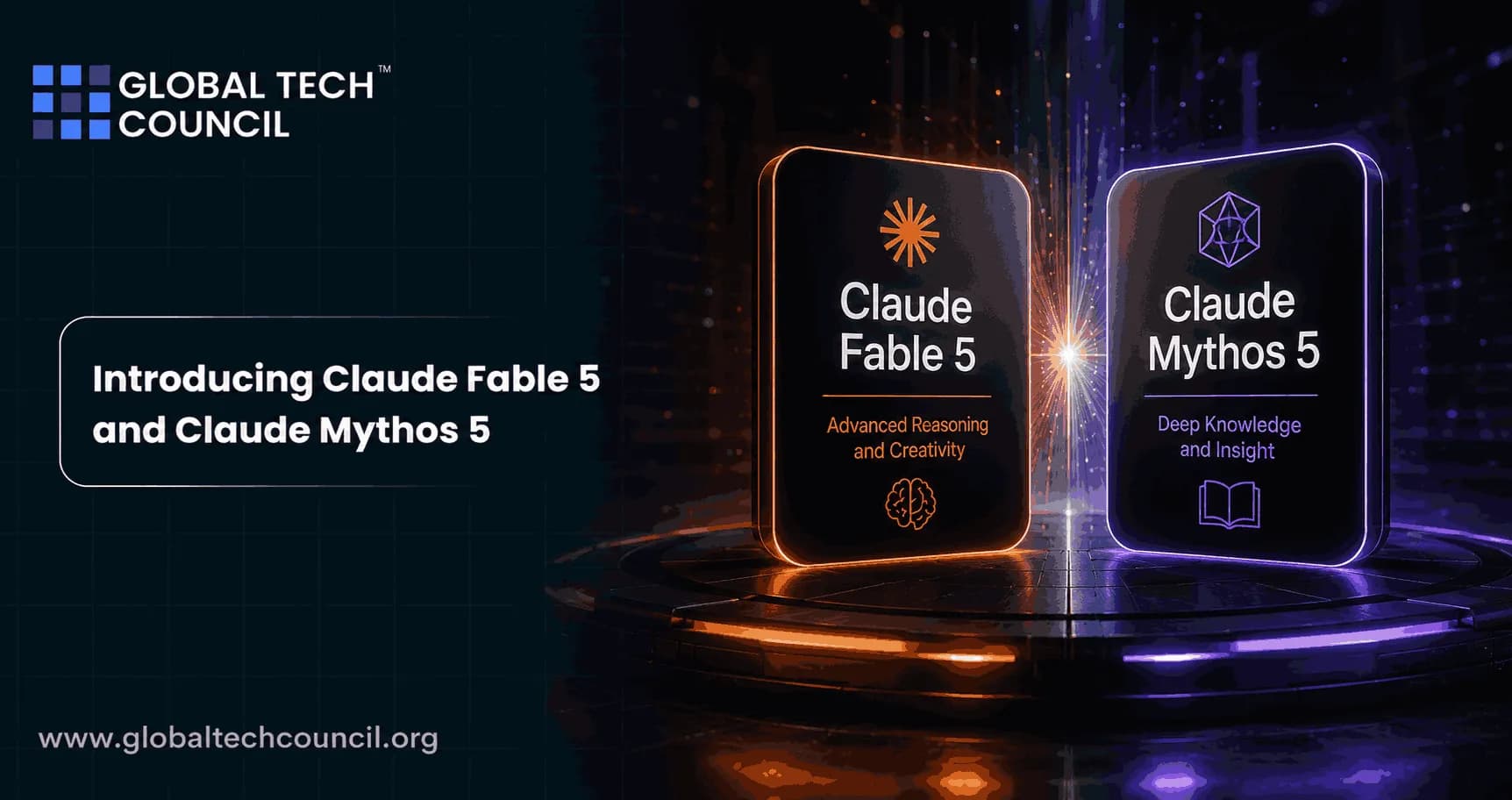
Introduction
On June 9, 2026, Anthropic crossed a threshold that many in the AI industry had been watching closely. Furthermore, the announcement was not simply a new model release, it was the first time a Mythos-class AI system became available to the general public in any form. Claude Fable 5 and Claude Mythos 5 represent the most capable models Anthropic has ever built, sitting in an entirely new tier above the Opus class in capability. Consequently, for developers, researchers, enterprise teams, and AI professionals, understanding what these models deliver and how they differ from each other is now essential knowledge. This guide covers every dimension of the launch: capabilities, safety architecture, pricing, access pathways, benchmark performance, and the broader context of what these models mean for the future of AI.
The New Mythos-Class Tier
Before examining Claude Fable 5 and Claude Mythos 5 individually, it is important to understand the new model category they define. Anthropic has introduced a tier called Mythos-class models that sit above the Opus class in capability. This is the first new capability tier Anthropic has added above Opus since the Claude 3 generation introduced the Opus, Sonnet, and Haiku naming structure in March 2024.

The Mythos-class designation reflects a qualitative difference in what these models can do not just incremental benchmark improvements, but capabilities in software engineering, scientific research, long-horizon agentic work, vision, and memory that exceed what any previously available Claude model could achieve. The longer and more complex the task, the greater the performance advantage these models demonstrate over Opus-class predecessors.
The existence of a Mythos model first became publicly known on March 26, 2026, through leaked blog post drafts. Anthropic formally introduced Claude Mythos Preview in April 2026 releasing it exclusively to a small group of cybersecurity defenders and critical infrastructure providers through a program called Project Glasswing. Concerns about the model's advanced cybersecurity capabilities led Anthropic to hold back general availability while developing robust safety systems. The June 9, 2026 announcement of Claude Fable 5 and Claude Mythos 5 completes that arc delivering Mythos-class capability to a much wider audience through a carefully engineered safety architecture.
Claude Fable 5: The Publicly Available Mythos-Class Model
What Is Claude Fable 5?
Claude Fable 5 is Anthropic's most capable widely released model. According to Anthropic's official announcement, it is state-of-the-art on nearly all tested benchmarks of AI capability, showing exceptional performance in software engineering, knowledge work, vision, scientific research, and many other areas. The longer and more complex the task, the larger its lead over previous Claude models becomes.
Fable 5 is the publicly accessible version of the Mythos-class family. It carries the same underlying model architecture as Claude Mythos 5, but with an additional layer of safety classifiers that automatically route certain high-risk query categories to Claude Opus 4.8 instead of responding directly. This architecture allows Anthropic to make Mythos-level intelligence broadly available while preventing the most dangerous capability areas from being accessible without proper vetting.
Software Engineering Capabilities
Claude Fable 5's software engineering performance is the most extensively documented capability area from early testing. Stripe reported that Fable 5 compressed months of engineering work into days. In a 50-million-line Ruby codebase, the model performed a codebase-wide migration in a single data task that would have taken a full team over two months working manually. On Cognition's FrontierCode evaluation which tests whether models can pass difficult coding tasks while meeting the standards of high-quality production codebases Fable 5 scored highest among all frontier models tested, even at medium effort levels. Cursor's CEO described it as the state-of-the-art model on CursorBench, opening up a class of long-horizon problems that were previously out of reach. GitHub's Chief Product Officer noted that it took on complex, long-horizon coding tasks with a level of autonomy and reliability that exceeded previous benchmarks.
Knowledge Work Performance
On Hebbia's Finance Benchmark for senior-level reasoning, Fable 5 achieved the highest score of any model tested with substantial gains in document-based reasoning, chart and table interpretation, and problem solving. IMC noted that the model aced their trading-analysis evaluations across the board, including factual lookup, conceptual reasoning, root-cause analysis, and expected-value analysis. Harvey reported that in blind review, lawyers found Fable 5's legal redlines matched or beat their current model every time. One analytics firm reported that Fable 5 was the first model to break 90% on their core benchmark of complex, long-running analytical tasks, a 10-point jump over Opus with strong judgment and attention to nuance on the hardest questions.
Vision Capabilities
Claude Fable 5 is described as the new state-of-the-art model for vision-related tasks. It extracts precise numerical values from detailed scientific figures and performs complex vision tasks such as rebuilding a complete web application's source code from screenshots alone. Earlier Claude models required complex helper harnesses with additional navigation tools to play video games; Fable 5 completed Pokémon FireRed using only raw game screenshots with no maps, navigation aids, or extra game-state information.
Memory and Long-Context Performance
Claude Fable 5 and Claude Mythos 5 support a one-million-token context window by default and up to 128,000 output tokens per request. Fable 5 maintains focused, accurate performance across millions of tokens during long-running tasks and actively improves its outputs using its own internally generated notes. When evaluated on the deck-building game Slay the Spire with access to persistent file-based memory, Fable 5 benefited three times more from that memory than Opus 4.8 did under the same conditions. The model also reached the game's final act three times more frequently.
Claude Mythos 5: The Restricted Research-Grade Model
What Is Claude Mythos 5?
Claude Mythos 5 shares the same underlying model as Claude Fable 5, the same architecture, training, and capabilities but without the safety classifiers that constrain Fable 5's responses in high-risk domains. This means Mythos 5 operates with the full scope of Mythos-class capability, including unrestricted access to its advanced cybersecurity skills.
Mythos 5 is described by Anthropic as having the strongest cybersecurity capabilities of any model in the world. It is not generally available. Access is offered in limited availability to approved customers through Project Glasswing, in collaboration with the US government, as an upgrade to the original Claude Mythos Preview released in April 2026.
Project Glasswing and Access Requirements
Project Glasswing is Anthropic's program for deploying Mythos-class models responsibly to organizations with legitimate, vetted use cases in cybersecurity and critical infrastructure protection. The program operates under formal oversight and applies mandatory 30-day data retention requirements for safety monitoring. Mythos 5 is initially deployed through Project Glasswing as a direct upgrade to Mythos Preview. Anthropic has stated its intention to expand access through a broader trusted access program in the months following launch. Organizations seeking access contact their Anthropic, AWS, or Google Cloud account teams directly.
Life Sciences Research Capabilities
Mythos 5's capabilities extend well beyond cybersecurity into the life sciences. Anthropic's internal protein design experts used the model to accelerate aspects of the drug design process by approximately ten times. In a controlled evaluation, Mythos 5 with protein design and bioinformatics tools but no human assistance matched or exceeded skilled human operators on protein design tasks. The model independently chose binding sites, selected and ran protein design tools, and recovered from failures without human intervention. Nine out of 14 protein targets in this study yielded strong drug design candidates currently under investigation.
Mythos 5 is also Anthropic's first model to consistently generate novel, compelling scientific hypotheses. In blinded comparisons against Opus-class models, Anthropic's scientists preferred Mythos 5's molecular biology hypotheses approximately 80% of the time. One hypothesis - a novel mechanism for an E. coli protein was independently corroborated by a separate laboratory working on the same problem.
Additionally, Mythos 5 conducted novel genomics research over more than a week of largely autonomous work. It assembled single-cell data for millions of cells spanning 138 animal species and trained a custom machine learning model that outperformed a recently published model in the journal Science while being 100 times smaller in parameter count.
Safety Architecture: How Fable 5's Classifiers Work
The Safety Classifier System
The safety architecture distinguishing Claude Fable 5 from Claude Mythos 5 is a set of separate AI systems called classifiers. These classifiers run alongside the main model and detect potential misuse including jailbreak attempts in real time. When a classifier detects a request in a covered risk category, Fable 5 does not respond directly. Instead, the query is automatically routed to Claude Opus 4.8, which handles it. Users are informed whenever this fallback occurs.
This architecture means users receive a high-quality response in all cases a capable Opus 4.8 answer rather than an outright refusal. Anthropic's early data indicates that more than 95% of Fable 5 sessions involve no fallback at all. For those sessions, Fable 5's performance is effectively identical to Mythos 5's.
Covered Risk Categories
The classifiers cover three primary risk domains:
Cybersecurity: Mythos-class models excel at discovering and exploiting software vulnerabilities and performing multi-stage agentic hacking tasks including reconnaissance, discovery, lateral movement, and exploitation. The cybersecurity classifiers cover both specific exploitation requests and offensive cyber tasks more broadly.
Biology and Chemistry: Advanced capabilities in molecular biology, protein design, and chemical synthesis create dual-use risks. The classifiers cover queries in these domains where the information could provide uplift to malicious actors pursuing biological or chemical weapon development.
Distillation: Technical processes involving the concentration or extraction of dangerous materials are covered by a separate distillation classifier category.
Safeguard Trade-offs and False Positives
Anthropic has acknowledged that the classifiers are deliberately tuned conservatively at launch. This means some benign requests will trigger a fallback to Opus 4.8, a trade-off Anthropic accepts in order to prioritize safety during the initial deployment period. The company has committed to reducing false positives through ongoing refinement after launch and to improving safeguards as more capable models arrive in the coming months.
Pricing for Claude Fable 5 and Claude Mythos 5
Claude Fable 5 and Claude Mythos 5 are priced at $10 per million input tokens and $50 per million output tokens. This pricing applies to both models equally, regardless of whether users access the full Mythos 5 capability or the classifier-protected Fable 5 version.
This price point represents less than half the cost of Claude Mythos Preview, the limited-access version released in April 2026. At $10 input and $50 output per million tokens, both models are priced at exactly twice the cost of Claude Opus 4.8, reflecting the step-change in capability they represent.
There is no additional charge for long-context usage. Requests using the full one-million-token context window are billed at the same per-token rate as shorter requests. This is consistent with Anthropic's stated policy of eliminating long-context surcharges across its model family. The knowledge cutoff date for both models is January 2026.
Subscription Plan Availability
For users on Claude subscription plans, Fable 5 is available in a staged rollout:
Through June 22, 2026: Fable 5 is included on Pro ($20/month), Max ($100/month), Team, and seat-based Enterprise plans at no extra cost.
From June 23, 2026: Fable 5 will be removed from these subscription plans. Using it after this date will require usage credits until Anthropic has sufficient capacity to restore it as a standard included model.
Future restoration: Anthropic has stated its intention to restore Fable 5 as a standard part of subscription plans as quickly as capacity allows, with advance communication of any changes.
For API and consumption-based Enterprise plans, Fable 5 is fully available from June 9, 2026, at the standard $10/$50 per million token pricing with no staged rollout constraint.
Platform Availability
Claude Fable 5 is generally available across:
Claude API - directly from Anthropic
Claude.ai - the consumer chat interface
Claude Code - both web and CLI interfaces
Claude Cowork - the desktop collaboration tool
Claude Platform on AWS - available in North America, South America, Europe, and Asia Pacific
Amazon Bedrock - US East (N. Virginia) and Europe (Stockholm) at launch, with additional regions to follow
Google Cloud Vertex AI
Microsoft Azure Foundry
Claude Mythos 5 is not generally available. It is accessible exclusively through Project Glasswing to approved organizations. Organizations seeking Mythos 5 access should contact their Anthropic, AWS, or Google Cloud account team.
Both Claude Fable 5 and Claude Mythos 5 are designated Covered Models, which means they carry mandatory 30-day data retention requirements and are not available under zero data retention agreements.
Early Customer Feedback
Organizations with early access conducted independent evaluations. Stripe reported months of engineering compressed into days on a 50-million-line codebase migration. Replit noted that apps requiring 100 prompts a year ago can now be one-shotted. Cognition called Fable 5 the highest-scoring model on FrontierBench with particular strength on long-horizon reasoning. A physics research firm reported that Fable 5 reached near-GPT-5.5-level results on frontier physics research in 36 hours while using a third of the reasoning tokens. On spreadsheet tasks, one firm reported Fable 5 finished runs 25-30% faster than Opus 4.8 at every effort level.
What Claude Fable 5 and Claude Mythos 5 Mean for AI Professionals
The launch of Claude Fable 5 and Claude Mythos 5 marks the beginning of a new capability era in commercial AI. For professionals who build with, manage, or advise on AI systems, understanding these models at a structural level not just their feature list is now a meaningful professional differentiator.
For professionals across the broader technology ecosystem developers, architects, cloud engineers, and IT leaders who deploy AI models on AWS, Google Cloud, Azure, and direct API verified credentials signal technical competence in a field where the capability frontier has now moved to Mythos-class systems. A Tech Certification builds that recognized expertise across the technology domains directly relevant to deploying Claude Fable 5 and Claude Mythos 5 in production environments.
Professionals who pursue a Claude AI Expert certification develop the platform-specific technical knowledge needed to deploy Claude models effectively including understanding the classifier architecture that distinguishes Fable 5 from Mythos 5, structuring long-context prompts for the one-million-token window, and integrating these models into production agentic workflows with appropriate safety considerations.
Furthermore, as Mythos-class models introduce genuinely novel risks alongside their capabilities including advanced cybersecurity uplift and autonomous scientific research, understanding the foundational principles of AI safety, alignment assessment, and responsible deployment becomes a professional baseline. An AI Certification equips professionals with the structural technical grounding to evaluate these systems critically, assess safety architectures like Fable 5's classifier system, and make informed deployment decisions at the enterprise level.
Finally, for marketing professionals, growth strategists, and commercial teams leveraging Fable 5's document reasoning, content generation, and knowledge work capabilities to drive campaign performance and audience engagement, a Marketing Certification provides the strategic framework to connect these AI capabilities to measurable commercial outcomes turning Fable 5's exceptional performance in long-horizon analytical tasks into structured marketing workflows and measurable campaign results.
FAQs
What are Claude Fable 5 and Claude Mythos 5?
Claude Fable 5 and Claude Mythos 5 are Anthropic's most capable AI models, representing the first generation of Mythos-class models, a new tier above the Opus class in capability. Both were launched on June 9, 2026. Fable 5 is broadly available with safety classifiers. Mythos 5 is the same model without those classifiers, available only through Project Glasswing to approved organizations.
When were Claude Fable 5 and Claude Mythos 5 released?
Both models launched on June 9, 2026. Claude Mythos Preview, the predecessor to Mythos 5, had been available in restricted form since April 2026 through Project Glasswing.
What is the Mythos-class model tier?
Mythos-class models are a new category in Anthropic's model family that sits above the Opus class in capability. This is the first capability tier Anthropic has added above Opus since the Claude 3 generation introduced the Opus, Sonnet, and Haiku naming structure in March 2024.
How are Claude Fable 5 and Claude Mythos 5 different from each other?
Both models share the same underlying architecture and training. The difference is that Fable 5 includes safety classifiers that automatically route certain high-risk query categories to Claude Opus 4.8, while Mythos 5 operates without those classifiers. Mythos 5 is not generally available.
What does Claude Fable 5 cost?
Fable 5 is priced at $10 per million input tokens and $50 per million output tokens, less than half the price of Claude Mythos Preview. This represents twice the cost of Claude Opus 4.8.
What does Claude Mythos 5 cost?
Mythos 5 carries the same pricing as Fable 5 $10 per million input tokens and $50 per million output tokens. Access requires approval through Project Glasswing.
Is Claude Fable 5 available on subscription plans?
Yes, through June 22, 2026, Fable 5 is included on Pro, Max, Team, and seat-based Enterprise plans at no extra cost. From June 23 onward, usage credits are required until Anthropic restores it as a standard included model when capacity allows.
What context window do Fable 5 and Mythos 5 support?
Both models support a one-million-token context window by default and up to 128,000 output tokens per request. There is no additional charge for long-context usage.
What is the knowledge cutoff date for these models?
The knowledge cutoff date for both Claude Fable 5 and Claude Mythos 5 is January 2026.
Where can developers access Claude Fable 5?
Claude Fable 5 is available via the Claude API, Claude.ai, Claude Code (web and CLI), Claude Cowork, Claude Platform on AWS, Amazon Bedrock, Google Cloud Vertex AI, and Microsoft Azure Foundry.
How do Fable 5's safety classifiers work?
Separate AI systems run alongside the main model and detect potential misuse in real time. When a classifier flags a query in a covered category cybersecurity, biology and chemistry, or distillation the request is automatically routed to Claude Opus 4.8 instead. Users are informed whenever this fallback occurs.
How often do the safety classifiers trigger?
Anthropic's early data shows that more than 95% of Fable 5 sessions involve no fallback at all. The classifiers are deliberately tuned conservatively at launch, meaning some benign requests may trigger a fallback, with false positives expected to decrease through post-launch refinement.
What is Project Glasswing?
Project Glasswing is Anthropic's program for deploying Mythos-class models to vetted organizations working in cybersecurity and critical infrastructure protection. It operates in collaboration with the US government and imposes mandatory 30-day data retention requirements for safety monitoring.
Can anyone apply for Claude Mythos 5 access?
Organizations seeking Mythos 5 access should contact their Anthropic, AWS, or Google Cloud account team to discuss eligibility. Access is restricted to approved customers with legitimate use cases in cybersecurity or related areas.
What was Fable 5's most impressive software engineering result?
Stripe reported that Fable 5 performed a codebase-wide migration in a single day on a 50-million-line Ruby codebase, a task that would have taken a full team over two months working manually.
How does Fable 5 perform in scientific research?
In protein design testing, Mythos 5 with bioinformatics tools matched or exceeded skilled human operators with no human assistance, yielding strong drug design candidates from nine of 14 protein targets. In genomics, Mythos 5 produced a custom ML model that outperformed a recently published Science journal model while being 100 times smaller.
What is the relationship between Claude Fable 5 and Claude Opus 4.8?
Fable 5 and Mythos 5 are both built above Opus 4.8 in capability. When Fable 5's safety classifiers trigger, queries are routed to Opus 4.8 rather than refused. Opus 4.8 remains available for all use cases and is the fallback model within Fable 5's architecture.
Are Fable 5 and Mythos 5 available under zero data retention agreements?
No. Both models are designated Covered Models by Anthropic, which means they carry mandatory 30-day data retention requirements. They are not available under zero data retention agreements.
What does the 30-day data retention requirement mean?
For both Claude Fable 5 and Claude Mythos 5, conversation data is retained by Anthropic for 30 days for safety monitoring purposes. This applies regardless of whether data retention would otherwise be zero under the customer's standard agreement.
What is the significance of this launch for the broader AI industry?
The launch of Claude Fable 5 and Claude Mythos 5 marks the first time a Mythos-class AI model has been made publicly available in any form. It demonstrates that advanced safety architectures can enable broad access to frontier-level AI capabilities while the restricted availability of Mythos 5 reflects the genuine dual-use risk that the most capable AI systems now present.
Related Articles
View All
Artificial Intelligence
Difference Between ChatGPT, Gemini, Claude, and LLaMA
Artificial Intelligence has produced several standout large language models, each designed with different goals in mind. ChatGPT, Gemini, Claude, and LLaMA are among the most widely used in 2025, but they don’t work the same way or serve the same audiences. Knowing what sets them apart helps users…
Artificial Intelligence
Project Manager Interview Questions and Answers for 2026
Prepare for 2026 project manager interviews with practical questions, sample answers, AI project scenarios, remote leadership tips, and value-focused guidance.
Artificial Intelligence
How Project Managers Use Data Analytics to Improve Project Outcomes
Learn how project managers use data analytics to improve planning, risk control, budgets, resources, quality, and stakeholder decisions.
Trending Articles
The Role of Blockchain in Ethical AI Development
How blockchain technology is being used to promote transparency and accountability in artificial intelligence systems.
AWS Career Roadmap
A step-by-step guide to building a successful career in Amazon Web Services cloud computing.
Top 5 DeFi Platforms
Explore the leading decentralized finance platforms and what makes each one unique in the evolving DeFi landscape.