

What Is Generative AI and How Does It Work?

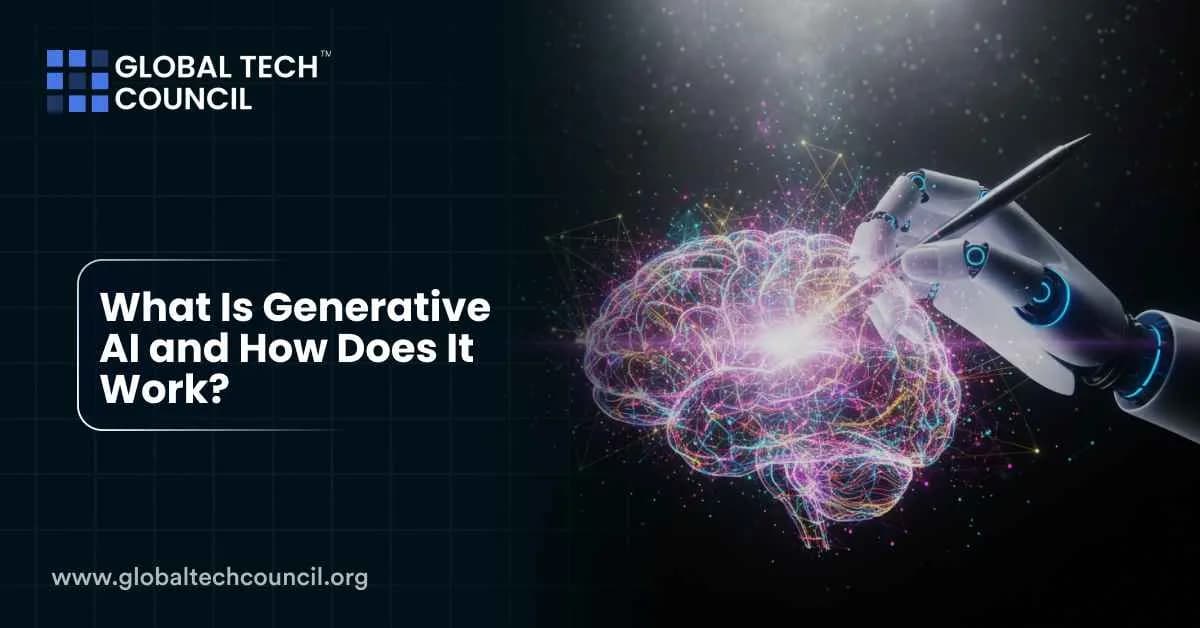
 Generative AI is a type of artificial Intelligence that does more than analyse—it creates. Whether it’s text, images, audio, or even video, these models are designed to produce content that looks and feels original. They work by studying massive datasets, identifying patterns, and then using those patterns to generate new outputs. If you want to go deeper into how these systems are built, an artificial intelligence certification can provide structured training to understand the core principles behind them.
The Basics of Generative AI
Generative AI is powered by models trained to recognise and replicate the structures found in data. Unlike traditional AI, which might classify emails as spam or not spam, generative AI can write the email itself, complete with tone and structure. Modern models like GPT, Stable Diffusion, and others use advanced architectures that allow them to go beyond basic prediction and into content creation.

How Generative AI Works
The process begins with training. A model is given access to vast datasets of text, images, or other content. It learns the statistical patterns hidden within this information. Once trained, the model takes a prompt—like a sentence or an image—and uses its learned rules to create something new.
Architectures That Power Generative AI
- Transformers: Best known for powering large language models, they use attention mechanisms to capture relationships between words or tokens.
- Diffusion Models: These begin with random noise and refine it step by step until a clear image or video emerges, often guided by text prompts.
- GANs (Generative Adversarial Networks): Built with two networks, a generator and a discriminator, these models compete until the generator produces outputs that the discriminator can’t distinguish from real data.
- Hybrids: Newer approaches combine transformer and diffusion techniques to balance speed, accuracy, and quality.
Latest Trends in Generative AI
By 2025, adoption has expanded across industries. Enterprises are deploying generative AI to accelerate workflows, while research labs explore multimodal models capable of handling text, images, video, and even 3D assets in one system. At the same time, shortages of clean training data are pushing companies to explore synthetic data generation. Hybrid architectures, like MADFormer, are also emerging to overcome limitations of single-model types.
Use Cases Across Industries
Generative AI is no longer confined to research labs. Writers use it for articles and creative storytelling. Designers rely on it for visual drafts. In healthcare, generative models simulate molecules or predict outcomes in early drug discovery. In entertainment, AI-powers visual effects, game assets, and even full scenes in films. In business, it supports summarisation, customer communication, and brainstorming.
Opportunities to Upskill
Professionals who want to learn how to apply these systems in real settings can explore a deep tech certification that provides exposure to cutting-edge technologies like generative AI, robotics, and advanced computing. For those more focused on managing data-driven predictions, a Data Science Certification delivers the right mix of theory and practice. On the business side, a Marketing and Business Certification shows how AI can guide customer strategies and growth without losing sight of ethics.
Challenges and Concerns
Generative AI is powerful but not flawless. Models sometimes “hallucinate” facts, producing outputs that sound correct but are wrong. Bias is another issue, since data used for training may contain cultural or social inequalities. There is also the matter of cost—training large models requires massive amounts of computing power and energy. On top of that, ethical concerns around deepfakes, copyright, and misinformation remain at the center of public debate.
Strengths and Weaknesses of Generative AI
Advantages and Limitations of Generative AI
| Advantages | Limitations |
| Creates original text, images, and video | Can produce false or misleading content |
| Accelerates creative and business workflows | High compute and energy demands |
| Powers multimodal outputs (text-to-image, text-to-video) | Training data shortages and licensing issues |
| Supports drug discovery and scientific research | Ethical concerns like deepfakes |
| Enhances customer experiences with personalised outputs | Bias and fairness challenges |
| Saves time in content generation and summarisation | Over-reliance may reduce human creativity |
| Expands design possibilities for media and art | Outputs lack true human intuition |
| Enables rapid prototyping and brainstorming | Regulation still evolving |
| Offers new career opportunities in AI fields | Integration challenges in enterprises |
| Continuously improving with hybrid models | Explainability and transparency gaps |
Conclusion
Generative AI is changing how we create and interact with digital content. From text and art to science and business, it is becoming a foundation for innovation. At the same time, its risks—bias, misinformation, and heavy resource use—cannot be ignored. The future will require careful use, clear regulation, and professionals who understand both the potential and the limits. For anyone looking to be part of that future, developing skills through certifications in AI, data, marketing, and deep tech is a smart step toward shaping how this technology is used responsibly.
Related Articles
View All
Artificial Intelligence
How Do AI Voice Clones Work, and Are They Safe?
Voice cloning is no longer science fiction. With a few seconds of recorded audio, AI systems can now replicate a person’s voice so convincingly that it can be difficult to tell the difference between real and fake. The technology is powerful, but it also raises big questions about safety, ethics,…
Artificial Intelligence
The Future of Predictive + Generative AI in Data-Driven Decisions
Businesses have always depended on data to make decisions, but the tools are changing quickly. Predictive AI shows what is likely to happen next, while generative AI creates new possibilities. When these two are combined, companies can not only forecast outcomes but also simulate scenarios,…
Artificial Intelligence
How Does Character AI Work?
Character AI is a fascinating technology designed to simulate human-like interactions using artificial intelligence. But how does it work to mimic humans so aptly? Let’s find out! What is Character.AI? Character AI is an advanced AI platform that allows users to create and interact with virtual…
Trending Articles
The Role of Blockchain in Ethical AI Development
How blockchain technology is being used to promote transparency and accountability in artificial intelligence systems.
AWS Career Roadmap
A step-by-step guide to building a successful career in Amazon Web Services cloud computing.
Top 5 DeFi Platforms
Explore the leading decentralized finance platforms and what makes each one unique in the evolving DeFi landscape.