

Secure Software Development Lifecycle (SSDLC): Integrating SAST, DAST, and SCA into DevSecOps
 Suyash Raizada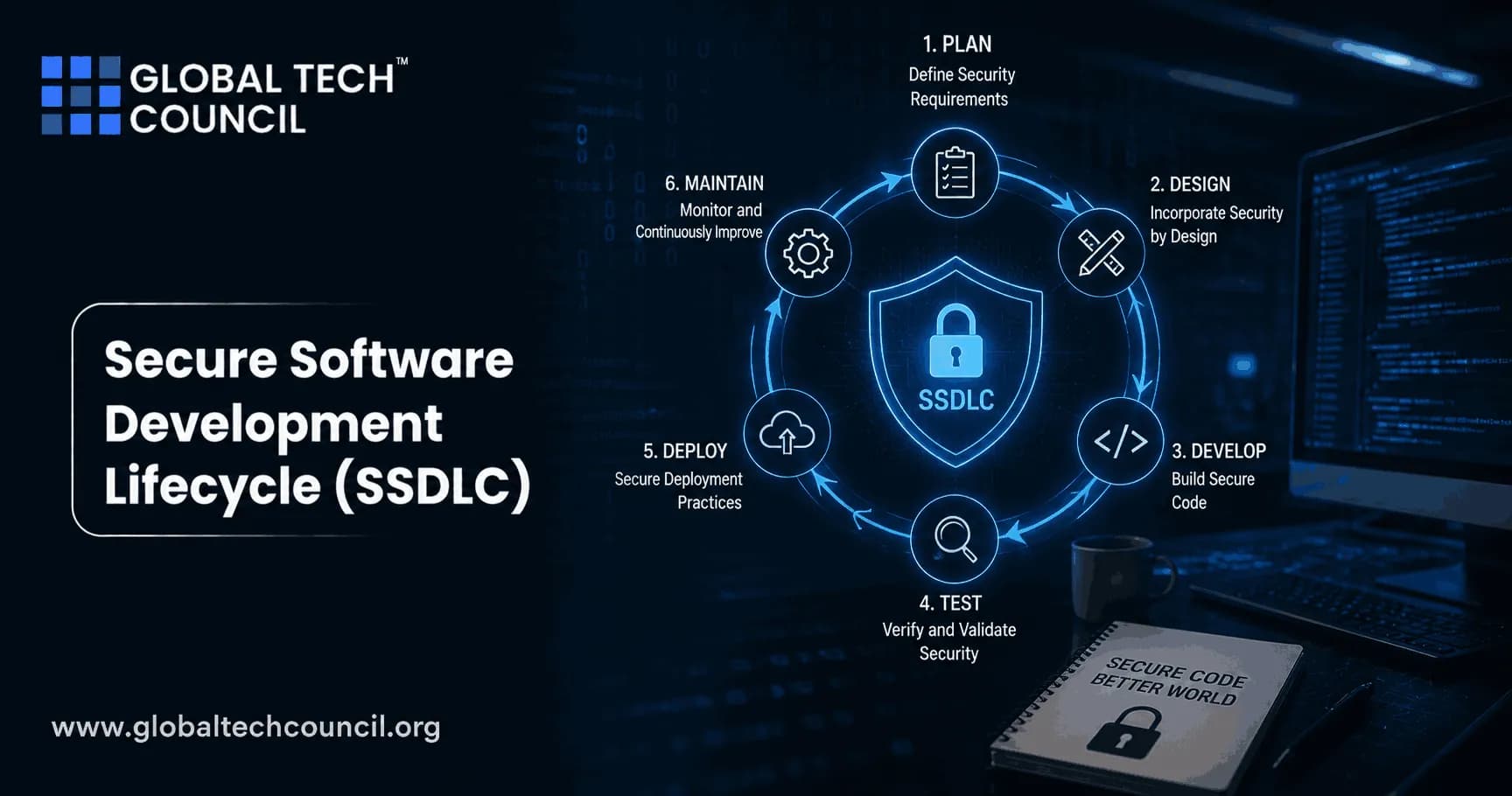
Secure Software Development Lifecycle (SSDLC) has shifted from a final-stage security review into a continuous, automated discipline embedded in DevSecOps. The goal is practical: detect vulnerabilities earlier, reduce remediation cost, and lower release risk by integrating SAST, SCA, and DAST directly into CI/CD workflows. Current industry guidance treats security as a shared responsibility across development, operations, and security teams, with automation and workflow-triggered testing as the baseline for modern application security.
This article explains how to implement an SSDLC that aligns with how teams actually ship software today, including where SAST, DAST, and SCA fit in the pipeline, how they complement each other, and what a mature program looks like in practice.

What Modern SSDLC Means in DevSecOps
In a DevSecOps operating model, SSDLC is not a separate phase that starts near release. It is a set of security controls distributed across the lifecycle and executed continuously, often automatically. Current DevSecOps guidance emphasizes two principles:
Shift left with automation: run static testing and dependency checks early and often, ideally on code changes and builds.
Validate at runtime: run dynamic testing later in the pipeline against a running application to confirm what is actually exposed.
Testing frequency is also increasing. Black Duck's Global State of DevSecOps 2023 survey, covering more than 1,000 IT professionals, found that 53% test the security of business-critical applications at least weekly and 31% test at least daily. That trend reinforces why SSDLC controls must be pipeline-native to remain sustainable at scale. Build the technical expertise needed to secure next-generation applications by earning an AI Powered Coding Expert Course credential, exploring advanced innovation trends through a Deeptech Certification, and learning how technology-driven strategies create business value with a Marketing Certification.
How SAST, SCA, and DAST Fit Together in an SSDLC
The most effective SSDLC implementations treat SAST, SCA, and DAST as complementary layers, not interchangeable tools. Each control surfaces different failure modes and should be placed where it provides fast, actionable feedback.
SAST (Static Application Security Testing)
SAST analyzes source code or intermediate representations to identify insecure patterns. DevSecOps guidance increasingly recommends running SAST on code changes - such as commits and pull requests - because SAST does not require a compiled or deployed application. Triggering SAST whenever the codebase changes helps teams:
Catch common issues early, when fixes are least expensive.
Give developers fast feedback before deployment.
Prevent vulnerabilities from propagating into builds and releases.
SCA (Software Composition Analysis)
SCA focuses on third-party and open-source components, including transitive dependencies. Supply-chain risk has become a central application security concern, which is why SCA is now a core SSDLC control. Mature SCA implementations typically check:
Known vulnerabilities in libraries and frameworks
Transitive dependency risk (dependencies of dependencies)
License and policy compliance issues
Deprecated or unmaintained packages
In practice, SCA should run on commit, during build, and again near release to catch newly disclosed vulnerabilities and confirm the final artifact meets policy requirements.
DAST (Dynamic Application Security Testing)
DAST tests a running application and simulates attacker behavior through exposed interfaces. Because it requires a deployed environment, DAST is typically positioned later in the pipeline - for example, against a test or staging deployment. DAST helps teams identify:
Runtime security issues that only appear during execution
Misconfigurations and observable attack paths
Issues that are difficult to detect through code analysis alone
DAST provides a critical reality check: it validates what is actually reachable and exploitable in the deployed service, not just what might exist in code.
Recommended Placement in CI/CD: A Practical Mapping
A useful way to design an SSDLC is to map controls to the workflow events developers already follow. This keeps feedback loops tight and reduces friction across teams.
1) Design Stage: Set the Security Direction
Security requirements aligned to business risk
Architecture review for trust boundaries and data flows
Threat modeling to prioritize risks before code is written
2) Development Stage: Secure the Code and Dependencies
SAST on code changes (commit, pull request, merge)
SCA during development and build to manage third-party risk
Secret scanning to prevent credential leakage
Secure code review focusing on logic and design flaws
3) Build Stage: Secure the Artifacts You Ship
Artifact and container image scanning
Signing and integrity checks to strengthen supply-chain controls
Policy enforcement so only compliant artifacts are promoted
4) Test Stage: Validate Runtime Behavior
DAST in test or staging against the running application
Fuzzing where input-handling risk is high
Penetration testing for critical releases and high-risk systems
5) Release and Operations: Monitor, Respond, Improve
Monitoring and alerting integrated with incident workflows
Vulnerability management and remediation tracking
Incident response runbooks aligned to the application threat model
How to Integrate SAST, SCA, and DAST Without Slowing Delivery
A consistent message across DevSecOps guidance is that SSDLC must improve security without reducing development efficiency. The strongest programs are engineered for speed and developer usability from the start.
Use Incremental and Pipeline-Native Scanning
Incremental scanning is a common implementation approach: scan only changed code or only affected dependency graphs so developers receive results in minutes rather than hours. Pipeline-native checks also reduce context switching by surfacing findings directly in pull requests and build logs.
Trigger the Right Tests from the Right Events
On pull requests: SAST and SCA are ideal because they run without a deployed application and provide early feedback.
On builds: SCA combined with artifact or image scanning aligns with what is being packaged and shipped.
On deployment to staging: DAST validates the running service and exposed endpoints.
Adopt Layered Gating, Not a Single Checkpoint
A layered gating approach reduces risk while avoiding bottlenecks. For example, failing fast on critical SAST findings in pull requests, enforcing dependency policy at build time, and using DAST as a promotion gate from staging to production for critical services all reflect established DevSecOps patterns. Static checks belong early, artifact checks during build and repository push, and dynamic checks later in the pipeline.
Prioritize Findings Based on Risk and Exploitability
Automation is effective at catching many common issues, but not all vulnerabilities carry equal risk. Mature teams tune rules and policies so developers are not overwhelmed by low-signal alerts. Automated SSDLC tooling addresses widespread, well-understood vulnerability classes, while complex logic flaws still require human-led review and penetration testing - particularly for high-impact applications.
What a Mature SSDLC Looks Like Beyond SAST, DAST, and SCA
While SAST, DAST, and SCA are foundational, mature SSDLC programs extend coverage with additional layers:
Secret scanning to prevent credential exposure
Container and image scanning for runtime base images and packages
Fuzz testing for parsers, APIs, and input-heavy components
IAST to observe application behavior during testing
RASP to help detect and respond to attacks in production
Continuous vulnerability monitoring for newly disclosed issues
The underlying principle remains consistent: security controls should be distributed across the lifecycle and supported by automation, monitoring, and clear ownership.
Implementation Checklist: Getting Started with SSDLC in DevSecOps
Define security requirements and threat model for key services before implementation begins.
Integrate SAST into pull requests with developer-friendly reporting and clear remediation guidance.
Integrate SCA into builds with policies covering vulnerability severity and license constraints.
Stand up a staging environment suitable for DAST that mirrors production exposure where feasible.
Set pragmatic gates that fail builds only on agreed critical issues at first, then tighten thresholds over time.
Create a remediation workflow with SLAs, clear ownership, and tracking for recurring issues.
Measure and improve using metrics such as time to remediate, escape rate, and scan duration.
Conclusion: SSDLC Is a System, Not a Tool
A modern Secure Software Development Lifecycle (SSDLC) is best understood as a layered system built into DevSecOps workflows. SAST helps teams find code-level defects early, SCA reduces dependency and supply-chain exposure, and DAST validates what is exploitable in a running application. When integrated into CI/CD with workflow-based triggers, incremental scanning, and risk-based gating, these controls improve security outcomes without slowing delivery.
Master the principles of secure software development, AI-driven security automation, and modern DevSecOps practices with an AI Expert Certification, enhance your understanding of intelligent systems through a Generative AI Expert Course, and gain insights into transformative technologies with a Tech Certification.
FAQs
1. What is a Secure Software Development Lifecycle (SSDLC)?
The Secure Software Development Lifecycle (SSDLC) is a framework that integrates security practices into every phase of software development. It helps organizations identify, prevent, and remediate vulnerabilities before applications are deployed to production.
2. Why is SSDLC important for modern software development?
SSDLC reduces security risks by embedding security controls throughout the development process rather than treating security as a final checkpoint. This proactive approach helps organizations build more secure and resilient applications.
3. How does SSDLC differ from a traditional SDLC?
Traditional SDLC focuses on planning, development, testing, and deployment, while SSDLC incorporates security activities at every stage. This ensures vulnerabilities are addressed early and continuously throughout the software lifecycle.
4. What is DevSecOps?
DevSecOps is a methodology that integrates security into DevOps practices by automating security testing and monitoring. It promotes collaboration between development, operations, and security teams to deliver secure software faster.
5. What is SAST in application security?
Static Application Security Testing (SAST) analyzes source code, bytecode, or binaries for security vulnerabilities without executing the application. It helps developers identify security issues early during the coding phase.
6. What are the benefits of using SAST?
SAST enables teams to detect vulnerabilities before software reaches production, reducing remediation costs and improving code quality. It also provides developers with immediate feedback during development.
7. What is DAST?
Dynamic Application Security Testing (DAST) evaluates a running application by simulating attacks against it. This testing method helps identify vulnerabilities that may not be visible through static code analysis.
8. How does DAST improve application security?
DAST tests applications in real-world conditions and can uncover issues such as authentication flaws, misconfigurations, and injection vulnerabilities. It provides valuable insights into runtime security risks.
9. What is Software Composition Analysis (SCA)?
Software Composition Analysis (SCA) identifies and evaluates open-source components and third-party libraries used within applications. It helps organizations detect known vulnerabilities and licensing risks.
10. Why is SCA important in modern development?
Most modern applications rely heavily on open-source software. SCA helps organizations monitor dependencies, manage risks, and quickly respond to newly disclosed vulnerabilities in third-party components.
11. How do SAST, DAST, and SCA complement each other?
SAST identifies code-level vulnerabilities, DAST detects runtime issues, and SCA analyzes third-party dependencies. Together, they provide comprehensive security coverage across different layers of an application.
12. At what stage should SAST be performed?
SAST should be integrated early in the development process, ideally during coding and code review stages. Early detection allows developers to address security issues before they become more costly to fix.
13. When should DAST be conducted?
DAST is typically performed after an application is deployed in a test or staging environment. It evaluates how the application behaves under real-world attack scenarios before production release.
14. What are common vulnerabilities detected through SCA?
SCA can identify outdated libraries, known CVEs (Common Vulnerabilities and Exposures), insecure dependencies, and licensing compliance issues. These risks can significantly impact application security if left unaddressed.
15. How does automation support SSDLC?
Automation enables continuous security testing throughout the development pipeline. Automated SAST, DAST, and SCA scans help organizations identify vulnerabilities quickly while maintaining development speed.
16. What role does CI/CD play in SSDLC?
CI/CD pipelines allow security testing tools to run automatically whenever code changes occur. This integration ensures security checks are performed consistently without slowing down software delivery.
17. What challenges do organizations face when implementing SSDLC?
Common challenges include tool integration complexity, developer resistance, false positives, limited security expertise, and balancing security requirements with development deadlines. Effective planning can help overcome these obstacles.
18. How can developers contribute to SSDLC success?
Developers can follow secure coding practices, participate in security training, address vulnerabilities promptly, and collaborate with security teams. Their involvement is critical to building secure applications.
19. How does SSDLC support compliance requirements?
SSDLC helps organizations meet regulatory and industry standards by providing structured security processes, audit trails, vulnerability management, and continuous monitoring throughout the software lifecycle.
20. What is the future of SSDLC and DevSecOps?
The future of SSDLC includes greater automation, AI-powered security testing, continuous risk assessment, and tighter integration with cloud-native development practices. These advancements will help organizations strengthen security while accelerating innovation.
Related Articles
View All
Cyber Security
Most Powerful Cybersecurity Software Tools In 2020
A Cybersecurity Program is an organization or individual’s must for Data Protection and Privacy. The tool used to secure the network, device, or software from cyberattacks is cybersecurity. It is used to restrict access to unauthorized files, cyber-attacks, and identity theft. The numerous…

Cyber Security
Cybersecurity Facts for 2026: Threats, Trends, and Real-World Lessons
Cybersecurity in 2026 features faster exploitation, growing ransomware profits, rising supply chain attacks, and AI-driven threats. Learn the key facts and priorities.

Cyber Security
Phishing-Resistant Security: Email Authentication (SPF/DKIM/DMARC) and User Training That Works
Learn how SPF, DKIM, and DMARC reduce spoofing, where they fall short, and which simulation-driven training methods measurably lower phishing risk.
Trending Articles
The Role of Blockchain in Ethical AI Development
How blockchain technology is being used to promote transparency and accountability in artificial intelligence systems.
AWS Career Roadmap
A step-by-step guide to building a successful career in Amazon Web Services cloud computing.
Top 5 DeFi Platforms
Explore the leading decentralized finance platforms and what makes each one unique in the evolving DeFi landscape.