

Zero Trust Security in 2026: Architecture, Implementation Steps, and Common Pitfalls
 Suyash Raizada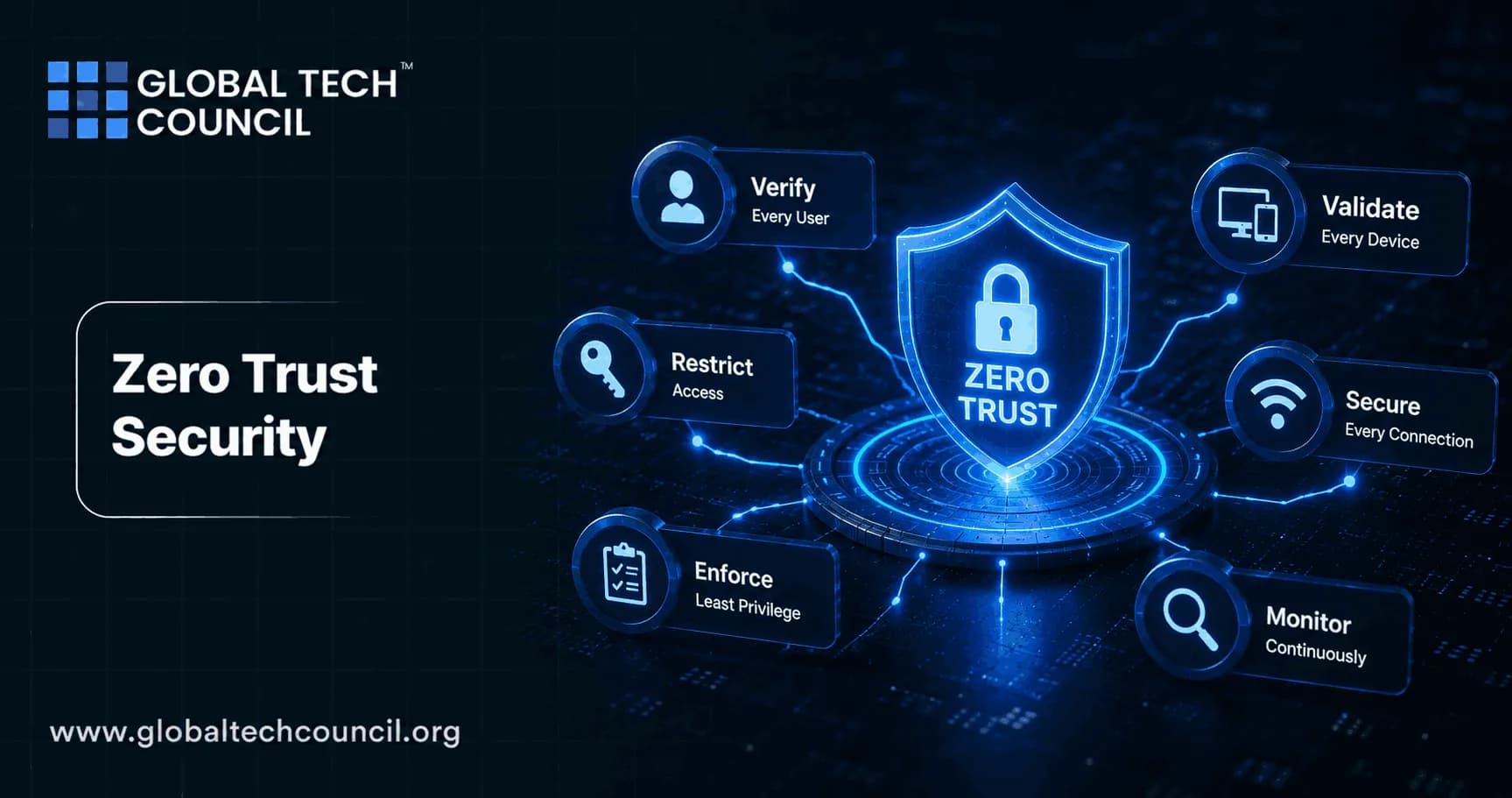
Zero Trust security in 2026 has moved from an emerging best practice to an operational expectation across regulated industries, cloud-first enterprises, and hybrid IT and OT environments. The core principle remains consistent with NIST SP 800-207: assume the network is compromised and make per-request access decisions using identity, context, and policy, rather than trusting users or systems simply because they reside on an internal network.
What has changed by 2026 is maturity and scope. Programs now extend beyond user remote access to include workload identity, application-layer enforcement, microsegmentation for east-west traffic, and data-centric controls that follow sensitive information across SaaS and multi-cloud environments.

What Zero Trust Security Means in 2026
Modern Zero Trust security programs generally align with NIST SP 800-207 and draw from public-sector roadmaps such as the CISA Zero Trust Maturity Model, alongside newer standards like ETSI TS 104 102 (the ZT-Kipling methodology). Across these frameworks, several principles appear consistently:
Never trust by default: Network location (LAN, VPN, data center) is not a trust signal.
Verify explicitly and continuously: Identity and device or workload posture are evaluated for each access request, with context and risk informing the decision.
Least privilege: Access is scoped to exactly what is required, ideally time-bound and context-aware.
Assume breach: The architecture is designed to contain lateral movement and reduce blast radius.
In 2026, identity has become the primary control plane for Zero Trust. This includes not only workforce identities but also service accounts, APIs, containers, and workload-to-workload communications, where strong machine identity and short-lived credentials reduce the risk of credential theft and reuse. Build a stronger Zero Trust foundation for 2026 by learning AI-driven security concepts through an AI Security Certification, strengthening enterprise defense skills with a Cybersecurity Expert Certification, and improving automation capabilities through a Python Certification.
Zero Trust Architecture in 2026: Core Components
NIST describes Zero Trust Architecture as an enterprise plan that applies Zero Trust concepts to relationships and workflows. In practical terms, most implementations rely on decision and enforcement components that work together to produce accurate per-request access decisions.
Policy Decision and Enforcement Model (PDP and PEP)
Policy Decision Point (PDP): Where access decisions are made.
Policy Engine: Evaluates policy using identity, posture, context, and signals such as telemetry and threat intelligence.
Policy Administrator: Translates the decision into a form that enforcement components can apply - for example, issuing a token or configuring a session.
Policy Enforcement Point (PEP): Enforces the allow or deny decision at runtime. This may be a gateway, proxy, endpoint agent, service mesh sidecar, API gateway, or an application component.
Building Blocks Found in Mature Programs
By 2026, effective Zero Trust security programs commonly include the following building blocks:
Identity and access management (IAM): Central identity providers, strong authentication, adaptive access, and governance to reduce privilege creep.
Device posture and endpoint controls: Access decisions incorporate device health, patch level, and security agent status.
Workload and machine identity: Cryptographic identity for services and workloads, often based on platform attestation and short-lived credentials.
Microsegmentation: Service-level segmentation to control east-west traffic within data centers and clouds.
Application-layer access (ZTNA and identity-aware proxies): Connecting specific users to specific applications instead of extending broad network access.
Data-centric security: Classification, encryption, tokenization, and attribute-based access control at data access points.
Telemetry and continuous monitoring: Centralized logging of access decisions, authentications, posture changes, and resource access to support continuous verification.
Implementation Roadmap: Zero Trust Security in 2026
A recurring theme in industry guidance is that Zero Trust is not purchased as a product - it is built by changing how access decisions are made and where policies are enforced. The roadmap below synthesizes common steps from NIST-aligned programs and iterative methods like ETSI ZT-Kipling.
1) Establish Vision, Scope, and Governance
Start with clear business drivers such as ransomware resilience, cloud migration, remote work, M&A integration, or regulatory requirements. Then choose an initial scope using the protected surface approach: a critical application, dataset, or business process.
Form a steering group that includes security, IT, networking, cloud, and business owners.
Define success criteria that address both security outcomes and operational impact.
2) Inventory Assets, Identities, and Trust Relationships
Zero Trust security depends on accurate identity and asset data. Build a living inventory covering:
Users, groups, roles, and privileged accounts across identity providers and directories
Devices including managed endpoints, BYOD, IoT, and OT systems
Applications across on-premises, cloud, and SaaS
Machine identities such as service accounts, APIs, containers, and automation
Explicitly identify static credentials and implicit trust paths, such as long-lived API keys, passwords embedded in code, shared admin accounts, or broad VPN access to internal subnets.
3) Map Transaction Flows for the Protected Surface
For each protected surface, map who or what needs access, from where, to which resource, and through which protocols. Thorough flow mapping prevents policies from breaking legitimate operations - a step where many projects succeed or fail.
Document east-west dependencies between services, databases, and shared platforms.
Capture administrative flows separately from user flows.
4) Design the Target Architecture and Enforcement Points
Select patterns that fit your environment, often combining identity governance, microsegmentation, and application-layer access. Decide where PDP and PEP functions will reside, for example:
Identity provider and conditional access policies
Identity-aware proxy or ZTNA broker for per-app access
Service mesh sidecars and mTLS for workload-to-workload traffic
API gateway for authentication, authorization, and rate controls
Treat workload identity as a first-class requirement, not an afterthought, particularly in Kubernetes and multi-cloud environments where service-to-service traffic dominates.
5) Harden Identity: MFA, Governance, and Time-Bound Privilege
Identity is the control plane, so modernizing IAM typically delivers the fastest risk reduction:
Centralize authentication where possible and implement SSO to improve usability.
Enforce MFA for all privileged access and move high-value workflows toward phishing-resistant methods.
Adopt just-in-time and just-enough access so elevated permissions expire automatically.
Improve joiner-mover-leaver processes to reduce orphaned accounts and stale access.
6) Add Device and Workload Posture to Access Decisions
Continuous verification in 2026 means posture and context must factor into every access decision:
Block or require step-up authentication when endpoints are missing patches or required security controls.
For workloads, prefer short-lived tokens or certificates issued based on attested identity rather than static secrets.
7) Deploy ZTNA and Microsegmentation Iteratively
Many organizations begin by replacing broad VPN access with ZTNA that connects users to specific applications. In parallel, microsegmentation reduces lateral movement inside clouds and data centers by enforcing identity and policy for east-west traffic.
Segment the most critical applications first.
Enforce allow-list policies based on verified identities and known flows.
Expand to additional segments as telemetry and operational confidence improve.
8) Apply Data-Centric Controls
Data-centric security becomes essential as information moves across SaaS, multi-cloud, and third-party environments:
Classify data and define sensitivity-based policies.
Use encryption and strong key management, and consider tokenization for high-risk fields.
Enforce attribute-based access control at data access points using identity and context attributes.
9) Centralize Telemetry and Continuously Refine Policies
Zero Trust security depends on visibility. Aggregate logs for authentications, access decisions, posture evaluations, and key application flows. Use analytics and behavior baselines to detect anomalies and tune policies over time.
10) Iterate Using Maturity Models (ETSI and CISA)
ETSI ZT-Kipling formalizes an iterative approach: define the protected surface, map flows, build architecture, create policy, then monitor and maintain. CISA maturity guidance reinforces that progress should span identity, device, network, application, and data pillars rather than concentrating on one area alone.
Common Pitfalls in Zero Trust Security Programs
Despite the maturity of Zero Trust security in 2026, implementations still stall for predictable reasons. Addressing these early reduces rework and stakeholder fatigue.
Pitfall 1: Treating Zero Trust as a Product Purchase
Deploying a single tool such as ZTNA or a next-generation firewall does not create a Zero Trust Architecture by itself. Zero Trust requires architectural change in policy, identity, enforcement placement, and continuous verification.
Pitfall 2: Big-Bang Scope
Attempting to redesign the entire enterprise at once often leads to disruption and project failure. Use the protected surface approach and expand iteratively based on measured outcomes and stable operations.
Pitfall 3: Ignoring Workload and Machine Identity
Focusing only on user MFA leaves a significant gap in service-to-service security, where static secrets and overly permissive trust zones enable lateral movement. Workload identity and short-lived credentials should be treated as core requirements from the start.
Pitfall 4: Insufficient Telemetry and Feedback Loops
Without visibility into policy decisions and access paths, it is not possible to verify effectiveness or safely tighten controls. Central logging and continuous monitoring are not optional elements of a Zero Trust program.
Pitfall 5: Overreliance on Network Location as Trust
Designs that still treat internal networks or VPN presence as trusted contradict Zero Trust principles and leave room for lateral movement following an initial compromise.
Pitfall 6: Poor Identity Hygiene
Policies are only as reliable as the identity data behind them. Orphaned accounts, stale group memberships, and privilege creep reduce the accuracy of access decisions and increase operational risk.
Pitfall 7: Neglecting User Experience and Change Management
Overly aggressive controls can trigger workarounds that undermine security. Successful programs pair stronger controls with usability improvements such as SSO, adaptive access, and phased rollouts supported by clear communication.
Conclusion: Making Zero Trust Security Real in 2026
Zero Trust security in 2026 is best understood as a continuously improving operating model built on identity-centric verification, fine-grained enforcement, and strong visibility. NIST SP 800-207 provides the architectural foundation, while the ETSI ZT-Kipling approach reinforces iterative scoping and disciplined policy design.
Organizations that succeed treat Zero Trust as a multi-year architectural program: start with a protected surface, map real transaction flows, modernize identity and posture, enforce at the application and workload layers, and measure outcomes consistently. The goal is not to achieve perfection in a single quarter, but to build a defensible, auditable, and resilient access model that holds up across cloud, enterprise, and OT environments. Prepare to design secure access systems, reduce implementation gaps, and avoid common Zero Trust mistakes by building backend expertise with a Node.js Certification, advancing practical security knowledge through an AI Security Certification, and learning how to communicate trust-based digital strategies with a Marketing Certification.
FAQs
1. What is Zero Trust Security?
Zero Trust Security is a cybersecurity framework based on the principle of "never trust, always verify." It requires continuous authentication, authorization, and validation of users, devices, and applications before granting access to resources.
2. Why is Zero Trust important in 2026?
As organizations adopt cloud computing, hybrid work environments, and AI-powered systems, traditional perimeter-based security is no longer sufficient. Zero Trust helps protect modern infrastructures from increasingly sophisticated cyber threats.
3. What are the core principles of Zero Trust?
The core principles include verifying every access request, enforcing least-privilege access, assuming breach scenarios, and continuously monitoring user and device behavior. These practices reduce the attack surface and improve security resilience.
4. What is Zero Trust Architecture (ZTA)?
Zero Trust Architecture is the technical framework used to implement Zero Trust principles across an organization's networks, applications, devices, and users. It integrates identity management, access controls, and continuous monitoring.
5. How does Zero Trust differ from traditional security models?
Traditional security models often trust users and devices inside a network perimeter. Zero Trust eliminates implicit trust and requires verification for every access request regardless of location.
6. What role does identity play in Zero Trust?
Identity is a foundational component of Zero Trust because access decisions are based on user authentication and authorization. Strong identity verification helps ensure that only legitimate users can access resources.
7. Why is Multi-Factor Authentication (MFA) important for Zero Trust?
MFA strengthens security by requiring multiple forms of verification before granting access. It significantly reduces the risk of compromised credentials being used by attackers.
8. What is least-privilege access in Zero Trust?
Least-privilege access ensures users receive only the permissions necessary to perform their tasks. This limits potential damage if an account or device becomes compromised.
9. How does device security support Zero Trust?
Zero Trust evaluates the security posture of devices before allowing access to resources. Devices that fail compliance checks may be restricted or denied access to sensitive systems.
10. What is microsegmentation in Zero Trust Architecture?
Microsegmentation divides networks into smaller, isolated segments to prevent attackers from moving laterally. This containment strategy minimizes the impact of security breaches.
11. What are the first steps in implementing Zero Trust?
Organizations typically begin by identifying critical assets, mapping data flows, implementing strong identity controls, and assessing existing security gaps. A phased approach often leads to more successful adoption.
12. How does Zero Trust improve cloud security?
Zero Trust secures cloud environments by enforcing strict access controls, continuous monitoring, and identity verification. This approach helps protect distributed applications and data across multiple cloud platforms.
13. What technologies are commonly used in Zero Trust implementations?
Common technologies include IAM solutions, MFA, endpoint detection and response (EDR), privileged access management (PAM), network access controls, and security analytics platforms.
14. How does continuous monitoring support Zero Trust?
Continuous monitoring tracks user activities, device behavior, and network traffic in real time. This enables organizations to quickly detect anomalies and respond to potential security incidents.
15. What are the common challenges of implementing Zero Trust?
Organizations may face challenges such as legacy system compatibility, complex integrations, budget constraints, and resistance to operational changes. Strategic planning is essential for overcoming these obstacles.
16. What are common mistakes organizations make with Zero Trust?
Common mistakes include treating Zero Trust as a single product, neglecting user training, failing to inventory assets, and implementing controls without clear policies. These issues can limit the effectiveness of the strategy.
17. How does Zero Trust support regulatory compliance?
Zero Trust enhances compliance by enforcing strict access controls, maintaining detailed audit logs, and protecting sensitive information. These capabilities align with many cybersecurity and privacy regulations.
18. Can Zero Trust prevent all cyberattacks?
No security framework can eliminate all threats, but Zero Trust significantly reduces risk by limiting unauthorized access and improving threat detection. It focuses on minimizing the impact of successful attacks.
19. How is AI influencing Zero Trust Security in 2026?
AI is helping organizations automate threat detection, analyze user behavior, assess risk levels, and improve access decisions. These capabilities strengthen Zero Trust implementations while reducing manual effort.
20. What is the future of Zero Trust Security?
The future of Zero Trust includes deeper AI integration, adaptive authentication, continuous risk assessment, and expanded protection for cloud, edge, and IoT environments. It is expected to remain a key cybersecurity strategy for modern enterprises.
Related Articles
View All
Cyber Security
Steps for better application security
IT security is like a coconut- hard on the outside and soft on the inside. This means the security approach focuses on hardening the data center’s perimeter for preventing intrusion by external sources while making access by employees benign- not requiring any specific protective measures.…

Cyber Security
How Zero Trust Can Help Defend Against Ransomware Attacks
Ransomware is the most generally deployed malware in infiltrated cloud environments. Statistically speaking, it accounts for three times as many cases as crypto mining and botnet malware, second and third, respectively. Ransomware remains a serious threat, despite enhanced security capabilities…

Cyber Security
Cybersecurity Facts for 2026: Threats, Trends, and Real-World Lessons
Cybersecurity in 2026 features faster exploitation, growing ransomware profits, rising supply chain attacks, and AI-driven threats. Learn the key facts and priorities.
Trending Articles
The Role of Blockchain in Ethical AI Development
How blockchain technology is being used to promote transparency and accountability in artificial intelligence systems.
AWS Career Roadmap
A step-by-step guide to building a successful career in Amazon Web Services cloud computing.
Top 5 DeFi Platforms
Explore the leading decentralized finance platforms and what makes each one unique in the evolving DeFi landscape.