

Oracle Layoffs 2026: What 6 AM Job Cut Emails Signal for Cloud, AI, and Tech Careers

Oracle layoffs 2026 point to something bigger than a bad hiring cycle. Reports of large-scale 6 AM termination emails, combined with Oracle's own fiscal 2026 disclosure of a major net headcount reduction, show a hard shift in enterprise technology: less spending on labor-heavy software operations, more spending on AI data centers, cloud capacity, GPUs, automation, and high-performance infrastructure.
For you as a developer, architect, consultant, or technology leader, the message is blunt. Routine enterprise software work is getting compressed. Deep cloud, AI infrastructure, automation, security, and data engineering skills are becoming harder to ignore.

What Happened in the Oracle Layoffs 2026?
Investigative reporting described Oracle's March 31, 2026 workforce reduction as the largest in the company's history, with approximately 30,000 employees receiving termination emails around 6 AM. That figure equals roughly 18 percent of a global workforce reported near 190,000. Oracle's own fiscal 2026 filing showed a net reduction of about 21,000 full-time employees, from 162,000 to about 141,000, or roughly 13 percent over the year.
Both numbers can be true. A company can terminate more people than its year-end net reduction shows if some roles are backfilled, reclassified, moved to vendors, or absorbed through restructuring. The gross layoff number tells you the shock felt by workers. The net number tells you the final workforce position after the accounting dust settles.
The 6 AM email pattern matters because it says something about how large technology companies now execute workforce decisions. These were not long, manager-led transitions. Reports from India, including Bangalore-based engineering and consulting teams, described automated early-morning notices and repeated waves affecting database administration, Oracle Fusion Cloud ERP consulting, NetSuite implementation, and Oracle Health customer success roles.
Why Oracle Is Cutting Jobs While Spending Heavily on AI
The Oracle layoffs 2026 story is not only about cost reduction. It is about capital reallocation. Reporting linked the cuts to freeing an estimated 8 to 10 billion dollars in annual cash flow for AI infrastructure. Oracle has also been associated with roughly 156 billion dollars in AI data center capital spending commitments over multiple years, alongside major debt financing and restructuring charges.
That is the new math of AI cloud competition. Data centers for large AI workloads need land, power contracts, cooling systems, fiber, switches, storage, and specialized accelerators. A cloud provider cannot serve large language model training or high-volume inference with ordinary enterprise hosting capacity.
Oracle's strategy is tied to large AI compute demand from customers reportedly including OpenAI and Meta. The company is trying to position Oracle Cloud Infrastructure, or OCI, as a serious platform for AI workloads against Amazon Web Services, Microsoft Azure, and Google Cloud.
The trade-off is clear. Human capital is being reduced in some parts of the business so compute capital can be expanded in others.
Roles Hit Hardest by the Oracle Layoffs
The affected roles, based on reports and industry analysis, were not random. They clustered around mature, process-heavy, and support-intensive areas.
- Traditional database administration: Especially roles focused on routine maintenance, patching coordination, and on-premise support.
- ERP and SaaS implementation consulting: Oracle Fusion Cloud ERP and NetSuite work that depends on repeatable configuration patterns is vulnerable to standardization and automation.
- Oracle Health and Cerner teams: Health records and customer success functions reportedly saw significant restructuring after Oracle's 2022 Cerner acquisition.
- Backline support and escalation teams: CIO-focused analysis warned that customers may see thinner support benches, slower escalations, and more handoffs.
To be blunt, if your value is mostly knowing where to click in an admin console or how to follow a vendor playbook, that value is under pressure. Enterprises still need those tasks done. They just need fewer people to do them.
Why Cloud and AI Infrastructure Skills Are Moving Up
AI does not run on press releases. It runs on capacity. That capacity needs engineers who understand distributed systems, GPUs, networking, storage bottlenecks, observability, and failure recovery.
Here is a practitioner detail that rarely shows up in executive slides: a training job can look healthy until distributed communication collapses. A warning such as NCCL WARN NET/IB : No device found can mean the job silently falls back from InfiniBand or RDMA to sockets. Suddenly GPU utilization drops, training time spikes, and a cluster that looked expensive on paper becomes worse in production. The engineer who can diagnose that is now more valuable than the person who only knows how to request more instances.
That is where the career opportunity sits. The strongest demand is likely to grow in areas such as:
- GPU cluster operations: NVIDIA H100, GB200, GB300, AMD MI300 series, and MI355X class infrastructure need specialized operations knowledge.
- Site reliability engineering for AI systems: AI workloads fail differently from ordinary web applications. Queueing, checkpointing, capacity fragmentation, and model serving latency all matter.
- High-performance networking: Ethernet fabrics, InfiniBand, RDMA, congestion control, and east-west traffic design are no longer niche topics.
- MLOps and model deployment: Teams need people who can move models from notebooks into monitored, governed, cost-aware production services.
- AI security and governance: Data leakage, prompt injection, model access control, and supply chain risk are board-level issues now.
What This Means for Oracle Customers
If your company runs Oracle ERP, OCI, NetSuite, Oracle Database, or Oracle Health workloads, do not treat these layoffs as vendor gossip. They can affect operations.
Greyhound Research chief analyst Sanchit Vir Gogia warned that reduced Oracle support and backline expertise could lead to uneven service quality and slower incident escalation, especially when customer environments fall outside standard playbooks. That tracks with what many enterprise teams already know: the first support response is rarely the problem. The problem is getting to the person who has seen the weird failure before.
You should respond with practical controls:
- Document your Oracle architecture internally. Do not rely on vendor memory.
- Build runbooks for month-end, quarter-end, and major release windows. ERP outages during financial close are not theoretical.
- Strengthen observability. Use logs, metrics, tracing, and synthetic checks before opening a ticket.
- Cross-train your team. One Oracle specialist and a shared mailbox is not resilience.
- Review multi-cloud and exit options. You do not need to migrate tomorrow, but you should know your constraints.
Automation Is Replacing Tasks, Not Just Assisting Workers
Oracle's regulatory filing reportedly stated that AI adoption and deployment across operations have resulted, and may continue to result, in workforce reductions. That language matters. It is not the softer claim that AI merely helps employees work faster. It acknowledges substitution.
This is now a broader technology sector pattern. Reports put the 2026 tech layoff wave above 209,000 workers, with Oracle's job cuts described as the largest single event. At the same time, major technology companies are committing huge sums to AI infrastructure, model development, data centers, and automation platforms.
There is a hard lesson here: automation does not eliminate all work equally. It hits predictable, repeatable, ticket-driven work first. It increases demand for people who can design, audit, secure, optimize, and govern the automated systems.
Skills You Should Build After the Oracle Layoffs 2026
If you work in database administration, ERP consulting, support engineering, or enterprise implementation, do not wait for your own 6 AM email. Start shifting your skill profile now.
1. Cloud architecture beyond basic certification
Learn multi-region design, identity and access management, private connectivity, workload isolation, disaster recovery, and cost controls. For AI workloads, pay close attention to storage throughput, GPU availability, and network topology.
2. Data engineering and governance
AI systems fail when the data pipeline is weak. Build practical knowledge of batch and streaming pipelines, data quality checks, lineage, privacy controls, and retention policies.
3. MLOps and model operations
Focus on model packaging, inference endpoints, vector databases, monitoring, drift detection, rollback, and cost-per-request. A model that works in a notebook is only the start.
4. AI security
Study the OWASP Top 10 for Large Language Model Applications, access control for model endpoints, secrets management, and dependency risk. CVE-2024-3094, the xz Utils backdoor attempt, was a reminder that supply chain security is not an academic concern.
5. Automation with judgment
Python 3.12, Terraform, Kubernetes, CI/CD, policy-as-code, and observability tooling are practical career multipliers. But do not automate a broken process. You will only make failure faster.
For structured learning, you can use Global Tech Council's certification pathways in AI, machine learning, cloud computing, cybersecurity, data science, and programming as internal learning routes. If you are coming from an Oracle ERP or database background, pair cloud skills with data engineering first. If you are already a cloud engineer, move toward AI infrastructure, MLOps, and security.
What Hiring Managers Will Look For Next
Hiring managers will care less about generic enterprise software exposure and more about proof that you can handle systems under pressure. Show evidence.
- Build a small model deployment pipeline with monitoring and rollback.
- Deploy a cloud workload with infrastructure as code and least-privilege IAM.
- Benchmark inference latency and explain the cost trade-offs.
- Write an incident review for a simulated outage.
- Document security controls for an AI application that uses sensitive data.
Certifications help when they validate this kind of work. They are weakest when they become badge collecting. Pick courses that force you to build, configure, troubleshoot, and explain trade-offs.
The Career Signal Behind the 6 AM Emails
The Oracle layoffs 2026 headlines are painful because they make a private fear public. Even senior professionals at major vendors can be removed quickly when the capital model changes. That does not mean tech careers are disappearing. It means the center of gravity is moving.
The safest career path is not to chase every AI headline. It is to move closer to the systems that AI depends on: cloud infrastructure, data platforms, security controls, automation, governance, and production operations.
Your next step is simple. Audit your current role. If most of your work is repeatable support, configuration, or implementation, choose one adjacent high-demand track this quarter: cloud architecture, MLOps, AI security, or data engineering. Then build one real project and back it with a relevant Global Tech Council certification or course path. Do that before the market forces the decision for you.
Related Articles
View All
Info
Best Tech Careers of 2021: The Most Competitive Jobs
The world of jobs is changing real quick, so do the career options. The job roles which were the most popular and the career path which offered guaranteed employment in the 90s are outdated and almost saturated now. No new job post or increase is there in the careers; many jobs have already…
Info
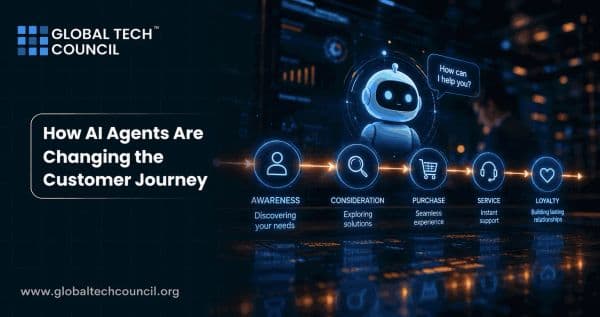
How AI Agents Are Changing the Customer Journey: What Marketers Need to Measure in 2026
AI agents are reshaping the customer journey in 2026 by influencing discovery, consideration, purchase, and retention. Here’s what marketers need to measure now.

Info
How Certifications in AI and Data Science Boost Job Security
You’ve seen job descriptions change overnight, teams get reshuffled, and new tools pop into every meeting. It’s unsettling. Certifications in AI and data science aren’t miracle cures, but they give you something practical: demonstrable skills, a clearer story to tell, and a better shot at staying…
Trending Articles
The Role of Blockchain in Ethical AI Development
How blockchain technology is being used to promote transparency and accountability in artificial intelligence systems.
AWS Career Roadmap
A step-by-step guide to building a successful career in Amazon Web Services cloud computing.
Top 5 DeFi Platforms
Explore the leading decentralized finance platforms and what makes each one unique in the evolving DeFi landscape.