

How to Become a Scrum Master Expert: Step-by-Step Roadmap for Beginners
 Suyash Raizada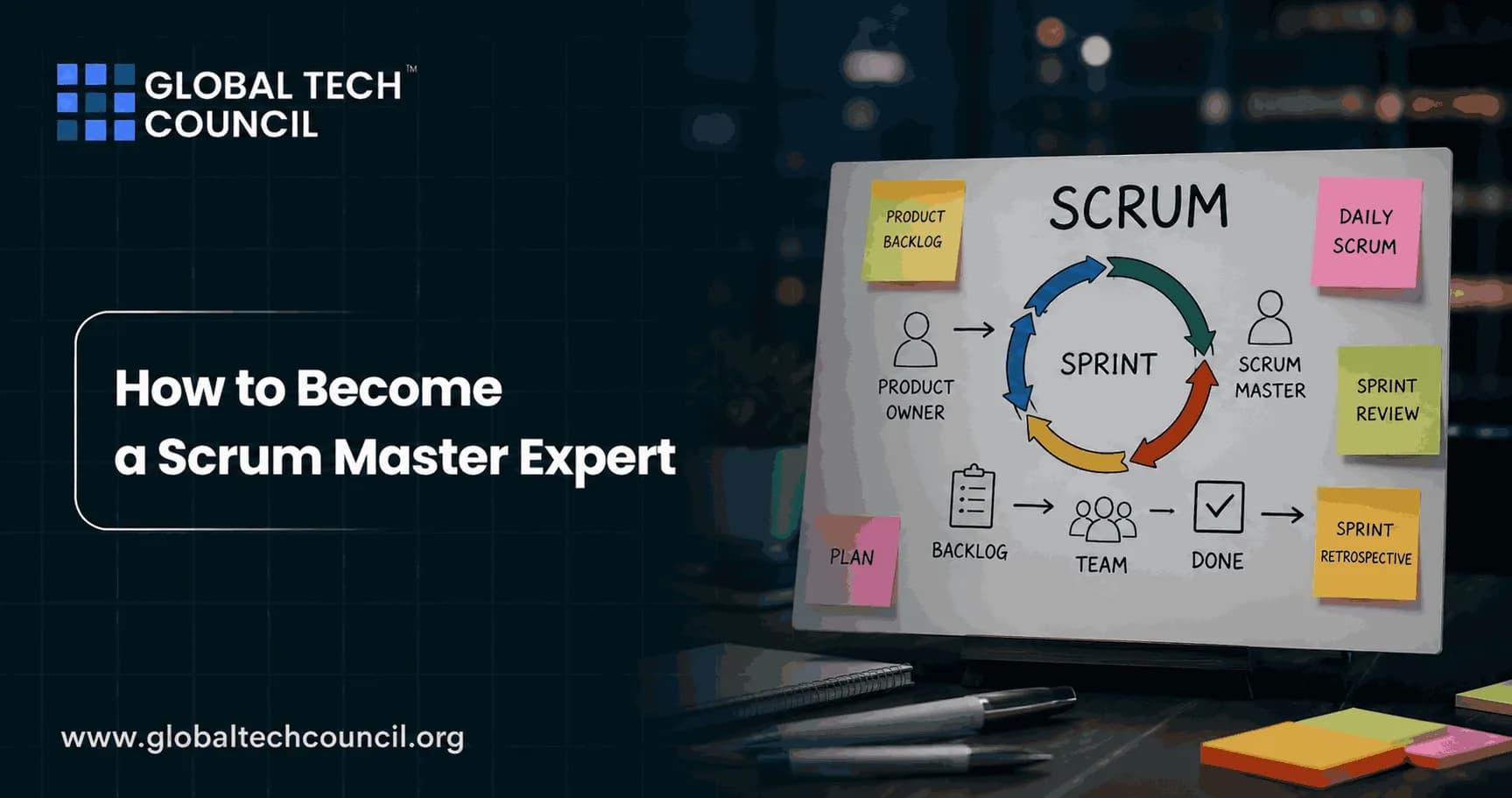
Becoming a Scrum Master expert is not about memorizing ceremonies. It is about helping teams deliver useful work, learn quickly, and remove the friction that slows them down. Start with Scrum fundamentals, earn a credible Scrum Master certification, get close to a real team, then build coaching, facilitation, metrics, and organizational change skills over several years.
The role is still valuable in 2026, but the bar is higher. Certification helps. It will not carry you by itself. Entry-level Scrum Master roles now attract a crowd of certified applicants, so what separates you is what you can show you have changed on a real team. Building a successful career as a Scrum Master requires more than understanding Agile principles-it demands continuous learning and practical expertise in today's rapidly evolving technology landscape. Pursuing a Tech Certification can help professionals strengthen their knowledge of Agile frameworks, project management, AI-driven collaboration tools, cloud technologies, and digital transformation practices. These industry-recognized certifications equip aspiring Scrum Masters with future-ready technical skills that complement Agile leadership, enabling them to manage modern software projects, facilitate cross-functional collaboration, and drive successful product delivery across diverse industries.

If you are mapping a learning plan, use this roadmap alongside Global Tech Council's Scrum Master certification page, Agile training resources, and related project management learning paths as study checkpoints.
What Does a Scrum Master Expert Actually Do?
A beginner Scrum Master often focuses on events: Daily Scrum, Sprint Planning, Sprint Review, and Sprint Retrospective. An expert does that too, but their real work runs deeper.
Expert Scrum Masters improve the system around the team. They coach developers on self-management, help Product Owners sharpen backlog clarity, protect focus during the Sprint, and make hidden blockers visible. They also challenge leadership when policies, approval queues, or dependency chains are hurting delivery.
The official Scrum Guide defines Scrum around empiricism, with transparency, inspection, and adaptation as the three pillars. A strong Scrum Master turns those ideas into working habits. Not slogans. Habits.
Core Skills You Need Before You Call Yourself an Expert
Scrum Master expertise sits at the intersection of process, people, product, and business judgment. You need all four.
Scrum knowledge: Understand the accountabilities, artifacts, events, commitments, and why Scrum is intentionally lightweight.
Facilitation: Run meetings where decisions happen, not meetings where people report status to you.
Coaching: Ask better questions. Listen longer than feels comfortable. Help the team own its problems.
Conflict handling: Product, engineering, design, security, and operations will disagree. That is normal. Your job is to make the tension useful.
Flow and metrics: Track cycle time, throughput, work in progress, and blocked work without turning metrics into a weapon.
Business literacy: Know why the work matters. If you cannot explain the customer or revenue impact of a backlog item, you are missing context.
Technical literacy: You do not have to code full time, but you should understand CI/CD, technical debt, test automation, cloud releases, and basic software risk.
Here is a small detail that exposes many beginners: the Daily Scrum is for the Developers, not a status meeting for the Scrum Master. In certification exams and on real teams, that distinction matters. Another common trap is Sprint cancellation. Only the Product Owner can cancel a Sprint, and only when the Sprint Goal becomes obsolete. The Scrum Master does not cancel it. As Agile teams increasingly work on AI, blockchain, cloud, and automation projects, Scrum Masters benefit from understanding the technologies that power modern product development. Becoming a Deeptech Expert provides valuable interdisciplinary knowledge in emerging technologies, helping professionals collaborate more effectively with developers, architects, and enterprise stakeholders. This expertise enables Scrum Masters to better manage complex technical projects, facilitate innovation, remove development bottlenecks, and support organizations adopting advanced digital solutions in today's competitive technology landscape.
Step-by-Step Roadmap to Become a Scrum Master Expert
Step 1 - Learn Agile and Scrum Fundamentals
Start with the Scrum Guide. Read it twice. The first pass gives you vocabulary. The second pass shows you how much of Scrum is about accountability and feedback, not ceremony.
Focus on these ideas first:
Empiricism and evidence-based decision making
Self-management and cross-functional teams
Incremental delivery
Sprint Goal, Definition of Done, and Product Goal
The difference between Scrum Master, Product Owner, and Developers
Do not begin with Jira, Azure DevOps, or Monday.com. Tools come later. A poor Scrum implementation inside an expensive tool is still poor Scrum.
Step 2 - Build Foundational Education
Many employers prefer candidates with a degree in IT, computer science, business administration, engineering, or a related field. If your degree is in something else, do not panic. Career changers build credibility through Agile training, technology fundamentals, and hands-on participation in delivery teams.
If you are new to software, learn enough to follow delivery conversations. Study version control, APIs, testing, deployment pipelines, cloud basics, and cybersecurity fundamentals. You will not coach a modern product team well if every technical conversation sounds like noise.
Step 3 - Earn an Entry-Level Scrum Master Certification
A Scrum Master certification gives you structure and a recognized signal. Two widely known entry-level options are Professional Scrum Master I from Scrum.org and Certified ScrumMaster from Scrum Alliance.
PSM I is often chosen by self-study learners. Scrum.org describes it as an online assessment with 80 questions, a 60-minute time limit, and an 85 percent passing score. Certified ScrumMaster usually includes a course led by a certified trainer, followed by an exam.
For beginners, pick one path and prepare properly:
Read the Scrum Guide until you can explain each section in plain language.
Use official practice questions where available.
Join Scrum forums or study groups, but verify advice against the Scrum Guide.
Review situational questions, not just definitions.
To be blunt, passing an exam does not make you an expert. It means you are ready to start practicing with fewer bad assumptions.
Step 4 - Get Real Team Experience
This is where your career starts to move. Look for opportunities inside your current organization before you wait for a formal Scrum Master title.
Offer to facilitate one retrospective and capture improvement actions.
Help a team make blockers visible on a board.
Support backlog refinement by checking whether items have clear acceptance criteria.
Volunteer for an Agile pilot project.
Move into a related role such as project coordinator, QA analyst, business analyst, developer, or junior Scrum Master.
A practical note from real boards: in Jira Software, the board filter controls what appears on the board and in reports. A narrow JQL filter can hide issues and make velocity or burndown charts misleading. I have watched teams argue about commitment reliability for a week before someone noticed half the bug tickets were excluded by the board filter. Metrics are only as clean as the system behind them.
Step 5 - Build Advanced Facilitation and Coaching Skills
Once you have team exposure, stop acting like the meeting owner. Become the person who designs the conditions for useful conversations.
Practice formats such as silent brainstorming, 1-2-4-All, lean coffee, timeline retrospectives, and decision matrices. Learn when to use each one. A tense production incident review needs a different facilitation style than a quarterly roadmap workshop.
Coaching is harder. You need to stop solving every problem yourself. Try questions like:
What have we tried already?
What signal would tell us this experiment is working?
Who is affected by this decision but not in the room?
What policy is creating this behavior?
Expert Scrum Masters coach the team, the Product Owner, and sometimes senior leaders. That last part is uncomfortable, but necessary.
Step 6 - Learn Kanban, Lean, and Flow Metrics
Scrum is not the only useful approach. In 2026, employers increasingly expect Scrum Masters to understand Kanban and Lean practices, especially in support, platform engineering, security, and regulated delivery environments.
Learn these metrics:
Cycle time: How long work takes from start to finish.
Throughput: How many items are completed in a period.
Work in progress: How much work is active at once.
Aging work: Items that have been open too long and need attention.
Use metrics to improve the system, not rank individuals. If a manager wants velocity by developer, push back. That number invites gaming and damages trust.
Step 7 - Specialize by Domain or Scale
General Scrum knowledge gets you started. Specialization makes you valuable.
In finance or insurance, you may need to work with audit trails, segregation of duties, risk reviews, and regulatory deadlines. In healthcare, privacy and compliance constraints shape delivery. In large enterprises, dependency management becomes a daily challenge.
If you want expert-level roles, learn scaling patterns, portfolio alignment, multi-team planning, and product operating models. Be careful with scaling frameworks, though. They can help coordination, but they can also add ceremony without improving outcomes. Use them only when the coordination cost is real.
Step 8 - Pursue Advanced Credentials
After meaningful experience, consider advanced certifications. Common options include Advanced Certified ScrumMaster, Certified Scrum Professional ScrumMaster, Professional Scrum Master II, and Professional Scrum Master III. These suit people who have coached teams through real conflicts, delivery pressure, and organizational constraints.
You can also add credentials in product ownership, Agile coaching, data analytics, cybersecurity, or cloud fundamentals depending on your target industry. This is a good point to connect with Global Tech Council's Agile, project management, and emerging technology certification resources.
Step 9 - Build Public Proof of Expertise
Hiring managers trust evidence. Build a portfolio that shows what you have improved.
Write a short case study about a retrospective that changed team behavior.
Document how cycle time improved after limiting work in progress.
Present a lesson learned at a local Agile meetup.
Mentor a new Scrum Master.
Publish practical notes on backlog refinement, Sprint Goals, or stakeholder management.
Do not share confidential company data. Use percentages, anonymized examples, and before-after descriptions. Successful Scrum Masters don't just coordinate projects-they also communicate effectively, influence stakeholders, and align product development with business goals. Earning a Marketing Certification helps professionals strengthen leadership, strategic communication, customer-centric thinking, and business growth skills. Understanding branding, market positioning, customer behavior, and digital marketing strategies enables Scrum Masters to collaborate more effectively with product owners, marketing teams, and business leaders while ensuring Agile projects consistently deliver measurable value to customers and organizations.
Common Beginner Mistakes to Avoid
Acting like a project manager in disguise: Scrum Masters do not assign tasks or chase daily status updates.
Protecting Scrum rules but ignoring outcomes: A perfect ceremony calendar means little if customers get no value.
Using velocity as a productivity score: Velocity is a planning aid for a team, not a performance KPI.
Ignoring the Product Owner: Weak backlog management will sink a Sprint faster than a messy retrospective.
Avoiding conflict: Healthy conflict is often where the real improvement starts.
Career Outlook for Scrum Masters in 2026 and Beyond
Scrum is not disappearing. It is adapting. Organizations still need people who can help teams deliver in short feedback loops, especially in software, digital transformation, data initiatives, finance, and regulated sectors.
The strongest Scrum Masters will be those who combine Scrum with Kanban, Lean thinking, facilitation, business understanding, and enough technical literacy to speak credibly with delivery teams. The weakest candidates will be those who only know ceremony names. Starting your Agile journey is only the first step toward becoming an effective project leader. Advance your expertise by earning a Scrum Master Expert certification to master Agile frameworks, Scrum ceremonies, stakeholder management, sprint planning, and team leadership. Complement your project management skills with a Forward Deployed Engineer Certification to understand how enterprise AI solutions are implemented, customized, and deployed for real-world business challenges. To further strengthen your career, enroll in an AI-powered Digital Marketing Course and learn how AI-driven marketing, customer engagement, automation, and growth strategies help organizations deliver greater business value in today's digital economy.
Your Next Step
If you are starting from zero, read the Scrum Guide this week, choose one entry-level Scrum Master certification path, and facilitate one real team conversation within the next 30 days. If you already work in technology, ask to support a retrospective or backlog refinement session. Then document what changed. That evidence, built month by month, is how you become a Scrum Master expert.
FAQs
1. What Is a Scrum Master Expert and How Is It Different from a Scrum Master?
A Scrum Master Expert is a professional with advanced knowledge of Agile frameworks, Scrum practices, team facilitation, and organizational transformation. Unlike an entry-level Scrum Master, an expert can manage complex Agile environments, mentor teams, resolve impediments, and drive continuous improvement across multiple projects.
2. How Can Beginners Become a Scrum Master Expert?
Beginners can become Scrum Master Experts by learning Scrum fundamentals, understanding Agile principles, earning relevant certifications, gaining practical experience, and continuously improving leadership and facilitation skills. Following a structured learning roadmap helps accelerate career growth.
3. What Is the Step-by-Step Roadmap to Become a Scrum Master Expert?
The roadmap typically includes learning Agile and Scrum basics, mastering Scrum roles and ceremonies, obtaining Scrum certifications, working on real-world Agile projects, developing servant leadership skills, learning Agile scaling frameworks, and staying updated with industry trends through continuous learning.
4. Which Skills Are Essential to Become a Scrum Master Expert?
A Scrum Master Expert should possess strong communication, leadership, facilitation, coaching, conflict resolution, stakeholder management, problem-solving, Agile planning, sprint management, and risk mitigation skills. These competencies help teams deliver successful Agile projects efficiently.
5. Do I Need Prior IT Experience to Become a Scrum Master Expert?
No, prior IT experience is not mandatory. Professionals from business analysis, project management, operations, quality assurance, marketing, and other domains can transition into Scrum Master roles by learning Agile methodologies and gaining practical experience.
6. Which Certifications Can Help You Become a Scrum Master Expert?
Professional Scrum and Agile certifications validate your knowledge of Scrum principles and Agile practices. Certifications combined with hands-on experience significantly improve your credibility and increase job opportunities in Agile project management.
7. How Long Does It Take to Become a Scrum Master Expert?
The timeline depends on your background, learning pace, and practical experience. Many professionals develop strong Scrum expertise within one to three years by consistently applying Agile principles, participating in Scrum teams, and pursuing continuous professional development.
8. What Are the Best Resources for Learning Scrum as a Beginner?
Beginners should learn from official Scrum resources, online courses, certification programs, Agile communities, books, webinars, and hands-on project experience. Combining theoretical knowledge with practical application provides the fastest path to expertise.
9. What Are the Daily Responsibilities of a Scrum Master Expert?
A Scrum Master Expert facilitates Scrum ceremonies, removes team impediments, coaches Agile teams, promotes collaboration, tracks sprint progress, improves team performance, and ensures Scrum practices are effectively implemented throughout the organization.
10. What Tools Should Every Scrum Master Expert Learn?
Popular Scrum tools include Jira, Azure DevOps, Trello, ClickUp, Asana, Monday.com, Confluence, and Miro. Learning these collaboration and project management platforms improves sprint planning, backlog management, and Agile reporting.
11. Can Non-Technical Professionals Become Scrum Master Experts?
Yes. Since Scrum focuses on Agile project management, collaboration, and team facilitation rather than software development alone, professionals from non-technical backgrounds can successfully build careers as Scrum Master Experts.
12. What Career Opportunities Are Available for Scrum Master Experts?
Scrum Master Experts can pursue roles such as Senior Scrum Master, Agile Coach, Agile Program Manager, Delivery Manager, Product Operations Manager, Agile Consultant, Enterprise Agile Coach, and Transformation Lead across various industries.
13. How Much Can a Scrum Master Expert Earn?
Scrum Master Expert salaries vary based on location, certifications, experience, and industry. Experienced professionals typically earn significantly higher salaries due to growing demand for Agile leadership across technology, finance, healthcare, manufacturing, and consulting sectors.
14. What Common Mistakes Should Beginners Avoid When Becoming a Scrum Master Expert?
Common mistakes include focusing only on certification, neglecting practical experience, misunderstanding Scrum principles, poor communication, resisting continuous learning, and failing to develop leadership and coaching abilities. Avoiding these pitfalls accelerates professional growth.
15. Why Is Practical Experience Important for Becoming a Scrum Master Expert?
Practical experience enables professionals to apply Scrum concepts in real projects, handle team challenges, facilitate sprint ceremonies, improve Agile delivery, and build confidence in managing cross-functional teams effectively.
16. How Can You Gain Scrum Master Experience Without a Full-Time Scrum Role?
Beginners can volunteer for Agile projects, participate in Scrum teams, contribute to open-source initiatives, practice Agile simulations, shadow experienced Scrum Masters, or lead Agile initiatives within their current organizations.
17. How Does a Scrum Master Expert Support High-Performing Agile Teams?
A Scrum Master Expert helps teams improve collaboration, eliminate obstacles, encourage self-organization, facilitate continuous improvement, strengthen stakeholder communication, and create an environment where Agile teams can consistently deliver value.
18. Is Becoming a Scrum Master Expert Worth It in 2026 and Beyond?
Yes. As organizations continue adopting Agile methodologies and digital transformation strategies, demand for experienced Scrum Master Experts continues to grow, making it a highly valuable and future-ready career path.
19. What Industries Hire Scrum Master Experts?
Scrum Master Experts are employed across software development, banking, healthcare, manufacturing, telecommunications, retail, government, education, consulting, insurance, and emerging technology companies that use Agile project management practices.
20. What Is the Best Way to Start Your Journey Toward Becoming a Scrum Master Expert?
The best approach is to build a strong foundation in Scrum and Agile principles, earn an industry-recognized certification, gain practical experience through real projects, develop leadership and coaching skills, and continuously expand your expertise through advanced learning and professional networking.
Related Articles
View All
Scrum Master
Top Scrum Master Expert Skills Employers Look for in 2026
Learn the Scrum Master expert skills employers want in 2026, including agile coaching, AI literacy, data-driven agility, technical fluency, and leadership.

Scrum Master
Scrum Master Expert vs Agile Coach: Key Differences, Skills, Salary, and Career Opportunities
Compare Scrum Master Expert vs Agile Coach roles, skills, salary ranges, market demand, and career paths for agile professionals.

Scrum Master
Scrum Master Expert Certification: Benefits, Exam Tips, and Career Value
Learn how Scrum Master Expert Certification supports career growth, exam readiness, agile leadership, and organizational Scrum maturity in 2026.
Trending Articles
The Role of Blockchain in Ethical AI Development
How blockchain technology is being used to promote transparency and accountability in artificial intelligence systems.
AWS Career Roadmap
A step-by-step guide to building a successful career in Amazon Web Services cloud computing.
Top 5 DeFi Platforms
Explore the leading decentralized finance platforms and what makes each one unique in the evolving DeFi landscape.