

From Project Manager to Scrum Master Expert: A Practical Transition Guide
 Suyash Raizada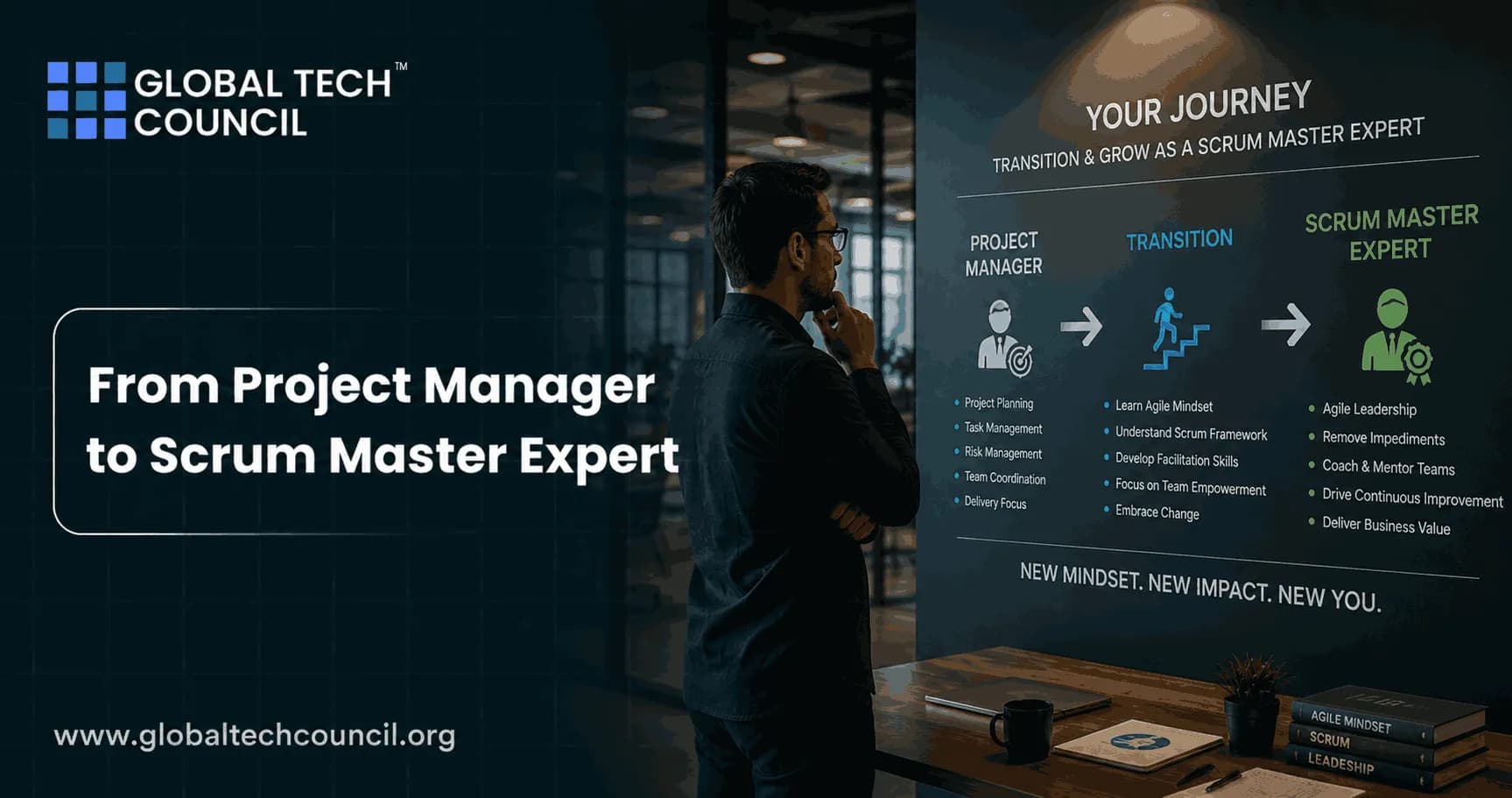
Moving from project manager to Scrum master expert is not a title swap. It is a change in how you lead. You move from controlling plans, dates, and task assignments to helping a team inspect, adapt, and deliver value in short cycles. If you have managed stakeholders, risks, vendors, and delivery pressure, you already have useful raw material. The hard part is letting the team own the work.
The timing is good. Agile now reaches well beyond software teams. Industry surveys such as Digital.ai's State of Agile reports and PMI's Pulse of the Profession research show continued use of agile and hybrid delivery across technology, finance, healthcare, operations, marketing, and product organizations. That creates room for project managers who can combine delivery discipline with Scrum coaching. Transitioning from Project Manager to Scrum Master requires adopting new leadership styles while expanding technical expertise. A Tech Certification helps professionals build practical knowledge of Agile methodologies, AI-powered project management tools, cloud technologies, DevOps, and digital transformation. These future-ready skills make it easier to lead self-organizing teams and successfully manage Agile projects in modern technology environments.

Why Project Managers Are Moving Toward Scrum Master Roles
Organizations still need people who can reduce delivery risk. They also need people who can help teams respond when requirements change, customer feedback arrives late, or dependencies block the next release. That is where the Scrum master role fits.
Market data points the same way. Recent salary guides place Scrum master compensation in the United States well into six figures for experienced professionals, with higher pay for skills in scaled agile, stakeholder management, and program coordination. Job postings also show demand outside pure software firms, especially where digital transformation is active.
Be careful, though. The market is not equally strong everywhere. Some companies treat the Scrum master as a meeting scheduler. Others expect one person to act as Scrum master, project manager, release coordinator, and delivery lead at the same time. That setup burns people out. Your goal should be agile leadership, not just a different job label.
Project Manager vs Scrum Master: The Real Difference
The biggest shift is authority. A project manager is often accountable for scope, schedule, budget, status reporting, and risk. In many organizations the PM also assigns tasks and pushes teams toward a committed plan.
A Scrum master works differently. The Scrum master serves the Scrum Team by coaching Scrum practices, removing impediments, improving collaboration, and helping the team become self-managing. The Product Owner orders the Product Backlog. Developers decide how to turn backlog items into a usable Increment. The Scrum master protects the framework and improves the system around the team. As Project Managers move into Agile leadership roles, understanding emerging technologies becomes increasingly valuable. Becoming a Deeptech Expert equips professionals with expertise in AI, blockchain, cloud computing, automation, and enterprise innovation. This technical foundation enables Scrum Masters to collaborate effectively with development teams while supporting organizations through complex digital transformation initiatives.
Key changes you need to make
From assignment to facilitation: Stop handing out tasks. Help the team clarify work and choose its own plan.
From fixed scope to empirical planning: Use Sprint Reviews, Sprint Planning, and backlog refinement to adapt based on evidence.
From status reporting to transparency: Make progress visible through Sprint Goals, working increments, flow metrics, and impediment tracking.
From escalation first to coaching first: Teach teams to solve local problems before every blocker becomes a management issue.
A small but telling detail: the 2020 Scrum Guide changed the language from self-organizing to self-managing. It also dropped the old three Daily Scrum questions. Many PMs still run the Daily Scrum as a status meeting with those questions directed at them. That is a giveaway. The Daily Scrum is a 15-minute event for Developers to inspect progress toward the Sprint Goal and adapt their plan.
Skills You Already Have as a Project Manager
You are not starting from zero. Strong project managers usually bring several strengths that Scrum teams need.
Stakeholder communication: You know how to explain trade-offs to executives and customers.
Risk awareness: You can spot dependency, compliance, budget, and timeline risks early.
Governance knowledge: You understand reporting needs, steering committees, audit trails, and approval gates.
Delivery discipline: You can keep conversations grounded in outcomes rather than vague activity.
Those skills matter most in hybrid organizations. PMI research has repeatedly shown that complex work often uses a mix of predictive, agile, and hybrid approaches. A Scrum master who understands both governance and iterative delivery can help teams avoid two common failures: fake agile with no discipline, and heavy process that blocks learning.
Skills You Must Build to Become a Scrum Master Expert
1. Scrum depth
Read the Scrum Guide until the terms feel boring. Then apply them. Know the accountabilities, events, artifacts, commitments, and why each exists. A Scrum master expert can explain why the Sprint Goal matters more than finishing every selected backlog item.
2. Coaching without command authority
This is the uncomfortable part for many PMs. You cannot coach well while secretly trying to control every decision. Practice asking better questions:
What evidence do we have?
What is blocking the Sprint Goal?
Who needs to be in this conversation?
What can the team change before the next Sprint?
Good facilitation feels quiet from the outside. The team talks more than you do.
3. Flow and delivery metrics
Velocity is useful only inside context. Do not compare teams by velocity. It rewards point inflation and creates terrible behavior. Track cycle time, lead time, work in progress, escaped defects, Sprint Goal success, and blocked time. If your team says everything is high priority, use flow data to show the cost.
4. Product thinking
Scrum is not a task machine. It is a product delivery framework. You need to help Product Owners refine backlog items, split work vertically, define acceptance criteria, and connect Sprint outcomes to customer or business value.
5. Scaling and systems thinking
Expert Scrum masters often work across multiple teams. You need to understand dependency management, release coordination, portfolio alignment, and organizational constraints. Scaled agile knowledge helps, but frameworks do not fix poor product ownership or unclear strategy. To be blunt, adding more ceremonies to a broken system just gives you a calendar problem. Making a successful career transition also requires strong communication and strategic thinking. A Marketing Certification helps aspiring Scrum Masters strengthen stakeholder engagement, leadership, branding, customer-centric thinking, and business strategy. These capabilities improve collaboration with cross-functional teams while ensuring Agile initiatives remain aligned with organizational goals.
A Practical Transition Plan
Audit your current role. List what you control today: scope, people, tasks, budget, reporting, vendors, risks. Then mark what a Scrum master should not own. This shows where your behavior must change.
Learn Scrum formally. Take structured Scrum training and study agile principles, empiricism, servant leadership, and team facilitation. Global Tech Council's Scrum Master learning resources fit here for professionals building certification readiness.
Practice inside your current organization. Volunteer to facilitate retrospectives, backlog refinement workshops, Sprint Reviews, or dependency sessions. Start with one team. Do not announce yourself as an expert after a weekend course.
Find a real team problem and improve it. Reduce blocked work, shorten refinement time, improve Sprint Goal clarity, or fix a recurring release handoff. Keep before and after data.
Build certification evidence. Pair Scrum certification with broader agile or project management credentials if you work in an enterprise setting. Global Tech Council courses in project management, agile practices, AI, data science, and cybersecurity can support professionals who want to work across modern technology programs.
Target mature agile environments. During interviews, ask how Product Owners are empowered, how many teams each Scrum master supports, and whether Scrum masters report into delivery, product, engineering, or an agile practice. The answers tell you more than the job description.
Common Mistakes During the Move
Acting like a project manager in Scrum clothing: If you assign every task and chase daily status, the team will never become self-managing.
Over-focusing on ceremonies: Scrum is not just Sprint Planning, Daily Scrum, Review, and Retrospective. The point is inspection, adaptation, and usable increments.
Ignoring Product Owner weakness: A poorly ordered backlog will damage the team faster than a weak standup format.
Using velocity as a performance target: This is one of the fastest ways to corrupt estimates.
Joining low-maturity organizations blindly: If leadership wants fixed scope, fixed dates, and full flexibility at the same time, you will spend your days explaining basic trade-offs.
Career Outlook: Think Beyond the Scrum Master Title
The narrow Scrum master role is changing. Some organizations now prefer titles such as agile coach, delivery lead, team coach, product delivery manager, or transformation lead. That does not mean Scrum mastery is dead. It means the best professionals are broadening their range.
If you want long-term mobility, build a portfolio around four areas: Scrum mastery, agile coaching, hybrid delivery, and business acumen. Add technology literacy too. AI product teams, DevOps environments, cloud migration programs, and data platform teams all benefit from leaders who understand iterative delivery and can speak enough technical language to be credible.
For example, you do not need to write production-grade Python to coach a machine learning team. But you should understand why model experiments rarely fit clean fixed-scope plans, why data readiness blocks delivery, and why validation metrics matter before a feature is called done. Moving from traditional project management to Agile leadership requires continuous professional development. Build your expertise with a Scrum Master Expert certification to master Scrum practices, Agile coaching, and team leadership. Strengthen your technical knowledge through a Forward Deployed Engineer Certification to understand enterprise AI implementation and customer-focused solution delivery. Complete your transition with an AI-powered Digital Marketing Course and gain valuable skills in AI-driven marketing, branding, customer engagement, and business growth.
Your Next Step
If you are moving from project manager to Scrum master expert, start with one honest question: are you ready to stop being the person with all the answers? If yes, build Scrum depth, practice facilitation, learn delivery metrics, and choose roles where agile is treated as a serious operating model.
For a structured path, begin with Scrum Master certification training, then add agile leadership, product thinking, and hybrid project delivery skills. Use your project management background as an advantage, but do not let it become your default setting.
FAQs
1. How Can a Project Manager Transition to a Scrum Master Expert?
A Project Manager can transition to a Scrum Master Expert by learning Agile principles, mastering the Scrum framework, developing servant leadership skills, earning Scrum certifications, and gaining hands-on experience with Agile teams. The transition involves shifting from traditional project control to team facilitation and continuous improvement.
2. What Is the Difference Between a Project Manager and a Scrum Master Expert?
A Project Manager typically focuses on planning, budgeting, scheduling, and managing project scope, while a Scrum Master Expert facilitates Agile processes, removes impediments, coaches teams, and promotes self-organization. The Scrum Master emphasizes collaboration and Agile values rather than direct project control.
3. Why Are Many Project Managers Transitioning to Scrum Master Roles?
As organizations increasingly adopt Agile methodologies, demand for Scrum Master Experts continues to grow. Many Project Managers transition because Agile roles offer strong career opportunities, higher demand, leadership growth, and the chance to work on innovative, fast-paced projects.
4. Which Skills From Project Management Transfer to a Scrum Master Role?
Project Managers already possess valuable skills such as communication, stakeholder management, leadership, risk management, problem-solving, planning, and team coordination. These transferable skills provide a strong foundation for becoming a successful Scrum Master Expert.
5. Which New Skills Should Project Managers Learn to Become Scrum Master Experts?
Professionals should develop expertise in Scrum, Agile principles, servant leadership, facilitation, Agile coaching, sprint planning, backlog management, conflict resolution, continuous improvement, and Agile scaling frameworks to succeed as Scrum Master Experts.
6. Do Project Managers Need Scrum Certification to Become Scrum Master Experts?
While certification is not always mandatory, earning a Scrum Master certification validates Agile knowledge and improves job opportunities. Certifications also help Project Managers understand Scrum roles, events, artifacts, and best practices before transitioning into Agile environments.
7. How Long Does It Take to Transition From Project Manager to Scrum Master Expert?
The transition timeline depends on prior Agile experience, learning pace, and practical exposure. Many Project Managers can successfully move into Scrum Master roles within several months by combining structured learning, certification, and real-world Agile experience.
8. What Challenges Do Project Managers Face When Becoming Scrum Master Experts?
Common challenges include shifting from command-and-control leadership to servant leadership, adapting to iterative planning, embracing self-organizing teams, and focusing on coaching rather than directing project execution. Developing an Agile mindset is key to overcoming these challenges.
9. How Can Project Managers Develop a Scrum Mindset?
Building a Scrum mindset requires embracing Agile values, encouraging collaboration, supporting team autonomy, welcoming change, promoting transparency, and focusing on delivering continuous customer value instead of rigid project plans.
10. Which Agile Frameworks Should Transitioning Project Managers Learn?
In addition to Scrum, professionals should understand Kanban, Lean, SAFe (Scaled Agile Framework), Scrum@Scale, Nexus, Large-Scale Scrum (LeSS), and Disciplined Agile to support projects of varying sizes and complexity.
11. What Tools Should New Scrum Master Experts Learn?
Project Managers transitioning into Scrum should become proficient with Jira, Azure DevOps, Confluence, Trello, ClickUp, Miro, Microsoft Teams, Slack, Monday.com, and other Agile collaboration and project management platforms.
12. Can Project Managers Become Scrum Master Experts Without Technical Experience?
Yes. Technical expertise is not a mandatory requirement for Scrum Master roles. Professionals from project management, operations, business analysis, marketing, and other domains can become successful Scrum Master Experts by mastering Agile practices and team facilitation.
13. What Career Opportunities Open After Becoming a Scrum Master Expert?
Professionals can pursue roles such as Scrum Master, Senior Scrum Master, Agile Coach, Delivery Manager, Agile Program Manager, Enterprise Agile Coach, Release Train Engineer, and Transformation Consultant after gaining Scrum expertise.
14. Does Transitioning to Scrum Master Improve Salary Potential?
In many industries, experienced Scrum Master Experts earn competitive salaries due to increasing demand for Agile leadership. Professionals with certifications, enterprise Agile experience, and strong coaching skills often qualify for higher-paying opportunities.
15. How Can Project Managers Gain Practical Scrum Experience?
Practical experience can be gained by joining Agile teams, participating in Scrum ceremonies, volunteering for Agile projects, shadowing experienced Scrum Masters, contributing to Agile transformations, and practicing Scrum in internal organizational initiatives.
16. What Common Mistakes Should Project Managers Avoid During the Transition?
Common mistakes include trying to micromanage teams, resisting Agile principles, focusing only on certification, neglecting servant leadership, failing to encourage team autonomy, and treating Scrum as simply another project management methodology.
17. How Can Project Managers Prepare for Scrum Master Interviews?
Candidates should review Scrum fundamentals, Agile principles, servant leadership concepts, Scrum ceremonies, Agile metrics, scenario-based interview questions, and prepare practical examples demonstrating leadership, collaboration, and problem-solving abilities.
18. Which Industries Hire Scrum Master Experts With Project Management Backgrounds?
Industries including software development, banking, healthcare, insurance, manufacturing, telecommunications, consulting, retail, government, and education actively recruit Scrum Master Experts who combine Agile expertise with project management experience.
19. What Is the Best Learning Path for Becoming a Scrum Master Expert?
A practical learning path includes studying Agile and Scrum fundamentals, earning Scrum certifications, mastering Agile tools, participating in real-world projects, developing leadership and coaching skills, and continuously learning through Agile communities and professional development.
20. Is Transitioning From Project Manager to Scrum Master Expert Worth It in 2026?
Yes. With Agile adoption continuing to grow across industries, transitioning from Project Manager to Scrum Master Expert is a valuable career move. Professionals who combine traditional project management experience with Scrum expertise are well-positioned for leadership roles, competitive salaries, and long-term career growth in Agile organizations.
Related Articles
View All
Scrum Master
Scrum Master Expert Salary Guide 2026: Trends, Roles, and Growth Opportunities
Explore Scrum Master expert salary trends for 2026, including pay ranges, hiring demand, certifications, career paths, and skills that raise earning potential.

Scrum Master
Scrum Master Expert Guide: Roles, Skills, and Career Path in Agile Teams
A practical Scrum Master expert guide covering modern responsibilities, skills, salary outlook, career paths, and how to stay relevant in agile teams.

Scrum Master
How to Become a Scrum Master Expert: Step-by-Step Roadmap for Beginners
A practical beginner roadmap to become a Scrum Master expert, covering Scrum foundations, certification, team experience, coaching, metrics, and advanced growth.
Trending Articles
The Role of Blockchain in Ethical AI Development
How blockchain technology is being used to promote transparency and accountability in artificial intelligence systems.
AWS Career Roadmap
A step-by-step guide to building a successful career in Amazon Web Services cloud computing.
Top 5 DeFi Platforms
Explore the leading decentralized finance platforms and what makes each one unique in the evolving DeFi landscape.