

Scrum Master Expert Guide: Roles, Skills, and Career Path in Agile Teams
 Suyash Raizada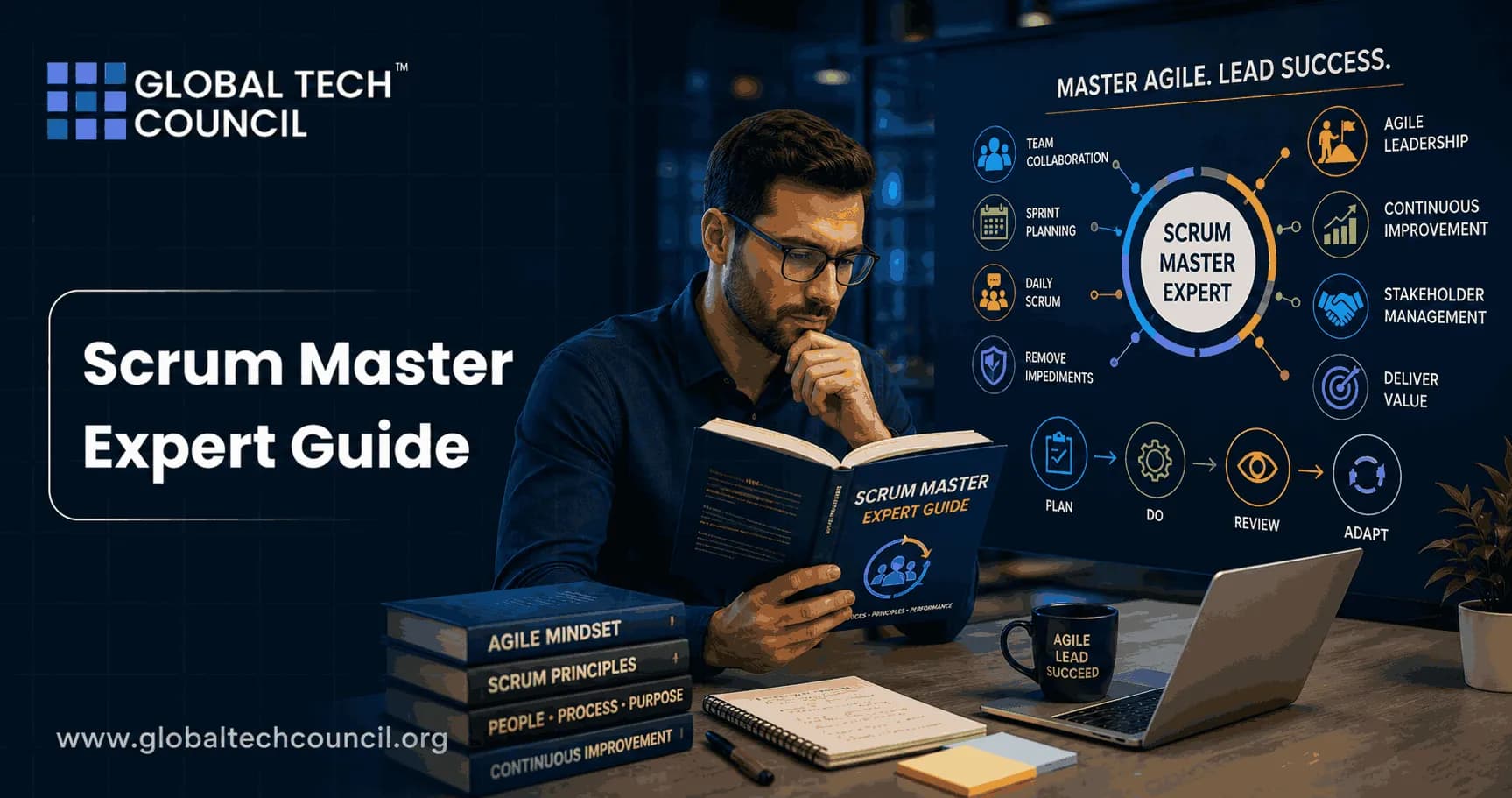
The Scrum Master role now sits somewhere between facilitator, delivery coach, and organizational change agent. If you only schedule ceremonies and move Jira tickets, the market is getting tougher on you. If you can coach teams, read delivery data, handle stakeholders, and tie agile work to business outcomes, the role is still in strong demand.
Agile stopped being a niche software practice years ago. Digital.ai's State of Agile reporting has repeatedly shown broad enterprise adoption, and several industry surveys put agile use near 71 percent of companies in some form. Software development adoption climbed sharply during 2020 and 2021, with some analyses reporting a jump from 37 percent to 86 percent. That scale keeps Scrum Masters employed. It also raises the bar. As AI transforms software development and Agile workflows, Scrum Masters must continuously expand their technical expertise. Pursuing a Tech Certification helps professionals develop practical skills in artificial intelligence, cloud computing, Agile automation, DevOps, and digital transformation. These certifications prepare Scrum Masters to lead AI-enabled teams, adopt intelligent project management tools, and remain competitive in the rapidly evolving technology landscape.

What a Scrum Master Does in a Modern Agile Team
The Scrum Guide 2020, written by Ken Schwaber and Jeff Sutherland, defines the Scrum Master as accountable for establishing Scrum as described in the guide. Sounds simple. It is not.
In a working team, you are not the admin. You help the Scrum Team and the wider organization use Scrum well. In practice that means you spend as much time with managers, Product Owners, and dependency teams as you do facilitating the Daily Scrum.
Core responsibilities
Facilitate Scrum events: Sprint Planning, Daily Scrum, Sprint Review, and Retrospective should produce decisions, not calendar noise.
Coach the team: Help Developers, Product Owners, and stakeholders understand Scrum values, empiricism, self-management, and clear accountability.
Remove impediments: Escalate blocked environments, slow approvals, missing test data, dependency queues, or policies that stop the team from delivering.
Improve flow: Use cycle time, throughput, work in progress, escaped defects, and aging work items to guide improvement.
Support product focus: Work with the Product Owner on backlog clarity, Sprint Goals, stakeholder feedback, and value-based prioritization.
Coordinate across teams: In scaled settings, help teams manage dependencies, shared release dates, integration work, and planning cadence.
A practical detail most new Scrum Masters miss: Jira's velocity chart can lie to you because story points added after sprint start still count toward the completed total. I have watched teams celebrate a velocity bump while the Sprint Goal failed, because half the work was injected mid-sprint. Check the Sprint Report, the issue history, and the scope change view before you draw any conclusion. The future of Agile leadership is closely connected to emerging technologies. Becoming a Deeptech Expert enables Scrum Masters to understand AI systems, blockchain platforms, automation technologies, and enterprise innovation strategies. This interdisciplinary expertise improves collaboration with engineering teams and prepares professionals to lead increasingly sophisticated digital transformation initiatives powered by advanced technologies.
Why the Scrum Master Role Is Changing
Most enterprises now run hybrid models. State of Agile reporting shows large and medium organizations often combine agile teams with portfolio planning, budget gates, risk reviews, and compliance checkpoints. Scaled agile analyses also suggest a majority of larger organizations use some form of scaled agile by 2025.
This reshapes your job. You may work inside Scrum, but you have to understand governance too. A bank, a healthcare firm, or a telecom provider may need audit evidence, release approvals, segregation of duties, and documented risk decisions. Telling those groups to "just be agile" is lazy coaching. Better Scrum Masters translate agile artifacts into the language the organization already uses.
The market debate is real. Some practitioners argue the traditional Scrum Master role is shrinking. They are partly right. A role limited to hosting ceremonies is easy to cut. A Scrum Master who improves predictability, clears blocked work, and helps leadership make better delivery decisions is much harder to replace.
Skills Every Expert Scrum Master Needs
1. Strong Scrum and agile knowledge
You need more than memorized events. Know why Scrum leans on empiricism, why each event exists, and what changed in the Scrum Guide 2020. The old term "Development Team" was replaced by "Developers," and the three commitments are now the Product Goal, the Sprint Goal, and the Definition of Done. Certification candidates trip over that one constantly.
Understand Kanban, Lean thinking, and XP practices too, plus the cases where Scrum is a poor fit. If a support team takes unpredictable production incidents all day, a flow-based Kanban system usually beats two-week sprint commitments.
2. Facilitation that produces outcomes
Good facilitation is not talking more. It is designing better conversations. Use silent writing before group discussion. Use Roman voting or fist-to-five when decisions stall. Time-box debates. Make conflict visible without making it personal.
Retrospectives are a common weak spot. If every retro ends with "communicate better," you have not found the system problem. Ask for evidence. Which handoff failed? Which queue waited longest? Which decision was unclear?
3. Data literacy
Senior Scrum Masters need delivery metrics, but they have to use them with care. Velocity is a team planning signal, not a productivity scoreboard. Comparing velocity across teams is almost always a mistake.
Better metrics include:
Cycle time: how long work takes from start to finish.
Throughput: how many items are completed in a period.
Work item age: how long active items have been open.
Defect escape rate: how many issues reach production or customers.
Sprint Goal success rate: whether the team meets the goal, not just closes tickets.
Use data to ask sharper questions. Do not weaponize it.
4. Product and business understanding
A Scrum Master does not own the product backlog. The Product Owner does. Even so, you need enough product sense to challenge output thinking. Ten completed stories are not success if none of them move a customer or business metric.
Learn basic product discovery, customer feedback loops, cost of delay, stakeholder mapping, and outcome-based planning. This is where many mid-level Scrum Masters grow into senior Scrum Masters or Agile Coaches.
5. Technical delivery literacy
You do not need to code like a senior engineer, but you should understand the delivery system. Continuous integration, automated testing, feature flags, trunk-based development, deployment pipelines, and incident reviews all shape how agile a team can really be.
If a team burns four days stabilizing every release branch, the problem is not Sprint Planning. It is engineering flow. A Scrum Master who understands DevOps can steer the right conversation with engineering leads.
6. Remote and AI-assisted collaboration
Distributed teams are normal now. Learn asynchronous facilitation, written decision records, virtual whiteboarding, and basic meeting hygiene. Get comfortable with AI-assisted tools that summarize meetings, flag delivery risks, or forecast completion from historical data.
Be careful, though. AI forecasts are only as good as the underlying work item data. If half the team updates tickets on Friday afternoon, the forecast is theater. As AI reshapes customer expectations and business models, Scrum Masters also need strong business and communication skills. A Marketing Certification helps professionals understand digital branding, AI-powered customer engagement, strategic communication, and business growth. These capabilities enable Agile leaders to align product development with evolving market demands while delivering greater value to customers and stakeholders.
Scrum Master Career Path
The career path is wider than it used to be. A common progression looks like this:
Junior Scrum Master: supports one team, learns the events, removes simple impediments, and works under a mentor.
Scrum Master: coaches one or two teams, supports the Product Owner, tracks flow, and improves team habits.
Senior Scrum Master: works across complex products, mentors other Scrum Masters, and tackles organizational blockers.
Agile Coach: coaches teams, leaders, and departments on agile adoption, systems thinking, and change management.
Enterprise Agile Coach or Delivery Leader: works across portfolios, operating models, governance, and transformation programs.
Other paths are valid. If you enjoy coordination, look at Release Train Engineer, Delivery Manager, Program Manager, or Agile Project Manager roles. If you enjoy customer problems and strategy, move toward Product Owner or product management.
To be blunt, do not box yourself into one title. Hiring managers increasingly want Scrum Masters who can handle reporting, stakeholder management, release coordination, and coaching. You do not need to become a traditional project manager, but you do need to speak that language when the organization demands it.
Scrum Master Salary and Market Outlook
Market data stays positive, though it varies by region. Scaled Agile salary guidance has placed average United States Scrum Master pay in the 105,000 to 140,000 USD range for 2025, depending on location, industry, and experience. Some job market reports forecast Scrum Master growth near 24 percent by 2026.
That does not mean entry is easy. Basic certification on its own carries less weight than it did five years ago. Employers want evidence: teams coached, cycle time improved, release risk reduced, stakeholder conflict handled, or adoption scaled across several teams.
Build a portfolio of outcomes. Document how you helped cut average cycle time from 14 days to 8 days, lifted Sprint Goal success from 50 percent to 80 percent, or reduced dependency wait time by changing intake rules. Keep it honest. Numbers without context will get challenged in interviews.
Common Mistakes That Hold Scrum Masters Back
Acting as the team's secretary: the team should update its own work and own its plan.
Turning the Daily Scrum into a status meeting: it is for Developers to inspect progress toward the Sprint Goal.
Confusing busy teams with effective teams: high utilization often breeds queues and delays.
Defending Scrum rules without understanding business constraints: agile purity rarely survives audit, finance, or regulatory pressure.
Using velocity as a performance metric: it just encourages point inflation and bad behavior.
Ignoring technical debt: poor engineering practices will break any agile framework.
How to Build Expertise as a Scrum Master
If you want to move from capable to expert, build a learning plan with three tracks.
Certification and structured learning
Start with Scrum fundamentals, then add advanced agile coaching, product ownership, DevOps, and data skills. Global Tech Council readers can explore the Scrum Master certification pathway alongside related programs in agile, project management, AI, data science, and cybersecurity. Pair any certification with real practice. The certificate opens the door; examples from live teams keep it open.
Hands-on practice
Volunteer to facilitate a difficult retrospective. Map your team's workflow. Pull cycle time data for the last three months. Sit in on a failed deployment review with the engineers. Ask the Product Owner how priorities are really decided.
Mentoring and community
Find a senior Scrum Master or Agile Coach who will review your facilitation plans and metrics. Join communities of practice. Bring real problems, not abstract questions.
Next Step for Your Scrum Master Career
The Scrum Master role is not dead. The narrow version is. Assess yourself against four areas: facilitation, delivery data, product thinking, and technical literacy. Pick the weakest one and build a single concrete artifact this month: a better retrospective design, a flow metrics dashboard, a backlog refinement checklist, or a dependency map. The future of Agile leadership belongs to professionals who combine Scrum expertise with technical innovation and business strategy. Advance your career with a Scrum Master Expert certification to master Agile leadership, sprint management, and organizational transformation. Expand your understanding of enterprise AI implementation through a Forward Deployed Engineer Certification and strengthen your business growth capabilities with an AI-powered Digital Marketing Course to stay ahead in the AI-driven workplace.
FAQs
1. What Is a Scrum Master Expert and What Do They Do?
A Scrum Master Expert is an experienced Agile professional who helps Scrum teams follow Agile principles, facilitates Scrum ceremonies, removes project impediments, and promotes continuous improvement. Their primary responsibility is to enable high-performing teams that consistently deliver value while fostering collaboration and self-organization.
2. What Are the Key Roles of a Scrum Master Expert?
A Scrum Master Expert serves as a facilitator, Agile coach, servant leader, mentor, problem solver, and process improvement advocate. They guide Scrum teams, support Product Owners, manage stakeholder communication, and help organizations successfully implement Agile methodologies.
3. What Skills Are Required to Become a Scrum Master Expert?
Essential Scrum Master Expert skills include Agile methodology, Scrum framework expertise, servant leadership, communication, facilitation, conflict resolution, stakeholder management, sprint planning, backlog refinement, problem-solving, emotional intelligence, and continuous improvement.
4. How Does a Scrum Master Expert Support Agile Teams?
Scrum Master Experts support Agile teams by facilitating daily stand-ups, sprint planning, sprint reviews, and retrospectives while removing blockers that affect productivity. They also coach team members, improve collaboration, and encourage Agile best practices to maximize team performance.
5. What Is the Career Path for a Scrum Master Expert?
The typical career path begins with Agile team participation, followed by Scrum Master, Senior Scrum Master, Agile Coach, Enterprise Agile Coach, Delivery Manager, Agile Program Manager, Release Train Engineer, and leadership positions focused on Agile transformation.
6. Do You Need Technical Skills to Become a Scrum Master Expert?
Technical expertise is helpful but not mandatory. Scrum Master Experts benefit from understanding software development concepts, DevOps, cloud technologies, and Agile tools, but their primary focus is facilitating collaboration and enabling successful Agile delivery.
7. Which Certifications Can Help You Become a Scrum Master Expert?
Professional Scrum and Agile certifications demonstrate expertise in Scrum principles, Agile frameworks, and team facilitation. Earning recognized certifications enhances credibility, improves job opportunities, and supports career advancement in Agile project management.
8. What Are the Daily Responsibilities of a Scrum Master Expert?
Daily responsibilities include facilitating Scrum ceremonies, removing impediments, monitoring sprint progress, coaching Agile teams, supporting Product Owners, improving communication, tracking Agile metrics, and ensuring adherence to Scrum principles throughout the development lifecycle.
9. What Tools Should Every Scrum Master Expert Learn?
Popular tools include Jira, Azure DevOps, Confluence, ClickUp, Trello, Monday.com, Miro, Microsoft Teams, Slack, and other Agile collaboration platforms. These tools support sprint planning, backlog management, reporting, and team communication.
10. How Does a Scrum Master Expert Improve Team Performance?
Scrum Master Experts improve team performance by fostering collaboration, facilitating effective communication, removing blockers, promoting continuous improvement, encouraging self-organization, and using Agile metrics to optimize workflows and sprint outcomes.
11. What Is the Difference Between a Scrum Master Expert and an Agile Coach?
A Scrum Master Expert primarily focuses on one or more Scrum teams, while an Agile Coach works across multiple teams or the entire organization to drive Agile transformation, mentor Scrum Masters, and improve enterprise Agile maturity.
12. Which Industries Hire Scrum Master Experts?
Scrum Master Experts are employed across software development, banking, healthcare, insurance, manufacturing, retail, telecommunications, consulting, government, education, fintech, and organizations implementing Agile methodologies.
13. How Long Does It Take to Become a Scrum Master Expert?
The timeline varies depending on experience, certifications, and practical exposure. Many professionals develop Scrum Master expertise within one to three years by combining Agile education, certification, and hands-on project experience.
14. What Challenges Do Scrum Master Experts Commonly Face?
Common challenges include managing stakeholder expectations, resolving team conflicts, handling changing priorities, removing organizational impediments, coordinating multiple Agile teams, and supporting enterprise Agile transformation while maintaining Scrum best practices.
15. How Can Beginners Start a Career as a Scrum Master Expert?
Beginners should learn Agile fundamentals, study the Scrum framework, earn a Scrum certification, gain practical experience through Agile projects, master collaboration tools, and continuously improve leadership and facilitation skills.
16. What Salary Can a Scrum Master Expert Expect?
Scrum Master Expert salaries vary based on experience, certifications, location, industry, and organization size. Professionals with enterprise Agile expertise, advanced certifications, and leadership experience generally earn higher compensation than entry-level Scrum Masters.
17. What Career Growth Opportunities Exist for Scrum Master Experts?
Career advancement opportunities include Senior Scrum Master, Agile Coach, Enterprise Agile Coach, Agile Consultant, Delivery Manager, Product Operations Manager, Agile Transformation Lead, Release Train Engineer, and executive Agile leadership roles.
18. How Is AI Changing the Role of Scrum Master Experts?
AI is helping Scrum Master Experts automate reporting, analyze Agile metrics, summarize meetings, predict project risks, and optimize sprint planning. Rather than replacing Scrum Masters, AI enhances their ability to make informed decisions and focus on leadership and coaching.
19. Which Soft Skills Are Most Important for Scrum Master Experts?
Critical soft skills include servant leadership, communication, active listening, facilitation, emotional intelligence, adaptability, coaching, negotiation, collaboration, conflict resolution, and strategic thinking. These abilities help Scrum Master Experts build high-performing Agile teams.
20. Is Becoming a Scrum Master Expert a Good Career Choice in 2026 and Beyond?
Yes. As Agile adoption continues to expand across industries and organizations invest in digital transformation and AI-driven project management, Scrum Master Experts remain in high demand. Professionals with strong Agile expertise, leadership capabilities, and continuous learning habits can expect excellent career growth, competitive salaries, and long-term opportunities in the evolving Agile ecosystem.
Related Articles
View All
Scrum Master
Scrum Master Expert vs Agile Coach: Key Differences, Skills, Salary, and Career Opportunities
Compare Scrum Master Expert vs Agile Coach roles, skills, salary ranges, market demand, and career paths for agile professionals.

Scrum Master
Scrum Master Expert Salary Guide 2026: Trends, Roles, and Growth Opportunities
Explore Scrum Master expert salary trends for 2026, including pay ranges, hiring demand, certifications, career paths, and skills that raise earning potential.
Scrum Master
Top Scrum Master Expert Skills Employers Look for in 2026
Learn the Scrum Master expert skills employers want in 2026, including agile coaching, AI literacy, data-driven agility, technical fluency, and leadership.
Trending Articles
The Role of Blockchain in Ethical AI Development
How blockchain technology is being used to promote transparency and accountability in artificial intelligence systems.
AWS Career Roadmap
A step-by-step guide to building a successful career in Amazon Web Services cloud computing.
Top 5 DeFi Platforms
Explore the leading decentralized finance platforms and what makes each one unique in the evolving DeFi landscape.