

Scrum Master Expert Salary Guide 2026: Trends, Roles, and Growth Opportunities
 Suyash Raizada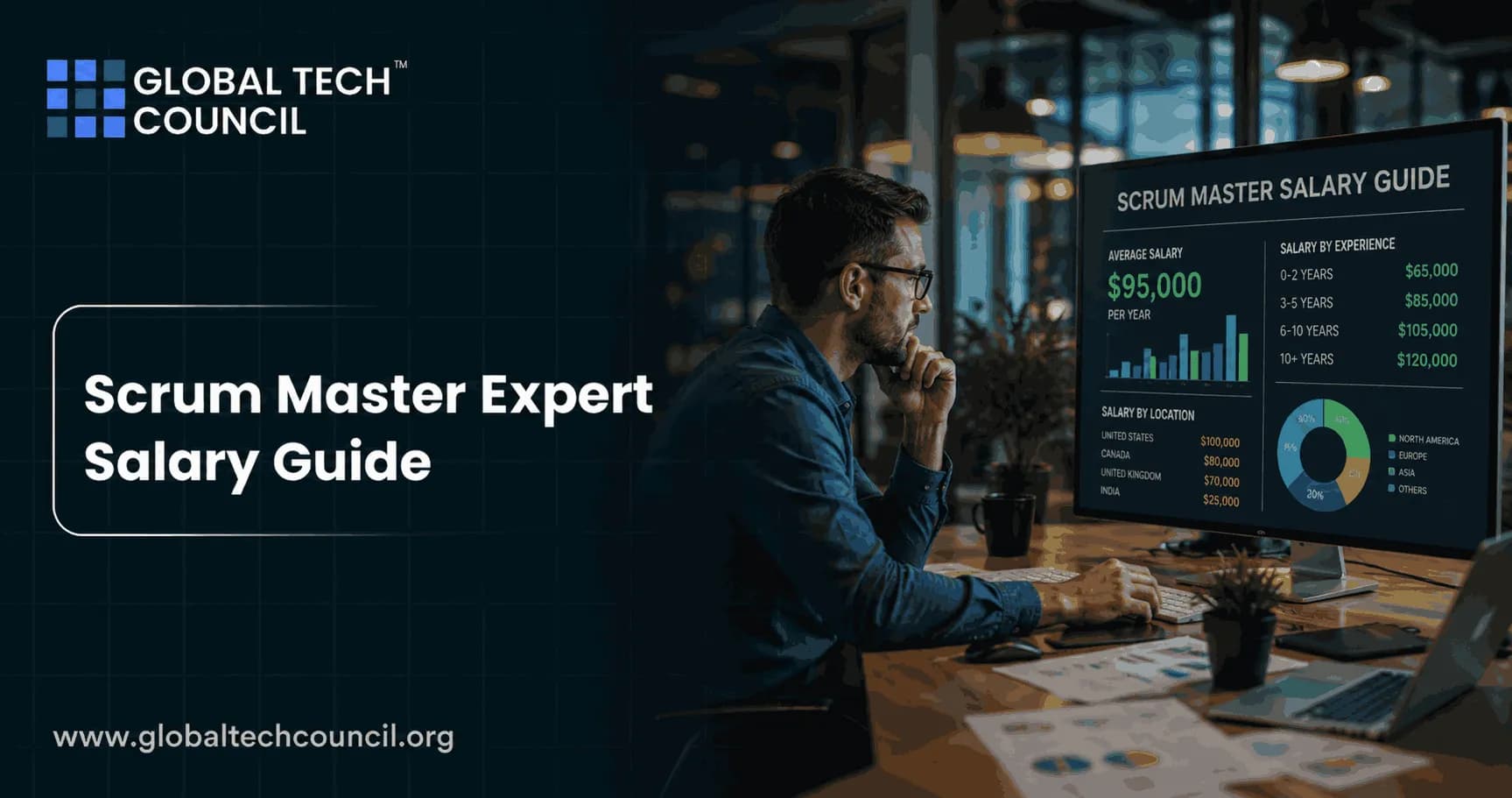
Scrum Master expert salary levels in 2026 favor practitioners who do more than facilitate events. In the United States, current salary guides place entry-level Scrum Masters around 81,000 USD, while experienced and certified professionals often move into the 100,000 USD to 165,000 USD range. Glassdoor data cited in recent agile salary reporting puts the average US Scrum Master salary near 126,000 USD per year, based on more than 10,000 reported figures.
That range is wide for a reason. A Scrum Master who only schedules daily scrums gets priced like a coordinator. A Scrum Master who improves lead time, removes cross-team blockers, coaches leaders, and helps product teams deliver measurable outcomes gets priced very differently. As organizations continue investing in Agile transformation and emerging technologies, employers increasingly value Scrum Masters with multidisciplinary technical expertise. Earning a Tech Certification helps professionals build practical skills in Agile methodologies, AI, cloud computing, DevOps, cybersecurity, and digital transformation. These future-focused certifications not only enhance technical competence but also improve career prospects, increase earning potential, and prepare professionals for leadership roles in technology-driven organizations.

What a Scrum Master Expert Actually Does in 2026
A Scrum Master is a facilitator, coach, and servant leader who helps a team understand and apply Scrum. That covers sprint planning, daily scrums, sprint reviews, retrospectives, backlog refinement, and impediment removal. Atlassian describes the role as a coach for the team and Product Owner, not a traditional project manager.
The expert version of the role is broader. You are not just protecting the calendar. You are improving the system around the team.
Coach teams on Scrum, empiricism, transparency, and self-management.
Help Product Owners improve backlog clarity and value ordering.
Work with stakeholders to reduce dependency queues and slow approvals.
Use flow metrics such as cycle time, throughput, escaped defects, and work in progress.
Support agile adoption across departments, not only inside one development team.
One practical detail matters here. Since the 2020 Scrum Guide, the old term Development Team was replaced by Developers, and the Scrum Team now has three accountabilities: Scrum Master, Product Owner, and Developers. Certification candidates still get tripped up by that wording. So do hiring managers. If you speak in current Scrum language, you signal that your knowledge is not frozen in 2017. Higher-paying Scrum Master roles increasingly involve managing teams developing AI, blockchain, cloud-native applications, and automation solutions. Becoming a Deeptech Expert equips professionals with advanced technical knowledge that enables better collaboration with engineering teams, stronger decision-making, and improved management of enterprise technology initiatives. This interdisciplinary expertise makes Scrum Masters more valuable to organizations undergoing digital transformation and creates opportunities for career advancement into strategic leadership positions.
Scrum Master Expert Salary Ranges in 2026
Salary varies by country, city, sector, seniority, and certification depth. In mature markets, especially the US, the numbers are strong.
Typical US Salary Bands
Entry-level Scrum Master: around 81,000 USD per year in recent 2026 salary analysis.
Mid-level Scrum Master: commonly 95,000 USD to 125,000 USD, depending on location and domain.
Senior Scrum Master: often 125,000 USD to 150,000 USD in high-demand markets.
Lead Scrum Master, Agile Coach, or scaled agile role: frequently 140,000 USD to 165,000 USD or more in large enterprises and technology firms.
Base salary is only part of the picture. Technology companies, consulting firms, and financial institutions may add annual bonuses, restricted stock units, retirement contributions, and training budgets. In some offers, total compensation sits well above base pay.
Why Certified Scrum Masters Often Earn More
Several 2026 compensation guides estimate that certified Scrum Masters earn roughly 15 percent to 25 percent more than non-certified peers. Certification is not magic. It will not compensate for weak facilitation or poor stakeholder skills. But it helps you clear screening filters and shows that you have studied a shared body of practice.
If you are building your credential stack, consider a Scrum Master certification through Global Tech Council, then pair it with training in agile coaching, product management, DevOps, or project leadership. The combination matters. Basic Scrum knowledge gets you into interviews. Evidence of applied improvement gets you the senior offer.
What Drives Scrum Master Expert Salary Growth?
1. Experience That Shows Measurable Impact
Years matter. Outcomes matter more. A senior Scrum Master should be able to say something like this: we cut average cycle time from 14 days to 8 days over two quarters by limiting work in progress, splitting stories smaller, and moving dependency review before sprint planning.
That beats saying you ran retrospectives for five teams. To be blunt, ceremonies are not the product.
2. Industry and Domain
Finance, software product companies, IT services, telecom, healthcare technology, and consulting usually pay better than low-margin sectors. These organizations often carry complex compliance, architecture, and release coordination needs. A Scrum Master who understands those constraints is worth more.
3. Geography and Work Model
Major US technology hubs and high-cost metro areas still pay above national averages. Remote work has changed the salary map, but it has not erased geography. Many employers now price roles by a mix of skill scarcity, office location, and candidate location.
4. Scale and Complexity
One stable team is useful experience. Five teams across security, data, mobile, and platform engineering is a different job. Scaled environments create more demand for dependency management, facilitation across time zones, and planning across product increments.
That is why experience with SAFe, Nexus, LeSS, or enterprise portfolio planning can raise your market value. Scaled Agile defines roles such as Release Train Engineer and Solution Train Engineer as natural growth paths for experienced Scrum Masters in larger organizations. Career growth and salary progression depend on more than Agile expertise alone. Developing leadership, communication, stakeholder management, and business strategy skills through a Marketing Certification enables Scrum Masters to influence organizational decisions, align Agile initiatives with business objectives, and effectively communicate value to executives and customers. These business-oriented capabilities strengthen long-term career growth while opening doors to senior management and leadership opportunities.
Hiring Trends: What Employers Want Now
Employers are getting more selective. A basic certificate and a few buzzwords are not enough. They want evidence that you can help teams produce better outcomes.
Expect interview questions around:
How you handle a Product Owner who changes priorities mid-sprint.
What you do when a team inflates story points to make velocity look stable.
How you coach managers who assign work directly to Developers.
Which metrics you use, and which metrics you refuse to weaponize.
How you facilitate conflict between engineering, product, and compliance teams.
A common trap: treating velocity as a productivity target. Good Scrum Masters push back on that. Velocity is a planning signal for a team, not a performance scoreboard for managers. Once leaders use it for comparison, teams game it. I have watched teams split one real story into six artificial tickets just to keep the chart green. Nobody shipped faster.
Career Paths for Scrum Master Experts
Vertical Growth
The usual path runs from Junior Scrum Master to Scrum Master, then Senior Scrum Master, Lead Scrum Master, Agile Coach, and sometimes Release Train Engineer. Each step widens scope. You move from helping one team run Scrum to helping an organization change how decisions, funding, planning, and delivery work.
Formal job levels are becoming more common. Companies now define Scrum Master bands by impact, not only tenure. A Level 3 Scrum Master might support two teams. A lead-level practitioner may coach other Scrum Masters, work with directors, and influence operating models.
Lateral Moves
Scrum Master experience also opens cross-functional paths:
Product Owner or Product Manager: best if you enjoy discovery, prioritization, customer problems, and value measurement.
Delivery Manager: a fit in organizations that blend agile delivery with project governance.
People Manager or Engineering Manager: suitable if coaching and team development are your strengths.
Agile Consultant: a strong option once you have real transformation experience, not just classroom knowledge.
Choose carefully. Product management is not simply a higher-paid Scrum Master track. If you dislike market research, stakeholder trade-offs, and saying no to features, stay in coaching or delivery leadership.
Skills That Increase Your Earning Potential
High-earning Scrum Masters usually build a T-shaped skill profile. Deep Scrum knowledge sits at the base. Around it, add product, technical, coaching, and organizational change skills.
Advanced facilitation: design workshops that produce decisions, not just discussion.
Coaching: use inquiry, observation, and feedback without taking ownership away from the team.
Systems thinking: find the policy, dependency, or approval step that slows everyone down.
Product fluency: understand outcomes, user value, roadmap trade-offs, and discovery habits.
DevOps awareness: know why continuous integration, test automation, deployment frequency, and incident response affect agility.
Metrics literacy: use cycle time, throughput, cumulative flow, escaped defects, and customer satisfaction responsibly.
For structured development, map your learning through Global Tech Council resources in Scrum Master training, project management, product management, DevOps, and leadership. Each one supports a credible agile career path.
How to Negotiate a Higher Scrum Master Salary
Do not negotiate with job titles. Negotiate with proof.
Build an impact portfolio. Include before-and-after metrics, facilitation examples, transformation work, and stakeholder feedback.
Show scope. State how many teams, products, regions, and senior stakeholders you supported.
List certifications clearly. Include Scrum, agile coaching, scaled agile, product, and related technical credentials.
Translate agile work into business language. Say reduced release risk, improved predictability, faster feedback, or fewer production defects.
Ask about total compensation. Base pay, bonus, equity, learning budget, and remote-work policy all matter.
One more point: avoid accepting a senior Scrum Master title if the company expects project management control without giving authority, budget access, or leadership support. That setup creates accountability without influence. It burns people out. Advancing your Scrum Master career requires continuous learning that combines Agile leadership, technical expertise, and business strategy. Strengthen your professional profile by earning a Scrum Master Expert certification to master Agile frameworks, sprint management, stakeholder communication, and team leadership. Expand your technical capabilities with a Forward Deployed Engineer Certification to understand enterprise AI implementation and customer-focused solution delivery. Complete your career development with an AI-powered Digital Marketing Course to gain expertise in AI-powered marketing, branding, customer acquisition, and business growth strategies that help you stand out in today's competitive job market.
Future Outlook for Scrum Master Experts
The Scrum Master expert salary outlook stays positive for 2026 and beyond, especially for practitioners who move past event facilitation. Demand is expanding in manufacturing, healthcare, banking, public services, and digital product organizations. The role is also becoming more outcome-oriented.
That shift is healthy. The strongest Scrum Masters get judged by how well they help teams learn, adapt, and deliver value, not by how perfectly they enforce a process checklist.
FAQs
1. What Is the Average Scrum Master Expert Salary in 2026?
The average Scrum Master Expert salary in 2026 varies based on factors such as location, experience, certifications, industry, and company size. Professionals with advanced Agile expertise and leadership experience typically earn higher salaries than entry-level Scrum Masters.
2. What Factors Influence a Scrum Master Expert Salary?
Several factors impact Scrum Master Expert salaries, including years of experience, Agile certifications, technical knowledge, industry demand, geographic location, organization size, and expertise in enterprise Agile transformation and Agile coaching.
3. Which Industries Offer the Highest Salaries for Scrum Master Experts?
Industries such as software development, financial services, healthcare, insurance, telecommunications, consulting, manufacturing, and technology companies often offer competitive compensation due to their growing reliance on Agile methodologies.
4. How Does Experience Affect a Scrum Master Expert Salary?
Professionals with several years of hands-on Scrum experience, leadership responsibilities, and enterprise Agile expertise generally command higher salaries. Senior Scrum Master Experts often receive significantly greater compensation than entry-level professionals.
5. Do Scrum Master Expert Certifications Increase Salary Potential?
Yes. Industry-recognized Scrum and Agile certifications demonstrate validated expertise, making candidates more competitive in the job market. Employers frequently offer higher salaries to certified professionals with proven Agile knowledge and practical experience.
6. How Does a Scrum Master Expert Salary Compare to an Agile Coach Salary?
Agile Coaches often earn higher salaries because they work at an organizational level, leading enterprise Agile transformations and mentoring multiple teams. Scrum Master Experts typically focus on team-level Agile delivery, although experienced professionals can also achieve highly competitive compensation.
7. Which Countries Offer the Best Salary Opportunities for Scrum Master Experts?
Countries with strong technology sectors and widespread Agile adoption, including the United States, Canada, the United Kingdom, Germany, Australia, Singapore, and several European markets, generally offer attractive salary opportunities for Scrum Master Experts.
8. What Entry-Level Salary Can a Scrum Master Expect in 2026?
Entry-level Scrum Master salaries vary by region and employer. Professionals with certifications, internship experience, or practical Agile project exposure often receive more competitive starting salaries than candidates without Agile experience.
9. How Much Can Senior Scrum Master Experts Earn?
Senior Scrum Master Experts who lead complex Agile programs, mentor multiple teams, and contribute to enterprise Agile initiatives typically earn higher salaries along with bonuses, performance incentives, and leadership opportunities.
10. How Does Remote Work Affect Scrum Master Expert Salaries?
Remote work has expanded employment opportunities, allowing Scrum Master Experts to work with organizations worldwide. Depending on employer policies and location, remote roles may offer salaries comparable to or higher than traditional office-based positions.
11. Which Skills Can Help Increase a Scrum Master Expert Salary?
High-demand skills include Agile coaching, servant leadership, stakeholder management, conflict resolution, SAFe, Scrum@Scale, DevOps, AI-powered Agile tools, Jira, Azure DevOps, and enterprise Agile transformation experience.
12. What Career Roles Can You Pursue After Becoming a Scrum Master Expert?
Career progression may include Senior Scrum Master, Agile Coach, Enterprise Agile Coach, Delivery Manager, Agile Program Manager, Release Train Engineer, Transformation Consultant, Product Operations Manager, and Agile Practice Lead.
13. Is Scrum Master Expertise Still in High Demand in 2026?
Yes. As organizations continue investing in Agile transformation and digital innovation, experienced Scrum Master Experts remain highly sought after across technology and non-technology industries for their ability to improve team performance and project delivery.
14. How Can Scrum Master Experts Increase Their Earning Potential?
Professionals can improve earning potential by gaining practical Agile experience, earning advanced certifications, mastering Agile scaling frameworks, developing leadership skills, learning AI-enabled project management tools, and taking on enterprise-level responsibilities.
15. Do Company Size and Industry Affect Scrum Master Expert Salaries?
Yes. Large enterprises, multinational corporations, consulting firms, and technology companies often offer higher salaries and additional benefits compared to smaller organizations, particularly for experienced Agile professionals.
16. What Salary Trends Are Shaping Scrum Master Careers in 2026?
Key salary trends include increasing demand for enterprise Agile expertise, higher compensation for professionals skilled in Agile coaching and digital transformation, growing adoption of AI-assisted project management, and expanded opportunities for remote Agile leadership roles.
17. How Do Agile Certifications Impact Career Growth Beyond Salary?
Agile certifications enhance professional credibility, strengthen leadership capabilities, improve job opportunities, and prepare professionals for senior Agile and enterprise transformation roles. They also demonstrate a commitment to continuous learning and industry best practices.
18. Which Industries Are Creating the Most Growth Opportunities for Scrum Master Experts?
Growth opportunities are strongest in software development, fintech, healthcare, e-commerce, manufacturing, telecommunications, government, education, consulting, and organizations implementing enterprise Agile transformation initiatives.
19. What Skills Will Employers Value Most in Scrum Master Experts Beyond 2026?
Future-ready Scrum Master Experts should develop expertise in Agile coaching, enterprise Agile frameworks, AI-driven project management, data-informed decision-making, stakeholder engagement, leadership, and change management to remain competitive.
20. Is Becoming a Scrum Master Expert a Good Long-Term Career Choice?
Yes. With organizations continuing to embrace Agile methodologies, digital transformation, and cross-functional collaboration, Scrum Master Experts are expected to enjoy strong career growth, competitive salaries, and diverse leadership opportunities across industries. Investing in Agile expertise today can lead to long-term professional success and advancement.
Related Articles
View All
Scrum Master
Scrum Master Expert vs Agile Coach: Key Differences, Skills, Salary, and Career Opportunities
Compare Scrum Master Expert vs Agile Coach roles, skills, salary ranges, market demand, and career paths for agile professionals.

Scrum Master
Scrum Master Expert Guide: Roles, Skills, and Career Path in Agile Teams
A practical Scrum Master expert guide covering modern responsibilities, skills, salary outlook, career paths, and how to stay relevant in agile teams.
Scrum Master
Top Scrum Master Expert Skills Employers Look for in 2026
Learn the Scrum Master expert skills employers want in 2026, including agile coaching, AI literacy, data-driven agility, technical fluency, and leadership.
Trending Articles
The Role of Blockchain in Ethical AI Development
How blockchain technology is being used to promote transparency and accountability in artificial intelligence systems.
AWS Career Roadmap
A step-by-step guide to building a successful career in Amazon Web Services cloud computing.
Top 5 DeFi Platforms
Explore the leading decentralized finance platforms and what makes each one unique in the evolving DeFi landscape.