

Scrum Master Challenges: Common Problems Experts Face and How to Fix Them
 Suyash Raizada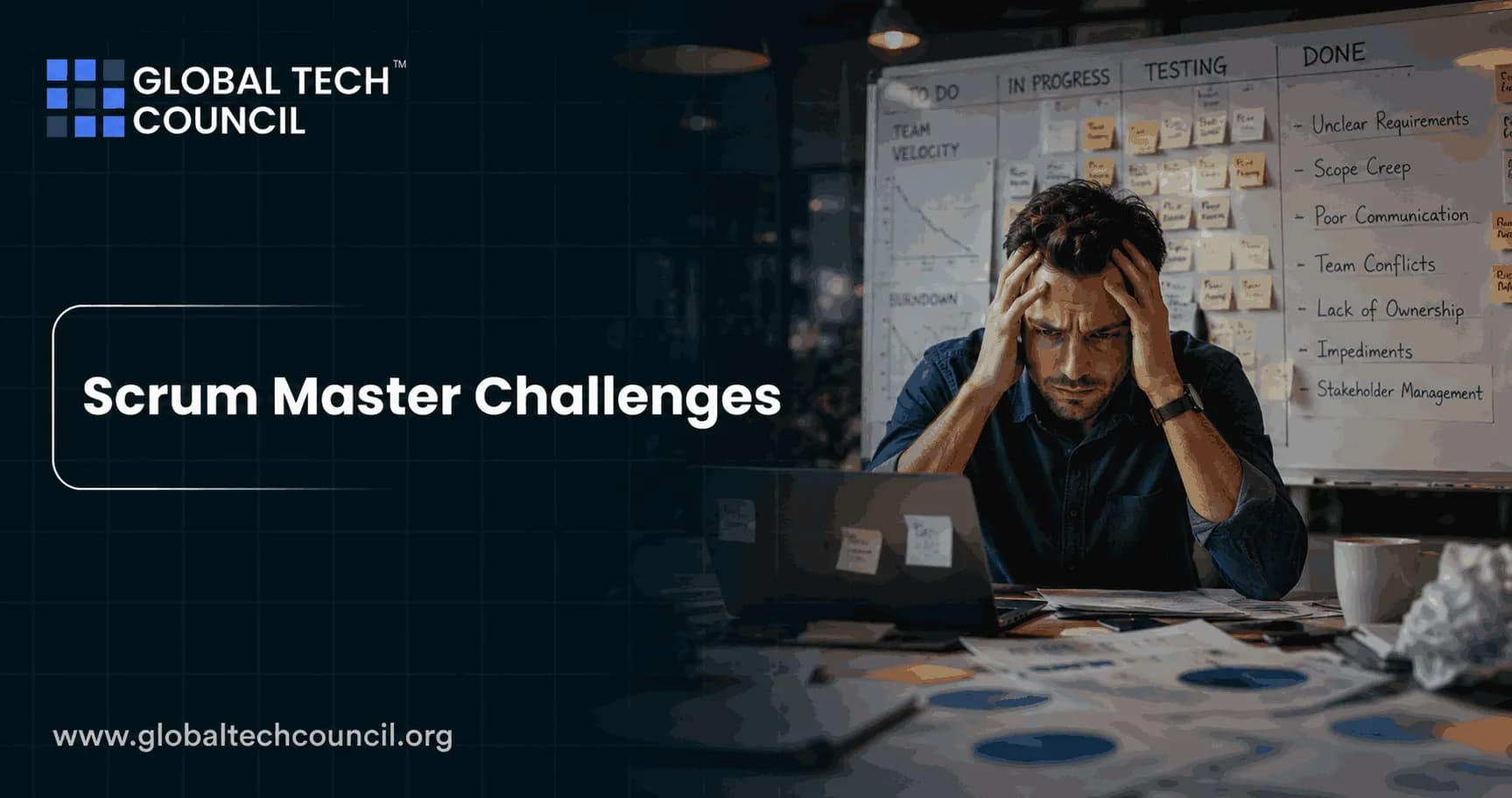
The Scrum Master role sits at one of the most demanding intersections in modern technology work: part servant leader, part coach, part organizational change agent. Agile adoption now spans approximately 66% of organizations globally, and Scrum Master job growth is projected at around 24% by 2026. Senior Scrum Masters command salaries of $140,000 to $160,000 or more in many markets. Yet the pressure that comes with this demand is real. Even experienced practitioners regularly encounter challenges that no certification fully prepares them for.
Understanding these challenges, naming them precisely, and knowing how to fix them is the difference between a Scrum Master who keeps teams moving forward and one who becomes a bottleneck. For professionals who want structured, expert-level preparation to handle these challenges confidently, a dedicated Scrum Master Expert certification provides the rigorous framework and applied knowledge that turns common pain points into manageable problems.

This guide breaks down the most significant challenges Scrum Masters face in 2026, explains why each one persists, and provides actionable solutions grounded in current Agile research and field practice.
What Makes the Scrum Master Role Uniquely Difficult?
A Scrum Master is not a project manager, a team lead, or a product owner. They hold authority without formal power. They influence without commanding. They serve without submitting. This structural ambiguity is the source of many challenges because the role requires constant navigation of organizational politics, team dynamics, and process complexity without a traditional management toolkit.
Furthermore, the role has expanded significantly. In 2026, Scrum Masters are expected to integrate AI-driven planning tools, lead distributed remote teams across time zones, manage technical debt alongside product owners, and drive organizational change at scale. As a result, the challenges facing Scrum Masters today are more complex than ever before.
Challenge 1: Role Misunderstanding and Organizational Ambiguity
The Problem
One of the most persistent and damaging challenges a Scrum Master faces is the widespread misunderstanding of what the role actually involves. Many organizations treat the Scrum Master as a meeting scheduler, a glorified project coordinator, or simply the person who runs standups. Senior leaders who have not internalized Agile principles often question whether the role is necessary at all.
This misunderstanding has two serious consequences. First, the Scrum Master's authority to remove organizational impediments is undermined. Second, the team loses the coaching, facilitation, and servant leadership that drives genuine Agile performance.
The Fix
A Scrum Master must proactively build credibility and visibility from the beginning. The Scrum Guide is clear: the role serves the team, the Product Owner, and the organization. Translating this into language that leadership understands means demonstrating outcomes, not processes.
Instead of explaining Scrum theory to skeptical executives, identify their actual business problems and solve them using Agile approaches. When leadership sees faster delivery cycles, improved team morale metrics, and reduced rework, they become Agile advocates organically. Scrum Masters should also establish clear role definitions in writing at the start of each engagement, shared across all stakeholders, to prevent scope creep into project management territory.
Challenge 2: Resistance to Agile From Teams and Stakeholders
The Problem
Teams accustomed to traditional Waterfall project management often resist the transition to Scrum. This resistance can come from developers who find frequent ceremonies disruptive, senior team members who distrust iterative delivery, or business stakeholders who prefer detailed upfront plans. In some organizations, resistance runs deep enough to cause Agile transformations to stall entirely.
Research consistently shows that fear of change, misunderstandings about Agile, and concern about losing control over established workflows are the primary drivers of this resistance. Pushing through resistance without addressing its root cause only deepens it.
The Fix
Lead with empathy before leading with process. Understand the concerns driving resistance before attempting to change behavior. Use small, visible wins: demonstrate how a two-week sprint produces faster feedback than a six-month planning cycle. Share concrete data on how Agile practices have improved delivery speed and quality in comparable teams.
Introduce change incrementally. A full simultaneous shift to Agile ceremonies, roles, and artifacts can feel overwhelming. Starting with one or two ceremonies, showing their value, and then expanding works far better than forcing an overnight transformation. Patience and coaching are more effective than enforcement.
Challenge 3: Managing Time-Boxing and Meeting Discipline
The Problem
The Scrum Master is directly responsible for maintaining time-boxed ceremonies. Daily stand-ups run long. Sprint planning sessions drift into scope debates. Retrospectives become venting sessions that produce no actionable outcomes. When participants lack focus or use ceremonies to relitigate decisions, meetings lose their value and team members disengage.
This challenge compounds quickly. Teams that tolerate poor meeting discipline develop lower respect for Scrum ceremonies overall, which reduces their effectiveness as inspection and adaptation tools.
The Fix
Establish a clear agenda for every ceremony and communicate it before the event. During stand-ups, enforce the three-question format: what did I do yesterday, what will I do today, and what is blocking me. Use a visible timer. When someone attempts to go off-topic, acknowledge it briefly and defer it: "That's important - let's add it to the parking lot and address it after the stand-up." This technique respects the concern without derailing the timebox.
In sprint planning, prepare the backlog in advance with the Product Owner so that the planning session focuses on commitment and clarification rather than discovery. In retrospectives, use structured formats such as Start/Stop/Continue or the Five Whys to drive specific, actionable improvements rather than open-ended complaints.
Challenge 4: Poor Team Dynamics and Interpersonal Conflict
The Problem
Teams are diverse by nature: different working styles, communication preferences, technical backgrounds, and personal expectations. Conflict arising from these differences is not only predictable but, if managed well, healthy. The problem emerges when conflict becomes personal, goes unresolved, or creates silos that slow delivery.
Poor team dynamics typically manifest as missed sprint goals, recurring conflicts during standups, and slower delivery of value to stakeholders. In remote and hybrid environments, these tensions are harder to detect because informal communication channels that naturally surface problems in co-located teams are absent.
The Fix
A Scrum Master must build psychological safety as a foundation. When team members trust that they can speak openly without negative consequences, conflict surfaces early rather than festering. Regular retrospectives, run in a psychologically safe environment, are the primary mechanism for surfacing and resolving team friction before it escalates.
For active conflicts, practice active listening and remain neutral. Use structured conflict resolution: listen fully to each perspective, reframe the disagreement in terms of shared goals, and align the team on what success looks like for the sprint and the product. Private one-on-one coaching sessions can address interpersonal issues that are too sensitive for group settings.
Challenge 5: Stakeholder Engagement and Expectation Management
The Problem
Stakeholders who do not understand Agile often push for scope additions mid-sprint, provide feedback too late in the cycle, or fail to attend sprint reviews at all. This disengagement breaks the feedback loop that makes Scrum valuable. When a Product Owner is isolated from stakeholders, the backlog loses relevance to actual business priorities.
Additionally, stakeholders frequently overestimate what a team can deliver in a single sprint, particularly when they observe a high-performing team's velocity and assume that pace can be sustained indefinitely without consequence.
The Fix
Educate stakeholders on their role in Scrum. Their participation in sprint reviews is not a formality but the mechanism through which the product evolves in alignment with business needs. Use team velocity data to communicate capacity honestly. Charts showing what a team realistically delivers per sprint, over time, are more persuasive than verbal estimates.
Establish structured feedback loops beyond the sprint review, such as brief stakeholder check-ins at the midpoint of each sprint. Adapt communication styles for different audiences: technical depth for engineering leadership, business outcomes for product and commercial stakeholders. When stakeholders understand that early, frequent feedback reduces costly late-stage rework, engagement typically improves.
Challenge 6: Managing Technical Debt
The Problem
Technical debt accumulates when teams consistently prioritize new feature delivery over code quality, refactoring, and architectural improvements. Left unaddressed, it slows future delivery, increases defect rates, and eventually becomes a critical risk to the product. Scrum Masters who focus exclusively on velocity and sprint completion often overlook the long-term impact of unchecked technical debt.
Many development teams also struggle to communicate the severity of technical debt to non-technical Product Owners and stakeholders, who naturally prioritize visible features over invisible infrastructure improvements.
The Fix
Make technical debt visible. Add it to the product backlog as explicit items with clear descriptions of business impact. When a team consistently pays a velocity penalty because of a problematic legacy component, frame that cost in terms the Product Owner understands: "This module costs us approximately two days of capacity per sprint in unplanned fixes."
Allocate a consistent percentage of sprint capacity, typically 15% to 20%, to debt reduction. This approach prevents debt from compounding while maintaining forward delivery momentum. Refactor strategically: address the components that most directly impact team velocity and product reliability first.
Challenge 7: Scaling Scrum Across Multiple Teams
The Problem
Organizations that outgrow a single Scrum team face new coordination challenges: dependency management between teams, alignment on shared backlog priorities, synchronized releases, and consistent Agile culture across teams with different maturity levels. A Scrum Master operating in a scaled environment must manage intra-team dynamics while also navigating inter-team coordination complexity.
Frameworks such as SAFe (Scaled Agile Framework) and LeSS (Large-Scale Scrum) exist to address these challenges, but implementing them without sufficient preparation and organizational alignment creates more friction than it resolves.
The Fix
Choose a scaling framework that fits the organization's actual size, complexity, and culture rather than adopting the most prominent framework by default. SAFe works well for large enterprises with many interdependent teams; LeSS is better suited to organizations that want to preserve simplicity while scaling.
Use Program Increment (PI) planning events to align multiple teams on shared objectives and dependencies. Map and actively manage team dependencies so that cross-team blockers surface quickly rather than silently delaying delivery. Ensure that each Scrum Master in a scaled environment maintains a community of practice to share learning, align standards, and support each other's growth.
Challenge 8: Navigating the Remote and Hybrid Environment
The Problem
Remote and hybrid work has become the norm rather than the exception. For Scrum Masters, this shift removes the informal communication channels, spontaneous collaboration, and visible team energy that make co-located Agile teams so effective. Communication barriers, time zone misalignment, and a tendency for remote team members to work in silos all undermine the transparency and collaboration that Scrum depends on.
Detecting early warning signs of disengagement, conflict, or burnout is also significantly harder in a distributed environment where non-verbal cues are invisible.
The Fix
Establish clear communication protocols and make them explicit: which tools are used for which types of communication, response time expectations, and how ceremonies are conducted virtually. Use visual collaboration tools such as digital Kanban boards, shared retrospective canvases, and video-enabled standups with cameras on to maintain human connection.
Create overlap hours for essential collaboration when teams span time zones, and respect boundaries outside those windows. Regular one-on-one check-ins between the Scrum Master and individual team members are more important in distributed environments because informal hallway conversations do not exist. These touchpoints surface concerns before they become blockers.
Challenge 9: Integrating AI Into Agile Workflows
The Problem
AI-powered tools are transforming how software teams work, and Scrum Masters are increasingly expected to guide teams through this integration. AI tools that automate standups, predict sprint velocity, summarize retrospective findings, and flag backlog risks are entering team workflows at pace. Teams that adopt these tools without governance risk losing the human inspection and adaptation processes that make Scrum effective.
The risk is real: teams may begin treating AI-generated recommendations as commands rather than inputs, reducing the collaborative decision-making that drives team ownership and psychological safety.
The Fix
Position AI tools as augmentation, not replacement, for Scrum processes. Machine learning analytics that forecast sprint velocity are valuable input for planning conversations, not a substitute for them. The team still commits together; the AI informs that commitment with better data.
Scrum Masters should invest in understanding AI-assisted development workflows to guide teams intelligently. According to ZipRecruiter, future Scrum Masters will need a strong foundation in Agile methodologies combined with a solid understanding of AI concepts and machine learning workflows. Professionals who want to build this technical foundation systematically can do so through deep-tech learning resources offered by platforms such as Deeptech Certification, which covers the underlying technical principles that enable intelligent evaluation of AI tooling decisions within Agile environments.
Challenge 10: Preventing Team Complacency and Sustaining Continuous Improvement
The Problem
High-performing teams sometimes plateau after achieving a comfortable delivery rhythm. Retrospectives become formulaic. The team stops surfacing genuine improvement opportunities. Velocity stabilizes but does not grow. This stagnation is particularly dangerous because it feels like success from the outside while quietly eroding the continuous improvement culture that makes Scrum valuable over time.
The Fix
Vary retrospective formats regularly to prevent habituation. Use techniques such as the Sailboat, the DAKI (Drop, Add, Keep, Improve), or the Four Ls (Liked, Learned, Lacked, Longed For) to surface perspectives that standard formats miss. Challenge teams with stretch goals that require new approaches rather than simply executing familiar routines.
Introduce external Agile practitioners to share experiences from other contexts. Encourage team members to attend community events, read current Agile literature, and experiment with new practices within a safe boundary. The Scrum Master's role is to keep the team curious about improvement, not just compliant with process.
How Certified Expertise Elevates Scrum Master Performance
The ten challenges above are not unique to beginners. Experienced Scrum Masters encounter variations of these problems throughout their careers, in different organizational contexts, at different scales, and with different team compositions. What changes with expertise is not the disappearance of these challenges but the speed and precision with which they are diagnosed and resolved.
Professionals who invest in structured, expert-level credentials develop a broader toolkit and a deeper understanding of the systemic causes behind common surface-level problems. A Scrum Master Expert certification provides exactly this depth: advanced facilitation skills, stakeholder management frameworks, scaling knowledge, and AI-integration guidance that go significantly beyond foundational Scrum certification.
Additionally, because Scrum Masters must frequently communicate the business value of Agile practices to commercial and executive stakeholders, adding a Marketing Certification sharpens the ability to frame technical and process improvements in the language of business outcomes. This communication skill, often undervalued in Agile training programs, directly improves a Scrum Master's ability to secure organizational buy-in and sustain Agile adoption at scale.
Conclusion
The Scrum Master role demands a rare combination of technical understanding, interpersonal intelligence, organizational awareness, and coaching skill. The challenges documented in this guide are not signs of failure; they are the defining terrain of the role. Every challenge has a proven solution, and every solution is learnable. The Scrum Masters who navigate these problems most effectively are those who invest continuously in their own development, build structured expertise, and approach each obstacle with curiosity rather than frustration.
Organizations that support their Scrum Masters with the right credentials, resources, and organizational authority gain a significant competitive advantage. Agile adoption, when led by genuinely skilled Scrum Masters, consistently improves delivery speed, team engagement, product quality, and stakeholder satisfaction. The investment in solving these challenges is, ultimately, an investment in the organization's ability to build better products faster.
Frequently Asked Questions
1. What is a Scrum Master?
A Scrum Master is a servant leader and coach who ensures a team follows the Scrum framework, removes impediments, facilitates ceremonies, and fosters continuous improvement. They serve the team, the Product Owner, and the organization without holding traditional management authority.
2. What are the most common Scrum Master challenges?
The most common challenges include role misunderstanding, resistance to Agile, poor meeting discipline, team conflict, disengaged stakeholders, technical debt, scaling complexity, remote team management, AI integration, and sustaining continuous improvement culture.
3. Is the Scrum Master role the same as a project manager?
No. A project manager directs and controls execution, often with formal authority over team members. A Scrum Master facilitates, coaches, and removes barriers without commanding the team. The roles require fundamentally different skills and approaches.
4. How does a Scrum Master handle resistance to Agile?
By leading with empathy, identifying the concerns behind resistance, demonstrating small wins, using data to show Agile benefits, and introducing change incrementally rather than forcing an immediate complete transformation.
5. What should a Scrum Master do when standups run too long?
Enforce the three-question format strictly, use a visible timer, acknowledge off-topic issues and defer them to a parking lot, and prepare a clear agenda before the meeting. Consistent enforcement quickly resets meeting culture.
6. How can a Scrum Master build trust within a new team?
By being present and accessible, following through on commitments, advocating for the team's needs with leadership, remaining neutral during conflicts, and demonstrating genuine interest in each team member's success.
7. What is the Scrum Master's role in managing technical debt?
To make technical debt visible in the backlog, frame its business impact in terms the Product Owner can act on, and advocate for consistent sprint capacity allocation to debt reduction alongside new feature work.
8. How is the Scrum Master role changing because of AI in 2026?
AI tools now assist with sprint forecasting, backlog analysis, retrospective summaries, and workflow automation. Scrum Masters are increasingly expected to guide teams in using these tools responsibly while preserving human-driven inspection, adaptation, and team ownership.
9. Can a Scrum Master work across multiple teams simultaneously?
Yes, though it creates challenges around dedicated support and accessibility. When stretched across teams, Scrum Masters should focus on the highest-priority problems in each team and mentor emerging Scrum practitioners to share the load.
10. How does a Scrum Master manage distributed or remote teams?
By establishing explicit communication protocols, using visual collaboration tools, creating overlap hours for essential ceremonies, conducting regular one-on-one check-ins, and making informal connection opportunities deliberate rather than incidental.
11. What causes stakeholder disengagement in Scrum, and how is it fixed?
Stakeholders often disengage because they do not understand their role in the Scrum process. Regular education on how sprint reviews drive product direction, paired with communication tailored to each stakeholder's priorities, significantly improves participation.
12. How should a Scrum Master handle a team member who consistently violates Agile principles?
Through private coaching first: understand the behavior's root cause, explain the impact on the team, and collaborate on a specific improvement plan. If coaching fails, escalate through appropriate organizational channels without bypassing the servant-leadership approach.
13. What is psychological safety and why does it matter for Scrum Masters?
Psychological safety is the team's shared belief that speaking up, taking risks, and admitting mistakes will not result in punishment or humiliation. It is foundational to effective retrospectives, open backlog refinement, and genuine continuous improvement.
14. How does a Scrum Master support a struggling Product Owner?
By providing coaching on backlog management, helping prioritize based on business value, facilitating better communication with stakeholders, and ensuring the Product Owner has the organizational support they need to make effective decisions.
15. What is the difference between Scrum Master challenges in small teams versus enterprise environments?
Small teams face challenges primarily around role clarity, culture, and process adoption. Enterprise environments add coordination complexity, scaling frameworks, dependency management, political resistance, and cultural consistency across many teams.
16. How can a Scrum Master prevent retrospective fatigue?
By regularly varying retrospective formats, introducing new facilitation techniques, ensuring every retrospective produces at least one specific actionable improvement, and following up on previous actions to demonstrate that retrospectives drive real change.
17. Should a Scrum Master have technical knowledge?
Technical knowledge is not mandatory but is highly beneficial. It allows the Scrum Master to understand the complexity and risk of technical decisions, communicate more effectively with developers, and recognize when technical impediments require organizational intervention.
18. What is the career path for an experienced Scrum Master?
Experienced Scrum Masters typically progress into Agile Coach, Release Train Engineer (in SAFe environments), Head of Agile Transformation, or Product leadership roles. Some transition into organizational change management or executive consulting.
19. How does a Scrum Master measure their own effectiveness?
Through team health metrics, sprint goal achievement rates, velocity trends, reduction in recurring impediments, stakeholder satisfaction, and the team's progressive movement toward genuine self-organization and continuous improvement.
20. What certifications are most valuable for an advanced Scrum Master in 2026?
Advanced certifications that cover scaling frameworks, AI integration, facilitation depth, and stakeholder management are most valuable. A Scrum Master Expert credential, combined with broader technology and business communication credentials, provides the most comprehensive foundation for senior Agile leadership roles.
Related Articles
View All
Scrum Master
Scrum Master Metrics: How Experts Improve Agile Team Performance
Learn how Scrum Master experts use focused metrics for flow, quality, predictability, value delivery, and team health without turning data into surveillance.
Scrum Master
Future of Scrum Master Experts in AI-Driven Agile
Explore how AI-driven Agile project management is reshaping Scrum Master experts into AI-enabled coaches, facilitators, and systems leaders.

Scrum Master
How to Become a Scrum Master Expert: Step-by-Step Roadmap for Beginners
A practical beginner roadmap to become a Scrum Master expert, covering Scrum foundations, certification, team experience, coaching, metrics, and advanced growth.
Trending Articles
The Role of Blockchain in Ethical AI Development
How blockchain technology is being used to promote transparency and accountability in artificial intelligence systems.
AWS Career Roadmap
A step-by-step guide to building a successful career in Amazon Web Services cloud computing.
Top 5 DeFi Platforms
Explore the leading decentralized finance platforms and what makes each one unique in the evolving DeFi landscape.