

Scrum Master Metrics: How Experts Improve Agile Team Performance
 Suyash Raizada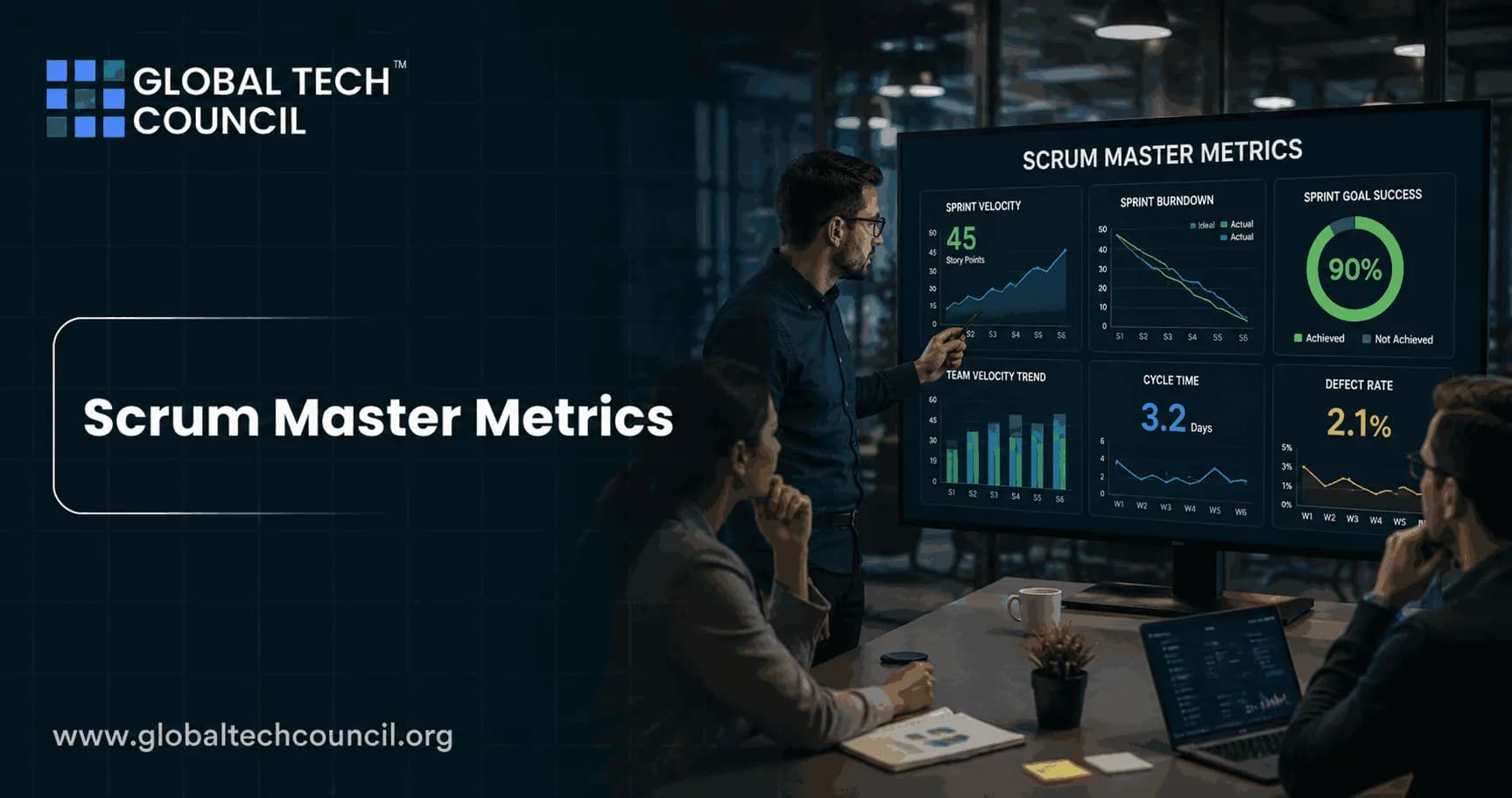
Scrum Master metrics work best when they make the team's system visible, not when they rank people. Expert Scrum Masters use a small set of delivery, flow, quality, value, and team health measures to coach better decisions. Not fifty charts. Not a dashboard nobody reads. A few signals that answer real questions.
The Scrum Guide 2020 is clear that Scrum rests on transparency, inspection, and adaptation. Metrics support that loop when the team owns them. Used badly, they become surveillance. Used well, they expose stuck work, planning risk, hidden rework, and stress before the sprint falls apart. Measuring Agile success requires Scrum Masters to understand both performance metrics and modern technology practices. Pursuing a Tech Certification helps professionals develop expertise in Agile analytics, AI-powered project management tools, DevOps, cloud collaboration platforms, and digital transformation. These certifications enable Scrum Masters to interpret key performance indicators more effectively, optimize team productivity, and drive continuous improvement across Agile projects.

Why Scrum Master Experts Have Moved Beyond Velocity
Velocity still has a place. It helps a stable team plan near-term capacity, especially when the team sizes work consistently. But velocity is not a productivity score. It is also not comparable across teams because story points are local. A five-point story in one team may be a two-point story somewhere else.
To be blunt, making velocity a target is one of the fastest ways to corrupt it. Teams inflate points, split work oddly, or avoid hard technical improvements because the metric rewards visible output over healthy delivery.
Experienced Scrum Masters now use balanced metric sets. A typical set might include:
Predictability: sprint goal achievement, throughput range, release burnup
Flow: cycle time, lead time, work in progress, work item age
Quality: escaped defects, rework, defect age, test automation coverage where useful
Value: adoption, customer satisfaction, support ticket reduction, usage data
Team health: engagement, psychological safety, trust, retrospective action follow-through
That mix matters. If throughput rises while escaped defects also rise, the team is not improving. It is borrowing time from the future. Today's Agile teams often build AI, blockchain, cloud computing, and enterprise software solutions where performance metrics extend beyond velocity and sprint completion. Becoming a Deeptech Expert equips Scrum Masters with the technical knowledge needed to understand engineering workflows, system complexity, deployment processes, and innovation metrics. This interdisciplinary perspective helps Agile leaders make informed decisions that improve both technical delivery and overall team performance.
The Core Scrum Master Metrics That Actually Help
Sprint Goal Achievement
Sprint goal achievement is more useful than counting completed stories. A team can complete eight unrelated backlog items and still miss the goal that mattered. Track whether the sprint goal was met, partly met, or missed, then discuss why.
Good Scrum Masters look for patterns. Are goals too broad? Is the Product Owner changing scope mid-sprint? Are dependencies outside the team blocking delivery? The number opens the conversation.
Cycle Time and Lead Time
Cycle time measures how long work takes once the team starts it. Lead time measures the wider wait from request to completion. These two Scrum Master metrics reveal flow better than velocity does.
If cycle time has a long tail, check for oversized stories, unclear acceptance criteria, slow code review, or waiting on external teams. A median cycle time of three days may look fine until you notice that 15 percent of items take more than two weeks. That tail is where predictability dies.
Throughput
Throughput counts completed work items over a period. It supports probabilistic forecasting, including Monte Carlo simulations. Instead of telling stakeholders, "We will finish on June 30," you can say, "Based on the last twelve sprints, we have an 85 percent chance of completing this scope by the end of June if throughput stays within its current range."
That is a better conversation. It shows uncertainty without pretending the team can predict the future perfectly.
Cumulative Flow Diagram
A cumulative flow diagram, or CFD, shows how many items sit in each workflow state. When the "In Review" band keeps growing, the team has a review bottleneck. When "In Progress" balloons, WIP is too high.
Here is a real tooling detail that catches teams: in Jira, moving an issue into a Done column is not always enough for reporting. If the Resolution field is not set, some filters and reports still treat the issue as unresolved. I have seen teams argue over a broken burndown for twenty minutes before finding that workflow post-function problem. Check your workflow before blaming the team.
Escaped Defects and Rework
Quality metrics keep speed honest. Track defects found after release, defect reopen rates, production incidents, or the percentage of sprint capacity spent on rework. For software teams using DevOps measures, connect Scrum metrics with DORA metrics such as deployment frequency, lead time for changes, change failure rate, and time to restore service.
Do not use defect counts to shame developers. Use them to improve the system: test data, peer review, acceptance criteria, CI checks, environment stability, and backlog refinement. Tracking Agile metrics is ultimately about delivering greater value to customers and the business. A Marketing Certification helps Scrum Masters understand customer behavior, business performance, stakeholder expectations, and strategic growth initiatives. By combining Agile metrics with business insights, professionals can prioritize work more effectively, improve cross-functional collaboration, and ensure product development consistently supports organizational objectives.
How Expert Scrum Masters Use Metrics in Scrum Events
Sprint Planning
In planning, use historical throughput, recent velocity, known absences, WIP limits, and carryover work. Do not average the last ten sprints blindly. If three of those sprints included holidays or a production incident, call that out.
Ask the team:
What is the sprint goal?
What work is already in progress?
Which items have external dependencies?
What cycle time patterns should influence our commitment?
Planning becomes more realistic when the team talks about evidence instead of optimism.
Daily Scrum
The Daily Scrum is not a status meeting for the Scrum Master. Use metrics lightly. Work item age, blockers, and WIP are enough. If one story has been active for six days while the team's usual cycle time is two or three days, inspect it.
Short question. Big value: "What needs to happen today to move this item forward?"
Sprint Review
At the Sprint Review, avoid dumping team metrics on stakeholders. Pick measures that support product decisions. Release burnup, customer usage, defect trends, and progress against outcomes are usually more relevant than task completion.
If a feature shipped but customers are not using it, say so. Scrum exists to learn, not to keep a backlog factory running. High-performing Scrum Masters rely on continuous learning to improve team performance and deliver measurable business results. Build advanced Agile leadership skills with a Scrum Master Expert certification while expanding your understanding of enterprise AI implementation through a Forward Deployed Engineer Certification. Strengthen your business and customer engagement capabilities with an AI-powered Digital Marketing Course to master AI-powered marketing, branding, automation, and sustainable business growth.
Sprint Retrospective
The retrospective is where Scrum Master metrics earn their keep. Bring trends, not accusations. Show the cycle time chart. Show the last three sprint goals. Show how many retrospective actions were actually completed.
Then run an experiment. For example: "If we limit active work to one item per developer and pair on review-heavy stories, review wait time should drop next sprint." Measure it. Keep it if it works. Drop it if it does not.
Team Health Metrics Belong in the Same Conversation
Delivery data without team health data is incomplete. A team can hit every sprint goal for two months and still be close to burnout.
Use simple pulse surveys. Five questions are enough:
I understand the sprint goal.
I feel safe raising risks or mistakes.
Our team has the skills needed for current work.
Blockers are handled quickly.
Our retrospectives lead to real change.
Use a 1 to 5 scale and discuss trends. Keep responses anonymous when the team is new or trust is low. Psychological safety is not a soft bonus. Google's Project Aristotle research identified psychological safety as a key factor in effective teams, and most Scrum Masters see the same pattern in practice.
Common Metrics Mistakes Scrum Masters Should Avoid
Comparing teams by velocity: Different teams estimate differently. The comparison is usually meaningless.
Tracking too much: A dashboard with 30 metrics creates noise. Start with three to seven.
Using metrics as targets: Targets invite gaming. Trends invite learning.
Ignoring context: A drop in throughput during a major refactor may be a good investment.
Measuring individuals: Agile metrics should improve the system, not rank people.
Forgetting value: Completing backlog items does not matter if customers get no benefit.
A Practical Metric System You Can Start With
If you are coaching a Scrum team next week, do not start by buying a new analytics tool. Start with a question.
Define the improvement goal. Example: "Improve predictability for release planning."
Choose a few metrics. For predictability, use throughput, cycle time range, sprint goal achievement, and release burnup.
Set a baseline. Review at least six to eight sprints if the data is available.
Form a hypothesis. Example: "Reducing WIP will reduce cycle time variation."
Run one experiment. Limit active stories, refine smaller items, or add review pairing.
Inspect results in the retrospective. Keep the change only if the evidence and team experience support it.
This is where advanced Scrum Master skill shows up. Not in making prettier charts. In helping the team decide what to change.
What This Means for Scrum Master Career Growth
Metric literacy is now a core Scrum Master competency. Enterprises expect Scrum Masters to speak with engineering leaders, Product Owners, compliance teams, and executives. That means you need to understand flow, quality, value, and human systems.
If you are building this skill set, use Global Tech Council's Scrum Master learning resources as a structured preparation path. Related Agile, project management, DevOps, data analytics, and leadership courses can also help because modern Scrum Masters often work across the full value stream.
Your next step is simple: pick one team outcome that matters, select no more than five Scrum Master metrics, and review them with the team in the next retrospective. Let the team own the interpretation. Then run one measurable experiment. That habit is what separates metric collectors from expert Scrum Masters.
FAQs
1. What Are Scrum Master Metrics and Why Are They Important?
Scrum Master metrics are measurable indicators used to evaluate the health, efficiency, and performance of Agile teams. These metrics help Scrum Master Experts identify bottlenecks, improve sprint execution, optimize workflows, and support continuous improvement without focusing solely on individual productivity.
2. Which Scrum Master Metrics Are Most Important for Improving Agile Team Performance?
Key Scrum Master metrics include sprint velocity, burndown charts, burnup charts, lead time, cycle time, cumulative flow diagrams, sprint predictability, defect rate, escaped defects, team happiness, and customer satisfaction. Together, these metrics provide a comprehensive view of Agile team performance.
3. How Does Sprint Velocity Help Scrum Master Experts?
Sprint velocity measures the amount of work an Agile team completes during a sprint. Scrum Master Experts use velocity to improve sprint planning, forecast future capacity, and identify trends rather than comparing one team against another.
4. What Is the Difference Between Lead Time and Cycle Time?
Lead time measures the total time from a customer request to final delivery, while cycle time measures the time taken from when work begins until it is completed. Scrum Master Experts analyze both metrics to improve delivery speed and eliminate workflow inefficiencies.
5. Why Are Burndown Charts Important in Scrum?
Burndown charts visually track the amount of work remaining during a sprint. Scrum Master Experts use these charts to monitor sprint progress, identify delays early, and help teams stay on track to achieve sprint goals.
6. How Do Burnup Charts Improve Agile Project Tracking?
Burnup charts display completed work alongside the total project scope, making it easier to identify scope changes throughout a sprint or release. Scrum Master Experts use burnup charts to improve transparency and stakeholder communication.
7. What Is a Cumulative Flow Diagram in Scrum?
A cumulative flow diagram visualizes work items across different workflow stages over time. Scrum Master Experts use this metric to identify bottlenecks, monitor work-in-progress, and improve workflow efficiency across Agile teams.
8. How Do Scrum Master Experts Measure Sprint Predictability?
Sprint predictability compares planned work with completed work during a sprint. High predictability indicates accurate planning and stable delivery, while frequent deviations highlight opportunities to improve estimation and backlog refinement.
9. Why Should Scrum Master Experts Track Defect Rates?
Monitoring defect rates helps identify quality issues within the development process. Scrum Master Experts use defect-related metrics to encourage continuous testing, improve development practices, and increase overall product quality.
10. How Can Scrum Master Experts Measure Team Productivity Without Micromanaging?
Instead of measuring individual output, Scrum Master Experts focus on team-based metrics such as sprint goal achievement, collaboration, delivery consistency, quality, and customer value. This approach encourages teamwork rather than unhealthy competition.
11. What Is Team Happiness, and Why Does It Matter?
Team happiness measures employee satisfaction, motivation, and engagement within Agile teams. Scrum Master Experts recognize that motivated teams collaborate more effectively, solve problems faster, and consistently deliver better project outcomes.
12. How Do Scrum Master Experts Use Customer Satisfaction Metrics?
Customer satisfaction metrics help determine whether delivered features meet business expectations and user needs. Scrum Master Experts use customer feedback alongside Agile metrics to guide continuous improvement and prioritize valuable product enhancements.
13. Which Metrics Should Scrum Master Experts Avoid?
Scrum Master Experts should avoid using metrics that encourage unhealthy competition or individual performance rankings, such as lines of code written or individual story points completed. Agile metrics should focus on team performance and value delivery rather than personal productivity.
14. How Often Should Scrum Master Metrics Be Reviewed?
Most Agile metrics should be reviewed during daily stand-ups, sprint reviews, retrospectives, and release planning sessions. Regular analysis helps Scrum Master Experts identify trends, resolve issues quickly, and continuously improve team performance.
15. Which Tools Help Scrum Master Experts Track Agile Metrics?
Popular tools include Jira, Azure DevOps, Confluence, ClickUp, Rally, VersionOne, Trello, Monday.com, and Agile analytics dashboards. These tools provide automated reporting and real-time insights into sprint performance and project progress.
16. How Can AI Improve Scrum Master Metrics Analysis?
AI-powered Agile tools can automatically analyze sprint data, identify risks, predict delivery timelines, detect workflow bottlenecks, and recommend process improvements. Scrum Master Experts can leverage AI insights to make faster and more informed decisions.
17. How Do Scrum Master Metrics Support Continuous Improvement?
By analyzing Agile metrics after every sprint, Scrum Master Experts can identify recurring challenges, implement targeted improvements, optimize team workflows, and measure the effectiveness of process changes over time.
18. Which Industries Use Scrum Master Metrics to Improve Agile Performance?
Scrum Master metrics are widely used in software development, financial services, healthcare, manufacturing, telecommunications, retail, consulting, government, and other industries adopting Agile methodologies to improve project delivery and operational efficiency.
19. What Common Mistakes Do Scrum Masters Make When Using Agile Metrics?
Common mistakes include focusing only on velocity, using metrics to evaluate individuals, ignoring quality indicators, overlooking customer feedback, and collecting excessive data without taking meaningful action. Effective Scrum Master Experts use metrics to guide improvement rather than judge performance.
20. How Can Scrum Master Experts Use Metrics to Build High-Performing Agile Teams?
Scrum Master Experts use Agile metrics to improve transparency, enhance collaboration, optimize sprint planning, reduce bottlenecks, improve product quality, and support continuous learning. When applied correctly, Scrum metrics enable teams to deliver greater business value while fostering a culture of accountability, adaptability, and continuous improvement.
Related Articles
View All
Scrum Master
Future of Scrum Master Experts in AI-Driven Agile
Explore how AI-driven Agile project management is reshaping Scrum Master experts into AI-enabled coaches, facilitators, and systems leaders.

Scrum Master
Scrum Master Expert vs Agile Coach: Key Differences, Skills, Salary, and Career Opportunities
Compare Scrum Master Expert vs Agile Coach roles, skills, salary ranges, market demand, and career paths for agile professionals.

Scrum Master
Why Scrum Master Expertise Is Essential for High-Performing Agile Teams
Scrum Master expertise helps agile teams improve flow, protect focus, remove blockers, and deliver valuable outcomes with better predictability.
Trending Articles
The Role of Blockchain in Ethical AI Development
How blockchain technology is being used to promote transparency and accountability in artificial intelligence systems.
AWS Career Roadmap
A step-by-step guide to building a successful career in Amazon Web Services cloud computing.
Top 5 DeFi Platforms
Explore the leading decentralized finance platforms and what makes each one unique in the evolving DeFi landscape.